Breast Cancer: The Story of Two Sisters

On 20 May 2012, RO (B-696) came to our centre. It has been some years since we last saw her.  Anyway, we were glad that RO is still doing fine.  RO came with her blood test results (see table) and we read RO’s meridian using the AcuGraph. Basically the results were alright. RO also felt that she was doing fine without any complaints whatsoever.
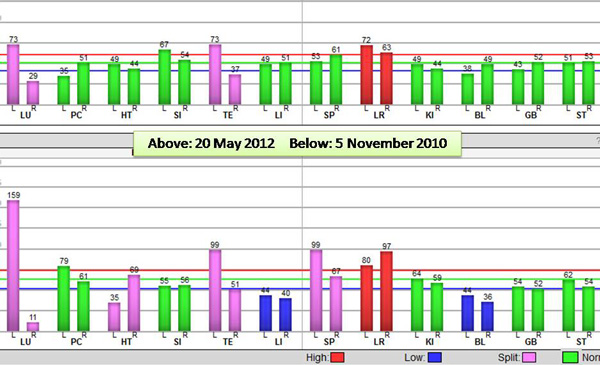
We told RO, “There is nothing much to worry about. Do what you are doing and keep it that way!” She had “won” the battle against her breast cancer – without chemotherapy or radiotherapy of course!

The Story of RO

Sometime in 2001, RO felt a lump in her right breast.  The lump was mobile and it came on and off. There was no pain. RO was only 36 years old then. A year later, on 9 October 2002, she went to consult a doctor in a private hospital. An ultrasound indicated an irregular mass with an approximate size of 1.7 x 1.4 x 1.1 cm. Multiple small microcalcification are noted in this lesion, very suspicious of a primary malignancy. A tru-cut biopsy was performed and confirmed an invasive mammary ductual carcinoma, Grade 3.

RO subsequently underwent a right mastectomy. The pathology report dated 16 October 2002 indicated an infiltrating ductal carcinoma with presence of tumour cells close to the deep surgical margin. All six right axillary lymph nodes are free of tumour. The tumour cells are moderately positive for estrogen and progesterone receptors. There is an over expression of P53 in about 40% of the tumour cells. There is focal membrane positivity for c-ErbB2 oncoprotein in the tumour cells.

Comment by Consultant Pathologist:  An ER and PR positive tumour is likely to respond to hormone therapy and is associated with a greater probability of a disease-free survival. ErbB2 (neu/HER-2) is an independent prognostic marker, and overexpression is correlated with a poor prognosis. It is generally associated with a shorter disease-free interval and lower overall survival rate. In some studies, p-53 has been shown to be an independent marker of adverse prognosis.

An ultrasound on 17 October 2002 indicated presence of a 3.4 x 2.5 cm uterine fibroid. There was no evidence of metastatic disease.

RO was referred to an oncologist for further management. Chemotherapy and radiotherapy were suggested. She refused further medical treatment and came to seek our help on 1 November 2002. She was prescribed Capsule A, C-tea and Breast M. In addition she was asked to take GY 5 and GY 6 for her uterine fibroid which she continued to take for a while and then stopped.

Since October 2002 until 2012, we got to see RO once a while. Her blood test results over the years (from November 2002 to May 2012) are as follows:

11 Nov02 12 Nov03 29May04 26Aug06 4Jun08 10 Oct10 8Jun 11 16May12
ESR 22  H 10 4 24 H 2 33 H 22 H 20
RBC 4.6 4.4 L 4.5 4.4 4.6 4.8 5.0 4.0
Haemoglobin 9.4 L 9.9 L 10.4 L 8.9 L 9.6 L 8.9 9.6 L 7.3 L
Platelet 390 332 394 359 385 469 H 487 H 397
WBC

6.1

6.0 8.6 7.2 5.4 4.7 5.2 5.0
CEA 0.1 1.3 0.8 0.2 <0.5 1.1 1.5 1.4
CA 15.3 14.0 11.2 12.1 10.5 7.7 10.9 13.5 11.7
CA 125 n/a 49.1 H 65.3 H 108.4 H 99.9 H 53.5 H 74.3 H 156.6 H


The Story of RA (sister of RO)

In mid-July 2004, we received a fax from RO requesting us to help her sister, RA (T-20), who had just discovered a lump in her right breast. RA was 41 years old then. A biopsy was performed followed by a right mastectomy.  According to the pathology report of 6 July 2004, the tumour was about 4.0 x 30 x 25 mm in size. It was an infiltrating ductal as well as intraductal and comedo type carcinoma. There was lymphatic vascular embolization of tumour with metastases to four out of thirteen right axillary lymph nodes. There was also Paget’s disease of the right nipple.

RA was asked to undergo chemotherapy and radiotherapy. She refused and came to seek our help on 17 July 2004. She was prescribed Capsule A, Breast M and C-tea.  RA took our herbs for more than a year and was doing alright.

1 Oct 04

24 Jan 05

24 Dec05

ESR

6

2

5

RBC

4.4

4.3

4.5

Platelet

193

192

232

WBC

5.9

5.7

7.3

Alkaline phosphatase

65

78

59

AST

21

26

21

ALT

28

27

36

GGT

9

11

11

CEA

20

2.4

1.8

CA 15.3

6.9

4.1

7.1

In 2004 (from July to December) we got to see RA only three times. In 2005 RA came to see us five times. We suspected from then on she defaulted taking the herbs and also did not take care of her diet. Her first visit to us in the year 2006 was in July.  She told us that she felt like there was a “hard bone” in her right breast. We suggested that she go and check it out with her doctor. She was reluctant. We got to see RA again three months later, in October 2006. After that she disappeared from our “radar.”

On 10 June 2007, RA came back to see us again. She told us of what had happened the past one year. The “hard bone” which she told us earlier was actually a recurrence and this occurred at the previous operation scar. But there was also a lump under her right armpit. Since she ignored it for a while, the lump “burst” and left a hole in her breast. She went back to her surgeon and was referred to an oncologist. So from January to May 2007. RA underwent six cycles of chemotherapy. On completion of the treatment RA was awarded a “Certificate of Achievement” below.

The chemo treatment cost  RM 18,000. After the chemo, the lump in the armpit shrunk.  She was then referred to the government hospital for further management. The doctor at the government hospital told her that radiation was not necessary in her case. A bone scan showed that the cancer had spread to her bones. She was put on Tamoxifen and had been taking it when she came to see us.

On 2 December 2007, RA came back to see us again with her CT scan report done on 21 November 2007. The study showed presence of 0.5 and 0.7 cm nodules in the apex of her right lung and a 0.3 cm nodule in the apex of her left lung.  There is a 0.9 cm node seen at the right side of her chest wall which could represent recurrence. There is a 1 cm hypodense cyst in Segment 2 of her liver and multiple hypodense lesions in Segments 3, 4, 5 and 8. These represent liver secondaries. 

RA was told that her cancer was a Stage 4. She had to undergo more chemotherapy. We did not get to see RA again. We came to know from her sister that RA went for more chemotherapy and died after that.

Comments

Perception or Deception – Let’s Get It Right

Our bus pulled over by the roadside and let us down to a shop selling locally made chocolate. The shop is among many orange trees. This being the month of June, most of these trees remain lush with green leaves not bearing any fruit. However, there are two or three trees near the shop that are unique – they have nice oranges on them! And many of us – the tourists – are taking pictures with the trees as the backdrop. I too took a nice picture of this “wonder” tree. But it did not take long for me to figure out that these are “fake oranges.” In short, it was a “deception,” although our human eyes perceive it as real oranges!

This trip to Korea just taught me one lesson – many things in life are all about perception – just that, perception! For many issues if we have time enough to look deeper into it, we may discover it is more than what the eyes can see! Then we can ask, is it just our perception or is it a deception or even a manipulation?

John F Kennedy once said, The greatest enemy of the truth is very often not the lie – deliberate, contrived and dishonest, but the myth – persistent, persuasive and unrealistic.

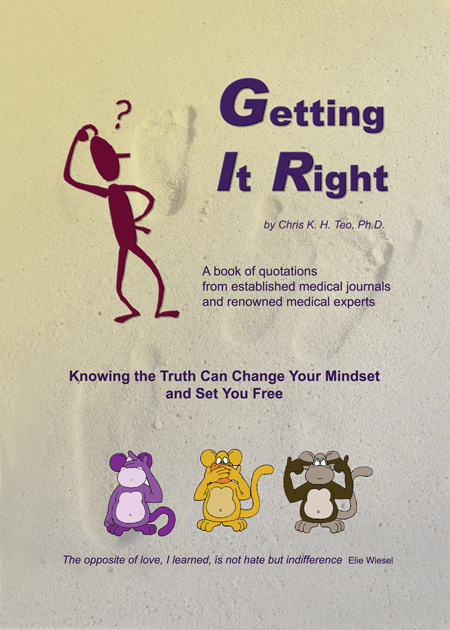
After I got into the bus again, I recalled a book that I wrote some years ago – Getting it right. 

Actually I call this a book of quotations because it contained statements made by renowned medical experts as found published in established medical journals.  By doing this way, I want to ensure that I get it right and not wrong! Among the questions I asked and attempted to answer in this book are: Is modern medicine the only proven and scientific therapy? Is traditional and complementary / alternative medicine quackery? Are research data always reliable and proven when published in peer-reviewed journals? Are drugs perfectly safe after FDA approval?  Are “they” protecting public safety or safe-guarding self-interest? Can medicine cure cancer?

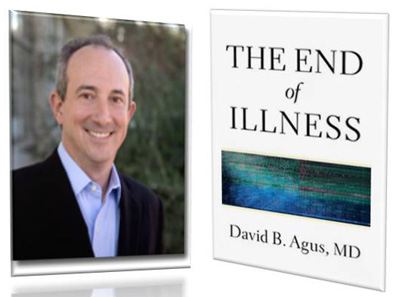
This orange tree was all forgotten after I came home. But after reading the book, The End of Illness, which my good friend S.Y. Yeong had sent me, “triggered” me to revisit this subject of perception again. Two sentences that Dr. David Agus wrote, awakened me – In the upcoming chapters, I’ll help you to answer that questions because many of these commonly held perceptions are just that – perceptions. I’m going to bust a few of these ideas and show you a different way of considering what’s good for you or not.

What is it that Dr. Agus wanted us to know? I suggest that you read his book for yourself, but let me share with you some of my thoughts.

First, I have high respect for this man. Dr. Agus  is professor of medicine and engineering at the University of Southern California Keck School of Medicine and the Viterbi School of Engineering. He obtained his undergraduate degree from Princeton University and his M.D. from University of Pennsylvania School of Medicine. Dr. Agus did his medical internship and residency at Johns Hopkins Hospital and his oncology fellowship training at Memorial Sloan-Kettering Cancer Centre. He is indeed well qualified to be saying what he is saying.

Second, it is not only his paper qualification that is just attractive, but the attitude of the man that I have the highest respect for.  Dr. Agus related a “trivial” event (for most people!) that changed him. This is what he wrote:

When I walked past my hospital’s gift shop and saw the cover of Fortune magazine proclaiming “Why We’re Losing the War on Cancer, “ … it seemed to be pointing a finger at me telling me how terribly I’d been doing my job. Cancer care has been much criticized over the last several decades, and clearly this article was trying to rip apart my field some more… It left a deep impression on me, for any cancer doctor who comes across such a blunt headline and well-thought-out essay is bound to feel disheartened and failing at his most essential job.

Clifton made remarkable points in the article, the most significant of which explained how we – as a society, but more specifically, within the medical community – have come to look at biology. For the last fifty years, we have focused on trying to understand the individual features of cancer in order to treat it rather than putting our efforts directly into controlling cancer. We have forgotten that curing cancer starts with preventing cancer.

When we reduce science down to the goal of finding the tiniest improvements in treatment rather than genuine breakthroughs, we lose sight of the bigger picture and find ourselves lost.

Is this why we’ve barely budged in our “war” against cancer in the last five decades?  … Gnawing questions like these began to bother me. I am, after all, an oncologist who cannot treat advanced cancer well. Medical science has made extraordinary progress over the past century, but in my field, the progress stalled out decades ago.

But, despite my initial reaction, I did and do believe that this kind of criticism is desperately needed, and I am inspired by the challenge to fix what’s broken.

To me, this is the measure of an honest, thinking man. This is what the wise and the educated should aspire to do. If there is a problem – say it out and more importantly, try to find a solution to it.

What are the problems that Dr. Agus see which do not seem to be right? He wrote:

Limitations of Medical Science

1.  The truth is that some doctors inflict a lot of harm today. The entire notion of “do no harm” has been corrupted; we’ve move into an extreme place in medicine that’s rarely data-driven and is horrendously overrun by false or unproven claims.

2.  A lot is going on in the body at any given moment. Yet we perform medicine in piecemeal – targeting one problem at a time. If you’re diagnosed with pneumonia, then you’ll receive a treatment specific for pneumonia and await your next health challenge. But what happens when you’ve got a system that’s broken down in a way that cannot be explained by any single invader …? Then you’ve got a real problem … because current methods of medicine don’t know what to do with you. The proposed treatment will probably mess with other areas in your system in ways that we may or may not know about. Your doctor will tell you that that treatment is “safe and effective,” but he’s only talking in relation to that one conditions, at that moment in time. He’s not considering everything else that encapsulates you – especially in the long run – because a lot of that knowledge remains to be understood.

3.  Rather than honouring the body as the exceedingly complex systems that it is, we keep looking for the individual gene that has gone awry or for the one “secret” that can improve our health. This kind of short-sightedness had led us far astray. 

The Medical Treatment for Cancer

1.  When Murray (Nobel laureate in physics) said to me point-blank, “Look at cancer as a system,” I really began to rethink everything – about cancer and our approach to treating it; about illness and our approach in medicine in general … I couldn’t help but ask myself: Is our way of looking at cancer keeping us from curing it? Moreover, does this faulty perspective preclude us from treating anything in medicine successfully?

2.   We’ve got a serious problem on our hands if all the intelligence and money currently going toward cancer are doing next to nothing in this so-called war. It’s time to change not only how we think about cancer … We need a radically different way of thinking…

3.   Cancer treatment is the place where we take the most risks in medicine because, frankly, there’s little hope for survival in many cases, and the cure is as evasive today as it ever was. I’m infuriated by the statistics, disappointed in the progress that the medical profession has made, and exasperated by the backward thinking that science continues to espouse, which no doubt cripples our hunt for the magic bullet.

4.  If you come to me for help in treating advanced cancer detected late in the game, your game is likely to be over soon. I don’t say this … to sound insensitive; I say it because it’s the truth … it’s a shame that the technology and innovation in medical research and treatment are so archaic, outdated, and, dare I say, in some cases barbaric.

5.  Despite chemotherapy’s being a widely used treatment for cancer, nobody has ever shown that most chemotherapy actually touches a cancer cell. It’s never been proven. Researchers can perform all this elegant work in tissue-culture dishes – if I expose a cell to this cancer drug, here’s what happens, and so on – but doses in those dishes are nowhere near the doses, nor the environment, that happens in the body.

6.  The death rate from cancer from 1950 to 2007 didn’t change much.  We are making enormous progress against other chronic diseases, but little against cancer. With the more common deadly cancers, including those that ravage the lung, colon, breast, prostate and brain we’ve had an embarrassingly small impact on death rates. The lack of change in the death rate from cancer is truly alarming. How can this be? What did we do wrong in our research?

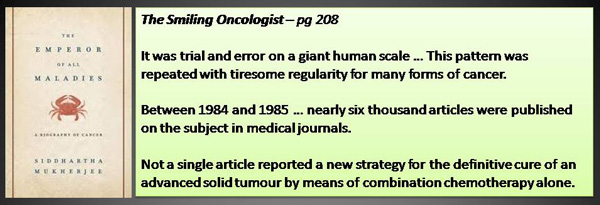
7.   Doctors such as myself arrive at solutions through plain old trial and error, and therefore we can’t always explain how things work. I can’t always tell you why a certain drug works or how it works other than to say I have seen results proving that it does. I also can’t always give you’re a straight answer as to which course of therapy might work for you. In fact, doctors – myself included – don’t actually know why these drugs kill cancer cells at all! There’s a lot of trial and error in my business. We don’t have the technology yet to precisely predict what medicine you’ll respond to or which one will work best. 

8.   When cancer is exposed to chemotherapy, drug-resistant mutants can escape. In other words, just as resistant strains of bacteria can result from antibiotic use, anticancer drugs can produce resistant cancer cells. The number of mutations shoots up exponentially as a cancer patient is treated with drugs such as chemotherapy, which inherently causes more mutations.   When chemotherapy drugs bind to DNA, they can cause cancer just as radiation can cause cancer by mutating the genome. This helps explain why survivors of breast cancer, for instance, can suffer  from leukemia later in life due to the chemotherapy they received to cure their breast cancer.

9.   It’s human nature to want to find magic bullets in medicine, but they happen once in a blue moon, and we may already have had all of our blue-moon moments. We haven’t found many new pills lately that really cure diseases. This is why the pharmaceutical industry is somewhat broken right now; it has run out of … a magical chemical that cures a disease. I don’t think we’re likely to find a lot more of those; it seems like a waste of time, money, and resources to keep looking for these magic bullets. We need a different approach – a new model.

Many doctors and authors before this have been saying similar things about cancer treatment. Dr. David Agus – one of America’s outstanding oncologist – has decided to join in the chorus. Let the song plays on to full volume!


Related post:  Book Review: The End Of Illness By Dr David Agus, M.D. by  Yeong Sek Yee & Khadijah Shaari https://cancercaremalaysia.com/2012/06/09/book-review-ehe-end-of-illness-by-dr-david-agus-m-d/

Book Review: The End Of Illness By Dr David Agus, M.D.

Reviewed by Yeong Sek Yee & Khadijah Shaari, 10, Jalan SS 19/1K, 47500 Subang Jaya, Selangor. Tel: 03-56342775 / 019-3278092

The Author:  Dr David B. Agus, MD, is a professor of medicine and engineering at the University of Southern California Keck School of Medicine and Viterbi School of Engineering and heads USC’s Westside Cancer Centre and the Centre for Applied Molecular Medicine. He is the co-founder of two pioneering personalized medicine companies, Navigencies and Applied Proteomics. Dr. Agus is an international leader in cancer care and new technologies and approaches for personalized health care and chairs the Global Agenda Council on Genetics for the World Economic Forum.

Introduction:  When Dr Agus decided to pursue a career in oncology, many of his mentors questioned his choice. Why, they asked, would a promising young doctor want to enter a field known for its inescapably grim outcomes? Although, it was precisely the lack of progress that inspired Dr Agus to join the war on cancer, he moved away from the modern methods of the medical establishment, which aim to reduce our afflictions to a single point. Why did he do so?

The following excerpts from the book give us an indication of his views on the effectiveness of modern medicine or specifically on the effectiveness of the conventional treatment of cancer:

a)      Cancer treatment is the place where we take the most risks in medicine because, frankly, there’s little hope for survival in many cases, and the cure is as evasive today as it ever was (page 1 ).

b)      I (Dr Agus) am infuriated by the statistics, disappointed in the progress that the medical profession  has made, and exasperated by the backward thinking that science continues to espouse, which no doubt cripples our hunt for that magic bullet (page 2 ).

c)      I (Dr Agus) am a realist, and the facts of cancer and many other life-threatening diseases are unnerving. In an age when we can communicate in seconds with people around the world using slick devices we tote in our pockets, it’s a shame that the technology and innovation in medical research and treatment are so archaic, out-dated, and, dare I say, in some cases barbaric (page 3 ).

d)      Rather than honouring the body as the exceedingly complex systems that it is, we keep looking for the individual gene that has gone awry or for the one “secret” that can improve our health. This kind of short-sightedness had led us far astray (page 4).

e)      The truth is that some doctors inflict a lot of harm today. The entire notion of “do no harm” has been corrupted; we’ve moved to an extreme place in medicine that’s rarely data-driven and is horrendously overrun by false or unproven claims. And that’s scary (pages 4-5).

f)       When we reduce science down to the goal of finding the tiniest improvements in treatment rather than genuine break-throughs, we lose sight of the bigger picture and find ourselves lost (page 6).

g)      Is this why we’ve barely budged in our “war” against cancer in the last five decades? (page 6)

h)      I am an oncologist who cannot treat advanced cancer well. Medical science has made extraordinary progress over the past century, but in my field, the progress stalled out decades ago (page 6).

i)        The death rate from cancer from 1950 to 2007 didn’t change much. (page 25 )

j)        We are making enormous progress against other chronic diseases, but little against cancer (page 25).

k)      With the more common deadly cancers, including those that ravage the lung, colon, breast, prostate and brain we’ve had an embarrassingly small impact on death rates (page 25).

l)        The lack of change in the death rate from cancer is truly alarming (page 26 ).

m)  When cancer is exposed to chemotherapy, drug-resistant mutants can escape. In other words, just as resistant strains of bacteria can result from antibiotic use, anticancer drugs can produce resistant cancer cells (page 37).

n)    The number of mutations shoots up exponentially as a cancer patient is treated with drugs such as chemotherapy, which inherently causes more mutations (page 39).

o)      When chemotherapy drugs bind to DNA, they can cause cancer just as radiation can cause cancer by mutating the genome. This helps explain why survivors of breast cancer, for instance, can suffer  from leukaemia later in life due to the chemotherapy they received to cure their breast cancer (page 39 ).

p)      It’s human nature to want to find magic bullets in medicine, but they happen once in a blue moon, and we may already have had all of our blue-moon moments. We haven’t found many new pills lately that really cure diseases. This is why the pharmaceutical industry is somewhat broken right now; it has run out of low-hanging fruit, a magical chemical that cures a disease. I don’t think we’re likely to find a lot more of those; it seems like a waste of time, money, and resources to keep looking for these magic bullets. We need a different approach -a new model (page 41-42).

q)      Right now, when doctors test a drug, they are looking at one variable over a discrete period of time. They only discover potentially bad side effects in retrospective studies – looking back after people have been taking the drug for a long time, or by pooling several studies together (page 47).

r)        There’s a lot of trial and error in my business. We don’t have the technology yet to precisely predict what medicine you’ll respond to or which one will work best (page 64).

s)       Despite chemotherapy’s being a widely used treatment for cancer, nobody has even shown that most chemotherapy actually touches a cancer cell. It’s never been proven (page 86).

t)       When people ask me (Dr Agus) why most cancer drug development in lab animals doesn’t work or cannot easily be applied to solve human problems, there are three reasons:

  • First, tumors grow slowly in humans as compared to in lab animals, where we can grow tumors in two weeks that represent 20 to 30 percent of the animal’s whole body size.  (page 93)
  • Second, it’s hard to compare human tumors with those in other animals. Human tumors tend to be unique, and when we try to replicate a human tumor in another animal we cannot achieve the exact same characteristics to study and manipulate (page 94).
  • Finally, controlling for the way various drugs work in different living bodies also presents an insurmountable challenge.(page 94)

Below are Dr Agus’s comments on some chemotherapy drugs: 

a) Avastin (bevacizumab) could cause bleeding in the brain….. (page 88),

b) Iressa (gefitinib)….patients who were on the drug showed improvement in its

symptoms but their tumours didn’t shrink (page 92),

c) Tarceva (erlotinib)…..helped lung cancer patients live longer but their tumours didn’t shrink (page 92),

d) Taxol (placitaxel)….when given to ladies with mestastatic cancer….”a great response”

which means that those women will show a 50% shrinkage in their tumour,,,,but the cancer will then  come back….i.e. the cancer “recurs” and the patient “relapses” (page

92).

Below are some more shocking comments from Dr Agus:

a) Doctors such as me (Dr Agus) arrive at solutions through plain old trial and error, and

therefore we can’t always explain how things work (page 89),

b) Doctors, (Dr Agus) included, don’t actually know how these drugs kill cancer cells at all (page 89)

c) Unfortunately, our only metric for success is shrinking a tumour. Slowing down its

growth isn’t usually accepted as success (page 92),

d) We already have all the drugs we need to treat the vast majority of diseases….we just

don’t know how to use this library of drugs (method), how much to use (dosage),and

when (schedule).

In conclusion, Dr Agus admits that drug resistance may be the reason why chemotherapy drugs may not work:

“My field in particular is a breath-taking spectrum of gray shades. Most people don’t understand that if your cancer is four centimeters in diameter and you come back four months down the road and the cancer is now six centimeters, we call that resistant…..your cancer is resistant to the drug” 

The Above Book Reviewed Is Yet Another Book Which Your Doctor/Oncologist Will Never Advise You To Read. Other Such “Banned” Books/Resources You May Want To Read (Which Your Oncologist Will Never Advise You) Are Listed Below:

 1) THE COMPASSIONATE ONCOLOGIST by Dr James W. Forsythe, MD, HMD…..read  what cancer specialists don’t want you to know.

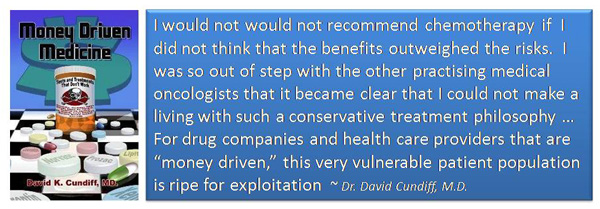
2) MONEY DRIVEN MEDICINE by Dr David K Cundiff, MD…..read about                   chemotherapy for Non-responsive cancers

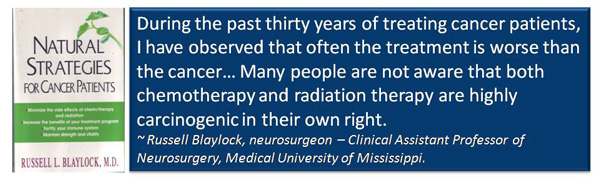
3) NATURAL STRATEGIES FOR CANCER PATIENTS  by Dr Russell Blaylock, MD…..Chapter 3 is entitled  Chemotherapy: Poisoning Cancer (and You).

 4) KNOCKOUT ….INTERVIEWS WITH DOCTORS WHO ARE CURING CANCER by Suzanne Somers ( read Dr Forsythe’s interview in Chapter 9 )

5) CANCER: WHAT YOU NEED TO KNOW (about Surgery, Chemotherapy, Radiotherapy, Pharmaceutical Drugs and the Politics of Cancer by Dr Chris Teo)

 6) GETTING IT RIGHT(a book of quotations from established medical journals and    renowned medical experts by Dr Chris Teo).

7) WHAT YOU REALLY NEED TO KNOW ABOUT CANCER by Dr. Robert Buckman in collaboration with specialists at The MD Anderson Cancer Centre, Texas. (read Chapter 9 – With So Many Breakthroughs, Why is There No Progress?)

8) AUSTRALIAN ONCOLOGISTS CRITICIZE CHEMOTHERAPY by Associate Professor Graeme Morgan, a Radiation Oncologist and Professor Robyn Ward, a Medical Oncologist in Australia and Dr Michael Barton, MD, a radiation oncologist. (all three oncologists did a research study on THE CONTRIBUTION OF CYTOTOXIC CHEMOTHERAPY TO 5-YEAR SURVIVAL IN ADULT MALIGNANCIES” which was published in the journal CLINICAL ONCOLOGY in 2004) …(COPIES AVAILABLE FOR READING)

9) ARTICLE: WHY 75% OF DOCTORS WOULD REFUSE CHEMOTHERAPY (just go to the Internet –Google or Yahoo and type in the above title and you will find a lot to read which your oncologist will never tell you).

10) ARTICLE: HOW MODERN MEDICINE KILLED MY BROTHER by Dr Russell Blaylock, MD, author of Natural Strategies for Cancer Patients. Just Google the title or Dr Russell Blaylock to read the article.

11) WHAT DOCTORS DON’T TELL YOU by Dr Lynne McTaggart (read about the truth of the dangers of modern medicine. Chemotherapy is cited in pages 223 to 229).

12) DVD: CANCER TALK by Dr Alfonso Wong, an oncologist from Hong Kong…..in the DVD, Dr Wong clearly explained that if after the first 4-6 cycles of chemotherapy there is no progress, then further chemotherapy will be futile…

13) DVD: DRUGS NEVER CURE DISEASE by Dr Lorraine Day, MD, a trauma surgeon and a breast cancer survivor. She had surgery to remove the big lump in her chest but refused any radiotherapy or chemotherapy…………….read more about Dr Day in her website……….www.drday.com

OTHER RELATED REFERENCES

1) THE TRUTH ABOUT THE DRUG COMPANIES by Dr Marcia Angell, MD, former editor in chief of the New England Journal of Medicine (read how they deceive us and what to do about it)

2) DEATH BY PRESCRIPTION by Dr Ray Strand, MD, (the shocking truth behind an overmedicated nation).

3) THE POLITICS OF CANCER REVISITED by Dr Samuel S. Epstein, MD (in this book, Dr Epstein indicts the NCI, US and the American Cancer Society for responsibility in losing the cancer war).

4) THE CANCER INDUSTRY by Dr Ralph Moss, PhD (The classic expose of the Cancer Establishment –read chapter 5 CHEMOTHERAPY).

5) CANCER AND NATURAL MEDICINE by Dr John Boik, PhD (read Chapter 9 – The Treatment of Cancer by Conventional Medicine).

6) THE HEALING OF CANCER – The cures and the cover-ups by Barry Lynes.

7) QUESTIONING CHEMOTHERAPYby Dr Ralph Moss, PhD….Dr Moss was formerly a director in the prestigious Memorial Sloan-Kettering Cancer Centre, USA. He was sacked after he published a scientific study (conducted by researchers in the Cancer centre itself) that an alternative treatment method is effective……..

8) WWW.NATURALNEWS.COM …..operated by Mike Adams….just type in the name of the drug or type in chemotherapy effectiveness/side effects…..lots to read…

9) WWW.MERCOLA.COM …..operated by Dr. Joseph Mercola, MD…..just type in the name of the drugs or chemotherapy effectiveness, etc….also lots to read…