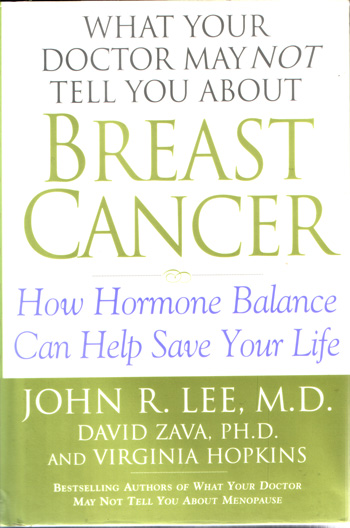
Book Review: What your doctor may not tell you about Breast Cancer

The authors:  Dr. John Lee graduated from Harvard University and the University of Minnesota Medical School. He is an expert in natural hormones replacement therapy. Dr. David Zava is a Ph.D. and Virginia Hopkins, M.A. is a medical writer specializing in women’s health.

Why is modern medicine going nowhere in its attempts to treat breast cancer?

Our research has found that the answer to this question lies primarily with:

  • The politics of medicine.
  • The Cancer Industry.
  • And the industries that create the pollutants that contribute to breast cancer.
  • The forces that would keep things the same – they are very powerful and entrenched.

Over the past few decades, conventional medicine has done very little to make any meaningful difference in what will happen to you if you get breast cancer, and virtually nothing has been done to reduce the incidence of the disease.

Breast Cancer Treatment

  1. Statistics clearly tell us that conventional medicines for treating breast cancer such as tamoxifen, radiation and chemotherapy just aren’t working in the long run.
  2. The way breast cancer is currently treated is a way of doing something in the face of not knowing what else to do.
  3. How can we be so bold as to state that conventional medical treatments for breast cancer aren’t working? It’s well documented. It seems as if every time we open a medical journal, there’s an article showing that conventional breast cancer treatments are ineffective, harmful, or both.
  4. Evidence-base medicine have shown that:

a)      Mammograms don’t really save lives.

b)      Radiation doesn’t really save lives.

c)       Tamoxifen doesn’t really save lives.

d)      Chemotherapy doesn’t save lives.

So what’s left for the conventional medical doctor to treat breast cancer patients with? Nothing, but the same surgical removal of the cancer that they were doing fifty years ago.

More American physicians need to face the hard, cold facts that current therapies just aren’t working and open their eyes to alternatives for prevention and treatment of breast cancer.

Radiotherapy

  • Radiation obliterates the breast cancer tumour in a small percentage of women, but in the process it causes many of them to die from other diseases.
  • There is no long-term benefit from using radiation to treat breast cancer, because even though the cancer may not recur at the site of the radiation, the overall chances of survival stay the same or are slightly worse.
  • And yet despite the fact that radiation helps so few women and eventually kills many of those whom it helped in the short term, it remains the standard of care in medicine for women who have breast cancer.
  • Despite this … if you have breast cancer your doctor will most likely insist that you undergo radiation treatments rather than exploring possibly safer alternatives.
  • How can this be?

Tamoxifen

  • We hope that those promoting tamoxifen remember to mention how many women taking it suffer from:

a)      Blood clots.

b)      Deterioration of vision.

c)       Diminished quality of life (hot flashes, night sweats).

d)      How many women have been forced to have a hysterectomy due to a particularly aggressive form of tamoxifen-induced uterine cancer?

  • It is rarely mentioned that women actually die of tamoxifen-induced uterine cancer.
  • Tamoxifen has been available for 25 years and its effect on breast cancer prevention is still being debated. This in and of itself should tell us something.
  • The only reason this is such a popular treatment right now is that it seems to oncologists to be better than doing nothing.

Chemotherapy

  • Chemotherapy is an attempt to poison the body just short of death in the hope of killing the cancer before the entire body is killed. Most of the time it doesn’t work.
  • Some chemotherapy does prolong life for a few  months, but generally at the high price of devastating side effects, and if a woman does happen to get lucky and survive that bout of cancer, her body is permanently damaged; recurrence are high.
  • The use of chemotherapy is purely a gamble, and we don’t think it’s worth taking. Sometimes it works, and sometimes it doesn’t, and sometimes it makes things worse.
  • It seems much smarter to find an alternative therapy with a good track record that will both support your body in fighting off the cancer and promote health.

Politics of Breast Cancer Industry

  • The detection and treatment of breast cancer is hugely profitable in the United States, generating billions of dollars a year.
  • All those mammograms, biopsies, lumpectomies and mastectomies, and all that chemotherapy, radiation and tamoxifen, create a substantial income stream for the hospitals, physicians, their support staff, those who make all the equipment and especially those who make the drugs.
  • Where is the financial incentive to go outside this framework?

Women – Terrified and Confused

  • Where does this leave the woman with breast cancer? She is terribly afraid and confused, but she is also pretty much crushed by the cog wheels of medical machinery.
  • She will be shuffled off to his operating table or that radiation clinic not because it is necessarily best for her as an individual, and not because that is what is going to truly help and heal her, but because she fits into that slot.
  • That is how the breast cancer industry machine works, and there is no other choice.
  • What the conventional medicine presents her with is that she is going to die if she doesn’t do it.
  • But if she sorts out the statistics correctly, she is going to realize that if she has a non-local cancer, even if she does everything the doctors tell her to do there is still a one in three chance that she is going to die, from the cancer or as a result of its treatment.
  • The path to possible recovery is paved with treatments that can do permanent damage.


Review: To Dance With The Devil

Karen Stabiner is a nationally recognized journalist. She wrote about the work of Dr. Susan Love – the eminent breast surgeon,and director of the University of California, Los Angeles Breast Cancer Centre.

The following are quotations from the book:

Life is a Roulette

  • Those of us outside this world tend to divide the population into us – the healthy ones and them – breast cancer patients. There is no such line. Yesterday they were on our side, tomorrow any one of us could cross over.
  • There is no sure way to dodge breast cancer – no proven preventive, dependable treatment and no cure.
  • No one can promise a cure. No one can even promise a consensus, since treatment is an exasperating imprecise art. All the doctors can do is to make sure they get what those doctors define as comprehensive treatment. That is how bad it is.
  • The only certainty is that over 183,000 women will get breast cancer this year, and about 44,000 will die of it.
  • Worse yet, there seemed to be nothing a woman could do to improve her odds. Life is a roulette   when it comes to breast cancer.

Standard Recipe for Cancer

  • Doctors continued to depend on combination of surgery, chemotherapy and radiation, despite their hit-and-miss success rate, because these were the only tools they had.
  • Medicine embraced action and discouraged inquiry.
  • Skeptics within the medical community suggested new remedies and watched their work go ignored for years.

Definition of Cure

  • Patients talked about being five years out as though that were an absolute demarcation. Dr. Susan Love had seen too many women recur at seven, eight, even ten years to buy that definition.
  • It is irresponsible to tell women they were cured at five years. Breast cancer grew slowly. Dr. Love had seen too many bleak surprises. Love did not believe in the nation of a cure.

You Never Catch Breast Cancer Only Yesterday

  • Breast cancer patients were probably starting to get sick eight to ten years before I met them. They did not know it – it could not, since neither a mammogram nor a physical examination can detect breast cancer when the first malignant cell divides.
  • It takes an average of one hundred days for that cell to turn into two, another hundred for those two to turn into four, and on and on, until one billion cancer cells reside in a woman’s body. Only then does the cancer elicit a response – the lump or mass that shows up as a showdown on a mammogram or under probing fingers. (But) it is in fact not the cancer itself but a reaction to it – an irritation.

Healing Ways – A Doctor’s Guide to Healing

The Author:  “I grew up in a medical household. My father was a family doctor in suburban London… I feel comfortable at the thought of being a doctor.”  Robin Kelly went to a medical school in the UK. “After my (intern) year, I pursued my interest in paediatrics and oncology.” In 1977, he emigrated to New Zealand and worked in a hospital. In June 1981, “I was content to settle into the life of a general practitioner in the comfortable seaside suburb of Takapuna on Auckland’s North Shore”.

Dr. Kelly eventually “was drawn to the holistic Taoist philosophies, the Laws of the Five Elements, the macrocosm expressed in the microcosm of the body, the focus on natural healing.” And he said, “What’s more it seemed to work.”

His focus is on integrating these holistic models into a modern   contemporary environment — blending the best of the East with the best of the West.
A past and current co-president of the Medical Acupuncture Society (NZ) and a founding trustee of New Zealand’s MindBody Trust, he studied Acupuncture and Chinese medicine in the 80s running teaching workshops for health professionals and doctors. Since the 90’s his overriding interest has been in researching the roles consciousness and quantum theory play in the deep healing process.

“I feel fortunate to have been able to watch the progress of “chronically ill” patients as a doctor, without the pressure to prescribe. In this setting, I have been free to explore the meaning of symptoms, seeing them in the overall context of healing. I have been able to observe the subtlety of healing, as patients leave behind the controlling chaos of chronic illness and embark on their journeys of self-discovery. It continues to be a privilege to accompany them along the way.”

You can visit Dr. Kelly’s website, http://www.robinkelly.co.nz/About+Us.html

In the foreword of this book, Dr. Steven Aung, Clinical Professor, Department of Medicine of the University of Alberta, Canada wrote:

  • Healing is not merely a technical phenomenon, but a holistic process of facilitating peace, happiness and harmony. Physicians are not superior to their patients. Both must work together with an attitude of mutual honour and respect.
  • Medicine should not have any divisions, east, west, north or south. It should always be aimed toward the total health and wellbeing of all our dear patients.
  • The essence of this sacred quest is to honour and respect our patients as our best friends and honoured teachers.

The following are quotations from the book.

  • Healing is re-emerging as a medical term, meaning more than the healthy resolution of a physical wound. It means returning to a state of joy, harmony and health; a state of being where life has meaning and purpose.
  • The existing model of disease often sees the body in a state of war, under attack from a foreign invader.  But there are many others who remain unwell despite the best efforts of “mainstream” treatments. Some cannot tolerate their medication; some are even made worse by their treatment or develop new conditions as a result. Many more feel awful, tired or pained without a reasonable diagnosis let alone a cure.  I have been asked to treat people who have failed to become well despite the best medical care available. The chronically ill, the perpetually stressed and those in constant pain appear at my home.
  • In the population of chronically ill people “the most common ingredient missing from their health care … is themselves”. Often the good intentions of medical professionals attempting to manage a condition lead to a lack of participation by the sufferer. By interfering with this personal responsibility, the patient’s confidence and ability to heal are often eroded. These patients feel failures, incurable and despondent.
  • Our bodies continually talk to us. If our bodies continue to be ignored, the messages can become more complex and difficult to fix.
  • I have had a close connection with cancer sufferers over the years. There are no strict ground rules for someone to follow when diagnosed with cancer. No universally correct way to deal with the uncertainties, the confusion and the distress. Every person, once properly informed, must find their own way, and it is our job as friends and professionals to stand alongside them. We all have the potential to heal even when there is no cure.
  • Some of the barriers to healing – repressed feelings, and a lack of loving support, loom large as potential blocks. Blocks, once understood, can be cleared. Ask yourself: How much peace is there in my life? Peace is valued from the cradle to the grave.
  • Humans worry. So we must come to terms with the fact that we are born worriers. But health requires balance. Too much worry blocks our quality of life. The pace of modern life and our many responsibilities prevent us from achieving the ultimate mindful state. Meditation – in its broadest context, is a pure state of mindfulness – a time when we can step outside our worries and fears. A place where we ourselves exists, unburdened and free.
  • Humour is often cited as a vital ingredient of a healthy, long-term relationship. The medical literature is short on laughs. Try entering “laughter” into any medical internet search engine; you’ll find it a sobering experience. Up comes paper after paper on “pathological laughter” – the inappropriate expression of joy  in the psychiatrically unstable!
  • Prayer has an important part to play in health – despite the apparent separation of medicine from spiritual issues over the past 300 years.
  • Most of us have to relearn how to breathe. It is our most vital subconscious activity, and yet modern living conspires to interfere, conditioning us into bad breathing habits.
  • For something so essential to our survival, modern medicine has surprisingly little to say about love. Maybe there are good reasons for not analyzing love too closely. No sooner have we studied and measured something than we start to want to control it. We set up guidelines, protocols and conditions for its use. For the moment then, perhaps it is better for love to remain mysterious and unconditional.
  • Doctors and patients can talk at cross-purposes. My experience with terminally ill adult cancer patients in London – junior doctors … were not trained to talk of death. The dying were prescribed cocktails of heroin, major tranquillisers and cocaine in increasing doses; no doubt a compassionate attempt by us to help drown the sorrows of terminal illness. On many occasions since, I have witnessed terminally ill children teaching their parents and families about matters of life and death. Children have shown me how healing can occur through the dying process; and why adults frequently find it so difficult to let go of life. Once the dying person has let go, a peaceful calm follows. I have felt the most relaxed in my life sitting alongside the bed of a dying person – no need to talk or plan, no better place to be.

Chinese Medicine and Holistic Healing

  • We are not simply isolated islands of human tissue closed off to the outside world. Healing involves interchange between ourselves, others and our environment; we are part of an open system. I believe that an understanding of these principles is in itself an important healing step. It allows a person seeking healing an opportunity to be involved, and thereby take responsibility for his or her healing. It also opens patients up to receiving the messages from their bodies, thereby gaining perspective and control of their health.
  • It is this open model of healing that forms the basis of Chinese medicine. The Chinese have studied the body in this way for thousands of years; it is their insights that have helped me reach a deeper understanding of healing. They have provided us with a working model of healing.
  • This (the above) challenges the very basis of the traditional, 20th century healthcare model, which sees our bodies as closed systems manipulated back to health from within. Medical science has progressed by studying each small part in increasing detail, with the assumption that this reductionist approach will provide us with all our answers.
  • Healing involves more than just the mechanical repair of the body. Once healed, a world previously denied opens up. Opportunities present themselves, relationships improve, as a new focus develops on the outside world. The healed have an improved “sense of self”, often better than before the illness.
  • We must consider other models of health that have withstood the test of time. Models based on centuries of empirical evidence and meticulous recording. Models that are as free as possible from being tarnished by commercial self-interest or political gain. I will use Chinese medicine as an example of this as it has been an area of intense interest to me over the years.
  • When I started to study Chinese medicine in the early 1980s, I was in two minds about it. On the one hand I was excited because it seemed to provide a valid and logical reason why acupuncture worked. It also linked physical diseases holistically with emotions and environmental conditions, which made sense to me. However, it was taught as a dogma with poorly constructed “scientific” trials always claiming a 98 percent success rate. This part didn’t ring true to me.
  • According to Chinese tradition, in the state of perfect health qi flows evenly through all the meridians, which interconnect and connect the organs (liver, heart, spleen, lungs & kidney) to the outside world. Symptoms such as pain represent a block in the flow of qi somewhere in a meridian.
  • “Orthodox” medicine still struggles with the philosophies of Chinese medicine and concepts such as qi. Canadian neuroscientist Professor Bruce Pomeranz … is of the many who advocate a shift away from the narrow thinking that tries to explain the healing arts in solely chemical terms.
  • For a therapist and health professional, acupuncture is a marvelous tool with which to facilitate healing. Acupuncture uses needles to conduct a state of harmony and connection in the body.

The Healer

  • To be a healer you have to be involved.
  • To be a healer you have to know the person.
  • To be a healer you have to listen.
  • To listen you have to know yourself.
    • Honestly and humility are valued above perfection and pride.
    • Quiet confidence is important in all healing arts – a mindful state, away from fear and insecurity. This does not mean over-confidence, an inflated ego, or a gung-ho approach.  It is the confidence that comes of knowing one’s self, warts and all. It is the confidence to say, I don’t know but I’ll look it up.


Toxic Reactions from the Sceptics

Despite our more enlightened times, it seems that the path of the modern healers is no easier than their predecessors throughout history. The wise words of Mother Teresa of Calcutta provide comfort and perspective to healers  whose intentions and skill are so misunderstood: “If you do good, people may accuse you of selfish motives; do good anyway.”

  • By definition all living creatures are creative. Knowing that creativity is our natural state should free us into pursuing our dreams and passions. And whatever these are is not for others to judge. The most important scientists in history have been passionate and creative people, lateral thinkers who were prone to leaping out of their baths, yelling “Eureka”.
  • One would think that medical doctors, with their scientific training, would be more convinced about acupuncture from all the evidence now to be found in the medical journals and textbooks. However, over my years of teaching acupuncture to doctors, it is the experience of the changes they feel themselves in response to a single tiny needle on their foot that really “hooks” them in. I have also noticed that many hanging on to a purely materialistic world view – whose lives are focused mainly on issues of control, power and conflict – remained unconvinced of the existence of a world beyond their senses (living in a “fool’s paradise” where the only reality is the one formed and conditioned by our five senses). No seasoned argument, no scientific advance seems to be able to jolt them out of this fixed mindset.
  • I have learned this lesson over the years running teaching courses for doctors and health professionals … I no longer try to convince others, doctors in particular, of the benefits of holistic healing; this is a journey they can only make of their own free will, when they are ready.
  • Twenty years ago, it would have been difficult for a doctor to write a book on healing. In those days many health professionals felt the future lay solely in the chemical and surgical correction of deficits detected by increasingly sophisticated and accurate diagnostic machines. Medicine was becoming efficient but somehow less personal, colder. The public started to explore natural and “alternative” health in an attempt to maintain control and understanding of their bodies. They were also seeking true caring and compassion, instinctively knowing that this was a vital ingredient missing from their prescriptions. Quite simply they were seeking ways to heal.
  • Most of the people I see in my practice come to me because modern biomedicine has not provided them with relief…. For those it has failed, we, as doctors should ask ourselves whether the “mechanical” model is appropriate. For those who continue to suffer day in day out, there is a wealth of such wisdom that can be applied. It is wrong for us to expect them to wait until “all is proven”.

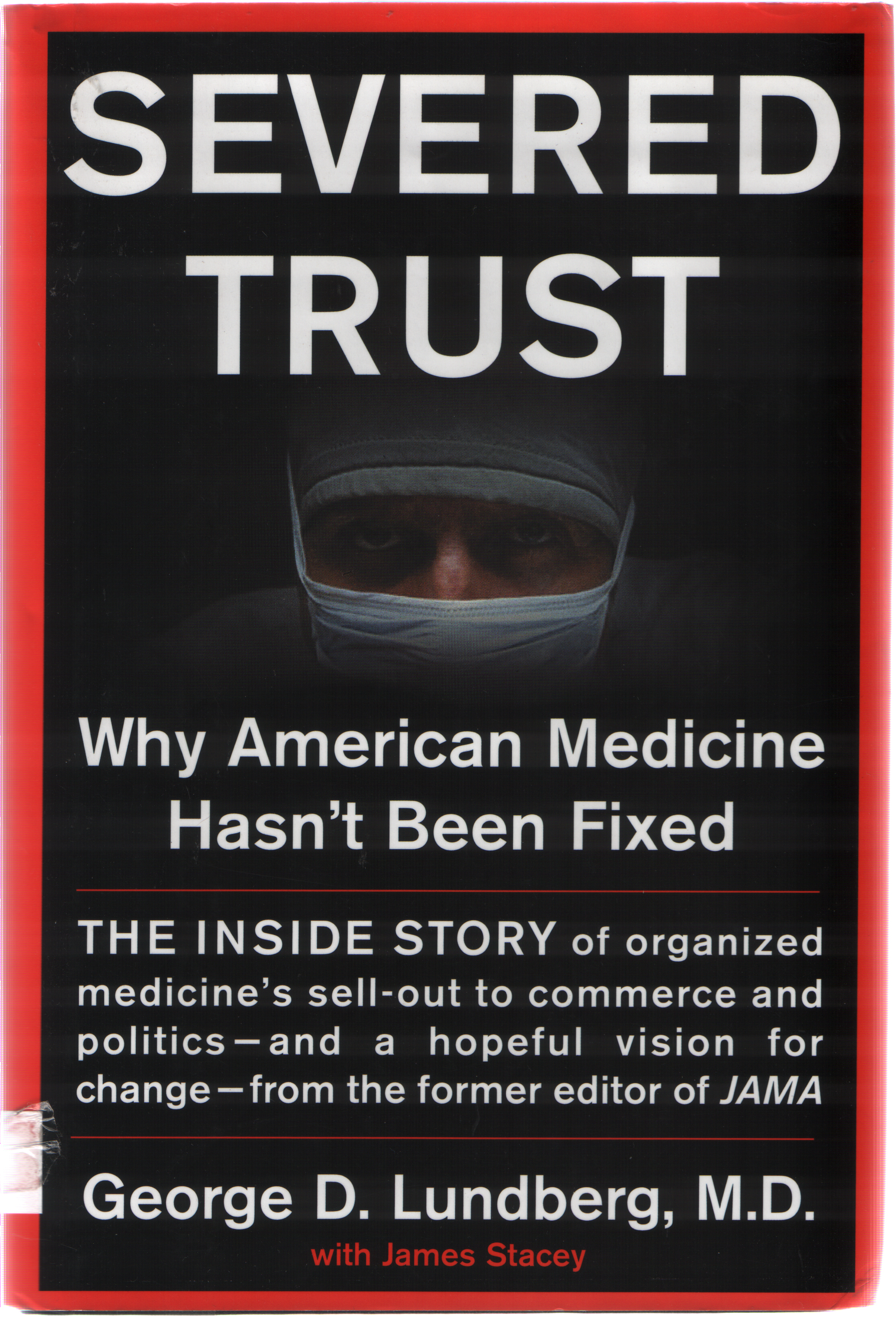
Book Review: Severed Trust by Dr. Geoge D. Lundberg, M.D.


The author was 17 years the editor of the respected Journal of the American Medical Association (JAMA). In January 1999, Dr. Lundberg was sacked by the JAMA leaders. He is now editor-in-chief of the international health information company called MedScape. The following are quotations (in italics) from his book.

US Medicine – Before and Now

In the early 1950s, medicine was a caring profession.Medical technology was relatively primitive and inexpensive. Cure were elusive – care services were essentially directed toward compassionate care for the people in need. Today, medical technology has become enormously complex and expensive – it largely neglects giving attention, comfort and reassurance to patients. Americans spent billions for cures and peanuts for care! 

Physicians have the means to perform any expensive technical procedures and yet they all too often fail to perform the service that medicine was created for. We doctors do not care for our patients, as we ought to. 

Where is the cure? Chasing after dreams and illusions? 

For all our progress CURES REMAIN ELUSIVE for a wide range of chronic disorders and life threatening diseases. At the moment, there is no cure for diabetes, multiple sclerosis, arthritis….Despite decades of intense research the cures are all TOO UNCOMMONLY achieved for the major cancer killers – colon, lung and breast cancers.

I would suggest that we are putting too many resources into a heroic, almost irrational chase for impossible cures. We’re too often investing in hopes, dreams and illusions instead of therapies that have been proven effective.

Medicine is only about money? 

When the American Medical Association talks about quality, what it really means is letting doctors do and order whatever they wish and thereby letting them make as much money as they can. 

When patients talk about quality what they mean is getting whatever they think they need as long as the insurance company pays for it. 

When members of Congress talk about quality, what they mean is providing billions into research aimed at curing all the ills that make their constituents (and themselves) unhappy.  

The profession of medicine has been bought out by business and unless physicians take it back, it will develop into a business technology in which faceless patients will be treated by faceless technicians. The doctors, patients, hospitals, drug companies, health insurers, government officials, etc – everyone wanted the best but unhappily everyone’s self-interest led them on to the worst.  

Medicine – based on science? 

The second most common (surgical) procedure, HYSTERECTOMY…doctors practising it tend to continue to recommend hysterectomy over less drastic treatments EVEN THOUGH SOLID STUDIES of patients’ outcome HAVE BEEN INCONCLUSIVE. 

BONE MARROW TRANSPLANTATION became a standard treatment for Stage 4 breast cancer while it is still an experimental procedures more than a decade BEFORE STUDIES SHOWED THAT IT IS NO MORE HELPFUL THAN CHEMOTHERAPY. 

No matter how great the talent, expertise and daring behind innovative, high-tech interventions, THEY DO NOT CONSTITUTE QUALITY medicine. We need to base medicine on science, not on hopes and dreams of cure and profit. 

Futile care –  what does that mean? 

One particularly onerous deviation from quality standard is so-called futile care – the practice of subjecting terminally ill patients to painful, costly, debilitating treatments that offer little or no hope of any meaningful recovery. 

Patients in their nineties who display symptoms of multiple organ system failure do not need to have another operation or to undergo another round of chemotherapy. What they need is more attentive care. 

The Best of All Medicines! 

In the end, we have to wonder whether LESS isn’t sometimes MORE in medicine. Sometimes the best medicine may be to advise cautious waiting. Often as Archie Cochrane (a renowned British physician of the early 1970s) so eloquently pointed out – the recuperative powers of the body are indeed more powerful than medications. Sometimes the very best therapy comes not from pills or procedures but from professional attention to a patient’s distress. 

Do Unto Others as You Would Have Them Do Unto You 

When I attended medical school in the 1950s, I had ONE LECTURE ON ETHICS, at the end of which the professor said it wasn’t all that complicated. It’s mainly a question of applying the Golden Rule, do unto others as you would have them do unto you.

Why Medicine is Under Attack? 

Why is there a general perception that physicians cover up, close rank and sometimes even bury their mistakes? Unhappily, these perceptions exist because TOO OFTEN THEY ARE TRUE. 

The sad state of affairs is that the profession of medicine seemed to lose its way… it lost its overriding commitment to care for the poor…and it lost its responsibility to self-govern its ranks … (the American Medical Association) was perceived as solely concerned with protecting physcians’ income and the perception TOO OFTEN WAS THE REALITY. 

What disturbs me even more today, is that the balance between business and professional values has tipped dangerously toward the business side…if the rocking horse rocks too far toward the business side…all trust and respect will disappear. Doctors will be fancy technicians and patients faceless cases. That would be bad for patient health. 

Errors in medicine kill more Americans per year than would THREE JUMBO JET AIRCRAFT CRASHES EVERY TWO DAYS at O’Hare Field (Chicago Airport).

It is difficult for doctors to change their culture. PHYSICIAN EGO IS ENORMOUS. The God image has been around for ages, largely because physicians have to make God-like decisions and offer God-like services. They don’t like to make mistakes. IT IS EVEN HARD FOR THEM TO ACKNOWLEDGE THAT THEY ARE CAPABLE OF MAKING MISTAKES. 

Every year 45,000 people apply for the 16,000 slots available in US medical schools. These are young people who typically made straight As in college. By the time the 16,000 reach medical school, they are accustomed to being the cream of the crop and recognised for doing things right. It is very diffucult for someone like that to admit a mistake, to say: How could I cut off the wrong leg? How could I be so stupid?

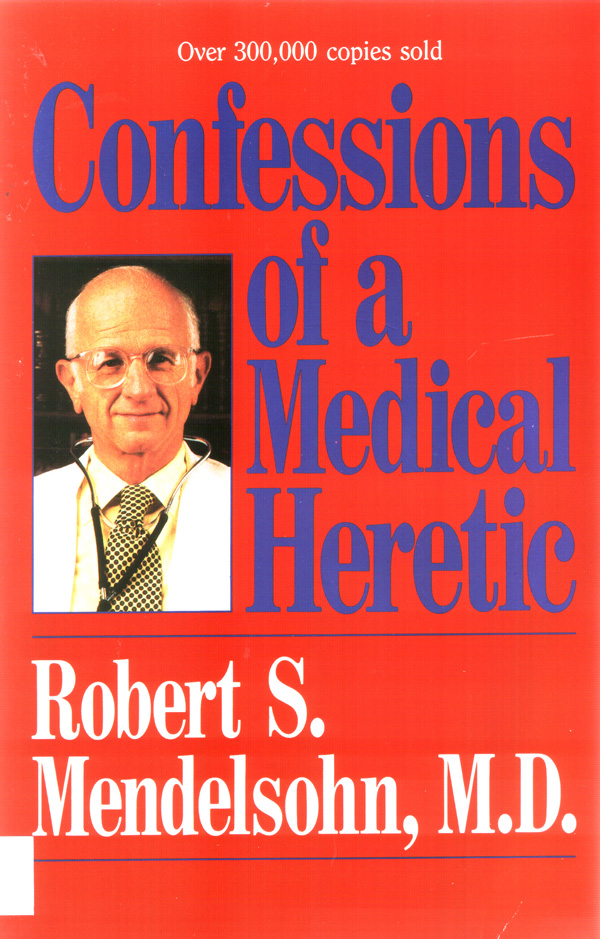
Dr. Robert Mendelsohn – A medical heretic and his shocking revelation


When I first read the opening pages of this no-holds-barred book, The Confession of a Medical Heretics, I was taken aback, amused and wondered if I was reading the correct book. The author, Dr. Robert Mendelsohn was an experienced, senior medical doctor – known to millions of Americans through his nationally syndicated column The People’s Doctor. He was an associate professor at the University of Illinois Medical School and a director of Chicago’s Michael Reese Hospital. He was also chairman of the Medical Licensure Committee of the state of Illinois. Read what he wrote.

Dr. Mendelsohn confessed that:

· I once believed in modern medicine … But, I no longer believe in modern medicine.

· I believe that …the greatest danger to your health is the doctor who practices modern medicine…I believe that more than ninety percent of Modern Medicine could disappear from the face of the earth – doctors, hospitals, drugs and equipment – and the effect on our health would be … beneficial.

· I believe that modern medicine’s treatment for disease are seldom effective and that they’re often more dangerous than the diseases they’re designed to treat.

The following are Dr. Mendelsohn’s advices to you and me:

· I don’t advise anyone who has no symptoms to go to the doctor for a physical examination. For those with symptoms, it is not such a good idea, either. Unless of course it is an emergency like accidents, etc.
Dr. Mendelsohn reminded us that, If you are foolish enough to make yearly visit for a routine check-up, to be aware of the following:
1) Beware that you may be used for purposes other than your own. You may be subjected or asked to undergo certain procedures for the doctor’s own good.

2) Be reminded that doctors are unable to recognize wellness. They are trained to treat diseases and most likely he will always find something wrong with you.

3) As long as the doctor is in control, he can define and manipulate the limits of health and diseases anyway he chooses. Of course, not all are that dishonest. But the worse scenario is when he has vested interest in something or procedure. Dr. Mendelsohn said: beware of the doctor’s self-interest.

4) Doctors almost always get more reward and recognition for intervening than not intervening. A good analogy to this advice is., ask a barber what to do with your hair. Invariable you will get your hair snipped off for one reason or another. If there is not much chance to snip anything off, then you may end with a different coloured hair.

5) If you are given drugs to take, ask questions and study the side effects of the drugs. For example, if you are given pills for high blood pressure. Take note that there are numerous documented side effects related to the drug – from rashes, muscle cramps to loss of sex drive in both men and women. Dr. Mendelsohn wrote: I wonder just how much of the middle aged population suffers from impotence, not from any psychological cause but simply from their blood pressure medication. 

Again, Dr. Mendelsohn asked: what kind of person will take that drug after reading the information? Unfortunately, many of us feel helpless. We are frightened to death. We fear after being told that something has gone extremely wrong with us. In haste, we just don’t think long or far enough. We swallow anything that is given to us. For this reason drug companies sell thousands of tons of pills each month just to pacify those instilled fears – real or perceived. We do not have the slightest inkling of what these chemicals are going to do to us.

6) Dr. Mendelsohn gave an amazing advice, If you are sick … your first defense is to have more information about your problem … You’ve got to learn about your disease and that’s not very hard. You can get the same books the doctor studied from. Read them. It is most likely that after reading you will be more informed than the doctor himself.

In this respect, I urge you to read more than one book. Go into the net and you will be amazed as to how much information you can get – all for free. Let me also ask you to consider this. How long do you get to talk to your doctor when you see him/her? Is it one minute, five minutes or half an hour? I got only a minute for my skin problem and I was shown the door after that. He did not answer any of my questions. Do you think, within that time span the doctor knows what is going on with you? Indeed, the best defense is not to abdicate the responsibility of your health to someone else. Your well being is your responsibility. The bottom line is, if you read and when you get to see your doctor, you can ask sensible questions.

7) Dr. Mendelsohn said,  Ask the doctor questions. In some cases, he’ll answer the questions. That’s the rare exception. It seems that doctors are extremely busy people and if you ask too much questions, he may just throw you out of his office. Patients told me these were what they got if they asked too much: Why do you want to know so much? I am doctor or you are doctor? But read what this good doctor wrote, Ask the questions anyway. From his attitude and his response you can judge him as a human being and get an idea of his expertise.

8) This is indeed a hard advice to swallow when Dr. Mendelsohn wrote, Doctors in general should be treated with about the same degree of trust as used car salesman. Whatever your doctor says or recommends, you have to first consider how it will benefit him. Make no mistake these words come from an experienced and senior doctor – chairman of the Medical Licensure Committee of the state of Illinois. The privilege was his to say. In his book he even said that if you don’t like the drug prescribed but you still need to be goody-goody with your doctor, then dump the drugs in the waste chute on the way home!

9) If you have a decision to make, this is one advice that Dr. Mendelsohn gave which again amazed and shocked me to the core. He said, You should seek out and talk to people you regard as having wisdom. Doctors tell you – don’t listen to the untrained, the quacks or pseudo-scientists. But Dr. Mendelsohn wrote, They are wrong – they are protecting their sacred authority. You may find that you can do without the doctor!

There are a few more shocking advices that he gave. Being a director of a Chicago hospital, Dr. Mendelsohn wrote,

  • A hospital is like a war. You should try your best to stay out of it, and if you get into it you should … get out as soon as you can…. For the hospital is … one of the most dangerous places on earth.
  • Overall, your chances of getting an infection in the hospital are about one in twenty … Half of the infections in hospitals are caused by contaminated medical devices … sheets, pillow cases, linens … Just because it’s white doesn’t mean it’s clean … the linens may be washed but the mattresses and pillows are not. 
  • Everything gets mixed up in hospitals – including patients. Mix-ups occur … all the times. Surgeons operate on the wrong leg. Medicines are given to the wrong patients…wrong food is served to people … even babies are mixed up.
  • There are many more shocking points eloborated in Dr. Mendelson’s book. Just try to get a copy of this book and read for yourself. Let me end by this remark made,
  • I believe that my generation of doctors will be remembered for two things –  the miracles that turned to mayhem, (that is the abuse of penicillin and cortisone); and for the millions of mutilations which are ceremoniously carried out every year in the operating rooms.
  • Don’t just read one or two books and pronounce yourself saved. Read 100 books! Read every book you can find on the subject of health, especially those that expose the dangerous inadequacies of Modern Medicine. Get use to the idea right away that NO SINGLE system can or should claim to have an exclusive fix on the dynamics of health.

THE COMPASSIONATE ONCOLOGIST … What Cancer Specialist Don’t Want Your to Know

Book reviewed by Yeong Sek Yee & Khadijah Shaari

For more details go to: http://www.drforsythe.com/images/stories/pdf/july2011.pdf

1) The Author:  This book is written by Dr James Forsythe. He earned his MD from the University of California at San Francisco. He is a board-certified oncologist and also a board-certified homeopath which makes for an interesting mix of Western and alternative medicines. The combination of the two allows Dr. Forsythe to be extremely creative in his approach to cancer. He is an integrative oncologist providing “the best of what both worlds have to offer.” Today, Dr. Forsythe enjoys a successful career as a medical oncologist who utilizes alternative treatments ~ Extracted from Knockout by Suzanne Somers, pg. 121).

2) What he does:  For more than 20 years, he has been interested in integrating alternative complementary and conventional medicine. Among medical professionals nationwide, Dr Forsythe has served as a highly respected leader in pioneering the combination of conventional, alternative and complementary medicine. His clinical and laboratory results show that, cancer patients who do integrative therapies have a greater likelihood of surviving with less toxic outcomes than those who choose conventional treatment alone.

3) What the Book is about: Dr Forsythe gives mind-blowing recommendations that many cancer specialists hope that you will never know about. In the book, he shocks the medical industry again by blowing the lid off the techniques used most often by standard cancer specialists to combat cancer. Do you realise that many standard oncologists know that certain cancer treatments including some chemotherapy regimens are likely to fail, but they never tell you beforehand?

Below is a summary of the main points in the book:

1) In the introduction chapter, Dr Forsythe explained “Why I Abandoned Conventional Oncology.” Why was he so disillusioned?

a)      We knew that the chemo was killing good cells, but we just hoped that it was killing enough bad cells too. All of the patients become horribly sick from the chemo and they were all miserable. Most of them also relapsed with cancer within a few years (page 16).

b)      During training, Dr Forsythe discovered how arbitrary the cancer protocols was…there was never a consensus about treatment (page 17). There are more than 100 “approved” cancer drugs…and there is no consensus on which drugs to use, what doses to use, how long to give them, or which types of cancer respond best to those drugs. All of these decisions are made arbitrarily and that turns patients into virtual guinea pigs. What conventional oncologists do agree on, however, is to attack the cancer with toxic drugs using the “slash and burn” approach, never deviating from the standard protocols (page 18).

c)      The biggest epiphany for Dr Forsythe come from the cancer survival rate numbers….”we were seeing only 2% of stage 4 cancer patients surviving after repeated rounds of slash and burn treatment.” His observation were confirmed in “The Journal of Oncology” in 2004 which reported that “in a large retrospective study, the overall survival rate for patients with stage 4 cancer receiving chemotherapy was only 2.1% in the US and in a similar study done in Australia showed only a 2.3% survival rate” (page 19).

d)      The above finding showed me (Dr Forsythe) that the over treatment approach and the treatment protocols using so many toxins constituted a failing strategy. Even if you were lucky enough to be one of those two out of a hundred who survived, you will have chemo brain symptoms, you might have heart and liver problems, and you would probably experience constant pain and the loss of feeling in your feet and toes (page 19).

e)      Those individuals who were lucky enough to survive Stage 4 cancers often suffered from many of the symptoms of toxic chemotherapy. These included chemo brain syndrome to peripheral neuropathies (nerve damage), cardiomyopathy (heart muscle disease), liver failure, kidney failure, hearing problems, and severe bone marrow depressions requiring repeated transfusion of red cells and platelets (page 20).

f)       The quality of their lives, even though they may have survived cancer, was often times very dismal and Dr Forsythe wondered if it was “worth the price” for survival. There was an old saying at Oncology meetings, “We cured the cancer, but the patients died”(page 20).

g)      Under this prevailing dogma (Big Pharma’s indoctrination and drug-obsessed dogma), if you receive a heavy dose of chemo and you die after this first treatment, that would be considered okay because the oncologist did everything by the book. The oncologist has no liability as a result (page 21).  (Comment: In other words, you can get murdered and yet you have to pay for it as well)

h)      I, (Dr Forsythe) know from first-hand experience that oncologists and physicians aren’t allowed to talk about supplements or diet as part of cancer treatment. Their protocol is chemotherapy, using exact doses by the book, and when you have nausea or other side effects, they give you another drug for that and expect you to be content with the consequences (Comment:…and you pay for it as well)  (page 22)

i)        Another factor that disturbed me (Dr Forsythe) was the escalation in patient treatment costs especially when they are directed to use toxic or ineffective cancer drugs following cancer…this amounted to a royal fleecing of people who have been rendered vulnerable and fearful by the prospect of a painful death (page19).

j)        If I (Dr Forsythe) am giving you chemo that isn’t working, then I am just giving you a poison. It’s a waste of your time, your money, and your immune system’s precious resources. Meanwhile, your cancer is left to continue its deadly growth (page 22). (Comment: Where to find such a compassionate oncologist in Malaysia??)

2) In Chapter 3, Dr Forsythe described the “Treatments They Will Offer you” and the prospects is very frightening. Some comments on the effectiveness of chemo drugs are: 

a)      Unbeknownst to the patient…the conventional oncologist cannot and does not know for sure whether any of the treatments being proposed will in fact work for that specific patient’s cancer. The reason for this is that he is basing all of his recommendations upon the latest clinical studies, none of which ever reveal a 100% response rate, so he does not inform the patient that there is a possibility that none of these therapies could work for the patient’s specific cancer (page 42).

b)      While most independent and well-meaning oncologists base their therapeutic decisions for first, second, or third line chemo drug protocols on the results of the latest published studies, or on the yearly presentation given at the prestigious American Society of Clinical Oncology meeting, often it is akin to entering a dark room with a handful of darts and hoping to hit the centre of the dart-board blindly (page 127).

c)      …Conventional oncologists routinely administer powerful toxic chemotherapy drugs to cancer patients based on statistical probabilities that these drugs will have a positive effect on shrinking the cancer and moving the patient into a complete, partial or stable disease state. If they are wrong, as often happens, the patient is essentially taking a poison without any beneficial effects. What this means is that when ineffective chemotherapy is given, the patient must endure all of the toxicities without receiving any benefits whatsoever (page 109).

d)      It is important for cancer patients to know that there are no chemotherapy protocols which demonstrates 100% efficacy and therefore, basing drug  selection on clinical studies which show anywhere from 40% to 50%, 60% to 70%, or even 80% response rates is still only, at best, guess work. That turns cancer patients into virtual guinea pigs! (page 108).

3)  In Chapter 5, Dr Forsythe answers….What Do Chemo Drugs Contribute?

a)      …targeted therapies (such as Iressa, Tarceva, Erbitux, Avastin, Nexavar, Sutent, etc) … are they super drugs? Despite all the publicised successes, there is still a dark side to the evolution of these “super drugs”… the truth is that in many cases an increased survival duration of only 3 to 6 month be the actual benefit using them (page 63/64),

b)      Iressa ... touted as an orally targeted treatment for non-small cell lung cancer, has been found in follow-up studies to be no better than a placebo in the treatment of non-small cell lung cancer (page 64),

c)      The devastating side-effects of multi-drug chemotherapy on the brain, heart, liver, kidneys and nervous system continues to  throw a dark shadow of doubt on quality of life issues for those few patients who survive 5 years of chemotherapy for Stage 4 disease (page 65),

d)      Is it worth the expense and all of the toxic side affects you will experience from reliance on these drugs in order to survive and become only 2 out of 100 patients alive after 5 years? (page 65),

e)      American Cancer Society statistics reveal that the big 4 cancer survival rate in the past 20 years increased by only 2% whereas the survival rate for liver, lung, pancreas and kidney cancers has not improved significantly for the past 4 decades (40years). This is truly a grim reality (page 68),

f)       There has never been a panacea or “magic bullet” yet developed to treat cancer, nor is there any cancer yet that responds 100% to any single drug or group of drugs. The onslaught of “slash and burn” tactics used in the war leave the body’s intrinsic defense mechanisms-immune function, white blood cells, natural killer cells, —all totally depleted (page 68).

Other Notable Main Points Highlighted by the Author

4) How scientific is evidence-based medicine?

a)      …Only 20 to 30% of what doctors do on a daily basis has been subjected to evidence-based medicine (page 47),

b)      Any time a patient is on more than 2 prescription drugs daily, there is NO evidence-based study proving anything (page 47),

c)      Big Pharma rarely runs studies on patients taking more than 2 drugs at a time, and drug interactions for poly-pharmacy are virtually unknown and untested (page 47).

5) What Conventional Oncologist seldom discuss with patients

a)      Some important consideration that are never addressed by any conventional oncologists….the patient should know the cancer’s specific nutritional requirements, it’s need for simple sugars, it’s need for an acid environment, it’s need for a low oxygen environment , and the fact that cancer cells are low energy systems (page 40).

b)      …Oncologists and physicians aren’t allowed to talk about supplements or diet as part of cancer treatment (page 21).

(Comment: Is that why oncologists advise cancer patients that they can eat anything they like?)

6) How dangerous are CAT Scans and PET scans?

a)      … do not allow your doctor to over-test your body with excessive amounts of radiation including excessive CAT scans or PET Scans, which can often make your condition worse by weakening your immune system (page 31),

b)      … a single CAT Scan of the chest may be equivalent to 100 plain chest X-ray films and a PET scan performed with a radio-tagged sugar molecule may deliver 5 times the radiation dosage and exposure of a single CAT Scan(page 100),

c)      The” gold standard” and most invasive testing is that of the PET Scan, which by radiological standards delivers as much radiation to the recipient as the entire combination of a head, chest, abdomen, pelvis and home scan combined (page 34),

d)      The PET scan is based upon the fact that cancer cells, out of necessity rely upon simple sugars for this main source of nutrition. The scan itself uses a radio-tagged sugar molecule to essentially “light up” cancer anywhere in the body, except in the brain tissue which also rely upon sugar as its main source of energy. (page 34),

e)      Incidentally, the PET scan is not definitive by any means. A cancer deposit or metastasis must reach a diameter between 5.0 and 10.0 mm before it can even be detected on a PET scan. Therefore, a sizeable amount of cancer could be present in the body and not be detected at all on PET scanning (page 35).

7) Some concluding messages

a)      According to Big Pharma and the cancer industry, death from chemotherapy is acceptable as long as standard chemo protocol has been adhered to (page 91),

b)      Without specific knowledge of the genetic markers for specific tumours to guide them in composing chemo drug protocol, each oncologist is truly” shooting in the dark” (page108),

c)      The conventional oncologist’s main hope is that the chemotherapy will kill the cancer before it kills the patient (page 117). 

d)    “It was during my training at UC San Francisco that I discovered how arbitrary the cancer treatment protocols we were learning had already become. Someone would get an idea that we should prescribe a particular drug twice a week for this or that cancer and it should be a standardized dose. Many times there was no scientific evidence behind what they were saying…”

An interesting point to share with you. –  When I (YSK) came across this book, I wanted to buy it from prominent book seller like the Amazon, Barnes & Noble or Borders. None of them carried this book nor is it listed at all. Why?
Lymphoma — The Patient from Hell: A Review

I decided that I am not going to buy any more books when we were in the US this time. But it was not to be. My daughter drove me to two bookshops in Houston, Texas and Durham, North Carolina. I ended up buying nine books instead of the usual 30 to 40 books while on a trip like this. But I am glad that I did this.

One of the books I bought has an interesting title, The Patient from Hell. This 300-page book was written by Professor Stephen Schneider, Professor for Interdisciplinary Environmental Studies, Professor of Biological Sciences, Professor (by courtesy) of Civil and Environmental Engineering, and a Senior Fellow in the Woods Institute for the Environment at Stanford University. Dr. Schneider was the world’s leading expert on climate change and global warming. He had consulted with federal agencies and/or White House staff in the Nixon, Carter, Reagan, G.H.W. Bush, Clinton and G.W. Bush administrations.

In 2001, Dr. Schneider was diagnosed with mantle cell lymphoma, a rare type of non-Hodgkin’s lymphoma. He was treated by Dr. Sandra Horning, a leading expert on lymphoma – “the best person in the world for treating what you have”. Dr. Horning is also from Stanford and is a professor of medicine.

This book gives a blow-by-blow account of Schneider’s journey with cancer. It documents how a great mind – a climatologist, discussed, debated or argued with another leading light of medical science, the oncologist – Professor Sandra Horning. From the questions and answers during their consultation sessions, we can decipher the many truths about lymphoma and its treatment, done at a world-class hospital.

Mantle Cell Lymphoma and Treatment

  • A perfectly healthy Schneider noticed a star-shaped black and blue mark on the inside of his upper right arm while bathing. Further evaluation revealed “a few swollen lymph nodes, and they didn’t really hurt, but I knew I couldn’t continue to deceive myself … (I) was going to be poisoned. And I had agreed to it.”
  • CT and PET scans were done followed by a biopsy of the lump. It was a mantle cell lymphoma. Before chemotherapy, Schneider underwent a bone marrow biopsy to know the extent of the spread.

“Sandra explained that the fact that I had lumps both above and below my diaphragm was a good indication that I had cancer in my marrow and that it was already a stage 4 cancer … for mantle cell, reaching stage 4 is pretty common.”

  • Schneider received the “new” Stanford’s chemotherapy regimen using  CHOP + Rituxan (C = cyclophosphamide, H = hydroxyl daunorubicin or Andriamycin, Oncovin or vincristine and P = prednisone)” This treatment is also available here.

“Before Stanford’s new protocol had been implemented, 50 percent of her (Dr Horning) mantle cell lymphoma patients were dead within two years, and 90 percent didn’t make it past the five-year mark. With the new protocol, however, she hadn’t lost a patient in four years.”

  • After three cycles of chemo, CT scan showed that the lumps had disappeared. Sandra said,” You’re in full remission after only three chemos; it’s a remarkable achievement.” Schneider continued with chemotherapy and in total had six cycles.
  • Although in remission Schneider was told that the cancer cells might still be hiding somewhere in the body – perhaps the bones and behind the eye balls. To be sure, Schneider had to undergo a bone marrow transplantation (BMT).
  • BMT required that the whole body be treated with radiation followed by two lethal chemo treatment using megadoses of Cytoxan and another drug known as VP-16. Then “nearly all my blood would be sucked out … put into a centrifuge machine that would spin it until the medium- to heavy- weight particles were trapped and removed, and then the amount needed to keep me alive would be injected back into me.”
  • “Of course, there was the ever-present concern about what was going to come next, how quickly my cancer was being brought under control, and most important, if I would ever completely get rid of it.
  • Sandra said, “We never use the word ‘cure’ just remission. We’re very hopeful you will have a long and strong remission.”

Final Outcome

I was extremely happy to read this book, especially how the best brains pally against each other. I am seeing experts arguing in a cool and civilized way. What a great treat. I would like to say this to both the medical and alternative practitioners: Let us not insult each other, instead let us try to consult each other for the good of our  patients.

To know what really matters,  I “googled” Stephan Schneider lymphoma, hoping to get the latest updates. It is sad to say that in spite of all the best efforts, Dr. Schneider died on 19 July 2010, after an apparent heart attack on an airplane while en route to London from a scientific conference in Stockholm. He was 65.

In short, Schneider survived for nine years after his cancer diagnosis and treatment.  Did medicine really cure his cancer? Is this not something like people use to say, The operation is a success but the patient died of complications?  “Cytoxan had its dangers; it was known to deteriorate heart and lung condition, the cost-benefit calculus was not going to see me getting away scot-free.” Schneider received a lot of that drug and he knew the odds.

 Comments and Advice

Throughout the book, Schneider expressed his opinions about medical treatments –  based on what he had gone through. Let me quote some of his observations:

  • “ As a patient, I also gained firsthand experience with the system in which these professionals must maneuver, and I learned that the bureaucracy and hidebound attitudes embedded in that system are far from optimal – for doctors or for patients.”
  • “Too often, a patient’s treatments are performed “by the book” rather than being tailored to the patient’s specific needs. To put it more bluntly, much of the care that today’s patients receive is medicine by the numbers.”
  • “Most physicians – and patients – act as if the patient’s role is simply to take orders and be cooperative. Tradition suggests that only medical experts should decide on what treatment course to take; patients are presumed both incapable of material contribution to such decisions … But sometimes the patient knows better, at least about how the patient feels and what the patient needs.”
  • “Medicine entails ascertaining what might happen with or without intervention – what various treatments might do to alleviate certain conditions; what side effects might be generated by the treatments; and how the roulette is set up – that is, what probability of success can be assigned to each alternative.”
  • “It is up to you to decide with your doctors what treatment options are best for you and whether or not the side effects of the ‘cure’ are worth it given the probability of success; it’s not just an expert judgment. “
  • “Let me repeat: Choosing what risks to take is not a medical decision. You will be qualified to make choices about how you wish to face these risks. After all, it is you who, for better or worse, will be cured, become sicker and suffer side effects … That decision should be the patients’ choice because the trade-offs are personal value judgments, NOT medical science. All medicine can do is tell us the numbers – probabilities – but to make the choice is the patients’ right.”
  •  “Many important things in life… are a gamble. I often think of life as a roulette wheel containing both happy and nasty outcomes. No matter what we do, sometimes the roulette wheel presents us with lousy results. While we can’t always prevent undesirable events from occurring, I do think there is always something we can do to narrow the width of the slots that represent poor consequences and widen those that imply good outcomes. “

Our success stories with lymphoma: Click this link:  https://cancercaremalaysia.com/category/lymphoma/

 1.       Lymphoma Recurred Two Years After Intensive Chemo – Took Herbs and Remained Well

Siew (A948) was 20 years old when he suffered high fevers on and off in 1996. On CA Care Therapy 2002.  As of 2011, in perfect health.

2.       NHL-Kidney: Cancer-free after Six Months On the Herbs

Peter (not real name) shared his story with us in July 2000. He was diagnosed with lymphoma at 50 years old.  He started to take our herbs in 1999, and up to this day (2011) he is still doing fine. He was asked to undergo bone marrow transplantation and he said no! What could have happened if he had the BMT?

3.       The Story of Devi: A lady lawyer about 40 years old, afflicted by Non-Hodgkin’s lymphoma.

(Reproduced from our book:  Cancer Yet They Live).   Devi was diagnosed as having lymphoma. After finishing all medical treatments she came to CA Care on 18 August 1998 and started on the Cancer Care Therapy. It is 2011, and she is in perfect health and still taking the herbs!

My Healing from Breast Cancer by Dr. Barbara Joseph

Dr. Barbara is a woman, mother, medical doctor and breast cancer survivor. Let us quote what she wrote in the Introduction of her book.

  • After the initial shockwaves of my cancer diagnosis subsided, I began to truly live for the first time in my life. Deep inside I knew it was the beginning of a journey into the unexplored parts of my soul. 
  • My journey began … as I opened to my long-buried emotions … years of unexpressed anger fueled its growth. 
  • I recovered from Stage 3 breast cancer using a combination of conventional medical care and complementary modalities. The conventional care included six months of  chemotherapy (cytoxan, 5-FU and novantrone) before my lumpectomy … followed by radiotherapy and an additional three months of chemotherapy followed by surgery, until my body finally rebelled and said NO MORE.
  • The complementary modalities I used included counseling, support group therapy, nutritional education (sorely lacking from my medical training), an organic whole foods plant-based nondairy diet, supplements, visualization, affirmation, meditation and prayer, selected readings, workshops, exercise and unconditional self-love.
  • Healing is a process which I actively take part in on a daily basis. I attribute my ability to go through the conventional treatments … to be a result of the complementary approaches that I made use of then and continue to utilize today.
  • How many of you feel grateful? (For getting cancer? You must be joking??)
  • It is through our pain and our struggles that our lives ever deepen. Breast cancer was the opportunity to turn my life around … it brought up the issues of my lifetime, the reality of my mortality, the unexpressed grief of my childhood and the emptiness of our techno-crazed world … breast cancer brought into focus … the gap between the pharmaceutical bandaids that I utilized as a practising obstestrician-gynecologist and what my patients and I were really seeking. 
  • I realised now how profoundly confused women are about the crisis of breast cancer. We need to exercise our right to make informed choices with the help but not the DOMINANCE OF HEALTH CARE PROFESSIONALS. We need to acknowledge the limitations of conventional medicine without giving up the best it has to offer. 
  • The lack of clear cut answers in my own treatment decisions and the dismal cure rate gave me the incentive to make our own choices. 
  • I have searched for the truth … I’ve discovered that much of the helpful data I’ve found is not really new but readily accessible information that has been either DOWNPLAYED or IGNORED by the medical profession. 
  • I know that for learning to take place there has to be readiness. For me the pain of a breast cancer diagnosis opened my eyes and set the stage for my own readiness. 
  • I have come to become aware that there is no greater way to impact the health of the planet than through our daily food choices. We have all been profoundly affected by our early education (ha, eat more meat, drink milk, take eggs, etc, etc.) It is hard to put aside these out-dated beliefs and to find new ones to put in their place. It is difficult to associate the foods that we grew up with … with the growing epidemic of breast cancer. Today’s convenience foods may ultimately not be very convenient. We cannot continue to eat devitalized, contaminated foods and expect to maintain our health and vitality. 
  • The animals that provide the standard American diet live in abnormally close quarters and are pumped up with antibiotics to both treat and prevent infections. We ingest these antibiotics as we ingest these animals. And if that isn’t bad enough, hormones are now injected into cattle (also poultry, pigs, etc) either to increase milk production or to increase the weight of the soon-to-be-slaughtered animals for no other reason than TO ADD TO PROFITS. Research shows that Bovine Growth Hormone (BGH) may very well increase the risk of breast cancer. 
  • Pesticides are found in the breast milk of women with breast cancer in higher levels than in women without cancer. Toxic pesticides outlawed in this country (USA) are being sold to third-world nations (so, Malaysia may well be the dumping ground!) … this is not new information. But we do need to hear it. 
  • Medicine has been run too long … by the model that says: WE can find a cure for breast cancer: let’s just look a little deeper into the cells. This MECHANISTIC MODEL IS SERIOUSLY FLAWED. In this model, breast cancer needs only to be eradicated; however for true healing to take place the patient must be transformed … breast cancer is a different disease in every woman. Medicine forgets that breast cancer mirrors our emotional lives… TRUE HEALING MUST ADDRESS THESE ISSUES. 
  • Mental, emotional and spiritual aspects of breast cancer are no less important than the physical. The physical is only one dimension of our complex reality…We each need to find balance in the mind, heart and spirit as well as in our body and to learn what areas need to be looked into … 
  • Breast cancer can be the vehicle that transforms pain into compassion. Allowing me to feel the compassion flow was the healing. As I continue to develop this compassionate self-acceptance, the pain of my childhood and my present life is easier to bear and the anger that hides the pain continues to dissolve. 
  • We all have the power to lead healthier lives – it is simply a matter of choice. We must all do our personal work. 
  • The emotions that prevent us from making the healthier choices must be processed and healed over time. 
  • If we approach the pain in our lives with an open heart, the work of caring ourselves deeply will lead us to … our healing abilities.
  • Before my diagnosis I was disconnected from my inner wisdom. (Now Dr. Barbara knows that) it was okay to trust my intuitions regarding all phases of … my entire breast cancer experience. I sensed that we often can’t see the full picture, that we see what we need to see and must trust the rest. What a relief, I don’t have to know everything! 
  • Intellectually, we can’t always know the reasons. Scientific PROOF IS A MISNOMER. We are all BRAINWASHED to some extent in this culture about the power of scientific studies, all the while knowing that statistics CAN BE MANIPULATED TO PROVE JUST ABOUT ANYTHING. 
  • Throughout the 1980s the Cancer and Steriod Hormones Study (CASH) based in Atlanta published analyses that found no excess risk of breast cancer regardless of the age of exposure to birth control pills. A few years later reanalyses turned around the reassuring CASH studies, supporting a link between oral contraceptives and breast cancer in younger women. (Now, the same story is repeated. This time it is with HRT … and tamoxifen (the proven cancer-causing drug!!! You buy that??). 
  • I believe that intuition is far more powerful than intellect. 

Hold the world tightly yet lightly, Embrace life with all our hearts and might

Excerpts from the book: Why Me? by Pesach Kraus

This lovely, small book was given to us by someone (we don’t know who, signed as D.R.) with a handwritten note: Mr. and Mrs. Teo: I would like to share with you of what I have benefited from this book. My niece and a friend were your patients. This book is out of print for more than ten years. It was brought by a friend from Canada. Thanks D.R. My wife and I got to read this book. Let’s share it with others too.

The Author: Pesach Krauss is a Jewish rabbi and is a chaplain at the Memorial Sloan-Kettering Cancer Centre in New York – one the most prestigious cancer hospitals in the world. He devoted his time caring for the sick and the dying. Indeed, Rabbi Krauss had great strength and compassion in spite of the fact that life had been very cruel to him since his childhood days. His father migrated from Russia to the US. They lived in poverty. At the age three a streetcar rolled over his leg and as a result he had to have an artificial limb. His first wife died of cancer.

In Chapter 7: Life: A Precious Gift to Hold with Open Hands, Rabbi Krauss wrote:

When Muriel, my first wife, became ill with cancer and took a turn for the worse, we all knew that her days were numbered. Suddenly time became very precious … What do you tell someone who is fatally ill … Do you hide the facts? Some people do … but not with Muriel. We faced it together, bore the heavy burden together, as one family. Every step of the terrible journey was revealed. She wanted it that way.

At the outset Muriel made it very clear – she would not trade pain for time. Every moment was precious because so little time was left. Since drug would rob her of time and of her senses, she wouldn’t take drugs – until the pain became unbearable. Petty and useless talk disappeared. Each conversation became precious. Time, each moment, each hour, each day, became precious and was savored. Each sunrise was a glorious surprise.

I learned so much from those last days we spent together. How priceless are those simple things – sunlight, a moment, a touch, family, friends, love. And how careless we are of our most valued treasures. We take them for granted.

After my wife’s funeral I was approached by a member of my congregation, who said: Rabbi, my son was very upset at the injustice of your wife’s death. He wants to know, “How can you believe in God?”

Some people ask why this tragedy happened to me. Why does God allow people who are so much worse, even evil, to go around hurting others and yet enjoying life while my wife, who was filled with the love of her people, so gracious and so wise, was taken away?

I never asked such questions. Actually, these are not good questions because they don’t make the right assumptions about life.

What then are the right assumptions?

Life isn’t a matter of comparisons – my life in terms of someone else’s life, the number of my years versus the number of somebody else’s years, my joy against another’s, one way of death against another way of death. The judgment of God’s justice and mercy is not in the mathematics of the years, nor in the sum of birthdays and anniversaries.

If we died, the next moment of our life would be complete in itself. So was Muriel’s life. So is each person’s life – unique, complete in itself. So Muriel’s life was not short because the life of another person may have had more years. Nor was her life less blessed because her passing was through the gates of pain.

Where then is God? Where was He in Muriel’s life? Where is He in anyone’s life? These are the questions to ask: Was her life rich? How many lives did she touch? Was she a blessing to her family, friends and people with whom she had contact? Did she take her joys humbly and gratefully? Did she meet sorrows courageously? Was God present?

She was grateful for joys and never took them for granted. Each day, to her very last, she said the blessings: Thank you God for keeping me in life. Thank you God for another day. She saw life as a gift from God. A gift of which we are not deserving and which we could never repay and which someday is returned.

From my own experience, I learned the great truth of human existence: One must not hold life too precious; one must always be prepared to let it go. Muriel understood this and taught me. She held on to life, hands tight, because she treasured the moments as a gift – yet hands open to release because she know that life, though precious, was a gift to be relinquished and returned.

Could I have held on to my beloved even one moment longer – and put time in a deep freezer? Could I have enjoyed sunlight even one day longer with her, no matter how hard I tried? Could I have prevented night from falling? That moment had to pass. No power on earth could have retained it. Had I tried to hold back the irresistible force, it would have been a losing battle. At the end, I would still be left empty-handed and BITTER about my loss.

Sooner or later we must bid farewell to the persons and things we love. Sometimes the separation is slow and peaceful and sometimes it is swift and violent. But the inevitable LETTING-GO is something we must learn to accept and comes to terms with. As I see it, nothing can be more undignified than a futile attempt to retain what must be released … Many men and women cling so hard to a youthful image that they can’t grow older gracefully… parents can’t let go of their children, interfering with their lives, inflicting scars …….

This is a hard lesson to learn. I think of those who have suffered loss of a dear one or a loss of health who are NEVER RECONCILED and who corrode their years and the lives of those around them with deep mourning, depression and bitter complaints. Withdrawing from the sunlight into the dark shadows of despair, they forget that they are depriving loved ones who need them and that they have so much to add to life.

How do we let go of someone dear to us who has died?

 …Our focus must shift from a direct relationship to the departed to an identification with values formerly shared. In that way, we free ourselves from the cold grip of the past to embrace warm and tender memories and action for the present.

A year following my wife’s death, I delivered a sermon: … I want to say to the husbands and wives who love one another, never accept your good fortune casually. In your breakneck pace through life, stop for a few moments and say a prayer in gratitude. Thank God for each day; don’t take it for granted, while yet His sunlight shines on you.

To parents, I want to remind you how precious is the gift of your children. Thank God each day for children; be aware of their little aggravations, but see the good and joy as well.

I want to urge myself and all others, to hold the world tightly yet lightly – to embrace life with all our hearts and all our souls and all our might. For it is a precious gift.

In Chapter 14 Rabbi Krauss wrote:

When my wife died, I felt I had been robbed of a precious treasure. However, the prayer that I recited each day gradually began to change my bleak mood: God, you created the soul … that you breathed into me. You return it to me each day after my night of sleep. Someday you will take it back from me. As long as I have breath, I shall thank and praise you.

My mind and heart are locked into that prayer. I meditated long and hard and recalled many memories, good and happy. The insight, simple but yet profound, came to me that life is indeed a gift to which I am not entitled and for which I should be profoundly grateful, and I should respond by making every moment an opportunity for achievement, for paying back as a partner with God and creation.