CANCER’S COLLATERAL DAMAGE: PART 4–WHY THE RICH AND FAMOUS DIE FASTER WHEN THEY HAVE CANCER

by Yeong Sek Yee & Khadijah Shaari

Yes, the rich and famous (and insured) do die faster when they have cancer…more from the collateral damage due to the conventional (and scientifically proven?) cancer treatments than from the original cancer itself. A classic example is the sad story of Mrs. Jacqueline Kennedy Onassis who was diagnosed with Non-Hodgkin’s Lymphoma in January 1994 and died in May 1994, just barely 5 months after diagnosis.

In the best-seller, HOW WE DO HARM, Dr Otis Brawley, an oncologist and Vice-President of the American Cancer Society, bluntly stated that….”If you are rich and insured, you face another menace. Ironically wealth can increase your risk of getting lousy care. When wealthy patients demand irrational care, it’s not hard to find a doctor willing to provide it. If you have more money, doctors tell you more of what they sell, and they just might kill you. “

Below is a list of 15 (there are many, many more) rich and famous personalities who have succumbed to cancer and the average period from the date of diagnosis to death is less than 2 years. How is it that the scientifically proven/tested conventional cancer treatments did not help them? Did their cancer treatments come along with excessive collateral damage to their body system or were their cancers just too aggressive?

Likewise, you may remember that Malaysia’s most famous and leading oncologist, the late Dr Albert Lim, succumbed to prostate cancer on March 8th 2013 after less than a year of scientifically tested cancer treatments. He had metastasis to his pelvic area, liver and lungs as well. Was there excessive collateral damage or was the prostate cancer too aggressive??

HERE ARE THE 15 RICH AND FAMOUS WHO TRIED BUT DID NOT SURVIVE:

1) JO ANN DAVIS, 57

Jo Ann was a US Republican Congresswoman for Virginia and was diagnosed with breast cancer in 2005. She underwent chemotherapy treatments and a mastectomy. In early 2007, she suffered a recurrence. When the cancer returned, she underwent chemotherapy again. Jo Ann died on Oct 6, 2007.

Summary Point—From diagnosis to death: 2 years

2) LINDA McCARTNEY, 56

Linda McCartney, wife of Paul McCartney died in April 1998, less than three years after it was announced that she was treated for breast cancer. Although her chemotherapy treatments had seemed to have her cancer in check, she took a turn for the worse in March 1998 when the disease spread to her liver.

Summary Point—From diagnosis to death: Less than 3 years

3) HEATHER CLARKE, 39

Heather was the wife of Darren Clarke, a PGA Golfer. She died in August 2006 after a two year battle with breast cancer that had spread to her bones and liver. She was treated at the Royal Marsden Hospital in London.

Summary Point—From diagnosis to death: 2 years

4) MIRIAM ENGELBERG, 48

Miriam, a well-known US cartoonist was diagnosed with breast cancer in 2001 at the age of 43. Three years later, the cancer had spread to her brain and she died at age 48.

Summary Points—a) From diagnosis to recurrence: 3 years  b) From diagnosis to death: 5 years 

5) ELIZABETH EDWARDS, 57

Elizabeth Edwards, wife of John Edwards (a US presidential candidate) was initially diagnosed with breast cancer in 2004 and was treated with a combination of chemotherapy, surgery and radiation. In March 2007, a recurrence was discovered after she cracked a rib and a subsequent X-ray showed spots on another rib, on the other side of the chest.

Summary Point—From diagnosis to bone metastasis: Less than 3 years.                            

6) KING HUSSEIN OF JORDAN, 63

In July 1998, King Hussein was diagnosed with non-Hodgkin’s Lymphoma (NHL) and immediately underwent chemotherapy at MAYO Clinic in US. He was treated there for six months and returned to Jordan in January 1999.

In late January 1999, King Hussein returned to MAYO after his doctors found evidence that the lymphatic cancer had recurred. King Hussein underwent two bone marrow transplants with cells from his younger brother and sister (in December 1998 and January 1999).

In February 1999, King Hussein returned to Jordan for palliative care and subsequently passed away on February 7, 1999.

Summary Points—a) From diagnosis to recurrence: 6 months  b) From diagnosis to death: 7 months. 

7) FREDDY FENDER, 69

Freddy Fender, singer of hits like “Before the Next Teardrop Falls” and “Wasted Days and Wasted Nights” was diagnosed with lung cancer (two lemon-sized tumors) in January 2006. He underwent chemotherapy but later decided to stop treatment because of severe effects on his body. Following Fender’s initial round of chemo, he had a PET scan which showed that the tumors had shrunk, but also revealed that he had nine other tumors. Freddy Fender died on October 14 2006.

Summary Point—From diagnosis to death: 9 months. 

8) SUZANNE PLESHETTE

On August 11, 2006, Suzanne Pleshette was treated for lung cancer at Cedars-Sinai Medical Centre and the hospital claimed that the cancer was the size of “a grain of sand” when it was found during a routine x-ray, that the cancer was “caught very much in time,” that she was receiving chemotherapy as an outpatient. She was later hospitalized for a pulmonary infection and developed pneumonia, causing her to be hospitalized for an extended period ……as part of her treatment, a part of her lungs was removed… Pleshette died in January 19, 2009of respiratory failure.

Summary Point—From diagnosis to death: 1 year 5 months

9) DAN FOGELBERG, 56

Dan Fogelberg, a singer and songwriter, discovered he had advanced prostate cancer in 2004. He underwent hormonal therapy and achieved a partial remission but failed to completely eliminate the disease. Dan subsequently died on December 15, 2007.

Summary Point—From diagnosis to death: 3 years

10) LUCIANO PAVAROTTI, 71

Pavarotti, opera singer was diagnosed with pancreatic cancer in July 2006 and required emergency surgery to remove the tumor. On September 5, 2007, Italy’s AGI news agency reported that Luciano Pavarotti’s health had deteriorated and the singer was in a “very serious condition”. He was reported to be in and out of consciousness multiple times, suffering kidney failure. He finally passed away on September 6, 2007.

Summary Points—From diagnosis to death: 11 months 

11) DANA REEVE, 44

Dana Reeve, wife of Christopher Reeve (Superman), was diagnosed with lung cancer in August 2005 and passed away on March 6, 2006.

Summary Point—From diagnosis to death: 7 months only 

12) TONY SNOW, 51

Tony Snow, a White House spokesman, was treated for colon cancer in 2005 at which time his colon was removed and subsequently underwent six months of chemotherapy. In March 2007, doctors determined that the cancer had spread to his liver. He died in July 2008.

Summary Points: a)   From surgery/chemotherapy to liver metastasis: 1 ½ years  b)   From surgery /chemotherapy to death: 2 ½ years

13) MICHAEL LANDON, 54

Michael Landon was the star in the hit series “Little House on the Prairie” and “Bonanza”. On April 5, 1991 he was diagnosed with inoperable pancreatic cancer that had spread to his liver and lymph nodes. He underwent three sessions of chemotherapy but subsequently died on July 1, 1991.

Summary Point—From diagnosis to death: 2 months 

14) ARCHBISHOP CHRISTO DOULOS, 69

The Archbishop fell ill in June 9, 2006 and medical tests showed that he suffered from advanced cancer in the LARGE INTESTINE (COLON) and an unrelated malignant growth in the liver. A first operation to remove the intestinal cancer was deemed successful but later a liver transplant in the US was abandoned after discovery that the liver cancer has spread. The Archbishop passed away in January 2008.

Summary Point—From diagnosis to death: 1 ½ years 

15) MARTIN D. ABELOFF, 65

Dr Martin Abeloff, an international authority on the treatment of breast cancer and chief oncologist and director of the Sidney Kimmel Comprehensive Cancer Centre at John Hopkins University for the past 15 years, died of leukemia on September 14 2007. His leukemia, a form that is sometimes slow to grow, was diagnosed a year before that (i.e. approx September 2006).

Summary Point—From diagnosis to death: 1 year 

In his book, Dr Otis Brawley revealed a secret: Wealth in America (and elsewhere as well) is no protection from getting lousy care…in fact, wealth can increase your risk of getting lousy care.

Do you fancy getting some collateral damage?
 

CANCER’S COLLATERAL DAMAGE: PART 3 A BREAST CANCER STORY

by Yeong Sek Yee & Khadijah Shaari

In this segment on collateral damage, we have decided to feature the late Datuk Ilani Isahak, the Chairman of the Interfaith Relations Working Committee until her passing away on February 24th 2011 after a 3-year battle against breast cancer. On June 12th 2011, Dr Amir Farid Isahak (Datuk Ilani’s brother) recounts his sister’s struggle in an article in The Star entitled “MY SISTER’S CANCER.” Our story below is essentially excerpted/adapted from Dr Amir’s article.

In Dr Amir’s own words, this is his story:

“THIS is not just another sad cancer story, but the story of the struggles my own sister, Ilani Isahak went through, fighting her breast cancer for three years until she succumbed to the disease in February this year (2011). She followed everything the oncologist prescribed. Each time, after discussing with me, she would decide “no more chemo”, but after the next visit with the oncologist, she would tell me “the oncologist said it is absolutely necessary that I go for the chemo, so I agreed”. 

Soon after the initial six courses of chemo and one year of a “smart” drug ended, the cancer came back. The extremely expensive “smart” drug she was given was trastuzumab (Herceptin), which is a monoclonal antibody that targets the HER2 receptors on the breast cancer cells. However, a re-examination of her cancer cells then showed that she was not a good candidate for trastuzumab. The first report had been inaccurate. 

So her oncologist put her again on further chemotherapy. Other drugs were then tried, and there was some response, but internally the cancer was encroaching into her rib cage and onto the lining of the lungs (pleura). Besides hair loss, her fingernails were blackened after the repeated chemo sessions. 

The other “smart” drug she was given included bevacizumab (Avastin), which is also a monoclonal antibody that is supposed to prevent new blood vessel formation (anti-angiogenesis), thus preventing new cancer growth. (However, back in July 2010, the US FDA had evidence that bevacizumab was not suitable for breast cancer. In December 2010, the US FDA officially revoked its approval for the use of bevacizumab for breast cancer, saying that it is neither safe nor effective in breast cancer patients. The available data shows that bevacizumab neither prolonged overall survival nor slowed disease progression sufficiently to outweigh the risk it presents to breast cancer patients). 

Until the last six months of her life, my sister was relatively well, which means she had about two years of reasonably “good quality” life. Then she started to have chronic coughs.

At first, she still managed to do her normal chores, but she gradually deteriorated, and became breathless easily. A pleural effusion (fluid in the space covering the lungs) was diagnosed, but the first attempt to drain the fluid failed to relieve her symptoms.

Exactly one month before her death, she had to be admitted to the hospital, and had permanent drainage tubes inserted into both sides of the rib cage, and she required the oxygen mask continuously. The doctors also decided that she could have palliative care only, with no further active treatment. After one whole month of suffering, she died. 

My sister died because the cancer spread to a vital organ – her lungs. There was copious pleural effusion that repeated and even continuous drainage could not solve it. The effusion meant that her lungs gradually collapsed.

With the reduced oxygen supply, the heart had to work harder, and soon it also succumbed. Although there were discussions to attempt surgery to seal the pleural cavity (thus preventing the formation of the effusion), by that time, her poor general condition made any major surgery unsafe.

At her death bed, she told me “learn from my mistake, do not go for chemo”. 

One of the major lessons about conventional cancer treatment that Dr Amir Farid imparted in his article is that: 

“If the cancer patient is not cured after the first course of chemo, she is unlikely to be cured at all. Cancer cells which are resistant to the first chemo are most likely resistant to further chemo. Although each subsequent chemo may drastically reduce the number of cancer cells, the tough resistant ones will multiply and manifest their presence soon enough.” 

NB: Dr Amir Farid Isahak is a medical specialist who practises holistic, aesthetic and anti-ageing medicine. He is a qigong master and founder of SuperQigong.  

ACKNOWLEDGEMENTS:

The article was excerpted from the sources below which we acknowledge with thanks:

1)   Breast Cancer: Ilani’s Message – Learn from my mistake, do not go for chemo

Link: https://cancercaremalaysia.com/2011/03/11/435/

2)   My sister’s cancer–by Dr Amir Farid Isahak

Link: http://www.thestar.com.my/story.aspx?file=%2f2011%2f6%2f12%2fhealth%2f8879117&sec=health

3)      Ilani Isahak – A true Malaysian….A Tribute by Dr Amir Farid Isahak

Link: http://www.thestar.com.my/story.aspx?file=%2f2011%2f3%2f13%2flifefocus%2f8183426&sec=lifefocus

Colon-Liver-Lung Cancer: Hunting For The Magic Bullet

A lady school teacher came to see us in early 2012. Her husband is a medical doctor (later, I got to know that her daughter is also a medical doctor).  She did not come with any medical report – she just wanted to tell me her story and based on that prescribe her herbs.

She had colon cancer that had spread to her liver.  She had completed her chemo and had also undergone a RFA treatment (radiofrequency ablation). In spite of that, her CEA was rising.

The first question I asked her, “What do you want me to do? What do you expect to get when you come and see me?”  Her answer, “I want to find a cure.” To that I told her, “No, I am sorry I don’t have anything to cure anybody. My herbs are not magic.”

Then I asked her to read my two books, Cancer – Why They Live and What You Need to Know About Chemos … She would not even look at the books! But she insisted on wanting to try my herbs. My answer was, “No.  For now, I would not prescribe you any herbs. Go home and pray to your god (s) after you have gone through my websites – www.cacare.com and www.CancerCareMalaysia.com

Were we being cruel to send her home without giving her the herbs? Sometimes we need to be “apparently” cruel to be kind and honest. While we fully understand that patients who come to us are helpless, desperate and lost – it is extremely unfair and wrong for us to make them believe that we can offer them a cure for their cancers. Our experience over the past 18 years dealing with cancer patients tells us this fact clearly – No one on earth can cure cancer! You just have to learn to live with your cancer and heal yourself. Saying that the treatment gives you a response does not mean a cure. To achieve a tumour shrinkage after treatment is equally meaningless. Shrinkage generally does not translate into a cure. And saying that if you remain alive for 5 years means your cancer is cured is scientifically baseless.

These are the “truths” that you may have missed out or you have not been told.  Read the medical literature, no one ever talks about cure for cancer. If they do, they generally mean being alive for 5 years. That is not cure! It is only a remission.  We have seen cancer recurring even long after that. My aunty had a recurrence after 13 years. Her cancer spread to her lungs and she died.

So when we sent this lady teacher home to “learn” more we were just being truthful – we cannot cure any cancer. Unfortunately she did not want to learn. She portrayed as a well-informed patient who knew all the medical terms — “after all I am the wife /also mother, of medical doctors.”

Patients who come to us with this kind of “shopping-for-magic-bullet” mentality, are sure to be very disappointed with us. We would send them home without any herbs and ask them to think over.

We understand most patients who come to us are generally medically given up – they have gone though all possible medical treatments and failed. They have nowhere else to turn to for help. I used to jokingly tell patients, “Yes, we are the last one stop.” Given that situation what do patients expect us to do? Cure their cancers? And we, at CA Care, promising them a cure?  Don’t be misled – we cannot cure your cancer. We also do not cure your medical results. At CA Care we want to heal you as a person. Healing is different from cure. Healing happens at all levels – physical, mental and spiritual.

Fast forward, April 2014 – about 2 years later. This same lady teacher came to see us again. I could not recongise her. She was dark (due to too much chemo?). I asked for her medical reports. Again – like before – she did not bring any. And she started to rattle her story below.

P: I was diagnosed with colon cancer in September 2010. I had an operation followed by 8 cycles of chemotherapy. I was okay for about 6 months. After that the tumour marker (CEA) started to go up. The cancer had gone to the liver. I did one time RFA (radiofrequency ablation). After one month, it seemed to be okay but my CEA did not go down. It was still climbing.

I did a PET scan and the result showed 2 tiny lymph nodes (collar bone) was infected, but the liver was okay.

I was started on chemo again – another 8 cycles. The CEA went down. It seemed to be okay. While on chemo, I was also given Avastin. After the chemo was completed, I was still on Avastin as maintenance.

A bit less than 6 months later, I did a PET scan. The doctor said everything was okay. But after the PET scan, the CEA started to go up again.

About a month later, I did a CT scan. There were tiny nodules in my lungs.

The oncologist started me on chemo again. This was the third round and I had 12 cycles. I was also given Erbitux.

After 12 cycles of chemo my CEA went down to 1.7 (normal 5). I continued to receive Erbitux as maintenance.

A scan later showed the nodules in the lung were still there but there were no other additional metastasis.

In October 2013, my CEA started to go up again. It was like 1.9.

My oncologist sent me to see a surgeon, to see if the infected lymph nodes could be removed. But the surgeon asked me to do a PET scan first before considering surgery. I did a PET scan.  The result showed everything was clear except for one nodule in my right lung. This could be an early metastasis. The surgeon was unable to proceed with the surgery because the nodule was too small. So nothing was done.

Today my CEA started to go up again. And all this while I was still on Erbitux.

Just before the Chinese New Year (January 2014) the oncologist started me on 5-FU (chemo again). My CEA was going up and Erbitux was not effective anymore. That was why the doctor added the 5-FU. I received this every week.

Even with the added 5-FU my CEA had gone up to 5 (from 1.7 before October 2013).

I have been going  for the chemo but for a few times now, I started to feel restless 5 or 10 minutes after receiving the drug. I felt restless and did not know where to put my legs, where to put my hands. I could not concentrate. When I talk to you, my eyes cannot focus on you. I am just restless and don’t know what to do. I don’t know whether this is the effects of the drug or it is psychological effect.

Two weeks ago, when they put the drug in, I felt very difficult. They called the doctor in. The doctor wanted to give me steroid (prednisone). But the week before I have asked the oncologist to take off the prednisone because it made me very drowsy. So when they wanted to give this again, I said no!

Last week I went to see my oncologist again. He stopped the Erbitux and said I was already too long on this. So he just gave me only 5-Fu. But I still felt restless even with only 5-FU.

In total I am on chemotherapy  for three and half years. (Note: 3 rounds of chemo with a total of 28 cycles besides the weekly 5-FU, maintenance Avastin and Erbitux).

Chris: To be honest, I am surprised that you are still alive today. I really don’t know what I can do to help you. What do you expect me to do in this situation? Because I don’t believe that by taking the herbs your CEA is going to come down, honestly. Now it is just at 5.

Patient: But I am scared that it will  go up.

C: Why do you worry wanting to get the CEA down – CEA is not going to kill you.

P: But every time the CEA went up, I went for a scan and they found something in there.

C: That is normal. We all know that. Nobody can cure any cancer. That’s my experience. What is more, even when you get cancer, they tell you to eat anything you like.

P: But I did “pantang” (abstain from certain food).

C: But the way you “pantang” is not the way we teach you to “pantang” at CA Care. It is useless if you don’t do it right. Follow what I tell you fully or don’t. No half measure.  Again let me tell you. If you come and see me hoping that your CEA can come down, no, I don’t think that is the correct logic. Honestly, I don’t think it will come down. For three and a half years the doctors could not get it down, and you expect me to do it!

P: It will not come down but I hope it will not go up.

C: I don’t know. You need to know that cancer cells are not the same, they are different. After round and round of chemo, some cancer cells are killed, but some can still remain alive or are not affected by the chemo drugs. Because of that some patients suffer from “more aggressive” cancer after chemo. Researchers have shown that chemo makes cancer more aggressive. That is why chemo does not work.

This is the attitude of patients. When all else have failed they come to us and expect me to do magic. How could I do it? My answer to you is, I am not going to be able to do it – as simple as that.

Other people may say, “Yes take this and take that, your CEA will go down, etc., and etc.” But I am not sure if this is going to be true or not. Why don’t you come back to see us only after you have decided you don’t want to do anymore chemo?

P: I thought of stopping the chemo.

C: It is not a matter of thinking you want to stop chemo. You have to decide – do you still want to continue with your chemo. If you want to continue, go ahead with the medical treatment. You have to be clear about this. I suggest that you go home and continue with your chemo.

Come and see me only after you have decided to give up chemo totally. When you reach that point, and you don’t want to do chemo anymore, and you have nowhere to go, then come and see me. Then we will try the herbs.

For now, don’t take the herbs yet. Go back and when you tell yourself. “I don’t want any more chemo and I have nowhere else to go,” then come and see Chris Teo. Then I’ll give you the herbs.

P: Now, I want to take a break from chemo and I want to take the herbs.

C: Take the herbs for how long?

P: Your wife suggested to try the herbs for one month.

C: You can take the herbs for one month, but I am going to tell you it is not going to give you any significant effects. No way. You have been on medical treatment for three and a half years and it never worked and you can’t expect to take the herbs for a month and it is going to work!

P: Not to go down but to see if it can control it or what.

C: Let me tell you again. When doctors have failed to help you for three and a half years, how can you expect my herbs to help you in a month. No way.

P: But Dr. Teo, I have a friend in Kuala Lumpur. He has lung cancer. The doctor said he only has 3 months to live. He did not go for medical treatment and he took your herbs instead. He is still alive today. It has been one year already.

C: Of course, patients who have not gone for chemo do better with our herbs!

I am obliged to prescribe this patient some herbs. She came back to collect the herbs the next day. She asked my wife:

a) What are the side effects of the herbs?

b) What are these herbs?

c) Some herbs could be dangerous and affect the kidney, etc.

My wife replied: No one has died because of our herbs. And many have been taking these for years. If you are afraid of the side effects or think they are dangerous, please don’t take them!

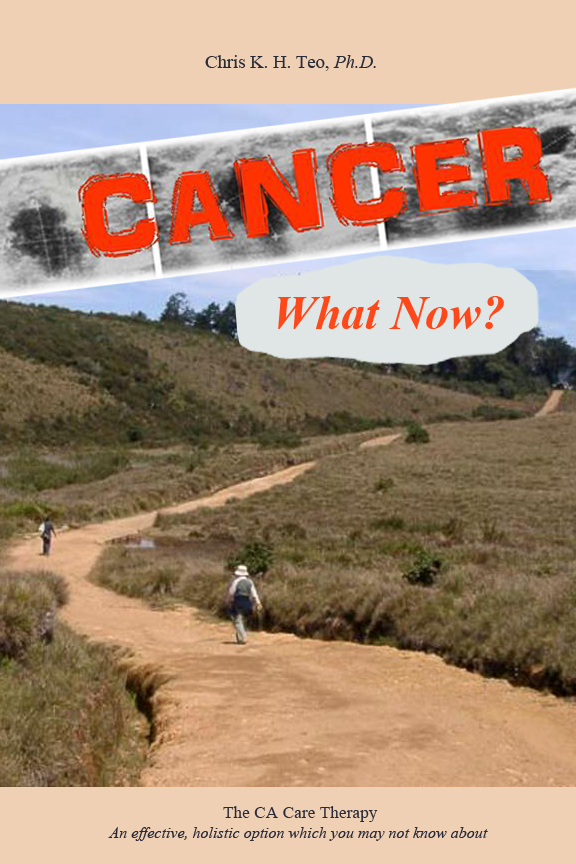
Comments: For those who have cancer and who know how to read, I strongly suggest that you read my recent book, Cancer – What Now?

Cover Front JPGIn this book I have discussed many topics that are important to you and your survival. Going for whatever treatment for your cancer is about you and your choice. Your life is in your hands.  When you get cancer, it is also about you. YOU, the person. It is not just about the tumour or the rising CEA, etc., etc.

I have written many articles trying to let you all know that shrinkage of tumour and decreasing of CEA are often meaningless. It makes you feel good for a few months and the cancer comes back again. Is this not what happened to the lady teacher above? PET scan said okay, all clear but soon something pop up again somewhere! More chemo again. When do you stop chemo?

In Chapter 3 of the book I talked about the types of patients who come to see us and their attitudes – wanting to find a magic cure when there is NONE. Of course, you can go for chemo, surgery, take this supplements and that supplements – beware of the empty promise! In Chapter 6, I wrote about the virtue of doing nothing!

I am aware that my way of dealing with cancer is rather non-conventional and against the commonly accepted norms. If you are following my writing in the websites, you will know that what we do in CA Care do help many patients. It is just whether you want to believe or not!

Look out for another story after this one. This is about a man with colon cancer who was at the point of death in the hospital and was asked to do chemo! His wife preferred to do nothing and brought him home in an ambulance! Like the Chinese say, if you have to die, die at home! This man remained alive at the point of time when I am writing this article.