This is an email from Linda (not her real name) received this morning: 1 March 2024 8:48 AM
Dear DR Chris,
Hi … How have you & wife been? It’s been almost 8 years since we last talk. First and foremost, the whole family would like to extend our greatest appreciation for your 5 Stars and tip top God-gifted abilities in dad’s NPC case.
The herbal decoction that was prescribed worked wonders. I remembered within a week of consumption, he’s able to slowly regained his strength & appetite. Believe it or not, he is still working till now! To which, I am glad to say that.
We have successfully achieved our main initial goal, that is “to live peacefully with his cancer.”
As of current, he is still facing the consequences of the side effects from the 13 sessions of radiotherapy that was done in 2017, i.e., weaken gum & loose tooth, hair thinning & he has not regained his sense of taste fully.
But thank God, from what I observe or physically see, there are no symptoms of an advancing cancer. He himself did not complaint of any discomfort, etc, which could be related to signs of an advancing cancer. I take it as good news.
In your opinion, do you think it is advisable to continue with the NPC 1 & NPC 2 or do you have any other ‘magic’ potions to recommend?
Again, thank you so much!! May God showers HIS countless blessings on you & family, and may HE bless you with happiness and rewards you for your kindness.
Thank you for your guidance & wisdom. As a Muslim, we believe in GOD’s plan, and meeting you is part of it.
Regards, Linda.
PS: Over the years and up till now, dad has been promoting your CA Care to his circle of clients & friends.
Within these 7 years, we met a number of our clients who are diagnosed with NPC just like dad. They completed the radio/chemotherapy treatment and within 1 year or so, without having a chance to fully recover from the side effects, they encountered a recurrence and sadly they succumbed to it. These experiences are really an eye opener. Wondering if the therapy kills the cancer first or the person receiving it?
May God bless us all with health & wealth. Looking forward to your reply.
The Story of Her Father
On Sat, Jun 10, 2017 at 3:00 AM, Linda wrote:
Dear DR Chris Teo,
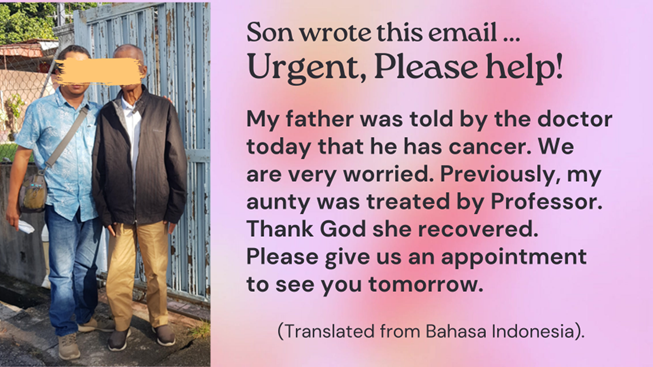
I apologize for writing without the benefit of an introduction, I am writing this email, with the hope that I can schedule an appointment with you, on behalf of my father who has been diagnosed with nose cancer (T2N1).
My father, ABA, 58 years old, has been diagnosed with nose cancer (T2N1) in February 2017 and was scheduled for 33 sessions of radiotherapy and 6 rounds of chemotherapy (4 hrs of cisplatin IV infusion), with an approximate total cost of SGD$9,700.
He declined the chemotherapy treatment (oncologists here are very persistent, we had to go thru a series of ‘debates’) but complied to radiotherapy treatments.
We were initially ensured of a total recovery. Doctor mentioned that only 30% suffered from mild side effects and seeing my father is young he is confident that my father will be able to spring back to life in seconds.
Little did we know that radiotherapy is just as bad. He is currently on his 13th session. The tormenting days started as early as day 2. He is unable to eat – maybe because of the many big ulcers, sudden chills, fever, nausea/vomiting and scalded skin. He is so weak.
And ever since radiotherapy, I noticed he started to develop tight congestive cough at night. As of now, he said he had loss his sense of taste and hearing to his right ear.
On 6 June 2017, during a scheduled consultation, we expressed our concern on his deteriorating health, and if there is anything that they can provide to aid him during this time, and they mentioned a list of medications in which they don’t recommended. Their only advice is to allow his antibody to fight it off naturally.
At the end of the day, we were only prescribed with a tin of Ensure Vanilla powder. Disappointed with their lack of concerned and couldn’t help feeling betrayed, that was when we finally decided to called it off and stop the radiotherapy treatment.
It has been more than 48 hours from his last radiotherapy session and he doesn’t seem to be getting any better.
Our family do believe in herbs but we have no knowledge on it. We sincerely hope you are willing to look into my father case. My father is eager to take all possible aggressive measures to combat this disease or at least to live peacefully with it.
We understand that this is one of many such requests that come across your desk and greatly appreciate any guidance that you can give. We lived in Singapore.
Thank you, in advance, for your help. I look forward to hearing from you at your earliest convenience.
Our Therapy Helped Him
On Wednesday, July 12, 2017, 3:47 AM.
Hi Dr Chris,
Hope all is well. The whole family would like to extend our greatest appreciation for your help, advices and herbs. Just like the pastor (link below), he is now strong enough to walk and work!
The swell on his right lymph node have totally disappeared.
Although his sense of taste has not recovered fully, but he’s eating now. Ulcers gone!
Phlegm/mucus isn’t that thick anymore.
No more congested cough throughout night. Amazing!
Initially we had to bring the tea to him, now he will be the one asking for it!
As you know, the team at Acquisition International have been carefully considering nominations for the eighth annual Business Excellence Awards. We would like to express our thanks to you for taking part. We have seen some truly outstanding companies get involved this year.
Following on from your recent nomination, it gives me great pleasure to inform you that CA Care Penang has been successful this year and has gone on to receive…
Medical Therapy Consultants of the Year 2024 – Malaysia
…in the Business Excellence Awards 2024!
How CA Care Penang Was Chosen
Following initial contact from our nominations team, you were included within our 2024 shortlist and progressed through to the research stage. To determine the results, the Acquisition International judging panel and research team consider the commitment, expertise, and innovation shown by nominees through nomination information, votes, any supporting evidence, along with the results from their own comprehensive fact-checking and research process. Our merit-driven approach has brought us much success and commendation throughout its use and enforces our stance that victors are not determined by popularity of votes, but by their contributions!
Rina (not her real name) was a 30-year-old lady from Indonesia. She led a healthy life except that she was told there was one or two cysts in her uterus. She had the following problems during her menses.
She had pain about 3 days before her menses and the pain persisted until 2 days after the menses started.
It was a pulling pain.
Before menses she had pain in her back and breasts.
Before menses she suffered from mood swings.
Before menses she likes to eat sour food.
But it was not to be. In August 2023, Rina had a laparoscopic surgery in a private hospital in Jakarta. The histopathology report confirmed:
Salphingitis – inflammation of the left and right fallopian tubes.
Leioyonma (also referred to as fibroids or myomas).
The medical treatment cost Rina IDR 200 million or about RM61,000.
In December 2023, Rina underwent 3 cycles of chemotherapy. Unfortunately, she did not know the drugs used on her. After chemotherapy, Rina was given Pamorelin injection, once a month for 3 months. Since her wellbeing was going downhill, Rina decided to stop further medical treatment.
Did the above treatment “cure” or help Rina?
Unfortunately, the answer is a big NO. That is why Rina decided to come and seek our help. Rina and her sister said each day life was “hell” for her. This happened after the completion of chemotherapy. She suffered:
Pain on and off. She had to take pain killer medications.
Once a while she had “wind” or gas in her stomach.
She was not able to sleep.
She felt tired all the time.
Her appetite was very poor.
Her urination was 5 to 6 times per night.
When I met her, Rina presented as a desperate and frustrated lady. This could be “seen” from her facial expression. She told me that there was constant pain in her uterus.
In spite of the medical treatments, there was blood discharge for 1 to 2 days, then there was pain, then there was blood discharge again.
The pain was intense during the night or early morning. When asked to rate her health condition on a scale of 0 to 10, Rina said it was 10 – real hell that she had to go through each day.
I prescribed her some herbs to take care of her uterus, fibroid, PMS, gassy stomach and frequent urination.
The next day Rina texted me saying that her problems improved after taking the herb for only ONE day!
After taking the herbal tea, I felt sleepy.
Even though I felt sleepy, I have more energy.
Pain in the uterus was less.
Abdominal pain is totally gone!
Urination frequency at night was reduced!
One month after the herbs.
Rina and her elder sister came back to Penang again. It was amazing to learn that Rina had recovered – no more hell! See the video below;
Her sister said: Before she on herbs, she would call me very often and complained about all problems that she had. Now she is far, far better – her problems almost gone.
Rina regained her health and was back to normal again.
Problems
Before the herbs
One month after taking the herbs
Pain
Rated at 10 (scale of 0-10)
Gone!
Stomach gas / wind
Discomfort on and off
Improved
Unable to sleep
Slept at 4 or 5 a.m. woke up after a few hours
Slept at 10 or 11 p.m. and woke up at 7, 8 or 9 a.m.
Appetite
Very poor
Appetite normal
Frequent urination
5 x per night
2 x per night
No energy
Preferred to stay home
Like to go out and be on the move
Comments
I spent some time trying to understand the reason for her menses problem. After some questions, it appears to me that Rina suffered from PMS (premenstrual syndrome).
Over the years, I have helped many ladies with PMS. This can be easily solved by taking our PMS herbs for a month or two.
With her problems, Rina went to a private hospital for surgery. This baffles me! Does Rina really need surgery for her problems? Can this be solved by a much less invasive and cheaper way?
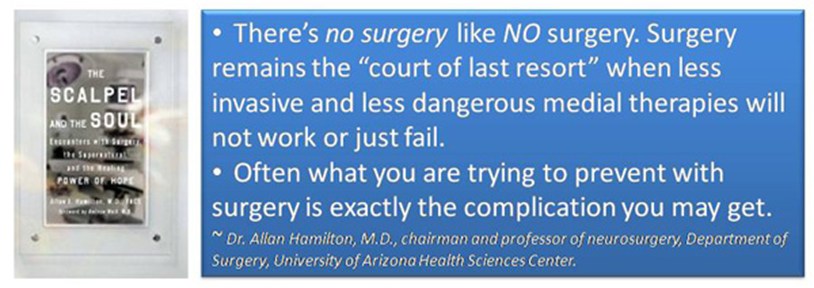
Please reflect on the quotations below:
Even more baffling is that Rina had to undergo chemotherapy! Based on the histology report, Rina did not have any cancer. Why does she need chemotherapy? Is this just a case of prevention stretched a bit too far? Rina suffered from inflammation of the left and right fallopian tubes. Surgery was done to take care of that. Did she really need chemotherapy for her inflamed fallopian tubes which have been removed? Where is the science in that?
After 3 cycles of chemotherapy, Rina underwent hormonal treatment with Pamorelin. This is even more baffling. Why Pamorelin? From the internet, I learned that Pamorelin is used to treat prostate cancer! Prostate cancer drug on the lady? A lady can have prostate cancer? Does it sound right or scientifice?
Oh, no – Pamorelin is also used to treat endometriosis in women. That is what scientific medicine say? You buy that? Say what you like, the medical report never mention that Rina suffered from endometriosis anyway! She has fibroid.
It looks like Rina has be overtreated. Is this not the reason why Rina suffered badly after her chemotherapy?
Since I am not able to know the name of the chemo drugs used, I am not able to speculate why Rina suffered so badly. But for Pamorelin, the main side effects of this drug are: hot flushes, night sweating, vaginal dryness, headache, dizziness and nausea, to name just a few!
My final comment.
Ladies, it is your life. Decide carefully before you allow anyone to use the knife and toxic drugs on you. These may not be the answer to your problem.
During this Chinese New Year 2024 – the year of the Dragon! – I had the opportunity to read two books The Red Light Therapy and The Cancer Industry – Crimes, Conspiracy and the Death of My Mother. Both of them were written by Mark Sloan of Ontario, Canada.
Mark’s mother had cervical cancer. She died after surgery, radiotherapy and chemotherapy. Mark wrote:
(This) happened when I was 12 years old. My father called a family meeting in the living room and sat my sister and I down on the couch. We had no idea what he was about to tell us but he looked upset … and I knew at that moment something was terribly wrong.
Dad told us that our mom had cancer.
Doctors found a cancerous lesion on her cervix about the size of a baby fingernail. Dad told us they had detected it early and were going to rush her in for surgery followed by radiotherapy to ensure the cancer wouldn’t return. He assured us that treating her quickly would give her the best chance of survival, and we’ve got the best doctors in Canada working on her.
After surgery and radiotherapy …
Six difficult months passed … back into the hospital for re-assessment. The cancer had spread to her hip area and they wanted to do chemotherapy.
The dramatic decline in her health immediately following chemotherapy was disturbing. Within days of her first treatment, her legs swelled up so badly that she could no longer walk. The poison injected into her veins reduced her jaw muscles to scar tissue so she could barely open her mouth to talk. Chewing food was out of the question so she was reduced to a liquid diet and we began bringing her smoothies.
My mom was able to return home shortly after chemotherapy treatments but her return wasn’t at all glorious like I had imagined. I remember laying in bed late at night and hearing her downstairs crying in excruciating pain. My mother went from looking like a healthy middle-aged woman to something approximating a prisoner of war who had been captured and tortured by the enemy.
The confusion began to set in and then quickly turned to anger: Why was my mother in pain? I thought we had some of the best doctors working on her giving her the best treatments available. She was supposed to get healthy but the treatments have made her worse!!!
A couple months later…
When I got downstairs, Dad was a mess; unable to hold back his tears and struggling to speak.
Dad told us that our mom was gone.
Time to Ponder and Ask Questions
Cancer – surgery, radiotherapy and / or chemotherapy, etc. The patient died. Does this happen often to cancer patients? Unfortunately, the answer could be yes or most likely.
For the following questions, I shall not answer the questions posed but rather quote what Mark Sloan wrote in his books.
2. Can medical treatments cure cancer? This is what Mark wrote (pg. 44) in the Red Light Therapy:
It’s been almost 50 years since the war on cancer has been declared and yet more people are diagnosed and dying of the disease than ever before.
If you give somebody 50 years and around $500 billion dollars in research money to find a cure for cancer and they literally come up with nothing, what do you do? You fire them and find a new approach.
Yes. Many people are being fed with the propaganda that cure is just around the corner! Really?
3. Why can’t they find a cure?
Mark wrote on page 45 of his book:
An industry that makes $126 billion dollars a year will never give us answers, if these answers would mean putting itself out of business.
It is up to us as individuals to understand what cancer is, and the most efficient ways to remedy it.
4. What can be the reality of today’s medical treatments for cancer?
Mark wrote on page 45/46
We’ve all seen at least somebody in our lives undergo surgery, chemotherapy and radiotherapy and then come out far worse than before. I saw it happen to my mother when I was 12 years old. As soon as she received chemotherapy, it was like she got hit by a truck. Instead of recovery, she died a few months later, and every moment from chemotherapy to death was spent in agony.
It is common sense that cutting a sick person with a knife, injecting poison into their bodies, and burning them with ionizing radiation will make their health worse.
It is time to learn from history and take action instead of ignoring it.
5. After much reading, did Mark learn anything?
In his book The Cancer Industry – Crimes, Conspiracy and the Death of My Mother (page 107), this is what he said:
When human being is sick with cancer, they deserve the absolute safest and most effective medicines known.
Yet in this world, cancer patients are routinely rushed into oncology centers where doctors sentence them to death using treatments that make industrial animal slaughterhouse look humane.
My mother didn’t die of cancer. She was murdered-for-profit by an industry that cares more about making money than saving lives.
The monstrous $126 billion dollar cancer industry, hell bent on preserving its profits at any cost, continues its murderous rampage to this day.
The above is Mark’s view. This is what he had learned. You may not agree with him. This is your right.
Let me end by quoting what Dr. Richard Smith said below. Dr. Smith worked at the British Medical Journal for 25 years, serving as editor in chief of the BMJ. Don’t you think he knew “something” that you and I do not know?
The Author: Professor Christopher Cheng is the CEO of Sengkang General Hospital and Senior Consultant Urologist at SGH and Singapore General Hospital. He is a pioneer in using robotics in prostate cancer surgery.
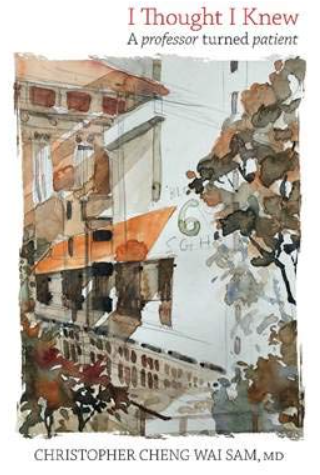
I thought I knew about prostate cancer … I have done countless … cancer operation for the prostate. I thought I knew… until I became a patient myself, lying on a cold operating table one Saturday morning in December 2017.
The reality is cancer can hit anyone.
The naked truth of what I went through may be shocking to some who have been led to believe erroneously, that modern healthcare, will all its glamorous robots and high-tech equipment, has a solution to almost anything.
Not all prostate cancers need to be cured or even treated and not all cancers that need treatment can be cured.
The treatment should not be worse than the disease itself and often more treatment is not necessarily the answer.
There are many both young and old who … believe that when the time comes, they can just check into the hospital and have everything fixed.
We will take care of you, but you must take care of yourself too.
(Doctors should) provide guidance and gentle nudges and support rather than coercion in their (patients) decision making … they are the ones who are on the operating table, they are the ones who have to live with the consequences.
After reading this article, I became more curious and wanted to know more about who Professor Cheng is, and more importantly to learn from him what it is like to be a prostate cancer patient when he himself is an expert of prostate cancer.
Let me share with you what I have learned from the above two articles. To let you know, I did not stop at that – I ordered the book I Thought I Knew written by Prof Cheng himself. I read the book. Later I shall write again, Part 2!
Prof Cheng, CEO of Sengkang Health and Senior Consultant, Department of Urology, Singapore General Hospital wrote:
Some time ago, I bade farewell to a good friend. I have operated on him to cure his cancer barely three months earlier, but his condition still progressed rapidly.
This friend eventually died. Before his death, this friend told Prof. Cheng:
Don’t let me suffer pain and I won’t want more chemotherapy.
Prof Cheng quoted what Willet Whitmore – another prostate cancer expert at the Memorial Sloan-Kettering Cancer Center – said:
Is cure necessary in those for whom it is possible, and is cure possible in those for whom it is necessary?
According to Prof Cheng:
For a large range of cancers, cure may be necessary but not possible, as in the case of my friend.
For the rest, cure is unnecessary, even though it is possible.
We should question if more medicine is better.
So, cancer patients, ponder carefully and seriously what Prof Cheng said.
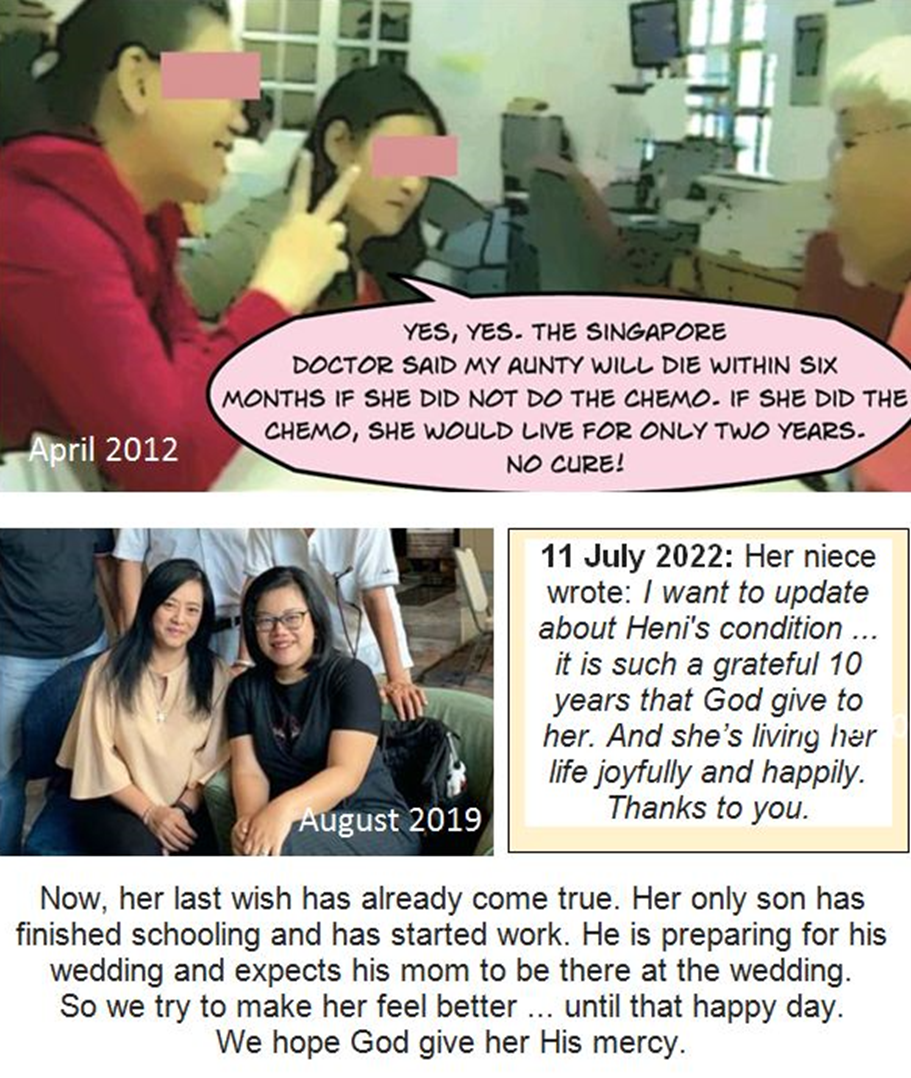
This is one reality that everyone of us need to know and accept – cure may be unnecessary, or cure may not be possible. I am reminded of a friend, Steve – a British engineer who chose to settle down in Bangkok. He too had prostate cancer. He went to Singapore and was put on Intermittent Triple Androgen Blockage Therapy. He then gave up this medical treatment and opted for alternative therapy. That was when he wrote to me for help. Diagnosed with prostate cancer in 2007 at the age of 63, Steve was till okay until 2023 (16 years without doctor’s medication).
In 2023, Steve had a swelling in his cheek. It was diagnosed as parotid cancer. He wrote me and asked for help again. He took our herbs for about three months, but the tumour did not go away. He was okay but had occasional pain. But every morning when Steve woke up, he looked into the mirror and felt (or imagined) that the tumour was getting bigger and bigger. Then Steve wrote that he had found “the best doctor in the best hospital with the best equipment” in Bangkok who could remove the tumour and make him live longer! Anyway, according to Steve, our herbal therapy is not a scientifically proven therapy! I fully agreed with Steve. So I told Steve: Go ahead and follow what your heart says. He went for surgery, suffered badly after that, and died 3 months 13 days later.
The Prostate Intervention Versus Observation Trust (PIVOT), led by Timothy Wilt, started in 1993 and analysed 731 patients over 12 years. The study compared surgically removing the prostate gland with ‘watchful waiting’.
The study found that there was little difference between the two.
Those who had an operation to treat the cancer had less than three per cent chance of survival compared with those who had no treatment.
Surgery has little or no benefit in extending the life of a patient.
Experts are believed to be ‘shaken’ by the news because thousands of men could have gone through painful and unnecessary surgery.
From the article Doctor diagnosed with advanced prostate cancer learns lessons on death, dying and compassion, written by Eveline Gan on 5 August 2023, I learned more interesting lessons from Prof Cheng:
I was this arrogant, impatient young surgeon, thinking I’m a godsend for mankind — until I became afflicted with prostate cancer, an area I’m supposed specialise in.
We are all human. All of us have our ego. It is only a matter of degree. Most cancer patients told me that if they asked the doctors too many questions, the doctors would become angry at them. Some doctors reacted this way – You are the doctor, or I am the doctor – meaning, if you don’t listen to my advice get out of my office! One patient once told me the oncologist just threw away my file against the wall because I did not agree with him.
Since not many cancer experts themselves get cancer, it appears that it is hard for them to understand what it is like to be a cancer patient. So, in this case Prof Cheng is an exemption. And he shared his experiences and feelings. Bravo! Thanks.
Over the years, at CA Care, I have adopted an open attitude when dealing with cancer patients – we are here to help those who need our help. We hope to make your life better after all medical treatments have failed. The language of love and compassion is not about trying to prove who is right or who is wrong. It is about recognizing limitations and exploring opportunities. What matters is our patients should get better.
Hidden Agenda.
Prof Cheng’s PSA was at 17.8 when he was first diagnosed with prostate cancer. He said:
In some (overseas) centres, if you have prostate cancer with a PSA of 17, the top surgeons will not operate on you because it would tarnish their results.
Prof Cheng explained further that some famous centres do not offer potentially curative treatment to patients with a PSA of more than 10, because poor outcomes may affect their reputations unfavourably.
This is a most shocking, a new knowledge that I have learned! It never occurred to me that in medicine there is such a “hidden agenda” as this – that is, certain medical experts would not offer treatment just to preserve their reputation. They want to pick and choose – only cases that they are sure they can win only! Is that a noble mission?
Over the years, I have been writing about experts giving all sorts of treatment just to “make money” – never mind if the outcome is unattainable. Professor Welch describes such attitude as You eat what you kill!
Over the years, I have seen many prostate patients. It never occurred to me that PSA 17.8 is very alarming, although it may mean the patient has cancer. Many patients who came to us had PSA of 531, and in some cases their PSA was even at 6,963 or 7,292. It never occurred to me that 17.8 is already a disaster! Another new lesson learned.
No to “kitchen-sink” treatment after surgery.
After his prostate cancer surgery, Prof Cheng said the oncologist proposed an “all-in kitchen sink” approach to treatment. In my twenty-seven years dealing with cancer, this is the first time I encountered this word – kitchen sink treatment! In layman language it means going for maximum treatment available.
Indeed, I was surprised and baffled at what Prof Cheng said:
I didn’t want an all-out treatment that would most likely give me many side effects.
I don’t think that being at the receiving end of the kitchen sink is going to make me any happier.
In other word, Prof Cheng did not want to undergo chemotherapy! Perhaps we need to recall what he had said earlier: In cancer, cure is unnecessary, or cure may not be possible. Unfortunately, not many patients buy this idea. They believe that with money they can go to the best doctor in the best hospital, and they can “buy” their cure! No, the reality is you may end up in a more dire situation – money gone and the patient died a miserable death.
While writing this article, I received an e-mail from the daughter to a prostate cancer patient.
Hi Dr Chris,
My Dad is suffering prostate cancer Stage 4. It had spread to bone, liver and some other area. He is 77.5 years old. He had received:
Hormone therapy
Chemotherapy
Lutetium LU 177
But his cancer is still spreading.
My Dad is a bit weak now, he lost his appetite and is also anaemic. Thank you so much Dr Chris, hope to hear some good news from you soon!
From the medical report, I came to understand that:
In 2016 he had radical radiotherapy and adjuvant ADT (androgen deprivation therapy).
PSA went down to 0.5.
On ADT throughout except a period in 2020.
In early 2021 his PSA rebounded. Recommenced ADT with brief response.
Later in April 2022 Casodex was added to the treatment.
No PSA response.
In June 2022, he took Daroltamide.
In August 2022: Suboptimal response to Darolutaminde.
In December 2022 his PSA was at 27. Right inguinal node at least 3 cm.
21 December 2022: Underwent chemo with Docetaxel.
Carboplatin added to Docetaxel in C3, as PSA was not dropping much initially.
PET scan post C6: Mixed response with one new spine metastasis.
By C9, PSA trending upwards from 16.3 to 16.8 to 17.9.
6 June 2023: Started on lutetium 177. PSA 15.0
20 July 2023: Legs showed DVT (swollen below the knee due to deep vein thrombosis).
1 September 2023: C2 luteteum. PSA rose to 43 (this is 8 weeks post C1 letuteum).
11 September 2023: PSA decreased to 38.
Creatinine rose from 108 to 150.
13 September 2023: Repeat PET scan metastasis in multiple nodes and other parts of the bones.
The daughter wrote: After that he went to China and received radioactive particle seed, and one cycle of chemo using mitoxantrone.
Question: Did the patient get any better after spending a bomb for these treatments? What was the total cost of the treatment? I did not have a chance to ask this question because the daughter did not turn up for her appointment!.
The blood test results on 30 November 2023 showed the following:
PSA = 249.90
SGOT/AST = 82 (normal less than 40)
Gamma-GT = 436 (normal less than 71)
Alkaline phosphatase = 513 (normal 40 – 129)
Creatinine = 2.69 (normal 0.67 – 1.17)
eGFR = 23.64 (less than 15 means kidney failure).
According to the doctor the patient has progressing mCRPC (failed NHA, chemotherapy and more recently lutetium) complicated by left hydronephrosis … causing new renal impairment. He has new PSMA avid liver lesions. He may also need early radiotherapy to the left pelvic node and posterior iliac bones.
One more important question to ask: If he is your father, who is already 77 plus years old, would you agree to let him go for more treatment? What do you expect to get at the end of the game?
Cancer: Fight it or Live with It, Your Choice!
We recognize that our work at CA Care is at odd with current medical thinking. Modern medicine wants to kill or shrink the tumour. And in the process kill the patients too. In The War on Cancer – an anatomy of failure; Dr. Guy Faguet, a cancer researcher, and medical doctor, wrote:
An objective analysis of cancer chemotherapy outcomes over the last three decades reveals that … the cell-killing paradigm has failed to achieve its objective … a model based on flawed premises with unattainable goal, cytotoxic chemotherapy in its present form will neither eradicate cancer nor alleviate suffering” (pg.89).
At CA Care we teach patients to live with their cancers. Concentrate on what matters. We don’t know how to cure your cancer and we don’t pretend we can cure your cancer either. But we know how to make your life better. If you can eat, sleep, walk, have no pains, and can live a bit longer of meaningful life – what else do you want?
Prof Cheng reminded us:
However rich, however powerful (they) are, they’ve all had to face death eventually. They all have to let go,
The difference, however, lies in how one faces death.
Death is Not a Failure
At CA Care we tell our patients not to fear death. Everyone has to die. You don’t have to have cancer to die. I have seen many cases where the cancer patient did not die but it was the healthy spouse who died first.
Dr. Bernie Siegel wrote:
I experienced being unhappy as a doctor. I was uncomfortable with the mechanical approach that we are taught in medical school. My success is measured by whether or not I saved your life. If I can’t save your life, I’m a failure. But now I don’t feel like a failure. I can help you live. After all you’re not going to live forever, no matter what I do.
There is an Indian saying:
When you are born, you cried and the world rejoiced. Live your life in such a manner that when you die, the world cries and you rejoice.
To me, this is the secret of how we can triumph and give meaning and beauty to our own death. We leave this world with a sense of pride and accomplishment knowing that we have done our best to make it a slightly better place for those we leave behind.
Richard Reoch (in Dying Well) wrote:
People who have lived fully are not usually afraid to die. We must all die. Death is, after all, the natural end of life. Yet some people fear death.
We often make the mistake of trying to keep a dying person alive as long as possible, no matter what the cost.
There are many occasions when the kindest thing to do is not to hunt for “better medicine” or a “better doctor” but to be close to and supporting the person who is dying. Let them know that you are glad for all the time, the joy and sorrow you have shared … In the last hours, love and acceptance will do far more good than medicine.
Dr. Bernie Siegel (in Peace, Love & Healing) said:
It is important that we realize that we can never cure everything. We will never find … cure for all the diseases. Dying can be a healing, ending a full, rich life for someone who is tired and sore and in need of rest.
The doctors went to war with Linda’s cancer. All Interested Parties involved won the game. Linda was the only unfortunate loser or victim. Let us not blame anybody for that is the way the world operates!
When Linda’s daughter came to consult me, she brought a pile of documents. It took me more than a whole day to sort them out and figure out what was going on. There are many lessons we (YOU and ME) can learn from Linda’s unfortunately experience.
First, let me pose one question:
If you have a similar problem like Linda, would you take the same route – go through the same process? Do exactly what she did?
My guess is most patients would opt to take the same road! After all Linda went to one of the best hospitals in the country. The doctors were supposed to be good and competent, etc., etc. Some people would say: What other choice do I have? I can’t go to the herbalists or alternative practitioners. I can’t trust them. They may just turn out to be quacks who are only after my money. Medical treatment is the best choice.
Sure, I understand you. I don’t wish to challenge your belief. I always remind myself: Make your own decision and bear the consequences of that decision. It is your body and your life.
When talking to Linda’s daughter, the impression I got was that the family was ignorant. They just followed whatever the doctors advised them. They followed the easy and simple belief that doctors know best. There is no need to ask too many questions. Why make life more difficult? No need to think, no need to ask questions – after all doctors can solve all of our medical problems.
I posed these questions to Linda’s daughter.
Before undergoing the surgery in Hospital A, did you ask the surgeon if the procedure is going to cure your mother? Her reply: Doctor said there is a 60% chance.
Before undergoing chemotherapy after the surgery, did you ask the oncologist if chemo is going to cure your mother? Same answer: There is a 60% chance.
After 13 cycles of chemotherapy failed and the cancer recurred, did you ask the oncologist why the treatment failed? Her reply: The oncologist said continue with the chemotherapy! Yes. Linda did exactly that except that she shifted to Hospital B for more of the same treatment!
Pre-surgery treatment. Linda was given radiation and TS One before undergoing surgery. This seems to be the standard protocol when a patient presented with a big tumour. Is this a good procedure? Well, it all depends on who answers this question! For the 25 cycles of radiation and a month supply of TS One, the family had to spend RM40,000.
Did the pre-surgery treatment shrink the tumour? Yes, but by just a bit only. Did it make any difference? I cannot answer that. But one thing is of great concern. According to Linda’s daughter, her mother suffered from the treatment.
Looking at the whole picture. Did the pre-surgery chemo-radiation and subsequentsurgery cure Linda? The answer is NO. Linda had to go for another 13 cycles of chemotherapy. Fortunately, Linda did not suffer any serious side effects.
Did chemotherapy cure Linda? Again, the answer is NO. The tumour grew bigger! What did the doctor say? The oncologist did not admit defeat! Go for more chemotherapy! This means, go on fighting and fighting – when will that stop?
Linda decided to go to another doctor in another hospital. So, all in all the whole treatment in Hospital A is a failure.
The oncologist said do more chemo. But whatever for? What do you expect to achieve? Thus far, one achievement was that the whole health insurance coverage was wiped out – about RM150,000 gone!
Let us look at what Linda received for her treatment.
TS-One – oral chemo for a month.
Xeloda + oxaliplatin – four cycles.
Avastin + Xeloda + irinotecan – nine cycles.
Avastin + oxaliplatin – one cycle.
The first three regimen of chemo failed. Do you think the fourth regimen is going to do any good? Linda had already received Avastin and oxaliplatin before. Does it make sense at all to give her the same drugs again? I understand it is just a different combinations.
FALSE IMPRESSION OF SUCCESS
When Linda was started on chemo-radiation before the surgery, the tumour did shrink. This gave everyone a good feeling that everything is going to be okay, right? The treatment worked. The oncologist was great! Bravo.
The surgery was done and it was a success! Another good feeling. Great surgeon! But some months down the road, the surgery turned out to be a failure. The cancer recurred and Linda had to undergo a second surgery in another hospital.
The first round of chemotherapy with Xeloda + oxaliplatin was a failure. No problems, change drugs and try again.
The drugs for the second round of chemo were: Avastin + Xeloda + irinotecan. The initial response to this new drug combination was great! Many tumours shrunk and some even disappeared. Linda did not suffer serious side effects. It appeared that Linda was on the right track. Everyone was probably hoping that the tumours will all eventually disappear. Let’s chase the rainbow – that “pot of gold” is within reach.
Unfortunately, it was not a happy ending. The tumour that shrunk earlier grew back again! This time bigger in size.
I can clearly say this. Such above experience is not uncommon. Over the years, I have cases after cases of similar false impression of success.
Linda (not her real name) was 57 years old when she had altered bowel habits. There was blood in her stools. She consulted a GP in her hometown who eventually told her to see a specialist in a hospital.
Linda eventually ended up in a well known Hospital A in Kuala Lumpur, where she received her initial treatment.
DIAGNOSIS
1a) A colonoscopy was done. The doctor was unable to get the scope to pass beyond the tumour.
1b) A biopsy confirmed rectal cancer – moderately differentiated adenocarcinoma.
1c) A PET scan indicated that the cancer had spread to the uterine wall, lymph nodes and probably lung.
CHEMO-RADIATION BEFORE SURGERY
Linda underwent concurrent chemo-radiotherapy. The aim of this treatment is to shrink the tumour before surgery is carried out.
Linda received 25 cycles of radiation and at the same time took TS-One everyday for one month while undergoing radiotherapy.
Outcome. Bravo! Good results. As expected, the tumour shrunk.
SURGERY
Linda underwent a surgery to remove the tumour. The procedure is known as Hartmann’s procedure plus TAHBSO) at Hospital A.
Histopathology indicated 7 out of 11 nodes removed were infected with cancer.
Lianda was fitted with a colostomy bag which she has to wear for the rest of her life.
CHEMOTHERAPY AFTER SURGERY AT HOSPITAL A
4a. Chemo Round 1: Linda received 4 cycles of chemotherapy using Xelox regimen (Xeloda + oxaliplatin).
Outcome: Unfortunately, the treatment failed.
4b. Chemo Round 2: The chemo drugs used were changed. Linda received 9 cycles of Avastn + Xeliri regimen (Xeloda + irinotecan).
Outcome: Good chance – there is hope! Let’s chase the rainbow.
Wait .. not so fast!
Unfortunately, this good news did not last long. Barely 4 months later, PET scan showed disease progress. This second round of chemo post-surgery also failed.
WHAT TO DO NEXT?
The oncologist in Hospital A said do more chemo! The family had lost confidence with the doctors in Hospital A. Linda was moved to Hospital B, an equally famous hospital in Kuala Lumpur, for further treatment.
SECOND SURGERY AT HOSPITAL B
Linda underwent a second surgery in Hospital B. This involved the removal of the vaginal stump and small intestine (jejunum and ileum).
Histopathology report confirmed a moderately differentiated adenocarcinoma. Two lymph nodes were examined and were found to be infected with cancer.
MORE CHEMOTHERAPY AT HOSPITAL B
Linda received 1 cycle of chemotherapy at Hospital B. The drug used were: Avastin + oxaliplatin.
Bad news: Linda suffered severe side effects of chemotherapy and was reluctant to proceed further.
CA Care
It was at this end game that I received an email from Linda’s daughter asking for help. The daughter wanted to try our herbs instead of continuing with chemotherapy. Unfortunately, Linda was not able to drink (or tolerate) our herbal teas.
Empower yourself.Knowledge is power goes a saying and I truly believe this is true. So, I advise you to read and ask questions. Seek knowledge so that you understand your illness. Research has shown that those who feel hopeless, helpless and accept their fate lying down survive poorly. I tell cancer patients to stand up and live! Do not just be contented to remain at the bottom of the pile with the following mentality: My doctor says this and my doctor says that. You will end up following everything that he says. I am not asking you to defy your doctor’s instructions but I also know that you may be led by the nose without having a clue about what is going on. It may not always be good for you.
Re-evaluate your strategy.In my books, I have written about gut feelings and common sense. Body-mind healers advocate the use of intuition or the 6th sense when making important decisions in life. I have come to realise that not all decisions made based on scientific data are wise or correct in many of life’s situations. Statistics and data can be deceptive, cold, dead and insensitive to human feelings. I advocate the use of simple common sense. For example, ask yourself if the treatment that you are undergoing is bringing you anywhere. Is it benefiting you or killing you?
Of course, when you go for any invasive treatment, your hope is to achieve a cure. Ask your doctor if there is such a thing as a cure for your condition. Some patients are given chemotherapy just for palliative reasons, not cure. The treatment is supposed to make your life better or more bearable. Re-evaluate that strategy and determine if that is what you want.
Dr. Jeffry Tobias (in Cancer) wrote:
…one important decision …. when to say no more.
Indeed, it is wise to know when to withdraw and to say enough is enough, if and when the treatment is spinning you in a circle.
There was one lung cancer patient who came and told me that his oncologist spent only half a minute with him every time he went for his chemotherapy. My advice to him was: Find another oncologist who can be more caring and who could give you more of his time and expertise. How much can a half-a-minute doctor help you? Can you expect such a busy-and-no-time doctor to save your life? Evaluate my comments and make your own decisions about all these issues. Sometimes what it takes is only common sense to save your life.
Make wise decisions.Gurdjieff said:
·The wise man is not educated and the educated man is not wise.
Yes, you don’t need to be educated to be wise. To enable you to make wise decisions, you need to be aware of the following:
·Do not make decisions based on or out of fear.
·If possible, before you make any important decision, seek more information, from different sources and viewpoints.
·Weigh out the options, both pros and cons. Do not simply see the good side of things only. Take into account the worst possible scenario as well.
·Connect with your Inner Self. Seek out your intuition, common sense or gut feelings. Take time to be alone, to be silent. Relax and let the Inner Voice within you speak to you. If you are too busy or preoccupied with other things, you cannot hear your own Inner Voice.
·Arrive at a decision that you can live with. It is your body – it is your liver or your breast that is to be cut off. Ask yourself if you can live with that decision. It is your life that is at stake. Doctors and other people can only help but you are the one who suffers the brunt of whatever is done to you.
·Once a decision is made, stay on course. Then, re-evaluate your strategy if it harms you.
Trust and flow – easy does it!Dr. Joseph Murphy (in The Power of Your Subconscious Mind) said:
According to your belief, it is done unto you.
The causes of failures in healing are mental coercion, lack of confidence, doubt and hesitation. All these reflect negative attitudes. If you come with the main goal of going all out for cure, chances are that you will fail to get one. In your intense desire to cure yourself, you can become very tense and may not have peace of mind. Have you ever experienced a time when you are trying very hard to crack and solve a problem? Your mind comes to a dead end.
Try to take it easy. Relax and go to sleep. When you wake up the next morning, things will look easier and you will get to solve your problem in no time. This is because the subconscious mind does not respond to mental coercion.
You do not have to teach your body how to heal itself. It is intelligent enough and wise enough to know how to heal itself. Relax and let the body do its job without your unnecessary interference. Ask and pray for good health and you get just that. Again, I say, take it easy.
Forgive and let go.Negative thoughts such as hurtful memories, bitterness, hatred, anger, etc., beget negative reactions and they block the free flow of life. Let your life be expressed in terms of love, forgiveness, sharing, caring, harmony, peace, beauty and abundance.
By loving and forgiving yourself and others you let go of your negative emotions and this is the first step and necessary ingredient of healing.
Just google this: Death by medical error in US. This is what you get.
Medical errors may account for as many as 251,000 deaths annually in the United States, making medical error the third leading cause of death.
Error rates are significantly higher in the U.S. than in other developed countries such as Canada, Australia, New Zealand, Germany and the United Kingdom (https://pubmed.ncbi.nlm.nih.gov/28186008/).
Medical errors – these are preventable adverse effects resulting from medical care rather than the patient’s condition. We’d like to think they don’t happen.
These issues aren’t new; the first major report on medical errors in the US is from over 2 decades ago. In 1999, To Err is Human from the Institution of Medicine estimated 98,000 deaths due to error. At the time, this would be the 6th leading cause of death in the country.
A study in 2010 found that this number had almost doubled to 180,000 deaths. And by 2013, the estimate ranged from 210,000 to 440,000 deaths per year. This landed medical errors as the 3rd leading cause of death trailing heart disease and cancer.
Light, professor of comparative health policy at Rowan University School of Osteopathic Medicine in Stratford, New Jersey said:
About 2,460 people per week are estimated to die from drugs that were properly prescribed, and that’s based on detailed chart reviews of hospitalized patients.
The estimate, which didn’t include those who died as a result of prescribing errors, overdose and self-medication, would make taking properly prescribed drugs the 4th leading cause of death in the U.S.
FDA approved Vioxx in 1999 as a painkiller. It was being extensively used and prescribed to patients who needed it. Vioxx was later shown to be deadly, causing heart attacks and strokes.
November 2007: Merck announces it will pay $4.85 billion to end thousands of lawsuits over its painkiller Vioxx. The amount … is believed to be the largest drug settlement ever.
To obtain FDA approval, Purdue had to demonstrate that OxyContin was safe and was as effective as other pain drugs on the market.
The FDA approved the application in 1995.
Many doctors began prescribing OxyContin. Doctors wrote 5.4 million prescriptions for the painkiller in 2014. OxyContin became America’s bestselling painkiller, and Purdue reaped $31 billion in revenue.
Rates of addiction and overdose soared alongside the rise in prescriptions.
The U.S. Justice Dept. launched a criminal investigation, and in 2007 the company and 3 top executives pleaded guilty to fraud for downplaying OxyContin’s risk of addiction. Purdue and the executives were ordered to pay $635 million.
The drug is widely blamed for setting off the nation’s prescription opioid epidemic, which has claimed more than 190,000 lives from overdoses involving OxyContin and other painkillers since 1999.
Many years ago, Vioxx was commonly prescribed to cancer patients. Now, this drug has disappeared from the market. What about OxyContin? That too is slowly going off the list although at times, I do know that some patients are still being prescribed with this drug.
But what came as a shock to me is Zantac, a commonly prescribed drug used to prevent and treat heartburn and other symptoms caused by too much acid in the stomach (acid indigestion). Many cancer patients suffer from this problem and they are given Zantac for the problem (even today as I am writing this article).
The chemical name of Zantac is ranitidine hydrochloride.
According to the authors, the British drug company Glaxo said that Zantac does not cause tumours. But the company’s own scientist and independent researchers said this commonly prescribed drug can cause cancer. This fact had been suppressed or kept away from the public for 40 years!
After reading the article I asked myself – It is for real? Or is it just another fake news?
The article went on to say:
This small British company was sometimes called Glaxo University. It conducted important pharmaceutical research that rarely resulted in profitable drugs. Then the scientists at Glaxo Laboratories created a molecule they called ranitidine
This drug is used to heal ulcers and also used to treat heartburn. They developed ranitidine quickly, and the US Food and Drug Administration reviewed it quickly. Glaxo gave it the brand name Zantac.
In 1978 the company was granted a US patent.
For years, Glaxo counted on Zantac for nearly half of its sales and almost as much of its profit. Zantac created reputations and fortunes.
In 2019 the drug was found to be tainted with high levels of a probable carcinogen called NDMA (N-Nitrosodimethylamine).
NDMA, is a yellow liquid that dissolves in water. It doesn’t have an odor or much of a taste. It was first linked to cancer in 1956 and is most toxic to the liver. The poison is created by ranitidine itself. In 2020 the FDA forced it off the market altogether.
From ranitidine’s beginning to its end, Glaxo had been warned by its own scientists and independent researchers about the potential danger.
Over the years, the company backed flawed research — designed to minimize concerns … Glaxo sold a drug that might harm people, tried to discount evidence of that and never gave anyone the slightest warning.
More than 70,000 people who took Zantac or generic versions of it are suing the company in US state courts for selling a potentially contaminated and dangerous drug.
Every public-health agency, from the Environmental Protection Agency to the FDA to the World Health Organization, says NDMA likely causes cancer in humans. But proving that a particular person’s cancerous cells were mutated by a company’s drug is complicated. Glaxo’s decisions suggest it never wanted to consider that possibility. The clues were there. The documents show that Glaxo preferred not to find them.
I cannot forget a man who came to our centre on behalf of his father who was in the ICU dying due to his lung cancer that had spread to his brain. The father was in a semi-conscious state – not being able to even open his eyes and mouth. He had received radiation to his head.
In a “heroic” voice his son told me he wanted to fight to the end!
To all patients and their family members, if that is what you want to do, that is okay! Be a hero if you like. From my experience no one wins when fighting a war against cancer! What do you expect to achieve by giving 5 shots of radiation to his head? It is better to learn how to face reality. If there is still a chance, learn how to live with your cancer.
Curing vs Healing
I have come to regard our work at CA Care as trying to healand teaching patients how to live with cancer. Some patients or their family members may disagree with our approach. That is okay with me.
A cure is a successful medical treatment that removes all evidences of the disease. A cure is what the doctors and patients want to achieve. For example: the liver is resected. The tumour is gone. But is that a cure? For a while it seems the cancer is cured. If you live more than 5 years, the doctors will say you are cured. But know the reality that the cancer can come back even after you have lived a normal life for some years. No one can tell or guarantee that the cancer will not recur. Often honest doctors use the word “remission”. It means the cancer symptoms have gone away.
Curing addresses the disease. Healing goes beyond curing. It is not about the absence of disease. Even when curing is not possible, there is an opportunity for healing.
Healing means different things to different people.
·Healing comes from deep inside an individual.
·Healing takes place at physical, emotional, mental and spiritual levels.
·Healing is an inner process through which a person becomes whole.
·Healing can bring a transformation, resulting in a difference in the quality of life.
·Healing brings inner peace and a sense of connectedness with the Absolute or Higher Being.
·You can access healing regardless of internal or external circumstances.
·There are cancer patients for whom curative treatment ultimately proved impossible, yet inner-healing process takes place. When it happens even if there is pain, there is no suffering.
Go for Healing!
We are aware that to help patients find healing for cancer is not an easy task. Since healing comes from within one’s own self, we can only help to point out the direction to healing as ultimately, it is the patients themselves who make the choice and efforts to achieve their goals.
In this world, we cannot choose when we die and how long we can live but we do have a choice of whether we want to be healthy or not. We can choose to live a peaceful life or a life full of worry, anxiety and uncertainty.
Most people who come to see us are generally desperate and lost. They do not know what else to do. Some of them have never had any experience with cancer before. So they are unsure of what to do: to go for surgery, chemotherapy or radiotherapy. Yet many others are told point blank that there is no more treatment available or there is nothing that can be done. In simple language it means to go home and wait to die. They receive a good supply of painkillers or morphine to tide them against the pains.
There are also the more experienced patients. They know what these treatments are about for they have gone through them all. Apparently, they have been well and thought that they have been fully cured. Then cancer strikes again. They come to seek other avenues of help. Whatever category you are in, I have the following advice for you: Go for healing!
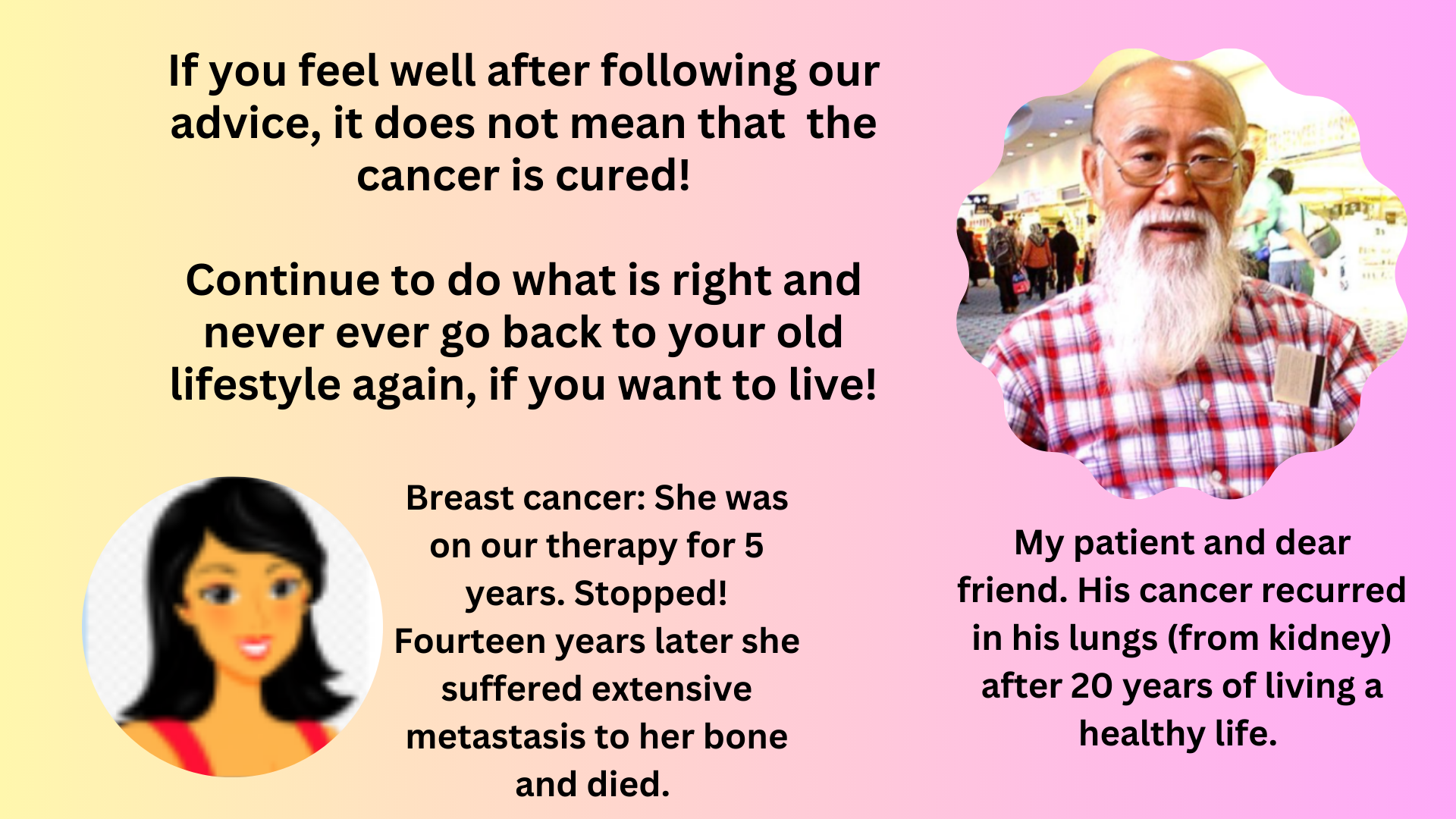
· Never say die and never give up. As long as you are still breathing, know that there is still hope even when you are told that you have no more hope. Hang on to your hope and believe that you still have hope.
Some people may accuse me of trying to give people false hope. It is cruel to raise false hopes. But on the other hand, some doctors tell you: You only have 3 to 6 months to live. There is no medicine, no cure. Just prepare to die. Some patients are told to enrol themselves with the palliative centre for further management (and you know the reason why!). Don’t you not think such insensitive comments or actions are even more cruel than raising false hopes?
I am fully aware that during distressed moments, cancer patients become very gullible and will grab at any straw that promises the slightest chance of hope for living. I have heard of vultures descending on your home, even in the middle of the night, offering magic potions with a promise of cure.
The mother of a boy who had cancer told me of one salesman who would call her 4 to 5 times a day to keep tab on how the son was doing. And each time the phone rang, it was with the advice to take more and more of the capsules he was selling. So the son ended up taking 60 capsules of the product a day, besides another dozen of other supplements. Use your discretion and be cautious.
From the point of view of science and medicine, hope and feelings do not count or exist. These attributes do not belong to the physical body for they do not show up on the X-ray film or CT/PET scan. Therefore, they are not supposed to exist. Yet, you and I know that there are things such as hope, love, feeling and inspiration. These are attributes of the soul and mind. They do exist and they matter – irrespective of what the medical world says.
I would say that there is no such thing as false hope. But there is such a thing as false hopelessness because no mortal on earth can play God. Only God decides who dies or when you die!
When the terminally ill patients come to me I used to tell them this:
· Don’t worry. All of us have to die someday. It is a matter of when – tomorrow, next month or the next 10 years. But, let me tell you that you need not die yet just because you have terminal cancer. I am younger than you and do not have any cancer but I may even die earlier than you. So don’t worry so much. Death is not an issue here. What matters now and the future is that while you are still alive you do not have to suffer. Let us pray that we can help you lead a normal, pain-free life. When the time comes and you have to go home, let us pray that you die peacefully.
Petrea King of Quest for Life Foundation, Australiasaid:
· Life is not a competition about how long we survive. It’s about the quality with which we live.
This is what Cancer Care Therapy is all about (discussed later). We see healing at various levels – physical, mental and spiritual. We may not be able to cure the physical body but we may be able to touch and heal the mind and the soul.
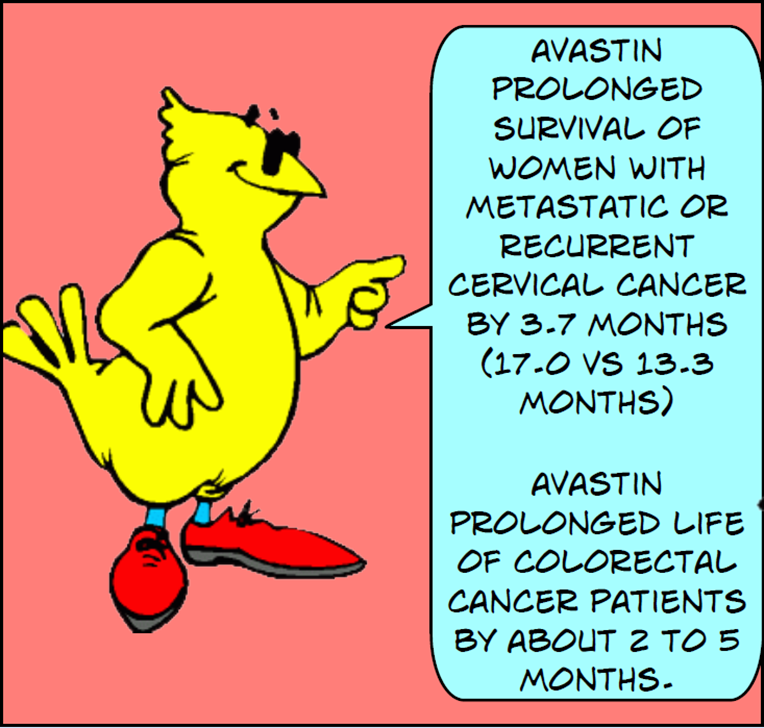
Lilly stomach cancer drug extends survival vs placebo
The overall survival among patients treated with the Lilly drug in the study was 5.2 months, compared with 3.8 months for those who received a placebo.
Effect of Fruquintinib vs Placebo on Overall Survival in Patients With Previously Treated Metastatic Colorectal Cancer
Median overall survival was significantly prolonged with fruquintinib compared with placebo – 9.3 months vs 6.6 months. (note: prolong survival of 2.7 months).
Median progression-free survival was also significantly increased with fruquintinib – 3.7 months vs 1.8 months (note: extend progression-free survival for 2.9 months).
“Landmark” study shows breast cancer drug Xeloda can extend lives
In one study, Xeloda cut patients’ risk of relapse or death by 30 percent over five years.
74 percent of patients were still alive and recurrence-free, versus 68 percent of women who’d received placebo pill.
Ask this: The difference is only 6% – why do we need to massage the data to become 30%?
In another study – only one group received Xeloda, while women in the other group were given placebo pills. The treatment was given in six or eight three-week “cycles,” with two weeks on the drug, one week off.
Five years later, 89% of Xeloda patients were still alive, compared with just under 84% of placebo patients.
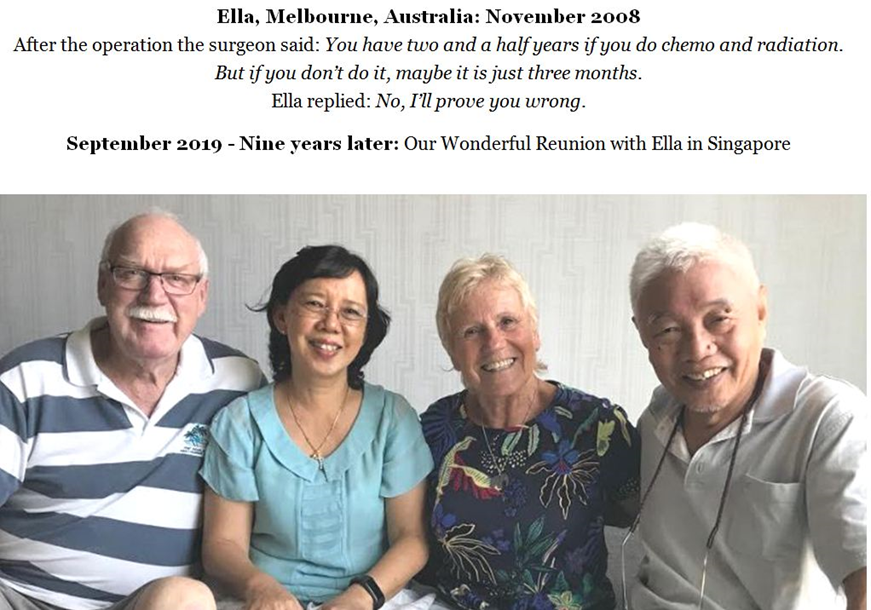
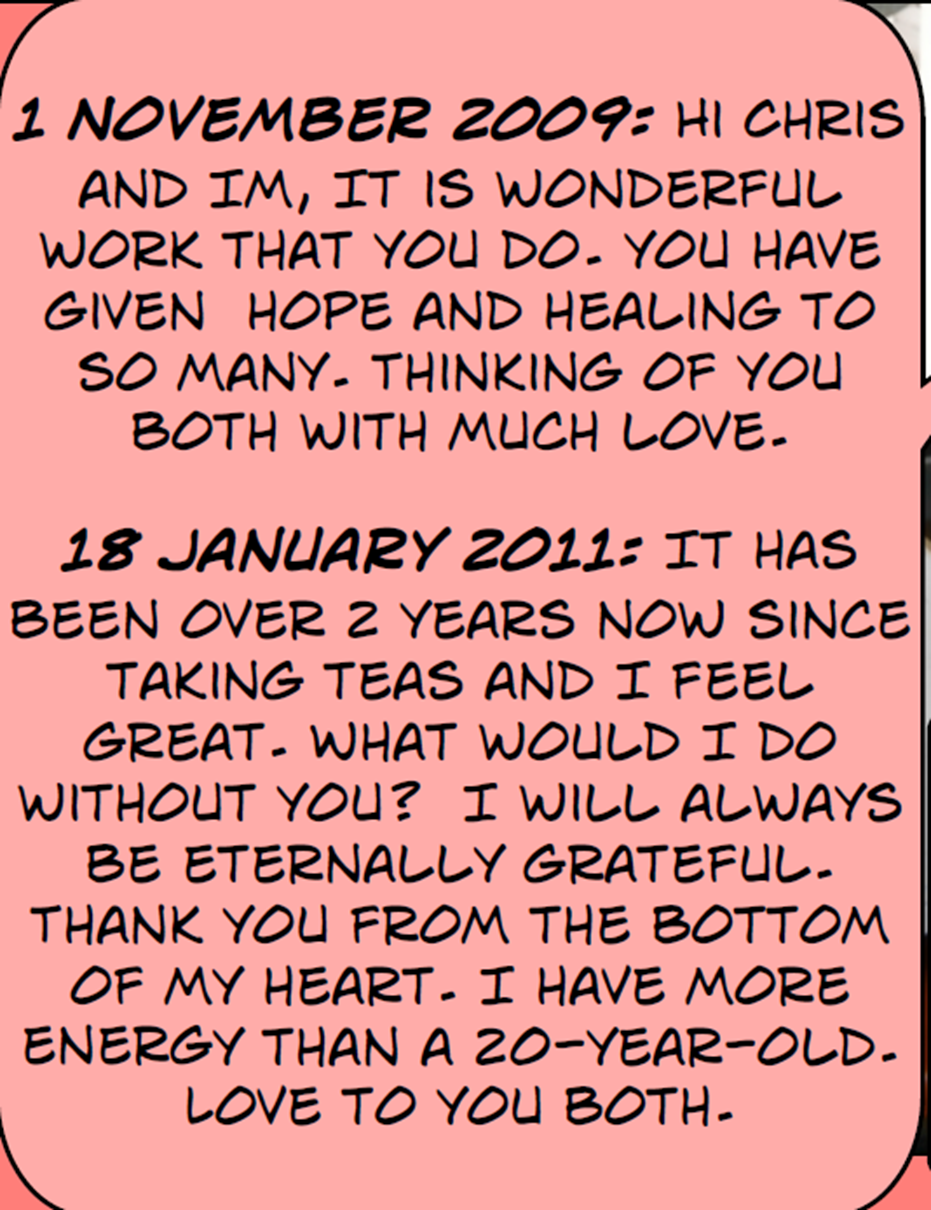
Ella is doing well. And she is taking the herbs, and of course NO chemo. Let me reproduce some of the e-mails she wrote us over the years.
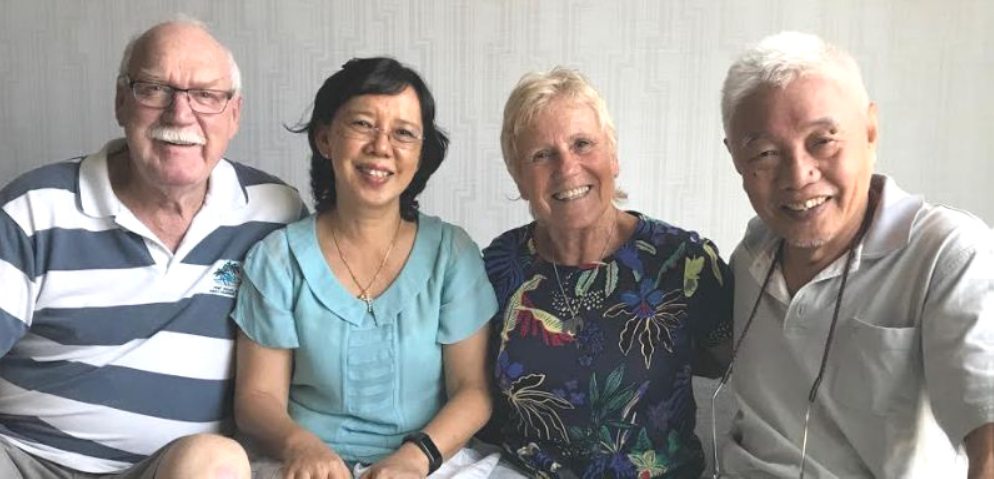
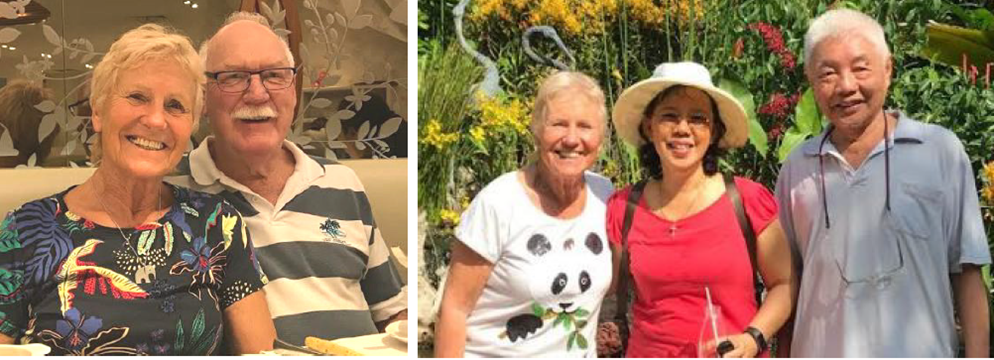
30 August 2019 – With Ella and Peter in Singapore
14 May 2020: after twelve years.
It seems so long ago when we last met … it was a get together for all of us and so lovely seeing Irene and family.
You must be so proud of your grandsons … Chris I have read all the books you gave me and they are fantastic. So easy for the lay person to understand and full of great information. Your passion shines through each page and your knowledge is priceless.
As I have mentioned before, it is so hard to educate the people here … It is much easier to pop a pill than to take the time to understand what your body needs to survive. You must see this all the time, especially from those in the
western world.
We are into winter now and feeling the cold … I love rugging up and taking a 4 km walk along the cliffs where we live with so much wild life to see … I am at my happiest when I am with Mother nature. I know you both are too.
Anyway, keep up the good work as the world needs people as you. After reading all the stories of your patients and how they found wellness, thanks to your dedication on helping them to heal. It is a great feeling to help those who look outside the square when given a cancer diagnosis and with guidance take on their own healing to wellness. You and Im must see these many times.
Sending love and blessings and keep forwarding the emails. Until we meet again, Hugs
xx Ella xx
May 2023 – Almost 14 years after her diagnosis, Ella sent us this note.
We are glad that we are able to help Ella in her time of need. We are even more happy and grateful to the Almighty to see her again in Singapore – so well and full of life. There are a few things we can learn from Ella.
Patients have choices or options.
You choose what you believe in and live with the consequences of your choice – for good or for bad. There is no point in trying to point fingers at others when things go wrong. Remember, it was your choice.
Ella knew what she wanted. She empowered herself well ahead of time about what cancer really is and what chemo could do to her. She was not blind when she made her choice.
She was right, the doctor was wrong!
Ella said she wanted to prove her doctor was wrong! Good to have something to look forward to, a wish in life, so to say. At CA Care we have seen such predictions proven wrong most of the time. But let us not blame the doctors. They only say things based on what they know or have been taught in medical school or while under practical training. And that is all there is to it. I have since realized about the tight system or box that they are brought up in.
Patients who choose to go into the box with them have a limited view about the well-known limited choices of
surgery, chemo or radiation. Get out of the box and you see a totally different view for your problem. When we met Ella again in Penang and then Singapore (twelve years later), she had proven her doctor wrong many times over!
Quality life.
I have posed this question to Ella when she came to visit us about a year after taking the herbs. Given a choice – which
one would you choose? Do chemo and live for two-and-a-half years OR have a solid one-year life of happiness without chemo?
Ella took a calculated risk or gambled with her life and she won. She had lived longer than what her doctor had predicted. Even with chemo she was told she would have only two and half years – and remember, most of the time would probably be spent going in and out of the hospital. But with the herbs, she suffered no side effects and she had lived a good life.
What else can you ever bargain for? And what additional proof do you need in order to believe?
Positive attitude.
Ella was so lively and positive in her attitude. That is the way it should be. Do what you have to do first, to help
yourself and then be happy with it. Live a positive life. Enjoy life to the fullest – busy being a grandmother of six kids, and at the same time being a wife running a happy family.
Many patients say they have positive attitudes. Saying is one thing, practising it is another. Ella is not a lamb easily led to the slaughter. She worked for her healing.
Actually, we knew Ella way before she had cancer. She is a health activist in Australia and she has been helping cancer patients as well, but not to the same extent as we do in CA Care due to the limitations imposed by the laws of her country.
Christmas time is party time with all the so-called great and wonderful food. Ella enjoyed the celebration but chose to stick to her healthy diet. Many patients don’t have that willpower. One lung patient said to me: Oh, the Hari Raya – we went home to our kampong (village) and I “tak tahan” (cannot stand) seeing those foods. So, I ate some, here and there. I suffered after I came home.
Don’t be a kiasu.
Ella is not a kiasu (afraid-to-lose-want-to-win all-the-time) type. Kiasu people like to ask a lot of questions but it is
no use – waste of time, because they don’t really believe in what we do. When they face a little problem they run away!
The herbs have to be boiled – that’s a big chore! The herbs do not taste good, that is also unbearable to the kiasu.
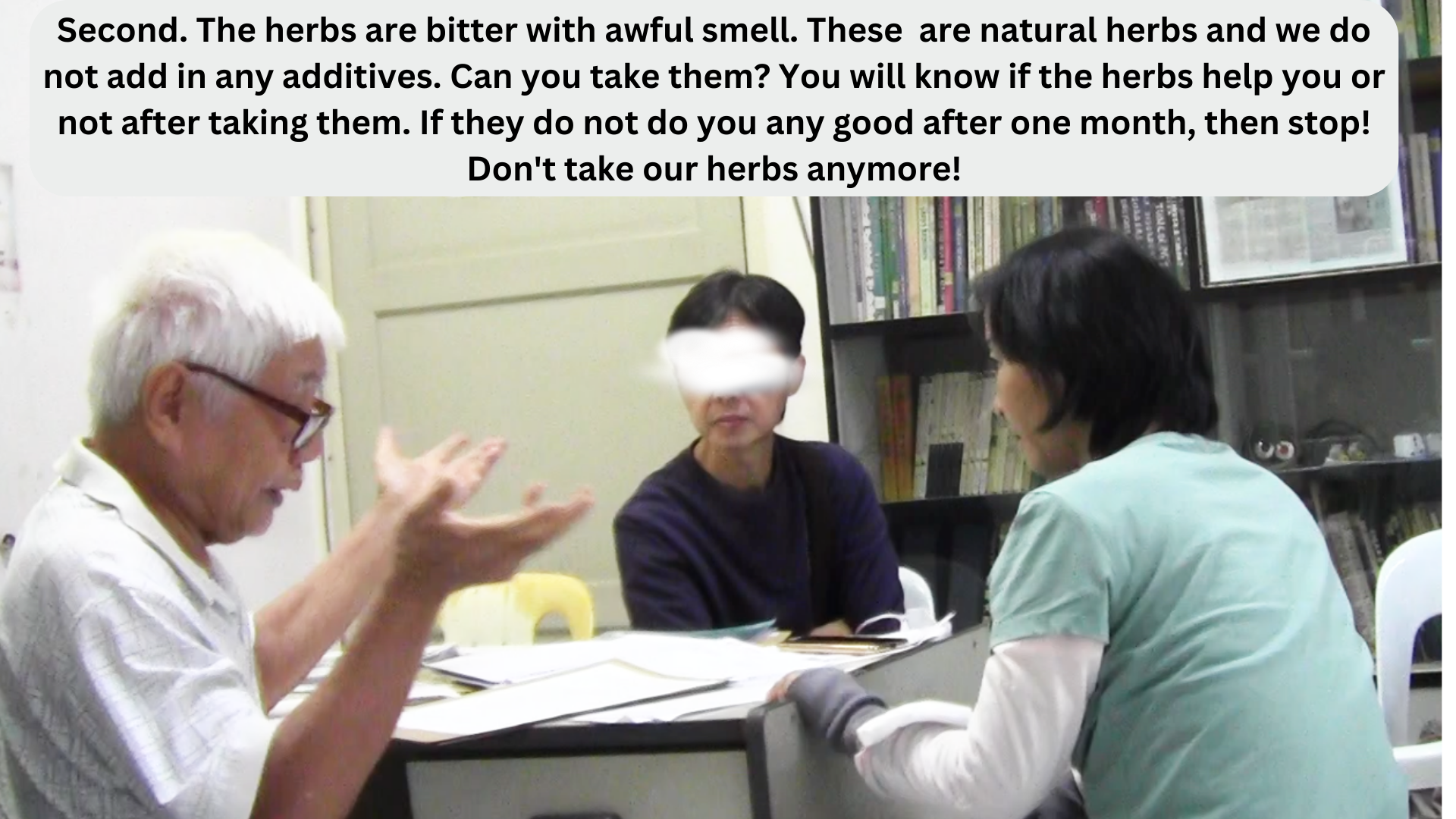
Our therapy is not easy to follow. It is not for any Tom, Dick and Harry. It is not for the faint hearted either. Patients need to be brave and be fully committed to find their own healing. There is no magic bullet. It requires a change in lifestyle, diet and attitude towards life.
We can show you the way, but you have to travel that road yourself. For that reason, it is a pleasure and our privilege to be able to help such a person like Ella – not a kiasu. We share the joy of her healing.

























 CANCER STORY
You must be logged in to post a comment.