Lessons I Learned While Warded in the Hospitals! Part 5  Monitoring My Progress

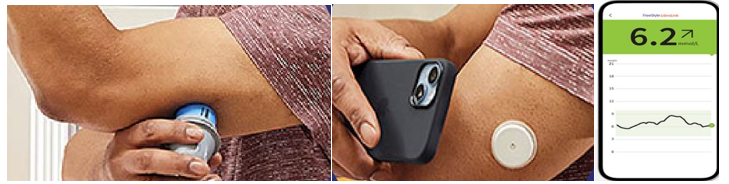
Use of Free Style LibreLink

I have reminded my cancer patients – when you are getting well, let the healing process goes on.  Spend time to help yourself get well. Monitor your progress.

In my case, I have 3 things that need to monitor.

  • Blood glucose for my diabetes. Remember the first reading I had showed a glucose level of 20.5. My HbA1C was at 13.6% which was very high. Now, my blood sugar level is within normal range – without taking any mediation! What is going on?
  • Sodium level – my reading went down to a critical low level of 118. Now, it is okay after taking salt pills.
  • My blood pressure and cholesterol were also high.

I have never been admitted into the hospital for years, and I felt “uncomfortable” to think that the nurses would prick my finger with a needle to withdraw blood for testing. Doing it once a day is ok, but what if this done a dozen times a day? Would be unbearable? Scary.

Fortunately, today we can buy a computer-link device which can be “installed” on the arm (see “white circular patch” below). You can use the handphone to monitor the glucose level anytime of the day and as many times as you like!  A great device indeed – discreet and convenient.
Discharged from the Hospital

After taking the drugs prescribed by the doctors for some days, I gave up on the drugs. This is because the drugs did not seem to bring any physical benefits to me. My physical conditions did not improve (or got worse?). You may say I am biased. OK, accepted!

Although I am a practising herbalist, be rest assured that I am not a dumb-narrow-minded person. I will give credit where credit is due. I started life as a scientist and I value and uphold genuine scientific data. This is the basic principle I always uphold when dealing with cancer patients.

Like in my case, my advice to anyone is. Go to the doctors / hospitals and find out exactly what is wrong with you (like I did in my case here). Do not go to the alternative medicine practitioners because most of the time, they may not get it right.

After knowing the cause of the problems, it is something else if you want to totally follow the doctor’s advice or not, with regards to the medications prescribed to you. Let this be your own personal decision after taking into consideration the effectiveness and side effects of the drugs.  Sometimes you need a lot of your own common sense to decide to accept anything that is fed to you.

Here are some brief notes of what happened to me after I started to gradually stop the doctor’s medications one by one.

  1. While on these medications I vomited quite often. What was the reason?
    1. After 4 days on Metformin, I stopped taking it. The vomiting subsided and eventually stopped.
    1. For 2 weeks, since my hospitalization, I was not able to move my bowels. On the night of 20 June, for the first time I started to take my herbal Constipation tea. To my surprise, the next morning I was able to move my bowels. I continued to take Constipation tea for a few more times and I was back to normal.
    1. On 21 June – the next medication to go was paracetamol. I was really concerned why I had to take so many paracetamols each day. I decided to try my luck with my Pain Tea (free of narcotics or pain drugs). Bravo, whatever little pain and discomforts I had disappeared by taking the Pain Tea.
    1. By 24 June, I was off most of the medications. The only one left was Sodium chloride. I continued to take this common salt for some more days before I fully stopped it

The Results that Matter!

One possible comment anyone would say is: Chris Teo, you are arrogant. You want to show off that you are “smarter” than the doctors. I am sorry, when it comes to trying to restore my own life, I don’t have to “show off”. Winning a brownie point just to boost my ego is not worth it. I am not a fool!

I must say it loud and clear, without taking those medications with ‘toxic” side effects, I was far better off. I could walk slowly by myself and had minimal discomforts. Is this not what you want?

With this comment, I wish to apologize to the doctors and nurses in the hospitals that I went to. I don’t mean to “insult” and be “ungrateful” to you all for helping me. I am sure my stay in the hospitals did help in my recovery in many other ways. Thank you, doc!

Let’s examine the data!

My wife used her handphone to record my glucose levels day and night. She ended up with “lots of boring” data which I believe no one is interested to know. It is more fun to watch TikTok la!

  1. Monitoring of glucose level

For a quick and easy understanding of the data collected, let me present the essence of my message in the form of slides below:
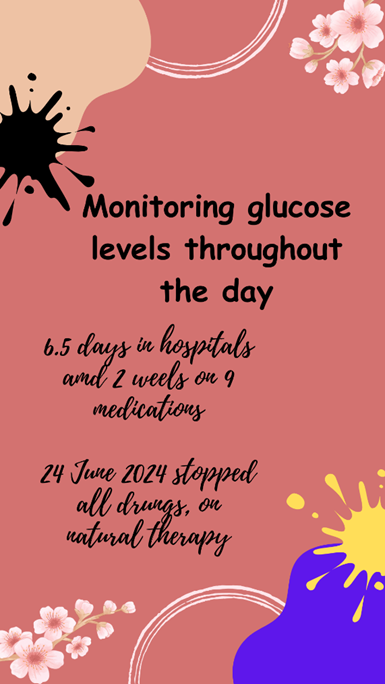
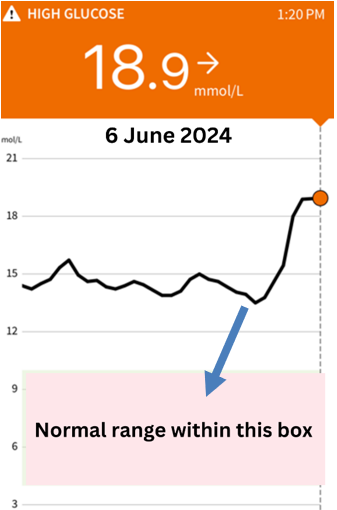
On 6 June 2024, my glucose level was very high, at 18.9 mmol/L.

Low or high blood glucose results can indicate a potentially serious medical condition. According to Freestyle LibreLink:

  • low glucose reading 3.9 mmol/L.
  • high glucose reading 13.9 mmol/L.

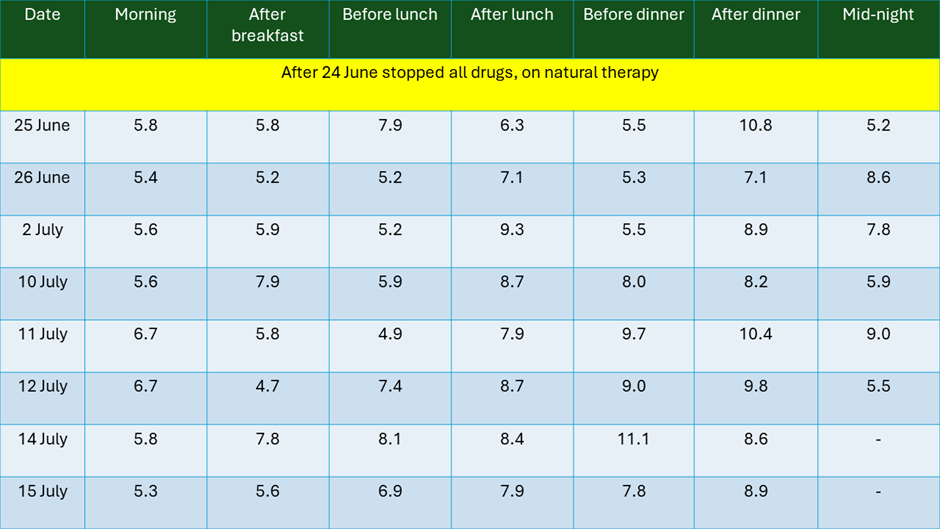
 After taking the medications prescribed for me, the blood situation gradually improved – the glucose dropped to 10.8 and 8.7 after 4 days.

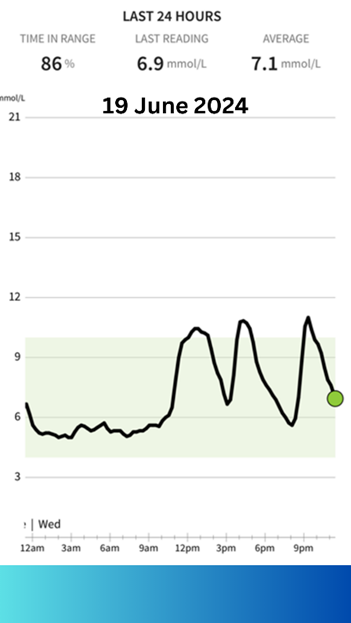
The situation improved further – the average glucose level dropped to 7.1 on 19 June; and eventually to 6.8 by 27 June, i.e. within the normal range.

In an individual, the glucose levels fluctuated from morning to mid-night within the body.
That is normal, provided the range is within normal limits. So it appeared that my diabetes was under control after taking the medications. So, why are you Chris Teo against taking the medicatons? Aare you trying to create a disharmony? My answer: I am more concerned with the side-effects the drugs. Five the  drugs prescribed have dangerous, documented side-effects. You may argue that this fear of side-effects are hived-up or an imagination of my mind.  Ok, I rest my case. Do what you think is right for you. I am asking you to discard your  medication!

For one month I was not on any medications. My average levels of glucose were maintained at 6.8 and 6.2. The situation seemed to return to normal. Am I crazy to believe this?
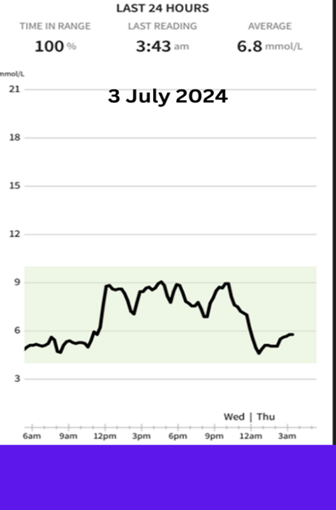
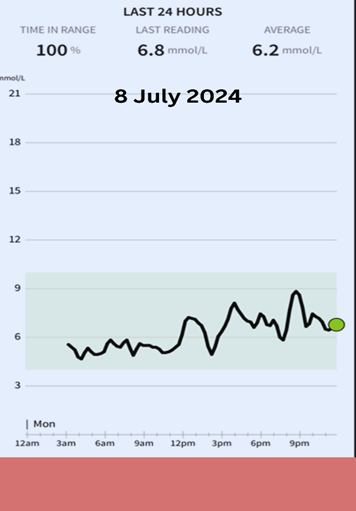
To the “scientific mind” I used the data that my wife had collected, analysed them and came to my own conclusion. This is how to find “truth” – the data speaks for you, not what other people tell you.

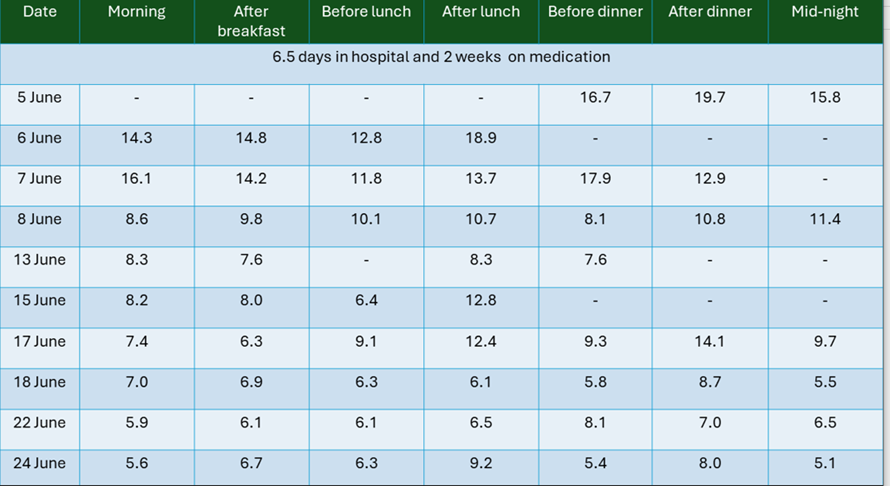
Now, let me present to you the data that my wife had collected in the form of “boring numbers”.

On 5 and 6 June, my sugar levels were high! I was hospitalized and put on various medications. By 13 June, things seemed very encouraging. I was discharged from the hospital, and I continued to take the prescribed medications while at home.

The conclusion: the doctor’s medications worked but at a hefty price tag (a topic I shall mention later).
For one month, from 25 June to the whole of July, I started to take herbs and used my e-therapy machine to help me with constipation, insomnia, muscle aches and spasm, itchy skin, etc. My good friend specially formulated protein supplements to help restore my energy.

I felt better, had more energy and most important my glucose level is normal.
  • Boosting of Sodium level in the blood

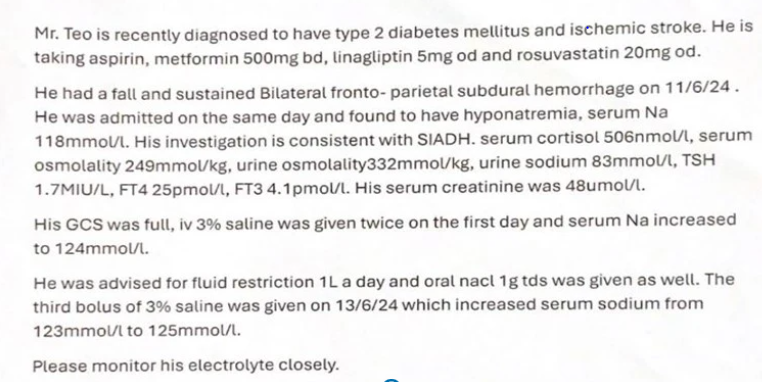
When I first did a blood test, it was shocking that the sodium level was critically low at 118.

In Hospital C,  I was given iv3% saline infusion twice. Serum sodium increased to 124mmol/L

11 June 2024 @14.44   Sodium  118 (critical)   

11 June 2024 @19.58   Sodium  120 (critical)   

11 June 2024 @23.45   Sodium  124 (critical)   

12 June 2024 morning  Sodium  124 (critical)   

!3 June 2024 @6:31      Sodium  123 (critical)   

!3 June 2024 @11:53    Sodium   125 (critical)   

14 June 2024 @ 8.10    Sodium    123 (critical)   

14 June 2024 @ 14:12  Sodium    127  Low

15 June 2024 @ 6:34    Sodium     126 Low   

I continued to take sodium chloride capsule, one per day. Yes, the treatment in Hospital C was effective. And I have to NO hesitation with this sodium chloride treatment because it has no “drastic” side effects. Thank you.
Lessons I Learned While Warded in the Hospitals! Part 3: Undergoing surgery – was that a correct decision?

I was recovering from my fall for about 2 months. I almost fully regained my health, and I was looking forward to going home to Penang. Suddenly I had a relapse. My left leg was very weak and painful. I could not stand up. I was not able to walk again.

I was taken to hospital C (in Johore) which is about 1 hour’s drive from Singapore. The doctor did a scan of my head. The swelling had grown bigger. The next morning, the neurosurgeon, my wife and daughter sat down for a discussion. What option do I have now?

The surgeon laid out only one possibility – undergo an operation immediately. I asked the doctor some questions.

  1. Can the surgery “kill” the patient? Like during the surgery, the patient just died. While this is possible, it is not likely it will happen in my case.
  2. Can surgery cure me? Not likely. There is NO cure. The fluid may come back again.
  3. Looking at my case, can surgery help me to regain some aspects of my health? Most likely but there is no guarantee.
  4. Do I need to do more surgeries in the future? Surgery after surgery? May be, no one can predict this.

Based on the answers I got, I have decided there and then that I would proceed with the surgery. I have no other choice. I don’t know if there is any non-medical alternative to my problem either. In other wards I am ignorant like most cancer patients. Yes, over the years, I have helped many patients with CANCER of the brain, and they recovered. But my case I don’t have brain cancer!

My only request to the doctor and my family members is do not try to be a super hero. If my chances of survival or recovery is remote, please don’t try to save me at any cost. Let me go in peace. I don’t want to suffer – drag on and on until I die. It is not worth it. I am ready to die.

A friendly anaesthetist visited me to explain what is involved in the surgery. I was to be given a general anesthesia injection. This anesthestics will gradually make me “go to sleep”.  The surgeon shall then work on me. There will be no pain!

So, the question – did I make the right decision to undergo this emergency operation? Let me say that I received a “miraculous healing” immediately after the operation. Before the operation, I could not move my left leg – no strength and painful. After the operation, my left leg immediately had more strength and all pain disappeared. In fact, my left leg is now much stronger than the right leg. Thank you, doc, for your help. The operation did a lot of good for me.

Let me be clear. I am not anti-doctor, although I am critical with what some doctors do or tell their doctors to do. I have read enough books written by medical experts themselves who warn readers about being taken for a free ride by their doctors. So be careful.

The mani reason why I agreed to the surgery was because I fully trusted the neurosurgeon who is operating on me.

  • He is humble and caring person. I could “see” the sincerity in hm in wanting to help his patients under his care. I am aware that all “humans” can only try their best but they cannot guarantee or promise a cure! Yes, the surgeon did admit to that – but he was willing enough to do his best. He did NOT tell me – Ah, your case is easy, I can cure you (like a certain famous oncologist told his patients!). I have heard enough of such “fake” assurance! The surgeon’s honestly is the prime factor that made me trust him. Great doc., thank you for your concern and willingness to give your best! I understand, the final outcome, is in God’s hands, not ours.

The surgery was scheduled for 8 p.m. or slightly later. This would take about 4 hours!

God’s Blessing!

By mid-night, I received a message: Operation successfully completed.

When I agreed to the surgery, I accept the fact that before mid-night, that is in the next 5 hours I may die. So, I was calm and was not worried or stressful. Let Your will be done, Lord.

Thank God I am still alive! And am able to share my story with you all. 

Lessons I Learned While Warded in the Hospitals! Part 2 Medications

Based on the “data” obtained from the scans and blood tests, it was clear that my problems arose due to high glucose and low sodium in my blood. My blood pressure was also high. In addition, I had a big swelling in my head due to the fall. Unfortunately there don’t seem to be any “magic” pills for these problems.

I was admitted into Hospital C to closely monitor my blood parameters at the same time take medications in the hope of restoring these deficiencies.

Let us examine the drugs that I was prescribed by the doctors.

  1. Omeprazole. This is to treat heartburn, gastric and duodenal ulcers, erosive esophagitis, and gastroesophageal reflux disease (GERD). etc.

The most common omeprazole side effect is headache, nausea, vomiting, or diarrhea.

Taking omeprazole at high dosages, or for longer than a year, raises the risk of more serious side effects. These can include bone breaks and pneumonia (a lung infection). 

The main question I have is, why do I have to take omeprazole (3 capsules per day) when I have  never suffered any gastric problems in my life?

  • Metformin is for type-2 diabetes. I took 1 tablet, once a day, @ 8-9 pm. It is important to note that metformin does not cure diabetes. It only helps lower the blood sugar levels to a safe range.

Metformin can cause side effects such as nausea, vomiting, and diarrhea. Unfortunately for me I had no diarrhea but I did not move my bowels for about 2 weeks while on the drugs.

Other known side effects of metformin: heartburn, stomach pain, bloating, gas, constipation, weight loss, headache, metallic taste in the mouth.

Metformin can cause Lactic Acidiosis – a rare but serious problem that must be treated immediately.

Metformin carries FDA black box warning. A boxed warning is the most severe warning the FDA issues.

Symptoms of Lactic Acidiosis can include:

  • Celebrex. This drug is usedto treat pain or inflammation caused by conditions such as arthritis, ankylosing spondylitis, and menstrual pain.

Celebrex is the drug that triggered the most serious warning alarm in me. I was asked to take 1 capsule, twice a day.

Many years ago, celebrex was a common pail killer that was dished out to most cancer patients! Then it just “disappeared” from the scene. Celebrex was found to increase risk of heart attacks and strokes in patients. Now, the drug has reappeared!

The questions I asked myself: Why do I need a pain killer drug that can cause heart attacks and strokes? I just had a mild stroke! Is that not enough?

 Another point is, I don’t have any serious pain to justify me taking such a dangerous drug. I can use my Pain Herbal Tea to solve this problem easily. Why do I need celebrex?

  • Paracetamol. I took this painkiller 4 times a day, each time 2 tablets. Paracetamol is used to treat headaches, migraine, toothaches, sore throats, period (menstrual) pains, arthritis, muscle aches, and the common cold.

I don’t have any severe pain. Mind bogging – take it whatever for? What is more, taking 8 tablets per day!

Taking 1 or 2 tablets of paracetamol each day is unlikely to harm. But taking more than 8 tablets in 24 hours is not advisable and can be dangerous. Too much paracetamol can cause liver damage.

The most common side effects of paracetamol: drowsiness and tiredness. rashes and itching.

  •  Metoclopramide (maxalon) Or domperidone (motilium) isfor nausea, vomiting, heartburn. One capsule is taken 3 times a day.

Again, I would like to ask. Why do I ever need this medication? Do I really need to take 3 times a day when I don’t have problems with nausea or vomiting? Or do I have to take it for “prevention”? I have never taken these drugs before!

Let us look at some the side effects of Maxalon:

Maxalon has a boxed warning. Boxed warnings are the most serious warnings from the U.S. Food and Drug Administration (FDA). They alert doctors and patients about drug effects that may be dangerous. 

  • Taking Maxalon may lead to muscle problems called tardive dyskinesia, resulting in unusual face muscle movement. You will not be able to control or stop these movements.
  • Other side effects may include involuntary limb movements, facial grimacing, torticollis, oculogyric crisis, rhythmic protrusion of the tongue, bulbar type of speech, trismus, opisthotonus (tetanus-like reactions), and, rarely, stridor and dyspnea, which possibly result from laryngospasm.
  • Maxalon can make you feel sleepy and lack of energy, low mood, feeling dizzy or faint (low blood pressure), diarrhoea.
  • In rare cases, Maxalon may cause a serious allergic reaction (anaphylaxis). The lips, mouth, throat or tongue suddenly become swollen, breathing becomes very fast or you are struggling to breathe (become very wheezy or feel like you’re choking or gasping for air), the throat feels tight or you’re struggling to swallow, your skin, tongue or lips turn blue, grey or pale. Suddenly become very confused, drowsy or dizzy
  • Nervous system disorder warning: Maxalon may cause neuroleptic malignant syndrome (NMS). NMS is a rare nervous system disorder that may be fatal. Symptoms include a high body temperature, stiff muscles, confusion, abnormal pulse or blood pressure, fast heart rate, and sweating.
  • Uncontrolled spasms warning: This drug may cause muscle spasms in your face, neck, body, arms, and legs. These spasms can cause irregular movements and body positions. These are more likely to happen during the first 2 days of treatment.
  • Depression warning: This drug may cause depression. This can occur even if you don’t have a history of depression. The symptoms may be mild to severe and may include thoughts of suicide.

What is the maximum days for taking Maxalon? The maximum recommended treatment duration is 5 days. The recommended dose is repeated up to 3 times daily by oral route.

What is the “danger” for Motilium?

Motilium may be associated with an increased risk of heart rhythm disorder and cardiac arrest. This risk may be more likely occur in those over 60 years old or taking higher doses. The risk also increases when Motilium is given together with some other drugs.

The side-effects of Morilium are:

  • Headache, trouble sleeping, nervousness, depression, dizziness, tiredness or irritability
  • Sleepiness or drowsiness, fits or seizures, agitation
  • Dry mouth or thirst
  • Regurgitation, diarrhoea, constipation, nausea, changes in appetite or heartburn
  • Rash or itchy skin.

Is it OK to take Motilium everyday?

  • It is recommended for short-term use only. It is associated with an increased risk of heart rhythm disorder, particularly in older people. If you faint or feel that your heart is beating quickly, you must speak with your doctor as soon as possible.

Can you stay on Motilium long term?

  • You’ll usually take Motilium for up to 1 week. This is because it can cause an irregular heartbeat (arrhythmia) if you take it for longer or at a high dose.
  • Motilium should start to work in about 30 to 60 minutes. It works best if taken before meals. The most common side effect of Motilium is a dry mouth, but this is usually mild and goes away by itself.

Why is Motilium banned in US?

  • Motilium has been banned in the United States for years because of fatal cardiac arrhythmias among cancer patients who had been prescribed the drug to prevent nausea and vomiting.

Besides the above drugs, I also took 1 tablet every day of the following:

  • Sodium chloride – common salt. Sodium also plays a part in nerve impulses and muscle contractions. Salt is also used to treat or prevent sodium loss caused by dehydration or excessive sweating.
  • Potassium. Potassium helps cells, kidneys, heart, muscles, and nerves work properly. Potassium levels can be low due to a disease or from taking certain medicines, or after a prolonged illness with diarrhea or vomiting. Potassium chloride is used to prevent or to treat low blood levels of potassium (hypokalemia)
  • Neurobion to treat and prevent symptoms of vitamin B deficiency and strengthen the nervous system.

I agreed to take these drugs …

While in Hospital C, I took the above medications. I have decided to comply FULLY with what I was told to do. If you don’t try you don’t know! If you don’t trust others how can others help you?

Unfortunately, I did not stay on these drugs for long.

  • I stopped taking metformin after 4 days due to vomiting.
  • 2 days later, I was off paracetamol.
  • 1 day later, I was off celebrex and neurobion.
  • I was only on sodium and sodium tablets.

After a fall I landed in three hospitals – road to my recovery! My Story Part 3

Hospital C in Johor

After my discharge from Hospital B in Singapore, it appeared that the doctors knew what had gone wrong with me, as outlined in their reports. Another hospital which is about one hour drive from our home (in Singapore) is Hospital C. It is in Johor. We moved to Hospital C for 5 days from 11 June @15:18 to 15 June 2024 @10:31.

The great difference between B and C is that in Hospital C, you pay in Malaysian ringgit – indeed a huge difference compared to Singapore dollars!

In Hospital C, I underwent these procedures and treatments:

  • Lumbar X-ray

There is reduce lumbar lordosis. The alignment is preserved.

No fracture or dislocation.

Impression: Lumbar spondylosis with likely L2/L3 disc bulge.

  • CT brain – 11 June. Day 2 post mild head injury (after second fall).

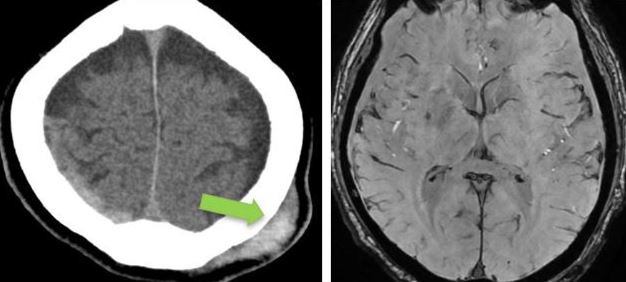
Bilateral fronto- parietal hypodense subdural hemorrhage / effusion widest at frontal region, right measures 10 mm keft measures 13 mm in thickness.

There is hyperdense component seen at right parietal region (9 mm in thickness). Mild enhancement of the sulci bilaterally.

Gray-white matter differentiation fairly preserved.

No hydrocephalus.

No skull fracture.

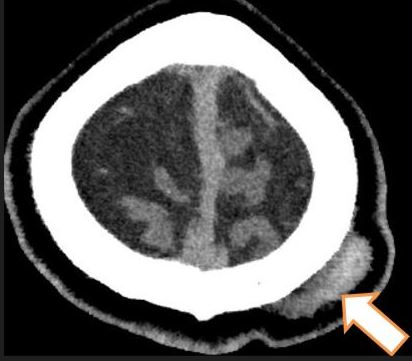
Left parietal scalp swelling.

Impression: Bilateral fronto-parietal subdural hemorrhage as described.

  • CT brain. Comparison made with CT brain yesterday – 12 June 2024.

Impression: Right parietal extra-axil haemorrhage, stable in size compared to previous.

Bilateral fronto-temporo-parietal subdural hygroma.

No new intracranial haemorrhage.

Blood- Tests

11 June 2024 @14.44

White Blood Cells                      12.0  H   (4.0-11.0)

Neutrophils                                 82.0 H  (40 – 75.0)

Lymphocytes                              11.2  L    (20 – 45)

Neutrophils (absolute value)   9.8 H   (2.0-7.5)

Lymphocytes (absolute value)  1.3 L  (1.5-4.5)

Sodium                                          118 (critical)    (135-145)

Potassium                                        3.6     (3.5-5.1)

Chloride                                            91  L   (98-109)

Creatinine                                        48   L   (62-115)

Calcium                                            2.14   L   (2.18-2.60)

Adjusted calcium                            2.1  L    (2.18-2.60)

11 June 2024 @19.58

Sodium                    120 (critical)   

Potassium               3.4 L 

Chloride                   92 L

Serum osmolality  249 L   (280-301)

Free T4                    25.4 H   (12.2-22.4)

11 June 2024 @23.45

Sodium                 124 (critical)   

Potassium             36 

Chloride                95 L

Urea nitrogen     2.4 L  (2.5-6.5)

!3 June 2024 @6:31

Sodium              123 (critical)   

Potassium           36 

Chloride              92 L

Urea nitrogen    2.3 L

!3 June 2024 @11:53

Sodium            125 (critical)   

14 June 2024 @ 8.10

Sodium          123 (critical)   

Potassium     38 

Chloride        94 L

Urea  nitrogen  2.5

14 June 2024 @ 14:12

Sodium          127  L

15 June 2024 @ 6:34

Sodium          126 L   

Potassium     3.7 

Urea nitrogen  2.2 L

Staying in Hospital was about taking the following medications and monitoring of blood as above.

8am
1. Omeprazole x 1 capsule
2. Metoclopromide (maxalon) / domperidone (motilium) x 1 tab (either or)
3. Celebrax x 1 capsule
4. Paracetamol x 2 capsule

9am – 10am (breakfast timing)
1. NaCl x 1 capsule
2. Potassium Cl x 1 tablet
3. Neurobion x 1 tablet

1- 2pm (pre lunch)
1. Metoclopromide (maxalon) / domperidone (motilium) x 1 tab (either or if papa feels nauseated)
2. Paracetamol x 2 capsule
3. NaCl x 1 capsule

6pm
1. Omeprazole x 1 capsule
2. Metoclopromide (maxalon) / domperidone (motilium) x 1 tab (either or)
3. Celebrax x 1 capsule
4. Paracetamol x 2 capsule

8pm-9pm (after dinner)
1. Metformin XR x 1 tablet
2. NaCl x 1 capsule

11pm-midnight (before sleep)
1. Paracetamol x 2 capsule

In the morning of15 June 2024, I was discharged and returned to Singapore. Was I fully recovered? I am sorry, the answer is NO. I was still unable to walk by myself and had to use a walking frame.

Cost of Hospitalization in Hospital C for 5 days

The total cost of hospitalization is RM 14,308.05, covering the following items:

  1. Hospital Charges RM 12,197.04

Medication                                       1,970.64

Medical & surgical suppliers             890.00

Nursing procedure                              663.68

Imaging                                              1,561.60

Rehabilitation services                       880.00

Laboratory investigation                2,391.68

Nursing care                                         525.52

Administrative charges                         56.56

House supply                                          48.80

Miscellaneous                                         97.52

Medical officer fee                                 42.96

Room and board                                1,724.00

Equipment /instrumentation           1,333.08

  • Doctor Charges RM 2,111.00

Dr. A – consultation & assessment. First consultation     235.00

Gen Ward visit (Weekday 8 am to 6 pm)                            840.00

Dr. B – Rad Fee            60.00

Repeat Fee – Brain      120.00

Repeat Fee Xray           21.00

Dr. C; Imaging – repeat fee – CT brain    120.00

Rad fee – on call surcharge                         60.00

Dr. D – consultation & assessment. First consultation     235.00

Gen Ward visit (Weekday 8 am to 6 pm )                          420.00

When you are in the hospital, remember that everything you used or was provided with has a price. So don’t be surprised. Take for examples:

  1. Vomit bag. This costs RM12.80 each. I needed this bag when vomiting. Worse is, the vomit was induced by the consumption of the prescribed medications.
  2. Every time I urinated, the disposable bottle costs me RM7.84 each.

After a fall I landed in three hospitals – here is more of my story! Part 2

Hospital B in Singapore

On 6 June 2024 my children got me admitted into the Urgent Care Centre, Hospital B in Singapore. I was there for 1.5 days. We did the following:

  1. CT scan of the head. No contrast.Had fall with occipital haematoma. The scans demonstrate evidence of bilateral subdural hygromas slightly more prominent on the left side. This is associated with evidence of an acute subdural collection in the right parietal region. There is no associated midline shift noted. The 3rd and 4th ventricles are central in position.

  • MRI Stroke Screen which showed a small acute infarct at the right lentiform nucleus. Multiple foci of susceptibility are seen in both cerebral hemispheres, worse at the frontal regions, likely representing hemosiderin deposition.
  • Bilateral fronto-temporal cystic hygromas are note, measuring up to 1.0 cm in thickness.
  • No intracranial space occupying lesion.
  • No hydrocephalus or midline shift.
  • MRA: There is a mild narrowing and irregularity in the A1 segment of the right anterior cerebral artery and the M2 segment of the left middle cerebral artery (MCA). These may represent atherosclerotic changes or sequalae of a prior insult.
  • The rest of the MRA of the circle of Wilis demonstrates no other significant aneurysm, stenosis or vascular malformation. Normal vascular variations are present. Bilateral posterior communicating arteries are hypoplastic
  • Stenosis is demonstrated.
  • Final conclusion –  normal pulmonary artery pressure.
  • No intra thrombus or pericardial effusion.
  1. Blood test results on 6 June 2024:

Troponin T   14.6 High Sensitive. Result is critical.

Creatine Kinase-MB  1.2 (0.0 to 6.0 ng/mL)

Potassium   3.8   (3.3 to 5.0 mmol/L)

Sodium    133  Low  (135 – 150 mmol/L)

Uria, serum  8.1   High  (2.8 to 7.7 mmol/L)

Glucose, fasting   13.4   High  (3.6 to6.0 mmol/L)

Est GFR   86  Expected range >=60 mL/min/1.73 square metres

C-Reactive Protein    14.38   H (<=9.99 mg/L

Reason for admission: Stroke on 6 June 2024                                                                                                                            

Secondary diagnosis: Type 2 diabetes mellitus without complication.

Discharge date: 7 June 2024

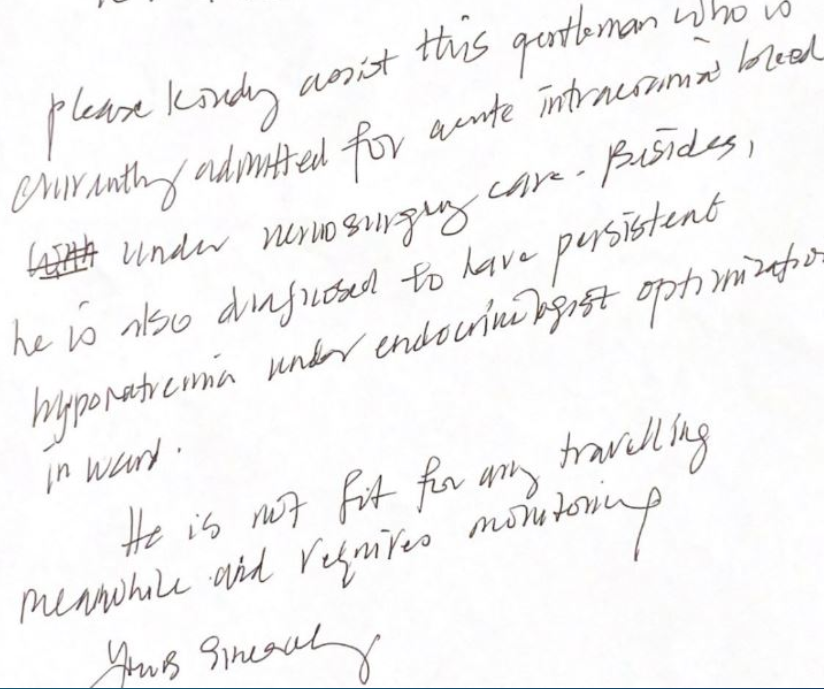
A note from the neurosurgeon stated: He is not fit for any travelling meanwhile requires monitoring.

The total costs in Hospital B in Singapore, was SGD 10,346.58 or RM 36,112.51

Admission date: 6 June 2023, 20:16, Discharge date: 7 June 2023, 17.41

  • MRI Stroke Screen                                 GD 1,177.20
  • CT Brain                                                              698.99
  • Observation bed – 3hs                                    286.76
  • Single room                                                       787.16
  • Single room – half day                                    393.58
  • Consultation – office hour                             125.69       
  • Consultation – after hour                               148.62       
  • Hospital charges                                           1,790.74
  • Ultrasound                                                        905.80
  • Daily treatment fee                                         325.69
  • Doctor’s attendance fee                                436.00
  • General follow-up screen                              420.68
  • After hours surcharge                                    196.40
  • Physiotherapy                                                  205.25
  • Speech Therapy                                               350.37

From Hospital B, I learned the following:

  1. The reason why I fell could be due to a mild stroke.
  2. For the first time in my life, I have been told, once again, that I have diabetes – and it is a serious one at that!
  3. My blood was low in Sodium, this could be related / a contribution to the mild stroke.
  4. My blood pressure was also high.

It seems that an elderly man with no pain or any “health problems” can suddenly get “sick”!

So please careful.

After a fall I landed in three hospitals – here is my story! Part 1

In May 2024, my life was really “drained!” Too many patients with too serious problems wanted my help. As usual I tried my very best to help, unaware that I was at the same time just “digging my own grave!” Let me share what happened to me.

But first, in writing this story, let me be up front with you. I am not against medical science. I went to the hospitals believing that medical science can help me – although I am an herbalist. Understand that no one has the monopoly to make fellow-citizens well again. It is either you believe in what you are doing, or you don’t.

From the beginning, may I tender my sincere apology to anyone who reads this article and finds it “offensive or crude” for the comments that I made. I was just giving my frank opinions. Please forgive me!

All the doctors and nurses who helped while I was in these hospitals were very nice and friendly. A big thank you to you all.

The Fall – A big lump in the head

In the early morning of 4 June 2024, I woke up to rush to the toilet to pass urine. While half way doing this, I felt dizzy and wanted to lie down but it was too late. I passed out and knocked my head resulting in a big bump. The next days, I fell one more time!

Life has many lessons to teach us as we age awaiting our final departure. I failed my first test. My first fall did not teach enough about the seriousness of a fall – I shouul have learned and should have prevented the repeat of such a fall.

Hospital A in Penang

After the fall, on 4 June 2024, I went to a private hospital in Penang , for check up.

  • X-ray for done to check if I suffered any broken bones. My ribs and bones of the pelvic region were okay!
  • Alignment of shoulder joint was normal.

  • CT of brain showed bilateral small chronic subdural hematoma (CSDH) noted. There is no acute intracranial bleed. There is no area of infarct seen. Brain stem and basal cisterns are normal. There is no skull fracture seen. There is scalp swelling in left occipital region.
  • Venous blood test: Hemoglobin A1c(HbA1c)- 13.6% – High. Normal = <5.7
  • I-Stat Chem8

Na = 135 mmol/L – range138-146 mml/L

K = 3.9 mmol/L – range 3.5 – 4.9 mmol/L

Glucose = 20.5 mmol/L – range 3.9 – 5.8  mmol/L

Urea = 4.6 mmol/L – range 8.0 – 26.0 mmol/L

Creatinine = 51 umol/L – range 53 – 115 umol/L

The total costs in Hospital A = RM 1,543 :

  • Physician Consultant 1– first consultation RM 70.00
  • Laboratory tests 1 – RM 198.00
  • Pharmacy – RM 93.00
  • Physician Consultant 2 – first consultation RM 70.00
  • Lab tests 2 – RM291.00
  • CT Brain – RM 370.00
  • X-ray – RM 195
  • Medical officer charges – RM 30.00
  • ECG Consultant – RM 35.00

From Hospital A I learned the following:

  1. The swelling of my head was not in my brain but at the external area outside the skull. The doctor told me it does not pose any immediate danger. This is very good news indeed.
  2. From the blood test results, I was told that I have diabetes. The sugar reading was 20.5 while the normal range was 3.9 to 5.8. This is rather shocking news! More of such unexpected news later.

Sadly, what had happened to me caused a lot of distress to both Albert and Irene who are living in Singapore. The same day I fell, Irene flew back to Penang.

Fighting lung cancer with chemotherapy, radiotherapy and immunotherapy failed. One billion rupiahs gone. Herbs helped him!

Aman (not his real name), fifty-five years old, had been a smoker for the past thirty years.  His problems started with fevers, loss of appetite and loss of energy. There was no cough. He consulted a doctor in his hometown (Indonesia) and was told he had tuberculosis (TB).  He was prescribed TB medication but it was not effective.

    Not satisfied, Aman came to a private hospital in Penang for further management. A CT scan on 22 October 2019 showed a lung mass measuring 4.6 x 4.8 x 6.0 cm. A biopsy indicated a Large Cell Lung Carcinoma.

    Aman underwent the following treatments:

1. Nine cycles of chemotherapy.  The drugs used were: Cisplatin + Eptoposide.

2. Thirty-three times of radiotherapy.

3.Twenty-four injections of immunotherapy. The drug used was Imfinzi or durvalumab. Each dose of Imfinzi cost IDR40 million. This was given every two weeks. This means Aman was on Imfinzi for two years.

Did all these medical treatments cure Aman? Unfortunately, the answer is NO.

A PET scan on 26 July 2022 showed a 2.1 cm metabolic active lesion seen in the lobe of right lung (see image above). This showed the tumour did not go away! Aman was told to do another biopsy to reconfirm that this mass is still a cancer! However, the oncologist told Aman that there would be NO more chemo or immunotherapy for him. The only option left is surgery.

The family was disappointed having spent more than one billion rupiahs for the above treatments that failed.     Aman came to seek our help. He gave up further medical treatment and was started on our herbs. It has been almost two years now – Aman is still healthy and leads a normal life (see photo below taken in May 2024).  He plays golf regularly. I once asked him, Is there any other problems? He jokingly answered: Just money problem!

Ask this question: Aman spent three years undergoing chemotherapy, radiotherapy and immunotherapy. The family spent more than a billion rupiahs for these treatments. What did he get?

The tumour shrunk from 4.6 cm to 2.1 cm. The oncologist gave up – no more treatment – and asked Aman to go for surgery! Is that a good answer? Take note, is this all the scientifically proven cancer treatment can offer?

Undergoing immunotherapy (the state-of-the-art treatment that is being promoted today) creates NO “magic”? But a change of diet and lifestyle plus taking of herbs restored Aman’s health! And more important, at a cost of peanuts!

Good bye Ina – Rest in Peace

When I woke up on the morning of 2 April 2024, Im told me that she had a dream. Ina, our cancer patient and a good friend, came to her in a dream.

In my dream, Ina was wearing a bright dress with many colors, and

everything looked bright and cheerful. I felt happy.

Chris was busy working at his computer – his back facing us.

Ina and I were happily sharing something on another computer when

she took out a cartridge and inserted it into a gadget and told me that we may have duplicates of some pictures. She said: There is no need to make copies of everything. I said something (that I cannot remember).

Then she turned to the left and picked up two babies, one on each arm and showed them to me.

I told her not to strain herself. She smiled and said it is okay.

That was when I woke up suddenly. I looked at the clock in my room – it was 7:30 a.m. I felt very afraid – my heart was very troubled. For a long while, I dared not check my handphone for fear of receiving any bad news about Ina.

There was a message in our whatsapp:  Aunty  passed on early this morning.

To be honest, this sad news came as no surprise.  When you have metastatic cancer, we know that there is no cure. There will be a day when we need to accept that death will come. That is the final cure for cancer. But while we are still alive, let us pray that there is no suffering and we go in peace. This is the message I would like to share with you.

That same evening, Im and I went to pay our last respect  to Ina and got to meet some members of her family. Although the mood was sober no one showed any feeling of desperation – everyone in the family did their best and Ina’s time was up and she left without any suffering. Amazingly after (or before?) she left Ina visited Im in her dream.

There is no denying, this is a good death.

Let me recall what happened to Ina – whom I wrote about in our book Breast Cancer – Sharing our 25 years of experience.

Her Tango with Breast Cancer

Ina was 51 years old when she was diagnosed with Stage 2 left breast cancer with nodal metastases. This was 12 years ago – around July 2012. She underwent surgery to remove the cancerous breast but refused further medical treatment – no radiation , no chemo and no tamoxifen, etc. She opted for our therapy – i. e., herbs and change of diet.

Why did she not want to go for chemo, radiotherapy, etc.? Unfortunately, Ina came from a family with cancer problems. She once told me that 50% of her family members got cancer. Both her father and mother died of cancer and she saw how they suffered. No, she would not want to go through all those tortures.

For 8 years (2012 to 2020), Ina was doing well and led a perfectly normal life. She took care of her diet very well and was serious about taking care of her health. She once told me that she hoped to live for “another 30 years”.

But it was not to be. The world was struck by the Covid-19 epidemic. During this lockdown period we did not get to see much of Ina. She was out of our radar. During this time, something was brewing up.

  1. Ina had her Sinovac vaccination:
  2. First dose: 9 July 2021
  3. Second dose: 30 July 2021
  4. Booster dose: 12 December 2021
  • Her blood test results on 17 September 2022 showed “good health, nothing abnormal”, as below:

ESR = 10

Platelet count = 271

Liver function tests = all values within normal range.

Alpha fetoprotein = less than 1.3

CA 125 = 4.8 (normal)

CA 15.3 = 14.9 (normal)

CA 19.3 = 28.7 (normal)

CEA = 0.9 (normal)

  • Ina was infected with Covid-19 on 25 September 2022 – in spite of the vaccination received earlier.
  • Ina became breathless and came to seek our help. She was given Lung Tea. After taking Lung Tea she felt okay.
  • Blood test on 10 May 2023 showed deteriorating results:

ESR = 52 High

Platelet count = 275

CA 125 = 4.7

CA 15.3 =  65.5 High

CA 19.9 = 48.8 High

  • PET scan on 14 September 2023 showed more serious condition.
  • The metabolically active left lung mass with multiple neck, axillary and mediastinal nodes. Left pleura and bone lesions are likely due to primary lung malignancy.
  • However, metastatic breast cancer recurrence cannot be excluded.
  • Ina continued to take the lung herbs. In view of the above PET scan results (now suggesting that she might have lung cancer besides breast cancer!) I suggested that Ina seek medical opinion and help in addition to taking our herbs. Ina made it clear to me that whatever it is, she was not prepared to go for chemotherapy or radiotherapy.
  • Ina still managed to lead a normal life but many times she felt breathless to the point of  not being able to walk much. Another problem she faced was wind or gas in her stomach which made her uncomfortable.
  • One day in early 2024, Ina, her husband, son and daughter came to our house for consultation – What to do now? This was my advice to Ina.
  • Yes, by all means go and consult the doctor and see what the cancer expert(s) can offer you.
  • I have done my best for you –  for the pasts 12 years – and now, I don’t have any more herbs to make your problems go away.
  • Ina said the oncologist wanted her to do a biopsy and PET scan and most probably follow up with oral chemo or immunotherapy drugs.
  • To be fair to Ina, I told her I am not going to give my opinion on this – she will have to make that decision herself.  If that is the only route to take, just give it a try.
  • I may give my thoughts but you and your family must come together, discuss and decide what to do.
  • I asked Ina to take Lung Phlegm tea together with the Lung tea. This was to help her with the laboured breathing. It was indeed surprising that Ina told us she became normal again after taking this tea. I talked to her over the phone. Her voice was strong like any healthy person.
  1. I received these messages:
  • 28 March 20240:  Agreed to go for scan today. Letrozole + ribociclib. She still felt breathless the whole day. Couldn’t sleep the whole night again. I think she’s going to give it a try.
  • 29 March 2023: Started on Letrozole and abemaciclib tonight. Biopsy confirmed hormone positive breast cancer.
  1. 2 April 2023: Im and I visited the Funeral Parlor to pay our last respect to Ina. We were told the following by various family members.
  1. Before Ina went to the hospital for the biopsy and treatment she was still okay. She was in her shop giving instructions to her staff on what to do.
  • Ina was prescribed 2 oral drugs.
  1. Letrozole or Femara. This is a commonly prescribed oral drug for breast cancer patient. If you wish to know what this drug can do to a patient, click this link: https://cancercaremalaysia.com/2019/12/30/rotten-breast-suffered-after-three-weeks-on-letronat/
  •  A targeted therapy cancer drug (either abemaciclib (Yulareb or Verzenios) or ribociclib (Kisqali). I am not able to confirm which drug was being used. Anyway, these are new drug that are not readily available in most hospitals in Malaysia. This is the second time I have heard of abemaciclib being used on breast cancer patients. The first time was from a Indonesian lady. She had many cycles of this drug in Jakarta. Unfortunately, the result was disappointing. As for ribociclib, this is the first time that I heard of this drug.
  • According to Ina’s husband Ina was given a cycle of these drugs (plus other pills) and that costs RM90,000 (ninety thousand ringgit). The family was also told that should Ina needed to be admitted in the ICU, it would cost the family at least RM5,000 per day.
  • Ina took the targeted therapy drugs:
  • Day 1, Ina took 1 pill.
  • Day 2, she took 2 pills.
  • Day 3, she took 1 pill.
  • Ina developed difficulties and she died early morning the next day, about an hour after the family had left the hospital for home.

Comments

Probably the first question anyone may want to ask is:Why did Ina die so fast? Three days after swallowing these scientifically proven drug, she was dead.

Can this be due to the following?:

  • Her breast cancer which she had been living with for the past 12 years without any problem  suddenly turned aggressive and killed her within 3 days. Can this ever happen?
  • It is because of lung complications arising from her covid-19 infection.
  • It is because of the scientifically proven targeted chemo drugs that she took?
  • Oh, it is just her fate – just that her time is up.

I would not wish to give my comment on the above reasons. It is up to you readers to come to your own conclusion based on your belief. I cannot and would not want to change your belief system either. So be it.

By bringing up the above question, I am also not trying to ask you to find a scape goat either. The doctors did  their best based on the knowledge that they had learned. All family members gave advices, rightly or wrongly, in the hope that what they said might help Ina.

To me, by sharing with you Ina’s story, is to highlight some lessons we can learn from Ina’s experience. Do you learn anything after reading her story?

Let me tell you what I learned. I thought, throughtout these 12 years, I have done my best to help Ina. But I must admit, upon reflecting on Ina’s case again, I would say I could have done better. I did not prescribe her the covid herbs that we have – especially the tea to deal with long covid symptoms. Yes, I gave Ina the lung herbs to help her with her lung problems but I wondered, could the covid herbs be better for her?  To me,  I believe the problem that Ina was facing was not breast cancer – she had been living with this for the past 12 years!. Yes, the lung has breast cancer cells but what mattered most was that her lungs needed help – she had severe breathlessness, lack of energy or strength, etc. Could these be caused by the covid infection she had earler – the monster referred to as long covid?

To understand more, visit the NHS, UK website: https://www.nhs.uk/conditions/covid-19/long-term-effects-of-covid-19-long-covid/

  • How long does fatigue last after COVID-19? Your recovery from COVID-related fatigue will likely depend on how severe your illness was. After a mild case of COVID-19 your fatigue may clear up after about 2-3 weeks. But if you had a severe case, it’s possible to feel sluggish and tired for months.

Ina “recovered” from her covid infection but her problems did not go away for many months. After recovering from covid, Ina took time off to visit South Korea. When she came home (according to her husband), she was still coughing.

More from the internet ….

  • Long COVID still worrisome 2 years after infection – even two years after infection with the virus, fallout from COVID-19 may persist.
  • COVID-19 can cause lasting lung damage.
  • Covid-19 continues to harm the body even months after a seeming recovery
  • Long COVID Has Caused Thousands of US Deaths: New CDC Data
  • COVID-19 can cause lasting lung damage.

What’s the link between coronavirus and lung cancer? COVID-19 disproportionately harms frail persons, including the elderly, and those with comorbid conditions, including cancer patients who are immunocompromised. 

Some people with cancer are at increased risk of serious illness if they get COVID-19, because their immune systems have been weakened by the cancer and/or its treatments.

What happens if cancer patients get COVID? Studies show that having a history of cancer may also increase your risk of serious illness and death from COVID-19.

Why is COVID bad for your lungs? After a COVID infection, the immune system can inflict remote damage on other organs by triggering serious inflammation throughout the body – and this is in addition to damage the virus itself has directly inflicted on the lung tissue.

Is there a problem with lung after COVID? If COVID-19 pneumonia progresses, more of the air sacs can become filled with fluid leaking from the tiny blood vessels in the lungs. Eventually, shortness of breath sets in, and can lead to acute respiratory distress syndrome (ARDS), a form of lung failure.

What organs are affected by COVID? The virus that causes COVID-19, can damage the lungs, heart, brain, kidneys, and blood vessels. Inflammation was first thought to be the main source of this damage.

Does Covid stay in your body forever? Scientists at the University of California San Francisco have discovered that remnants of the COVID-19 virus can linger in blood and tissue for more than a year after a person is first infected.

Does COVID weaken your immune system? In a small study supported by the National Institute of Allergy and Infectious Diseases (NIAID), severe cases of COVID-19 were shown to cause long-lasting changes to the immune system.

What are long Covid lung symptoms?

  • Difficulty breathing or shortness of breath.
  • Cough.
  • Chest pain.
  • Fast-beating or pounding heart (also known as heart palpitations)
  • Trouble breathing.
  • Persistent pain or pressure in the chest.
  • Inability to wake or stay awake.

Death is Not a Failure

Many people often time believe that to die is a failure. This idea is notoriously perpetuated in medicine.

Dr. Robin Kelly (in Healing Ways) said: Fear of death is seen as a necessary part of modern medicine … This idea stems from a materialistic view about life.

Dr. Bernie Siegel wrote: I experienced being unhappy as a doctor. I was uncomfortable with the mechanical approach that we are taught in medical school. My success is measured by whether or not I saved your life. If I can’t save your life, I’m a failure. But now I don’t feel like a failure. I can help you live. After all you’re not going to live forever, no matter what I do.

Those who are spiritually orientated understand that life on earth is only transient and therefore view life and death in a different light. There is an Indian saying: When you are born, you cried and the world rejoiced. Live your life in such a manner that when you die, the world cries and you rejoice.

To me, this is the secret of how we can triumph and give meaning and beauty to our own death. We can leave this world with a sense of pride and dignity knowing that we have done our best to make it a slightly better place for those we leave behind.

I saw Ina lying in the coffin and was told that the white blouse that she wore was specially designed by her.  I believe Ina was well prepared for this day. I am sorry I cannot make her live for the next “thirty years” but she had done 12 years very well.  Being a business woman Ina had many customers who had cancer. They went through surgery, chemo, radiation, tamoxifen, etc. Many suffered from the treatment and some died.

I recall what Ina told me after she went to consult the oncologist for her problems. Ina said something to this effect: The doctor was surprised. He said: You have stage 4 cancer and you can walk into my office like a normal person! Generally, stage 4 patient come in a wheelchair looking very sick. You walk in like a healthy lady with no problem!

No, Ina’s death is not a failure.

Let me end with what Dr. Bernie Siegel wrote in Peace, Love & Healing:

  • It is important that we realize that we can never cure everything. We will never find … cure for all the diseases. Dying can be a healing, ending a full, rich life for someone who is tired and sore and in need of rest.

Colorectal Cancer: Part 1: Surgery, chemo and chemo. Where is the cure?

Rose, 62 years old, had been having heart problems for the past 3 years. She is currently on heart medication. About 2 years ago, Rose was not able to move her bowels for 5 days. She was admitted into a hospital in Medan. Indonesia.

A CT scan indicated a mass in the sigmoid colon and multiple adenopathy.  A biopsy confirmed malignant metastatic adenocarcinoma.

  1. Rose underwent an operation, the cancerous colon removed, and was fitted with a colostomy bag.

Histology report indicated: Low grade adenocarcinoma of colon-rectum.

  • After the surgery, Rose underwent the following treatments.
  • Chemotherapy
  • Oral drug with Intacape (or Xeloda)
  • Immunotherapy (with Avastin)
  • Radiotherapy

Rose had her chemo treatment in Medan. She received the following:

Cycle 1 – 29 Aug 2022: Oxaliplatin injection + Intacape.

Cycle 2 – 19 Sep 22:     Oxaliplatin injection +  Intacape.

Cycle 3 – 14 Oct 22:      Oxaliplatin injection.

Cycle 4 – 3 Nov 22:       Oxaliplatin injection.

Cycle 5 – 23 Nov 22:     Oxaliplatin injection.

Cycle 6 – 20 Dec 22:     Oxaliplatin injection.

Cycle 7 – 13 Jan 23:      Oxaliplatin injection.

Cycle 8 – 24 Mar 23:    Oxaliplatin injection.

Cycle 9 – 11 May 23:    Oxaliplatin injection.

Cycle 10 – 20 Apr 23:   Oxaliplatin injection.

Cycle 11 – 5 Oct 23:      Avastin

According to the Kartu Kendali Kemoterapi (Chemotherapy Record Card), Rose received 5 more chemo injections from 13 November 2023 to 11 January 2024. The drugs used were:

  1. Uracil
  2. Iritero (or Irinocetan)
  3. Leucovarin
  4. Bevagen (or Avastin).

Since these treatments did not show improvement, Rose decided to come to Penang for further treatment.

  1. A CT scan on 22 January 2024 done at a private hospital indicated:
  2. Hypodense cystic lesion in right liver suspicious of post treatment changes, residual disease or tumour.
  3. Herniation of bowel loops into left lumbar.
  4. Previous rectosigmoid surgery with stoma seen in left lumbar region.
  • Rose underwent two cycles of chemotherapy in Penang, in January and February 2024.  The drugs used were: Irinotecan and the oral drug, TS-1 (instead of Xeloda as in the previous treatment).
  • The cost of the first visit in January 2024 was RM4,917.55
  • The cost of the second visit in February 2024 was RM5,170.25
  • The following are 2 blood test results done on January and February 2024.
 22 Jan 202421 Feb 2024
CEA20.1 High15.9 High
Neutrophils4.12.4 Low
Lymphocytes1.7 Low1.4 Low
Red blood cell count2.89 Low2.64 Low
Haemoglobin10.5 Low10.4 Low
Platelet count149   Low148 Low

How did Rose get to know CA Care?

While in Penang, Rose and her daughter went to a pharmacy store to buy some medications. While in the shop, they met Jaya (not real name) and his wife. This couple is also from Indonesia. Jaya shared his cancer experience with them. Eventually, Jaya recommended that Rose come to seek our help!

Who is Jaya?  He is our patient! Jaya was also diagnosed with colon cancer and underwent an operation in October 2014. After surgery, he received 2 cycles of chemotherapy with oxaliplatin + Leucovarin + 5-FU.

Jaya developed serious infection. He was rushed to Singapore and was hospitalised for 17 days. While in the hospital he remained unconscious for 3 days. The doctor had asked the family members to “get ready.” Fortunately, Jaya recovered from this ordeal.

Jaya refused further medical treatment –  no more chemo! Jaya and his wife came to seek our help and was started on our herbs. He was told to take care of his diet. It has been almost 10 years and Jaya is very much alive and kicking! More of his story below:

Questions to Ask

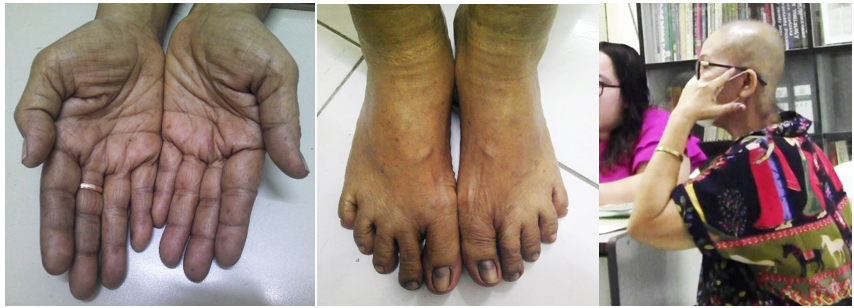
  1. Rose did what her doctors in Medan wanted her to do. She went through surgery and 11 + 5 cycles of chemotherapy. Did these treatments cure her? Unfortunately, NO. She ended up with a bald head, dark palms and feet.
  • What is more disappointing is that CT scan on 22 January 2024 showed there is a cystic lesion in her right liver. According to the report it could be due to post treatment changes, residual disease or tumour. Does this mean that the treatment causes metastasis to the liver?
  • No satisfied with the treatment in Medan, Rose came to Penang for more chemotherapy. Did the treatment help her? It is too early to say. After all, she had just received 2 cycles of chemo. But what is most baffling is that the chemo-drugs used were Irinotecan and TS-1.

Rose just had 5 cycles of Iritero – that is Irinotecan! In Penang she was given more of the same stuff. What is the whole idea? What can you expect from this treatment?

Rose was on Xeloda during her treatment in Medan. In Penang, she was given TS-1, another oral drug. Can TS-1 be better than the oral Xeloda?  Agreed, currently the popularity of Xeloda is fading and TS-1 is starting to “shine” as of now.

Let me end with this quotation.

Nose cancer: NO to chemo. Gave up radiotherapy half way. Still alive! Why?


This is an email from Linda (not her real name) received this morning:  1 March 2024   8:48 AM

Dear DR Chris,

Hi … How have you & wife been? It’s been almost 8 years since we last talk. First and foremost, the whole family would like to extend our greatest appreciation for your 5 Stars and tip top God-gifted abilities in dad’s NPC case. 

The herbal decoction that was prescribed worked wonders. I remembered within a week of consumption, he’s able to slowly regained his strength & appetite.  Believe it or not, he is still working till now! To which, I am glad to say that. 

We have successfully achieved our main initial goal, that is “to live peacefully with his cancer.”  

As of current, he is still facing the consequences of the side effects from the 13 sessions of radiotherapy that was done in 2017, i.e., weaken gum & loose tooth, hair thinning & he has not regained his sense of taste fully.

But thank God, from what I observe or physically see, there are no symptoms of an advancing cancer. He himself did not complaint of any discomfort, etc, which could be related to signs of an advancing cancer. I take it as good news. 

In your opinion, do you think it is advisable to continue with the NPC 1  & NPC 2  or do you have any other ‘magic’ potions to recommend?  

Again, thank you so much!! May God showers HIS countless blessings on you & family, and may HE bless you with happiness and rewards you for your kindness.

Thank you for your guidance & wisdom. As a Muslim, we believe in GOD’s plan, and meeting you is part of it. 

Regards, Linda.

PS: Over the years and up till now, dad has been promoting your CA Care to his circle of clients & friends. 

Within these 7 years, we met a number of our clients who are diagnosed with NPC just like dad. They completed the radio/chemotherapy treatment and within 1 year or so, without having a chance to fully recover from the side effects, they encountered a recurrence and sadly they succumbed to it. These experiences are really an eye opener. Wondering if the therapy kills the cancer first or the person receiving it?

May God bless us all with health & wealth. Looking forward to your reply.

The Story of Her Father

On Sat, Jun 10, 2017 at 3:00 AM, Linda wrote:

Dear DR Chris Teo,

I apologize for writing without the benefit of an introduction, I am writing this email, with the hope that I can schedule an appointment with you, on behalf of my father who has been diagnosed with nose cancer (T2N1).

My father, ABA, 58 years old, has been diagnosed with nose cancer (T2N1) in February 2017 and was scheduled for 33 sessions of radiotherapy and 6 rounds of chemotherapy (4 hrs of cisplatin IV infusion), with an approximate total cost of SGD$9,700.

He declined the chemotherapy treatment (oncologists here are very persistent, we had to go thru a series of ‘debates’) but complied to radiotherapy treatments.

We were initially ensured of a total recovery.   Doctor mentioned that only 30% suffered from mild side effects and seeing my father is young he is confident that my father will be able to spring back to life in seconds.

Little did we know that radiotherapy is just as bad. He is currently on his 13th session. The tormenting days started as early as day 2.  He is unable to eat – maybe because of the many big ulcers, sudden chills, fever, nausea/vomiting and scalded skin. He is so weak.

And ever since radiotherapy, I noticed he started to develop tight congestive cough at night. As of now, he said he had loss his sense of taste and hearing to his right ear.  

On 6 June 2017, during a scheduled consultation, we expressed our concern on his deteriorating health, and if there is anything that they can provide to aid him during this time, and they mentioned a list of medications in which they don’t recommended.  Their only advice is to allow his antibody to fight it off naturally.

At the end of the day, we were only prescribed with a tin of Ensure Vanilla powder. Disappointed with their lack of concerned and couldn’t help feeling betrayed, that was when we finally decided to called it off and stop the radiotherapy treatment. 

It has been more than 48 hours from his last radiotherapy session and he doesn’t seem to be getting any better.

Our family do believe in herbs but we have no knowledge on it.  We sincerely hope you are willing to look into my father case.  My father is eager to take all possible aggressive measures to combat this disease or at least to live peacefully with it. 

We understand that this is one of many such requests that come across your desk and greatly appreciate any guidance that you can give. We lived in Singapore.

Thank you, in advance, for your help. I look forward to hearing from you at your earliest convenience. 

Our Therapy Helped Him

On Wednesday, July 12, 2017, 3:47 AM.

Hi Dr Chris,

Hope all is well. The whole family would like to extend our greatest appreciation for your help, advices and herbs. Just like the pastor (link below), he is now strong enough to walk and work!

  • The swell on his right lymph node have totally disappeared.
  • Although his sense of taste has not recovered fully, but he’s eating now. Ulcers gone! 
  • Phlegm/mucus isn’t that thick anymore.
  • No more congested cough throughout night. Amazing!

Initially we had to bring the tea to him, now he will be the one asking for it!

Thank you so much. God bless u and family.

More Successful Stories

  1. The story of Eng. https://alternativecancertreatments.quora.com/ti-125865463
  2. Case of Pastor Danny.

https://cancercaremalaysia.com/category/npc-nasopharyngeal-carcinoma

It was “hell” after surgery + chemo + hormonal therapy. Herbs made her happy, happy! So where is the science?

Rina (not her real name) was a 30-year-old lady from Indonesia. She led a healthy life except that she was told there was one or two cysts in her uterus. She had the following problems during her menses.

  • She had pain about 3 days before her menses and the pain persisted until 2 days after the menses started.
  • It was a pulling pain.
  • Before menses she had pain in her back and breasts.
  • Before menses she suffered from mood swings.
  • Before menses she likes to eat sour food.

But it was not to be. In August 2023, Rina had a laparoscopic surgery in a private hospital in Jakarta. The histopathology report confirmed:

  • Salphingitis – inflammation of the left and right fallopian tubes.
  • Leioyonma (also referred to as fibroids or myomas).

The medical treatment cost Rina IDR 200 million or about RM61,000.

In December 2023, Rina underwent 3 cycles of chemotherapy. Unfortunately, she did not know the drugs used on her.  After chemotherapy, Rina was given Pamorelin injection, once a month for 3 months. Since her wellbeing was going downhill, Rina decided to stop further medical treatment.

Did the above treatment “cure” or help Rina?

Unfortunately, the answer is a big NO. That is why Rina decided to come and seek our help. Rina and her sister said each day life was “hell” for her. This happened after the completion of chemotherapy. She suffered:

  • Pain on and off. She had to take pain killer medications.
  • Once a while she had “wind” or gas in her stomach.
  • She was not able to sleep.
  • She felt tired all the time.
  • Her appetite was very poor.
  • Her urination was 5 to 6 times per night.

When I met her, Rina presented as a desperate and frustrated lady. This could be “seen” from her facial expression.  She told me that there was constant pain in her uterus.

In spite of the medical treatments, there was blood discharge for 1 to 2 days, then there was pain, then there was blood discharge again.

The pain was intense during the night or early morning. When asked to rate her health condition on a scale of 0 to 10, Rina said it was 10 – real hell that she had to go through each day.

I prescribed her some herbs to take care of her uterus, fibroid, PMS, gassy stomach and frequent urination.

The next day Rina texted me saying that her problems improved after taking the herb for only ONE day!

  1. After taking the herbal tea, I felt sleepy.
  2. Even though I felt sleepy, I have more energy.
  3. Pain in the uterus was less.
  4. Abdominal pain is totally gone!
  5. Urination frequency at night was reduced!

One month after the herbs.

Rina and her elder sister came back to Penang again. It was amazing to learn that Rina had recovered – no more hell! See the video below;

Her sister said: Before she on herbs, she would call me very often and complained about all problems that she had.  Now she is far, far better – her problems almost gone.  

Rina regained her health and was back to normal again.

ProblemsBefore the herbsOne month after taking the herbs
PainRated at 10 (scale of 0-10)Gone!
Stomach gas / windDiscomfort on and offImproved
Unable to sleepSlept at 4 or 5 a.m.  woke up after a few hoursSlept at 10 or 11 p.m. and woke up at 7, 8 or 9 a.m.
AppetiteVery poorAppetite normal
Frequent urination5 x per night2 x per night
No energyPreferred to stay homeLike to go out and be on the move

Comments

  1. I spent some time trying to understand the reason for her menses problem. After some questions, it appears to me that Rina suffered from PMS (premenstrual syndrome).

Over the years, I have helped many ladies with PMS. This can be easily solved by taking our PMS herbs for a month or two.

  • With her problems, Rina went to a private hospital for surgery. This baffles me! Does Rina really need surgery for her problems? Can this be solved by a much less invasive and cheaper way?

Please reflect on the quotations below:

  • Even more baffling is that Rina had to undergo chemotherapy! Based on the histology report, Rina did not have any cancer. Why does she need chemotherapy? Is this just a case of prevention stretched a bit too far?  Rina suffered from inflammation of the left and right fallopian tubes. Surgery was done to take care of that. Did she really need chemotherapy for her inflamed fallopian tubes which have been removed? Where is the science in that?
  • After 3 cycles of chemotherapy, Rina underwent hormonal treatment with Pamorelin. This is even more baffling. Why Pamorelin? From the internet, I learned that  Pamorelin is used to treat prostate cancer! Prostate cancer drug on the lady? A lady can have prostate cancer? Does it sound right or scientifice?

Oh, no – Pamorelin is also used to treat endometriosis in women. That is what scientific medicine say? You buy that? Say what you like, the medical report never mention that Rina suffered from endometriosis anyway! She has fibroid.

  • It looks like Rina has be overtreated. Is this not the reason why Rina suffered badly after her chemotherapy?
  • Since I am not able to know the name of the chemo drugs used, I am not able to speculate why Rina suffered so badly. But for Pamorelin, the main side effects of this drug are: hot flushes, night sweating, vaginal dryness, headache, dizziness and nausea, to name just a few!

My final comment.

Ladies, it is your life. Decide carefully before you allow anyone to use the knife and toxic drugs on you. These may not be the answer to your problem.

Cervical Cancer: She died after surgery, radiotherapy and chemotherapy.

During this Chinese New Year 2024 – the year of the Dragon! – I had the opportunity to read two books  The Red Light Therapy and The Cancer Industry – Crimes, Conspiracy and the Death of My Mother. Both of them were written by Mark Sloan of Ontario, Canada.

Mark’s mother had cervical cancer. She died after surgery, radiotherapy and chemotherapy. Mark wrote:

  • (This) happened when I was 12 years old. My father called a family meeting in the living room and sat my sister and I down on the couch. We had no idea what he was about to tell us but he looked upset … and I knew at that moment something was terribly wrong.
  • Dad told us that our mom had cancer.
  • Doctors found a cancerous lesion on her cervix about the size of a baby fingernail. Dad told us they had detected it early and were going to rush her in for surgery followed by radiotherapy to ensure the cancer wouldn’t return. He assured us that treating her quickly would give her the best chance of survival, and we’ve got the best doctors in Canada working on her.

After surgery and radiotherapy …

  • Six difficult months passed … back into the hospital for re-assessment. The cancer had spread to her hip area and they wanted to do chemotherapy. 
  • The dramatic decline in her health immediately following chemotherapy was disturbing. Within days of her first treatment, her legs swelled up so badly that she could no longer walk. The poison injected into her veins reduced her jaw muscles to scar tissue so she could barely open her mouth to talk. Chewing food was out of the question so she was reduced to a liquid diet and we began bringing her smoothies.
  • My mom was able to return home shortly after chemotherapy treatments but her return wasn’t at all glorious like I had imagined. I remember laying in bed late at night and hearing her downstairs crying in excruciating pain. My mother went from looking like a healthy middle-aged woman to something approximating a prisoner of war who had been captured and tortured by the enemy.
  • The confusion began to set in and then quickly turned to anger: Why was my mother in pain? I thought we had some of the best doctors working on her giving her the best treatments available. She was supposed to get healthy but the treatments have made her worse!!!

A couple months later…

  • When I got downstairs, Dad was a mess; unable to hold back his tears and struggling to speak.
  • Dad told us that our mom was gone.

Time to Ponder and Ask Questions

  1. Cancer – surgery, radiotherapy and / or  chemotherapy, etc. The patient died. Does this happen often to cancer patients? Unfortunately, the answer could be yes or most likely.

For the following questions, I shall not answer the questions posed but rather quote what Mark Sloan wrote in his books.  

2. Can medical treatments cure cancer? This is what Mark wrote (pg. 44) in the Red Light Therapy:

    • It’s been almost 50 years since the war on cancer has been declared and yet more people are diagnosed and dying of the disease than ever before.
    • If you give somebody 50 years and around $500 billion dollars in research money to find a cure for cancer and they literally come up with nothing, what do you do? You fire them and find a new approach.

    Yes. Many people are being fed with the propaganda that cure is just around the corner! Really?

    3. Why can’t they find a cure?

    Mark wrote on page 45 of his book:

    • An industry that makes $126 billion dollars a year will never give us answers, if these answers would mean putting itself out of business.
    • It is up to us as individuals to understand what cancer is, and the most efficient ways to remedy it.

    4. What can be the reality of today’s medical treatments for cancer?

    Mark wrote on page 45/46

    • We’ve all seen at least somebody in our lives undergo surgery, chemotherapy and radiotherapy and then come out far worse than before. I saw it happen to my mother when I was 12 years old. As soon as she received chemotherapy, it was like she got hit by a truck. Instead of recovery, she died a few months later, and every moment from chemotherapy to death was spent in agony.
    • It is common sense that cutting a sick person with a knife, injecting poison into their bodies, and burning them with ionizing  radiation will make their health worse.
    • It is time to learn from history and take action instead of ignoring it.

    5. After much reading, did Mark learn anything?

    In his book The Cancer Industry – Crimes, Conspiracy and the Death of My Mother (page 107), this is what he said:

    • When human being is sick with cancer, they deserve the absolute safest and most effective medicines known.
    • Yet in this world, cancer patients are routinely rushed into oncology centers where doctors sentence them to death using treatments that make industrial animal slaughterhouse look humane.
    • My mother didn’t die of cancer. She was murdered-for-profit by an industry that cares more about making money than saving lives.
    • The monstrous $126 billion dollar cancer industry, hell bent on preserving its profits at any cost, continues its murderous rampage to this day.

    The above is Mark’s view. This is what he had learned. You may not agree with him. This is your right.

    Let me end by quoting what Dr. Richard Smith said below. Dr. Smith worked at the British Medical Journal for 25 years, serving as editor in chief of the BMJ. Don’t you think he knew “something” that you and I do not know?

    Quotations from a professor turned patient

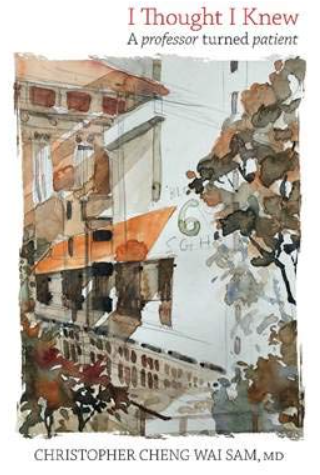
    The Author: Professor Christopher Cheng is the CEO of Sengkang General Hospital and Senior Consultant Urologist at SGH and Singapore General Hospital. He is a pioneer in using robotics in prostate cancer surgery.

    • I thought I knew about prostate cancer … I have done countless … cancer operation for the prostate. I thought I knew… until I became a patient myself, lying on a cold operating table one Saturday morning in December 2017.
    • The reality is cancer can hit anyone.
    • The naked truth of what I went through may be shocking to some who have been led to believe erroneously, that modern healthcare, will all its glamorous robots and high-tech equipment, has a solution to almost anything.
    • Not all prostate cancers need to be cured or even treated and not all cancers that need treatment can be cured.
    • The treatment should not be worse than the disease itself and often more treatment is not necessarily the answer.
    • There are many both young and old who … believe that when the time comes, they can just check into the hospital and have everything fixed.
    • We will take care of you, but you must take care of yourself too.
    • (Doctors should) provide guidance and gentle nudges and support rather than coercion in their (patients) decision making … they are the ones who are on the operating table, they are the ones who have to live with the consequences.

    Lessons We Can Learn from Professor Christopher Cheng, Singapore’s top doctor for prostate cancer.

    Sometime in mid-November 2023, a friend forwarded me this link: https://www.todayonline.com/singapore/doctor-diagnosed-advance-prostate-cancer-lessons-death-dying-compassion-2226691.

    After reading this article, I became more curious and wanted to know more about who Professor Cheng is, and more importantly to learn from him what it is like to be a prostate cancer patient when he himself is an expert of prostate cancer.

    I surfed the internet and got this link: https://www.cgh.com.sg/news/patient-care/more-medicine-may-not-be-better. This article, More medicine may not be better is indeedmind-boggling when you know that it comes from an outstanding cancer expert himself.

    Let me stop at that.

    Let me share with you what I have learned from the above two articles. To let you know, I did not stop at that – I ordered the book I Thought I Knew written by Prof Cheng himself. I read the book. Later I shall write again, Part 2!

    Prof Cheng, CEO of Sengkang Health and Senior Consultant, Department of Urology, Singapore General Hospital wrote:

    • Some time ago, I bade farewell to a good friend. I have operated on him to cure his cancer barely three months earlier, but his condition still progressed rapidly.

    This friend eventually died. Before his death, this friend told Prof. Cheng:

    • Don’t let me suffer pain and I won’t want more chemotherapy.

    Prof Cheng quoted what Willet Whitmore – another prostate cancer expert at the Memorial Sloan-Kettering Cancer Center – said:

    • Is cure necessary in those for whom it is possible, and is cure possible in those for whom it is necessary?

     According to Prof Cheng:

    • For a large range of cancers, cure may be necessary but not possible, as in the case of my friend.
    • For the rest, cure is unnecessary, even though it is possible.
    • We should question if more medicine is better. 

    So, cancer patients, ponder carefully and seriously what Prof Cheng said.

    This is one reality that everyone of us need to know and accept – cure may be unnecessary, or cure may not be possible. I am reminded of a friend, Steve – a British engineer who chose to settle down in Bangkok. He too had prostate cancer. He went to Singapore and was put on Intermittent Triple Androgen Blockage Therapy. He then gave up this medical treatment and opted for alternative therapy. That was when he wrote to me for help. Diagnosed with prostate cancer in 2007 at the age of 63, Steve was till okay until 2023 (16 years without doctor’s medication).

    In 2023, Steve had a swelling in his cheek. It was diagnosed as parotid cancer. He wrote me and asked for help again. He took our herbs for about three months, but the tumour did not go away. He was okay but had occasional pain. But every morning when Steve woke up, he looked into the mirror and felt (or imagined)   that the tumour was getting bigger and bigger. Then Steve wrote that he had found “the best doctor in the best hospital with the best equipment” in Bangkok who could remove the tumour and make him live longer! Anyway, according to Steve, our herbal therapy is not a scientifically proven therapy! I fully agreed with Steve. So I told Steve: Go ahead and follow what your heart says. He went for surgery, suffered badly after that, and died 3 months 13 days later.

    Little or No Benefit of Surgery.

    In 2012, Pamela Owen wrote this news article Prostate cancer surgery ‘has little or no benefit’ in extending life of patients (http://www.dailymail.co.uk/health/article-2136512/Prostate-cancer-surgery-little-benefit-extending-life-patients.html):

    • The Prostate Intervention Versus Observation Trust (PIVOT), led by Timothy Wilt, started in 1993 and analysed 731 patients over 12 years. The study compared surgically removing the prostate gland with ‘watchful waiting’.
    • The study found that there was little difference between the two.
    • Those who had an operation to treat the cancer had less than three per cent chance of survival compared with those who had no treatment.
    • Surgery has little or no benefit in extending the life of a patient.
    • Experts are believed to be ‘shaken’ by the news because thousands of men could have gone through painful and unnecessary surgery.

    From the article Doctor diagnosed with advanced prostate cancer learns lessons on death, dying and compassion, written by Eveline Gan on 5 August 2023, I learned more interesting lessons from Prof Cheng:

    • I was this arrogant, impatient young surgeon, thinking I’m a godsend for mankind — until I became afflicted with prostate cancer, an area I’m supposed specialise in.

    We are all human. All of us have our ego. It is only a matter of degree. Most cancer patients told me that if they asked the doctors too many questions, the doctors would become angry at them. Some doctors reacted this way – You are the doctor, or I am the doctor – meaning, if you don’t listen to my advice get out of my office! One patient once told me the oncologist just threw away my file against the wall because I did not agree with him.

    Since not many cancer experts themselves get cancer, it appears that it is hard for them to understand what it is like to be a cancer patient. So, in this case Prof Cheng is an exemption.  And he shared his experiences and feelings. Bravo! Thanks.

    Over the years, at CA Care, I have adopted an open attitude when dealing with cancer patients – we are here to help those who need our help. We hope to make your life better after all medical treatments have failed. The language of love and compassion is not about trying to prove who is right or who is wrong. It is about recognizing limitations and exploring opportunities. What matters is our patients should get better.

    Hidden Agenda.

    Prof Cheng’s PSA was at 17.8 when he was first diagnosed with prostate cancer. He said:

    • In some (overseas) centres, if you have prostate cancer with a PSA of 17, the top surgeons will not operate on you because it would tarnish their results.

    Prof Cheng explained further that some famous centres do not offer potentially curative treatment to patients with a PSA of more than 10, because poor outcomes may affect their reputations unfavourably.

    This is a most shocking, a new knowledge that I have learned! It never occurred to me that in medicine there is such a “hidden agenda” as this – that is, certain medical experts would not offer treatment just to preserve their reputation. They want to pick and choose – only cases that they are sure they can win only! Is that a noble mission?

    Over the years, I have been writing about experts giving all sorts of treatment just to “make money” – never mind if the outcome is unattainable. Professor Welch describes such attitude as You eat what you kill!

    Over the years, I have seen many prostate patients. It never occurred to me that PSA 17.8 is very alarming, although it may mean the patient has cancer. Many patients who came to us had PSA of 531, and in some cases their PSA was even at 6,963 or 7,292. It never occurred to me that 17.8 is already a disaster! Another new lesson learned.

    No to “kitchen-sink” treatment after surgery.

    After his prostate cancer surgery, Prof Cheng said the oncologist proposed an “all-in kitchen sink” approach to treatment. In my twenty-seven years dealing with cancer, this is the first time I encountered this word – kitchen sink treatment! In layman language it means going for maximum treatment available.

    Indeed, I was surprised and baffled at what Prof Cheng said:

    • I didn’t want an all-out treatment that would most likely give me many side effects.
    • I don’t think that being at the receiving end of the kitchen sink is going to make me any happier.

    In other word, Prof Cheng did not want to undergo chemotherapy! Perhaps we need to recall what he had said earlier: In cancer, cure is unnecessary, or cure may not be possible. Unfortunately, not many patients buy this idea. They believe that with money they can go to the best doctor in the best hospital, and they can “buy” their cure! No, the reality is you may end up in a more dire situation – money gone and the patient died a miserable death.

    While writing this article, I received an e-mail from the daughter to a prostate cancer patient.

    Hi Dr Chris,

    My Dad is suffering prostate cancer Stage 4. It had spread to bone, liver and some other area. He is 77.5 years old. He had received:

    • Hormone therapy
    • Chemotherapy
    • Lutetium LU 177
    • But his cancer is still spreading.

    My Dad is a bit weak now, he lost his appetite and is also anaemic. Thank you so much Dr Chris, hope to hear some good news from you soon!

    From the medical report, I came to understand that:

    1. In 2016 he had radical radiotherapy and adjuvant ADT (androgen deprivation therapy).
    2. PSA went down to 0.5. 
    3. On ADT throughout except a period in 2020.
    4. In early 2021 his PSA rebounded. Recommenced ADT with brief response.
    5. Later in April 2022 Casodex was added to the treatment.
    6. No PSA response.
    7. In June 2022, he took Daroltamide.
    8. In August 2022: Suboptimal response to Darolutaminde.
    9. In December 2022 his PSA was at 27. Right inguinal node at least 3 cm.
    10. 21 December 2022: Underwent chemo with Docetaxel.
    11. Carboplatin added to Docetaxel in C3, as PSA was not dropping much initially.
    12. PET scan post C6: Mixed response with one new spine metastasis.
    13. By C9, PSA trending upwards from 16.3 to 16.8 to 17.9.
    14. 6 June 2023: Started on lutetium 177. PSA 15.0
    15. 20 July 2023: Legs showed DVT (swollen below the knee due to deep vein thrombosis).
    16. 1 September 2023: C2 luteteum. PSA rose to 43 (this is 8 weeks post C1 letuteum).
    17. 11 September 2023: PSA decreased to 38.
    18. Creatinine rose from 108 to 150.
    19. 13 September 2023: Repeat PET scan metastasis in multiple nodes and other parts of the bones.
    20. The daughter wrote: After that he went to China and received radioactive particle seed, and one cycle of chemo using mitoxantrone.

    Question: Did the patient get any better after spending a bomb for these treatments? What was the total cost of the treatment? I did not have a chance to ask this question because the daughter did not turn up for her appointment!.

    The blood test results on 30 November 2023 showed the following:

    • PSA = 249.90
    • SGOT/AST = 82 (normal less than 40)
    • Gamma-GT = 436 (normal less than 71)
    • Alkaline phosphatase = 513 (normal 40 – 129)
    • Creatinine = 2.69 (normal 0.67 – 1.17)
    • eGFR = 23.64 (less than 15 means kidney failure).

    According to the doctor the patient has progressing mCRPC (failed NHA, chemotherapy and more recently lutetium) complicated by left hydronephrosis … causing new renal impairment. He has new PSMA avid liver lesions. He may also need early radiotherapy to the left pelvic node and posterior iliac bones.

    One more important question to ask: If he is your father, who is already 77 plus years old, would you agree to let him go for more treatment? What do you expect to get at the end of the game?

    Cancer: Fight it or Live with It, Your Choice!

    We recognize that our work at CA Care is at odd with current medical thinking. Modern medicine wants to kill or shrink the tumour. And in the process kill the patients too. In The War on Cancer – an anatomy of failure; Dr.  Guy Faguet, a cancer researcher, and medical doctor, wrote:

    • An objective analysis of cancer chemotherapy outcomes over the last three decades reveals that … the cell-killing paradigm has failed to achieve its objective … a model based on flawed premises with unattainable goal, cytotoxic chemotherapy in its present form will neither eradicate cancer nor alleviate suffering” (pg.89).

    At CA Care we teach patients to live with their cancers. Concentrate on what matters. We don’t know how to cure your cancer and we don’t pretend we can cure your cancer either. But we know how to make your life better. If you can eat, sleep, walk, have no pains, and can live a bit longer of meaningful life – what else do you want?

    Prof Cheng reminded us:

    • However rich, however powerful (they) are, they’ve all had to face death eventually. They all have to let go,
    • The difference, however, lies in how one faces death.

    Death is Not a Failure

    At CA Care we tell our patients not to fear death. Everyone has to die. You don’t have to have cancer to die. I have seen many cases where the cancer patient did not die but it was the healthy spouse who died first.

    Dr. Bernie Siegel wrote:

    • I experienced being unhappy as a doctor. I was uncomfortable with the mechanical approach that we are taught in medical school. My success is measured by whether or not I saved your life. If I can’t save your life, I’m a failure. But now I don’t feel like a failure. I can help you live. After all you’re not going to live forever, no matter what I do.

    There is an Indian saying:

    • When you are born, you cried and the world rejoiced. Live your life in such a manner that when you die, the world cries and you rejoice.

    To me, this is the secret of how we can triumph and give meaning and beauty to our own death. We leave this world with a sense of pride and accomplishment knowing that we have done our best to make it a slightly better place for those we leave behind.

    Richard Reoch (in Dying Well) wrote:

    • People who have lived fully are not usually afraid to die. We must all die. Death is, after all, the natural end of life. Yet some people fear death.
    • We often make the mistake of trying to keep a dying person alive as long as possible, no matter what the cost.
    • There are many occasions when the kindest thing to do is not to hunt for “better medicine” or a “better doctor” but to be close to and supporting the person who is dying. Let them know that you are glad for all the time, the joy and sorrow you have shared … In the last hours, love and acceptance will do far more good than medicine.

    Dr. Bernie Siegel (in Peace, Love & Healing) said:

    • It is important that we realize that we can never cure everything. We will never find … cure for all the diseases. Dying can be a healing, ending a full, rich life for someone who is tired and sore and in need of rest.