The Desperate and Unproductive Hunt for the Non-Existent Cure For His Lung Cancer

Tag (not real name) was a 59-year-old man from Indonesia. In April 2011, he had coughs with itchy throat. He went to see his doctors and was give medication but these did not help. In August 2011, he came to Penang for further consultation.  A CT scan on 22 August 2011 showed an irregular mass (6.6 x 8.0 cm) in the upper left lung extending to the pulmonary hilum with left hilar and mediastinal adenopathy. He also complained of pain in the left pelvis. MRI done on 6 September 2011 showed lesion at the body of C6, body and left pedicle of the L5 vertebra. This was probably metastatic in nature.  The doctor said Tag had a Stage 4 cancer.

Subsequently Tag underwent 5 sessions of radiation treatment to his neck area.  He also received Zometa injection and the oral drug, Tarceva. But later EGFR testing showed no mutation so Tarceva was discontinued. Tag underwent chemotherapy with Alimta (Pemetrexed ) plus cisplatin.

Tag was told that chemotherapy would not be able to cure him but would prolong his life. He was told he had 6 months to live.

After radiation and chemotherapy Tag seldom cough and the pain in the cervical and lumbar vertebrae nearly disappeared.

Re-examination of his chest CT scan showed his lung tumour had increased in size. Tag went to China for further treatment in October 2011. In China Tag underwent a biopsy again.  The cancer was again confirmed as a poorly differentiated adenocarcinoma.  Tag underwent the following treatments in China:

  1. Microvessel interventional chemotherapy using Alimta + cisplatin and nano material.
  2. Cryotherapy under CT guidance.
  3. Iodin-125 seed implantation under ultrasound guidance – 10 seeds were implanted in the lymph nodes.

All done, the treatment in China consisted of 5 cycles of chemotherapy, 2 times of cryotherapy and one Iodine seed implantation. The treatment was spread over  a few visits, each lasting 1, 3 or 6 weeks.

In March 2012, Tag returned to Indonesia and continued to receive chemotherapy with Alimta at the local hospital.

In August 2012 Tag returned to China again. After receiving one cycle of chemotherapy his condition “dropped” (worsened). He was asked to go home to Indonesia.

Not satisfied, Tag came to Penang again – to be hospitalized in the same hospital that he had received his first treatment.  His main concern was his elevated leucocytes count. He was rather obsessed with this high number.  He was only given antibiotics infusion because he refused anymore chemo-drugs. In spite of the antibiotics Tag’s leucocytes count remain stubbornly high.

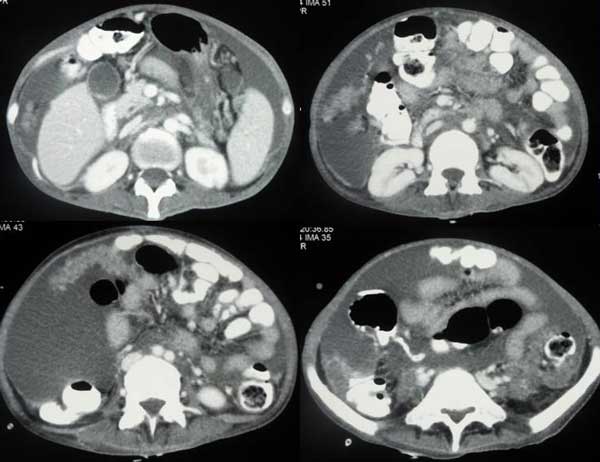
In the meantime while in the hospital, Tag’s wife came to CA Care and asked for our opinion.  The following are the images of his CT and PET scans.

Based on his medical history and failed medical treatment, I told Tag’s wife to learn how to accept and face reality. There would be no cure. And for him to come to Penang and check into a hospital trying to reduce his leucocytes count was surely mind boggling! He was barking at the wrong tree! Perhaps this is what Professor Jane Plant meant when she wrote, Conventional cancer treatment can process patients to the extent that they no longer understand what is really being done to them.  They have lost the ability to think rationally! They come wanting to only hear that they can be cured.

Tag’s wife told me that after a few days on antibiotics infusion, the doctor planned to do a PET scan. I objected to this idea. What is the whole rationale of doing scan  over and over again? Know that all these procedures are not good for cancer patients. Do it only if it is absolutely necessary. Just two months ago, you did a CT scan. Now you want to do it again. What do you expect to see and get?

I advised her to bring Tag home as soon as convenient.  And if he was agreeable to take herbs, then he can start on our therapy while at home. If he were to stay in Penang, he would have problems cooking, preparing the herbs, etc. It would do him a lot of good to stay home in a familiar environment.

Unfortunately, the next day my wife received a SMS informing us the Tag would want to go ahead and do the PET scan!

A few days later, Tag and his wife came to our centre after being discharged from the hospital. No, his stay in the hospital receiving the antibiotic infusion did not do any good at all. Then Tag complained that his arm was painful after the PET scan and asked if I have any herbs for this. My answer, Go back to your doctor and ask him to “repair” you.

After some days in Penang, Tag and his wife went home to Indonesia with a supply of herbs.

Sometime later, I received an email from his son informing that Tag had gone into a hospital in Jakarta. He still complained that his leucocytes count was high!  After a few days, his son wrote to say that Tag did another PET scan and this time he was concerned with the infected lymph nodes in his neck.

On 14 October 2012, I received an email from a medical doctor who is actually Tag’s relative. This is what the lady doctor wrote:

Hi Prof, I had sent you an email last week, did you receive it? Prof, last couple of weeks there was my family member with lung cancer  who  came to Penang..Now he is in hospital in Jakarta. There is fluid in his lung, The main tumor in his lung grew bigger and so he experienced dyspnea (breathlessness). Doctor wanted to do radiation to the main tumor  because it is pressing his airway. I want to ask, can we give him Ascites tea? What do you think of radiation? He keeps drinking your tea. What about the radiation, should he do it? Thank you for your help. Best regards

Reply:  Hello  B. Sorry for taking so long to write you. I have been busy with so many patients needing my attention. Okay about your relative. I am afraid it is difficult for me to say anything or help. He did not follow my advice. Even when he was in Penang he was in the hospital trying to make his leucocytes count lower!!! I told him you are doing the wrong thing in the wrong hospital. When the doctor wanted to do PET scan his wife SMSed my wife. I told him earlier not to do the PET scan.but the next day he did the PET scan! After he went home to Jakarta his son wrote that he had another PET scan!!!

I really don’t know. Since he is in the hospital, let the doctors take care of him. He is NOT like you …you followed what I said. He did not. Well, that is the way it is. I am not angry but I just give up. It is better for me to move on and help others who really need me. Take care and I believe you father is doing fine. Regards, Chris

23 October 2012: Prof, thank you for your reply, but unfortunately patient died last week in a hospital. He had been in ICU for 1 week. I have same problem here too. One of my family member  — 29-year-old, breast cancer metastised to the bone, liver, brain, pancreas and lungs. She did all that the doctor instructed — TACI, streotactic for her brain, etc. It is very difficult to persuade any person, if she does not believe us …even after she saw my father’s case. I also give up. Let her make her own decision. At least I have given her all the information. My father is in a good shape, he is gaining weight 12 kg, but still on Iressa. Regards, B.

(Note: Why did this lady doctor, B write such an email? The full story of her father’s recovery from advanced lung cancer is found in my latest book  below – Chapter 11 Lung-Bone-Brain Cancer: When Doctor and Herbalist Collaborate Miracle Happens.)

(Available at http://bookoncancer.com/productDetail.php?P_Id=56)

 Comments

  1. Blind faith and trust in technology

2. Difficulty to recognize that doing nothing could be a better option!

The behavior of this patient really puzzled me.  He came to ask for our opinion. He wanted to try our herbs, but he would not listen to what we say. There is no reason for such person to come and see us in the first place! Even more so, this man had done all the medical treatments and nothing had helped him. But why go on doing the same thing all over again?
In trying to understand him, I asked, What is your occupation?  This is one question I would never my patients, especially during the first visit. To me who you are is not relevant and I don’t want to be bias or influenced by your answer. But in this case I thought by knowing what he is will shed some light about the attitude of the person. His answer:  I am an administrator in the government.  That explains it all. I told him, Your job is to make people follow rules. If they don’t follow what you say, you give them “hell.” You follow the rules handed down to you without questioning.  You can do that with the human beings that you “administer”, but unfortunately cancer in you does not behave according to your wishes or rule. You have cancer in you and you want the leucocytes count to come down – by just decreasing that number does not cure you at all. I told you not to do the PET scan but you did it anyway because the doctor said so! You follow “the authority“ like you do in your job. Unfortunately it does not work when it comes to cancer. 

3. Not all patients who come to us find healing!

At our centre is a poster on the wall. It says:

You come to find the best doctor
There is none here, because the best doctor is found within you. 
We too wish to find the best, that is the best patient.
For it is with the best patient that we can both find healing together — for you!
Tag came to us after knowing that the father of the lady doctor above recovered from his lung cancer. This man had cancer in 2010, a year earlier than Tag. His cancer is more advanced than Tag’s –having spread from his lung to his brain and bone. Yes, this man is still doing fine as of this writing.  Why does he not die likeTag? It is because he chose “to do nothing.” Doing nothing does NOT mean that you go home and wait to die! It means you do not need to follow “the so-called established authority” and follow what they tell you to do. Dr. B’s father refused to “medical authority”. He went for alternative therapy. Unfortunately it did not work out well at first. He went down to the bottom of the pit before he found CA Care. That was when his two daughters flew to see us in Penang asking for help. Daughter B is a medical doctor and we agreed that we should work together and avoid as much invasive and toxic treatments as possible. The patient recovered.

Tag was able to see what happened to Dr. B’s father, who actually is a relative. But Tag wanted to follow his own path – doing things his own way. He followed the well established “rules” because he was “trained” not to question “authority.”

We just have to learn to understand him!
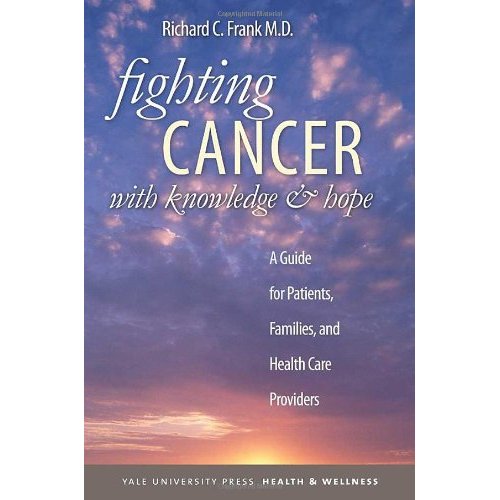
Fighting Cancer With Knowledge & Hope

Reviewed by: Yeong Sek Yee & Khadijah Shaari

THE AUTHOR:Dr. Richard C. Frank, MD,an oncologist, is the Director of Cancer Research, Whittingham Cancer Center, Norwalk Hospital, Norwalk, CT, and Medical Director, Mid-Fairfield Hospice, Wilton, CT.USA

WHAT THE BOOK IS ABOUT:  As expected, the whole book is devoted mainly to describing the virtues of conventional treatment of the various types of cancers via surgery, radiation, chemotherapy, targeted therapies and hormone therapies. However in the chapter on How Cancer Grows and Cancer Treatments at Work”,Dr. Frank gives an explanation as to why chemotherapy may not work for you. We summarize the main points below:-

CANCER CAN GROW UNPREDICTABLY (pages 124-126)

a)      Although cancer appears to develop in an organized fashion when viewed from the outside, if we were to go inside a tumour with a little magnifying glass and monitor the movement of cells and the integrity of DNA; we would see a much more chaotic situation.

b)      As a cancer develops and grows, the DNA that guides it along is prone to change…. as a cancer grows, its genetic makeup becomes diversified, which leads to a diversity of cell types within it…. cancer is not a collection of identical cells.

c)       The tendency of a cancer to generate cells with different capabilities explains many of the dreadful aspects of cancer that patients find so hard to grapple with:

  • Why it can spread from one location to another,
  • Why it stops responding to a treatment that was working,
  • Why it can return when it was in remission

The reason is that every cancer, whether it arises in the lung, breast, prostate, bone marrow, or elsewhere, contains different populations of cells that have distinct properties.

d)      A cancerous tumour does not contain billions of identical clones. Cancer could never develop in this way because it must avoid the immune system’s attack on it, live in areas of low oxygen tension, and compete with the rest of the body for vital nutrients.

e)      Inside any tumour are cells that are living and cells that have died. There are cancer cells capable of reproducing many others, called cancer stem cells, and cells completely devoid of this capacity. Cancer’s diversity is generated early. By the time it is diagnosed, some cells may already be capable of metastasizing and others may be able to withstand a particular cancer treatment. This is the basis of cancer’s resistance to treatment i.e. chemotherapy (see section “Why Do Cancer Treatments Sometimes Fail?”).

f)       When new cancer cells are generated inside a tumour, some will be hearty enough to survive and others will not be. If some cells survive the treatment, then it is mainly because their DNA contains the necessary alterations that help them resist the chemotherapy drug; this population of cells will then expand, and the compositions of the cancer will again change. (page 126)

g)      …. when a cancer returns after being declared in complete remission, it is because a few cells were different enough to stay alive after a treatment killed nearly all the other cells; this difference could have been present from the start of treatment or it could have developed as a response to it. Whichever occurred, it is cancer’s ability to diversify and adapt its DNA that enables it to survive. (page 126)

WHY DO CANCER TREATMENTS SOMETIMES FAIL? (PAGES 188-190)

(a) Drug resistance or the growth of cancer in the face of ongoing or recently completed treatments represents the main barrier to cure for many cancers…. (page 188). In many instances, oncologists cannot specify why a person’s cancer develops treatment resistance…. treatment resistance is probably the most complicated area of oncology. (page 189).

(b) The root cause of a cancer relapse lies in the fact that cancer is not an accumulation of exactly the same cells but rather a mixture of cells with differing properties. Some may have sensitivity to certain drugs and be killed by them, whereas others are resistant to those drugs. The resistant population will survive treatment and in time be detected as a cancer relapse. (page 189)

(c) Drug resistance may be present in an untreated cancer or emerge in response to therapy…. the innate adaptability of cancer cells and how they can sometimes outwit an effective therapy by altering their DNA or other molecules. This property explains the acquisition of resistance during a cancer’s growth. (pages 189-190)

(d)   Chemotherapy may lose its effectiveness when cancer cells activate a protein that pumps the drugs out as soon as they enter the cells; targeted therapies may lose their ability to control their targets when those receptors and signalling proteins mutate and morph into different shapes; hormone therapies may stop controlling cancer growth when estrogen or androgen receptors undergo a shape change or get massively overproduced, overwhelming the drugs meant to neutralize them. (page 190)

(e)   Several types of cancer have been found to contain a very small population of cancer stem cells, which are believed to be responsible for continually replenishing the pool of cells in a tumour. It turns out that an additional property of these cancer stem cells is their natural resistance to chemotherapy and other cancer treatment.

(f)     Some chemotherapy drugs (as well as radiation therapy) may contribute to (or directly cause) the development of new cancers many years after treatment (page 174). And it has been known for decades that chemotherapy alone cannot eradicate the advanced stages of the most common cancers (page 175).

TARGETED THERAPIES: (PAGES 175-180)

The current hot trend is to offer targeted drugs like Erbitux (for colorectal, head and neck cancers), Rituxan (for lymphoma), Herceptin (for breast cancer), Tarceva(for lung cancer), Sutent (for kidney cancer) and etc. Once in the bloodstream, they act like heat-seeking missiles, locating cancer cells wherever they lurk and gripping onto them via one specific receptor target (among thousands of receptors) that projects from the outer surface of the cells. The result is that the receptors stop transmitting growth signals inside the cells (page 177).

(a) Are targeted therapies “magic bullets”?

According to Dr Frank …..” although targeted therapies were developed with the hope that they would be magic bullets that would neatly eradicate cancer through selective targeting of one critical molecule, in general they have fallen short of this lofty goal. No cancer is considered curable by treatment through a targeted therapy alone… (page 180) The reason for the muted success of targeted therapies is that most cancers are caused not by one genetic derangement but by several; no one target functions as an Achilles heel. “(page 180)

(b) Do targeted therapies cause side effects?

“Like any other drug taken for any purpose, unintended effects may occur with these medications. Generally speaking, targeted therapies are easier to tolerate – less hair-loss, smaller declines in blood counts, less nausea… still, substantial side effects may occur with some targeted therapies, and they tend to increase the toxicities of chemotherapy when used in combination.” (page 182)

Finally, angiogenesis inhibitors (like Avastin, Sutent, Nexavar, Thalomid) constrict blood vessels not only inside tumours but also in other parts of the body. As a result, they often cause some degree of high blood pressure and are associated with an increased risk for kidney damage, bleeding, stroke and coronary artery blockage. (page 183)

In conclusion, we quote two very relevant statements by Dr. Frank:-

i.      Efforts to blast away metastatic cancers with mega doses of chemotherapy have fallen short because they do not root it out but rather cause more harm than good: the cancer is still present and the patient is sicker than ever. (page 143)

ii.      Even though billions of dollars are invested in cancer research every year, most new drugs in the research pipeline will extend life rather than the silver bullets that pierce the heart of cancer. (page 145)

THE FOLLOWING ARE SOME WORDS OF ADVICE BY DR FRANK ON NUTRITIONLpages 102-110.

Although the whole book is about conventional cancer medicine, Dr Frank did make some notable comments/advice on diet and cancer (not the”eat anything you like” type). We summarise the main points as follows:-

a)      …the contribution of diet…to the development of cancer is so large that if behaviours could be changed, many cancers could be avoided altogether(and many oncologists will be without jobs).  Almost 30 years and a great deal of research later, the link between poor nutritional habits…and the development of cancer have been solidified…


b)      A large and ever-growing number of studies indicate…..cancers are highly influenced by one’s pattern for living: a diet high in red meat and animal fats and low in fruits and vegetables…contributes an unhealthy pattern for living that often leads to major illness.

c)       Diet can promote or inhibit the formation of cancer…through:-

(i)      The presence of carcinogens in food (which can be natural constituents or man-made additives);

(ii)     The generation of carcinogens by cooking…when foods are smoked, fried, or grilled, polycyclic hydrocarbons are produced;

(iii)    The increased exposure of the body to carcinogens by a diet low in fiber, which slows down bowel movement;

(iv)    ”over-nutrition” or excess body weight.

d)      Excess body fat promotes the development of cancer because it leads to two important changes in the body’s chemistryLpage 109)

(i)      The development of the insulin resistance syndrome or metabolic syndrome; and

(ii)     The increased production of estrogen.

e)      More fat, more estrogen, more breast cancer.  The ovaries are the main source of estrogen production in menstruating women.  When ovarian function ceases upon menopause, estrogen is still produced in the female body, although in lesser amounts.  In post-menopausal women, fat becomes the main estrogen factory, with higher body weights correlating with higher estrogen levels…and estrogen stimulates the growth of the breast and uterus. Just as the normal cells in these tissues multiply in response to estrogen, so do (most) cancers derived from them.(page 109)

f)       The connection between fat and breast cancer is in part caused by the fact that fat contains an enzyme called aromatase that increases estrogen production.  So even after menopause, when the ovaries have ceased producing estrogen, the hormone still gets made in the body.  That’s why a class of medicines called aromatase inhibitors (AIs)…. blocks aromatase from working and thereby drastically reduces the levels of estrogen in the bloodstream.  Examples of AIs are femara (Letrozole), anastrazole (Arimidex)(page 110)

Note: This book was published in april 2009. Isbn no: 978-0-300-1510-2

Part 3: The Last Option: CA Care Therapy After Chemotherapy Had Failed

This case study consists of three parts.

Part 1: The High Cost of Staying Alive In a Private Hospital.

Part 2: Eleven to Nineteen Drugs A Day Could Not Cure Her – Rather Die Than Suffer More. 

MM came with her sister’s medical reports and scans below:

Facing Up to Reality

Having seen the scans and medical reports, the first thing I told MM was for her to be ready to accept the reality of the situation. Based on the medical reports, I do not see any chance to cure her at all. Even the oncologist had told MM that at best further chemotherapy would only prolong her life by a few months.  So facing death is a reality and we have to accept that.  I then posed another question to MM. In this case, do we really want to prolong MS’s (patient’s) life at all cost?

At this juncture I remember what I have read.

Dr. James Gordon, clinical professor of Georgetown University School of Medicine, (in Manifesto For A New Medicine) said, Death … needs to be addressed differently. If we do not fear it quite irrationally or regard it as our own enemy, we would be unlikely to reflexively mobilize extraordinary and extraordinarily dehumanizing and debilitating technological measures to prolong lives of patients who are clearly dying. Instead of acting out of blind instinct to preserve life … at all costs, we ought … to devote our time, energies and resources to spending time with dying people and their families.

Richard Reoch (in Dying Well) wrote, We often make the mistake of trying to keep a dying person alive as long as possible, no matter what the cost. There are many occasions when the kindest thing to do is not to hunt for “better medicine” or a “better doctor” but to be close to and supporting the person who is dying. Let them know that you are glad for all the time, the joy and sorrow you have shared … In the last hours, love and acceptance will do far more good than medicine.

Dr. Bernie Siegel (in Peace, Love & Healing) said: It is important that we realize that we can never cure everything. We will never find … cure for all the diseases. Dying can be a healing, ending a full, rich life for someone who is tired and sore and in need of rest.

Three Options

I offered MM three options and requested her to go back and discuss with her sister or her family members in Indonesia.

  1. Continue with medical treatment in Penang – do whatever the oncologist wanted her to do.
  2. Take her home to Indonesia without anymore treatment.
  3. Stay in the hospital but stop further medication from the hospital. Take herbs, i.e., follow the CA Care therapy.

However, I made it clear to MM that the decision as to what to do next must be hers. She had to take the risks and assume all the consequences, especially if she wanted to take option 3. I made it clear that I cannot be held responsible for whatever happens after taking the herbs. Her sister might just die – I don’t know!

MM decided not to continue with any more chemotherapy. And it is also not possible to bring her sister home right now because of her weak condition – she would not be able to stand the journey home. So Option 3 seemed to be the only way out. Let her sister stay in the hospital but take our herbs. When her condition improves, prepare to take her home quickly. The time frame – give CA Care Therapy a try for one or two weeks.

It was indeed a brave decision for each of us to make! Within the next three weeks (from 15 October to 8 November) we wrote 175 emails to each other. Let me reproduce just a few emails to give you an idea of what eventually happened.

18 October 2012:  Yes doctor we have already been informed that her this first or second week will be very hard for her. Hope she can cope with all the problems that would arise.  Her main issues now:
1. Tummy hardened.
2. Hard to breathe.
3. Area on upper abdominal and gastric pain.
4. Swelling on legs.
5. Some redness –  allergy that I observed maybe  due to the vitamin and milk infusion. It had already been stopped since yesterday. But still the redness  persists but lesser than yesterday.
6. Hard to relax and cannot sleep well.
7. Tense.

19 October 2012: After taking your herbs since yesterday 3 p.m. – started with Pain Tea, I observe that she had already passed motion three times, which is in my view is good. Not watery but soft. She passed out urine many times. Pain became lesser a bit but still hard to breathe. The liquid come out from the pig tail is lesser. Yesterday it came out around 850 ml. This morning it is only 150 ml. I have already discussed with the doctor in hospital that we cut off all infusions given to her previously including albumin, vitamin and the other drips. Any other issues I shall inform you later. Hope she responds well with the herbs. Thank you for your kind attention.

19 October 2012: She can sleep quite well now. She felt and looked very tired. Her first bowel motion started at 12.30 a.m. Back to sleep again and suddenly around 3.30 am she woke up and wanted to vomit. Nothing out only saliva,   nausea. Is the process of taking the herbs like this? As I know that having diarrhea is one of taking the herbs. How about the nausea? So far, I observe her overall condition is ok. She is still very weak, her legs swelling, tummy bloated, tiredness of the back (often asking for massage).  One more thing –  she can turn left and right and without complaining. Before turning her body makes her tummy pain. No complaining of pain now. The redness due to allergy still on her legs, lesser though. She took all your herbs yesterday according to your prescription without any single medicine from the hospital.   

19 October 2012: Since last night she still passed out stools. She cannot sleep well yet. She just told me now that her heart beats so fast since yesterday noon. Her hands and feet are cold. She cannot eat and drink much at this moment, even though she has no nausea anymore. She always feels very full. Does the inability to eat and drink much at this time affect her heart beating faster than usual, the tummy full (not hungry), and at the same time she should take too many herbs in a day? Her tummy looks smaller than before. Her feet are still swollen. The liquid came out was getting lesser to 600 ml yesterday. I took a picture of her while she was lying down. Kindly ask your advice based on her update condition.

Reply: 21 October 2012: The big question that you need to answer is only this: After stopping the doctor’s medication and going on herbs — IS she better or not? I expect life is going to be difficult for the first one or two weeks. Is it worth it? Or do you prefer to go back to the old ways and put in all the 13 to 16 drugs that the doctor gave. You have to decide. I don’t know if her situation is better or not, so I cannot say anything on that. Look at her condition –  before and after the herbs –  which one do you prefer? If you see a glass with water but it is not full with water …you can say it is a glass half full of water or you can say it is a glass half empty … this represents two different basic attitudes and perspectives… I don’t know which she belongs to.  

22 October 2012:  I can assure you that she is much better after stopping the doctor’s medication and going on herbs. Day by day there is improvement. Though she still feels the body heavy, legs swelling, hard to close her eyes to sleep because she feels there is much energy, though walking exercises makes her tired easily. Her passing of stools is lesser day by day. Since yesterday she passed out only 2 times passing stools. Today she has not had one yet. Passing urine is quite ok. Her liquid comes out around 600 ml per day. Her tummy is smaller than before but still swollen. Her pain is lesser day by day. No nausea. Her tummy still makes sound of water flowing. She has stopped all doctor’s medication since the first time taking on your herbs until now, including all infusion of albumin, vitamin and no more asking for morphine Injection. Has she passed through the healing crisis? We plan to go back end of this month or early of November and continue with your herbs. Kindly need your advice. 

22 October 2012: She told me she feels she is getting better and better even though she can hardly move freely. She feels heavy. She just moved her bowels. The doctor just came in and checked on her. He surprised to see her very fresh, and no more complain of pain and nausea. So he cut off the medication for nausea (which I have already done so without his knowledge). 

 23 October 2012:  I notice in this few days, there are some red spots on her arms. What are those red dots?

Since this morning, she started to feel no energy and power, lazy and is slow to respond if we ask something. She does not know what to do. Confuse.  No energy and power to turn her body to left and right. Her face looks tired and sleepy. I think she lose her weight again…only bone and skin.  If I ask her, Are you ok? Her answer is, I don’t know “. She sweat quite a lot.

23 October 2012 at 9:45 PM: Ok. Let see what surprises she will show us in the next few days. Right now, her body frozen, cannot move, do not know what is going on, do not know what to do.

(Note: At this point on receiving this email, I thought the patient’s time is up. There is no more hope. Tonight night, I did not want to check my mail again after reading this. I just wanted to have a good night sleep, expecting to be told the next morning that she is gone. But the next morning it was a great relief to receive this email).

24 October 2012: She has no cold, no fever. Her blood pressure and temperature are ok. Breathing is still ok. She feels her body heavy and stiff, uneasy to move and turn left and turn right compared the day before which she felt a lot energy.

25 October 2012: Her pains is lesser compared to yesterday. She still cannot tell if her stiffness has improved or not compared to yesterday. I tried the e therapy, Detox 2 for her at 10.30 am today. She still has nausea. It comes and goes. Is it also one of the side effects of the 50 mg Durogesic patch? She can eat half bowl of vegetable soup afterwards and rest for a while but after half an hour she feels the nausea again. Most of the time she is stayed lying down. How about the therapy for her tonight? Is it ok for her to eat a bite or two kuih pasar (contained of coconut covered with flour)?

Today is the third day. She still feels lazy, no energy to talk, and weak.  

26 October 2012:  This morning woke up at 5.30 am and I gave her a little bit Naturex to drink, and help her to sit up in   her chair closet to pass urine. After that I try to make her calm and relax by explaining that she is still in healing crisis and hope the condition will get better afterwards today or tomorrow because she is afraid of her condition had weaken and she has no energy this week. One thing that her nausea is getting lesser after the Durogesic patch is reduced to 25 mg. But, she feels a little bit pain on her abdomen. Seems she can bear the pain. If she cannot bear it, I plan to give her only Pain Tea whenever the pain comes.  What do you think of this situation? Do you think the sodium level dropped? Or  anything on your mind? Anyway, let see again later after she wake up. I will keep you informed. 

26 October 2012:  If it is found that she lacks of electrolytes and need infusion, can I still give her the herbs during infusion? Yes, she is still easily tired, lazy and no energy till now, she cannot sit too long and she feels uncomfortable for the whole body. Terrible she said. She still feels hard to swallow. Every time she eats and drinks make her nauseous so that is why she does not drink water. The liquid (from her abdomen) comes out yesterday. It was only 450 ml. Lesser. A lot of blood clots came out. Thanks a lot for your advices all this time, guiding me what to do.

27 October 2012: Around 9 a.m. this morning, I gave her the therapy for Anxiety and before the program finished she was already wanting to sleep. Succeeded to make her sleep even for only half an hour.

Her current condition is:

1. Still weak, lazy, no energy, tired easily.

2. Worried and fear of her condition right now that she feels terrible and getting worse

3. Hard to swallow

4. Uncomfortable body.

5. Legs swollen

6. Red spots still on her arms

7. Tummy still bloated even lesser day by day.

8. No passing stools yet only passing gases.

9. Passing urine only one or two times. The colour is also yellow dark.
Yes, I believe her condition will get better in these few days. 

27 October 2012: Doctor is curious because her stomach is getting smaller, the fluid also did not come out too much. No complain about pain anymore and no nausea after the Durogesic patch was decreased to 25 mg. So, the doctor plans to take the blood test on Monday to check her cancer marker and will do ultrasound to see the tumour inside. Do you think this Monday is the appropriate time to check as her condition is still weak and the red spots are still there along her arms? What do you suggest?

28 October 2012: The results of ultrasound showed not much liquid inside. The size of the tumour is still the same. Some tumours spread to spread out but still in the tummy. Sounds bad? Doctor will give her 1 pack of blood transfusion tomorrow morning, and keep giving her sodium infusion until Friday. On Wednesday, she will take the blood test again to make sure the platelets, sodium, Hb , etc., are ok before we go back. She is still weak with no energy, but she can swallow better than yesterday. She is very moody today and ask to go home already. She continues taking the herbs. 

29 October 2012:   Good morning. Last night when I get back to the hospital, she has just passed motion a lot and smelly after 1 week of constipation. After 4 packs of platelets infusion yesterday night, and 1 bottle of sodium chloride she looks more energized but she still feels weak. Her main issues since last night until now:
1. Her chest pain –  the feeling of something pressing the chest.
2. Her difficulty to swallow. Doctor found out that her throat has a lot of white fungus.

3. Her cocyx pinched so even after we cover it with duoderm, she still feel the pain and uncomfortable. No wound found actually.

30 October 2012: Her condition suddenly changed. She told me at around 5.30 a.m. she passed out stools and urine on the bed. After everything cleaned up, she cannot open her eyes, she is in coma state. It happened for almost one hour and suddenly she woke up by herself and asking to change position for her buttocks.  Doctor is going to take the blood test again to make sure that she has the electrolytes she needs at the moment. While in coma, her oxygen level, glucose, blood pressure and temperature were good.   The doctor explained to me that the cancer may have spread of to the brain. The cancer had attacked the brain so we should be prepared that she will be in this state on and off. Or it may be also because of low sodium. That is why he arranged to take another blood test just now.

He cannot dare to give blood transfusion at this moment as the risky of allergy is high. So, he planned to give her Eprex instead of blood transfusion. Her chest is now bruised because this morning a nurse tried to rub her chest very hard and of course this happen because the platelets are too low.

30 October 2012: Doctor will continue to give platelets, 4 packs today. And sodium chloride. For blood transfusion it is a bit risky because my sister’s antibody is positive. So the doctor said it is a bit risky due to allergy. 

30 October 2012 P.M:  We change our plan to go back tomorrow night to Jakarta. Doctor suggested to go back as soon as possible. Doctor still gives sodium and we are still waiting for platelets donor. No blood transfusion as the risk of allergy is high. The chance is 50%.

Her stomach swelled because I stopped giving her Abdominal Distention tea, only Lower Edema. But this morning I give her Abdominal Distention. After infusion her stomach becomes bigger and the fluid comes out more. She passed out less urine. This morning she passed a lot of stools together with urine. Leg still swelling sometimes looks bigger and sometimes smaller. Doctor suggest to give the blood transfusion in hospital in Jakarta, because if giving now may be  afraid of allergic reaction such as swelling on face, arms and redness. Afraid we cannot go back this Friday.

30 October 2012:  Yes. Thank you doctor.  I will keep the pigtail (tube from her abdomen) to Jakarta, as the internist doctor in Jakarta whom we have already contacted was also suggested that we keep the pigtail. Yes, I have got the tickets back to Jakarta tomorrow night. My brother and sister will come tonight to help me bring her home. She is now having the platelets transfusion, 4 packets. During the day, she has no complaints of pain or anything. She is just calm, alert and silent. I only give her Capsules A, C, and D. After we get back to Jakarta, we will continue giving her the herbal teas. Thanks a lot for all your kind attention, support and good cooperation. I will keep communicating with you and and updating her conditions.

3 November 2012 (in a hospital in Jakarta):  Good morning. Since yesterday night 7 p.m., she had to struggle to drink water. Until this morning, she has not eaten anything. She is still continuing the sodium concentrate 3% (2nd bottle) and amino acids (2nd). She told me last night that she felt getting worse, she couldn’t even open her eyes, her body has no energy, and now it is really hard to swallow. What do you think of it? What we can do? Is there any solution for her esophagus? So we stop the herbs at this moment cause her difficulty to swallow. Need your advice.

4 November 2012:  Dear Dr. Chris, with this email, I would like to inform you that she has already left this world today at 18.30. Since this morning, she is very calm and peaceful. Thank you very much for your kind attention and assistance during this period. Kind regards.

Reply: Thank you for telling me this sad news. Though sad, I also feel that this is the best medicine for her. You have done you best to help her and it seems there is no cure. It is no use to prolong her suffering so much. Though I feel it is sad thing to happen but I also think there is no other choice. Please take care of yourself now. Chris 

8 November 2012: Good morning. This morning my beloved sister will be cremated at 10.00 a.m. May her rest in peace.

Once again, on behalf of my sister, I would like to thank you for all your kind attention and good cooperation. Thank you and regards, 

Reply: Thanks so much MM for writing. Please take care of yourself. You have done your best for her. Chris


Would I Take On Such A Case Again?

Perhaps I was sticking out my neck out too far. But I agreed to take on this case because at that point in time, I felt inside me that this unfortunate lady desperately needed my help. And I had to do it. Would I do this again? Probably never again, unless I hear a loud thunder from heaven asking me to do so!

I just wonder what would happen if this story ended up differently, would I be made a scapegoat? Would they say that I kill the patient by giving her herbs and not the doctor’s medication? You can never guess the fallout from this case and what others may accuse me of.  But I remember telling MM this, I may not be able to help your sister because her case is way beyond me, but I may be able to help you – the one who is still living and not sick. Perhaps the experience you go through with CA Care can help you in some ways in the future.

On reflection, did CA Care make a difference in this case? Make your own conclusion! Cast your first stone if you may.

Let me end by quoting Glenn Miller, M.D., (in the Introduction of Ancient Herbs, Modern Medicine):

  • Throughout my career in medicine, I have always had great respect for my patient’s opinions and have advocated using whatever it took to give patients the best results.
  • I come to understand that there is more than one way to effectively treat patients. If Western medicine did not   have the right or best answer, I was free to search for a better answer. When we integrated Chinese and Western medicines, the battle against disease had a much greater chance of being won.
  • The efficacy of Chinese medicine can rival that of Western medicine – and for many chronic illnesses, Chinese medicine is actually more effective and a better choice. The strength of Chinese medicine comes from three thousand years of treating illnesses and promoting health.

Part 2: Eleven to Nineteen Drugs A Day Could Not Cure Her — Rather Die Than Suffer More

This case study consists of three parts.

Part 1: The High Cost of Staying Alive in a Private Hospital

Part 3: The Last Option: CA Care Therapy After Chemotherapy Had Failed

On Mon, Oct 15, 2012 at 11:18 a.m., the patient’s sister, MM, wrote me this email.

Dear Mr. Chris,
I saw your website accidentally this morning. I tried to search about the other ways of giving treatment to cancer patient whom doctor has already given up after giving chemotherapy treatment for 7 times. The first and second chemotherapy were given every 2 weeks. The third was given weekly 3 times and fourth chemotherapy given 2 cycles. The last 2 cycles of 4th chemotherapy showed the CA 125 (
CA 19.9) increase … Based on these lab tests, the doctor suggested to stop using the same chemotherapy drug and change to other drugs. This is to be done on 16 October, and stressing that the drug is not for curing but only for prolonging life.

After discussing with family, I plan to go for herbal and found your website. At the same time, we are now staying at  XYZ  Hospital, Penang. So, I already tried to make an appointment with you this Friday at 3 p.m. and shall bring all medical report of the patient. For your information the patient is my youngest sister.

Reply:  If you are in Penang, come and see me tomorrow at 10.30 a.m. Go to www.cacare.org and you see map in there. No need to bring the patient, but bring all medical reports. I don’t think you need to do the chemo tomorrow yet. Wait until you come and see me first.

MM wrote, She is very weak, hard to walk and sleep, her tummy getting bigger of the tumor cancer and liquid inside. Actually I would like to ask your opinion about the need to continue the next chemotherapy which doctor said is not meant to cure only to prolong life. The next chemotherapy is tomorrow on Tuesday.

Reply:  I don’t think you need to do the chemo tomorrow yet. Wait until you come and see me first. Chris.

Meaningless Decrease and Increase of Tumour Markers 

The initial chemo treatment cause both CA 125 and CA 19.9 to drop drastically. But that did not mean much. After more chemo, these markers started to rise again. And it was at this stage that the oncologist told the patient’s sister that the treatment did not work. She needed to go for more chemo using other drugs. Or she could just go home – and go ahead and take herbs if she would like to do so!

Date CA 125 CA 19.9
10 August 2012 6,794 90,055
22 August 2012 2,798 49,301
18 September 2012 1,260 14,694
25 September 2012 1,462 21,496
2 October 2012 1,739 25,110

 Do You Need Tumour Markers to Tell You That Patient Was Getting Better or Worse?

Medications While In Hospital

Based on the medical bills, MM was given the following medications while in the hospital.

Table 1: Medical drugs given to patient during one and half months in hospital

Drug Treat Side effects
Albumin Injection Lack of albumin in the body Allergic reactions – fever and chills, rash, nausea, vomiting, hypotension. circulatory failure, cardiac failure, pulmonary edema, bronchospasm.
Buscopan or Hyoscine inj Abdominal  cramps Breathing difficulties, constipation, dry mouth, eye or eyesight problem, faster heart rate, dizzy, lowered blood pressure, confusion, reduced sweating, skin hypersensitivity, urinary retention.
Carboplatin Chemo drug for cancer Short of breath, rapid heart rate, trouble concentrating, easy bruising, unusual bleeding, purple or red pinpoint spots under your skin, fever, chills, body aches, flu symptoms, sores in your mouth and throat, stomach pain, dark urine, clay-colored stools, jaundice, numbness or tingly feeling in hands or feet, hearing or vision problems, low magnesium (confusion, uneven heart rate, jerking muscle movements, muscle weakness or limp feeling, nausea, vomiting, loss of appetite, tired feeling.
Chlorpheniramine Allergies, itchy, sneezing Fast or uneven heart rate, mood changes, tremor, seizure (convulsions), easy bruising or bleeding, unusual weakness, short of breath, urinating less than usual or not at all, dizziness, drowsiness, dry mouth, nose, or throat, constipation, blurred vision, feeling nervous or restless.
Controloc Acid reflux Most serious: allergies – hives, swelling or closing of air passages and throat. Less serious:  flatulence, stomach upsets, diarrhea , insomnia.
Dexamethasone Anti-inflammatory, immunosuppressant steroid Acne, dry skin, thinning skin, bruising or discoloration, slow wound healing, increased sweating, headache, dizziness, spinning sensation, nausea, stomach pain, bloating, muscle weakness,vision problems, swelling, rapid weight gain, severe depression, seizure (convulsions), bloody or tarry stools, coughing up blood, low potassium (confusion, uneven heart rate, extreme thirst, increased urination, leg discomfort, muscle weakness or limp feeling), dangerously high blood pressure (severe headache, blurred vision, buzzing in your ears, anxiety, confusion, chest pain, shortness of breath, uneven heartbeats), sleep problems (insomnia).
Diphenoxylate / atropine (Lomotil) Diarrhea Stomach pain or bloating, diarrhea (watery or bloody), numbness of hands or feet, depressed mood, confusion, fast heart rate, urinating less than usual or not at all, drowsiness, dizziness, headache, tired or restless feeling, nausea, vomiting, upset stomach, loss of appetite, skin rash, or itching.
Dormicum Sedative Gastrointestinal disturbances, changes in libido, skin reactions, anterograde amnesia (selective memory loss), depression, restlessness, agitation, irritability, aggressiveness, delusion, rages, nightmares, hallucinations, abrupt withdrawal of Dormicum may provoke seizures.
DURAGESIC  patch Pain Slow heart rate, weak or shallow breathing, sighing, severe drowsiness, confusion, extreme fear, unusual thoughts or behavior; feeling like you might pass out, dry mouth, nausea, vomiting, constipation, headache, drowsiness, tired feeling, white patches or sores inside mouth or lips.
Eprex Anemia, bone marrow to produce red blood cells Hypertensive crisis, brain problems or seizures, nausea, deep vein thrombosis – this may be fatal, diarrhea, flu or flu-like symptoms including fever, jointpain, musclepain or tenderness, pulmonary embolism – this may be fatal, skin rash, vomiting, heart problems, oedema of the extremities.
Heparinised Saline injection Anticoagulants, prevent blocking by blood clots Unexplained nosebleeds, bleeding from gums when brushing teeth, red or dark brown urine, bloody or black stools, rash, itching, hives on the skin, swelling of the face, lips, tongue or other parts of the body, shortness of breath, wheezing or trouble breathing, fever, chills, runny nose, watering eyes, vomiting, nausea, itchy soles of the feet.
A-Hydrocort Allergic reactions, arthritis, blood diseases, breathing problems Headache, nausea, vomiting, dizziness, insomnia, restlessness, depression, anxiety, unusual moods, increased sweating, increased hair growth, reddened face, acne, thinned skin, easy bruising, tiny purple skin spots, irregular or absent menstrual periods, skin rash, swollen feet, ankles, and lower legs, vision problems, eye pain, muscle pain and weakness, black, tarry stool, unusual bleeding.
Intaxel inj Paclitaxel (India), chemo drug Decrease of blood cells, Numbness, tingling or burning of hands and feet, Increased blood pressure (severe headache, blurred vision, buzzing in your ears, anxiety, confusion, chest pain and shortness of breath, uneven heartbeats), Seizure, pale skin and unusual weakness, Fever, chills, body aches and flu symptoms, Joint and muscle pain, swelling, redness, skin color, mild nausea, vomiting, diarrhea or hair loss.
Kytril inj  Vomiting and nausea caused by chemotherapy. Fast or pounding heartbeats, fever, body aches, flu symptoms, easy bruising or bleeding; unusual weakness, headache, stomach pain or upset, loss of appetite, diarrhea or constipation, dizziness; or

sleep problems (insomnia).LexaproAntidepressantConstipation, Insomnia, Dizziness, dry mouth, headache, nausea, exhaustion, Hallucinations, irregular heartbeat, panic attack, allergic reactions, seizures, stomach pain, deteriorating depression, mood change, irritability, severe insomnia, breath shortening, fatigue.Lignocaine InjectionDisturbances in the heart’s rhythmNausea, drowsiness, mental/mood changes, ringing in the ears, dizziness, vision changes, tremors, numbness, headache, backache, fever, unusually fast or slow pulse, trouble breathing, seizures, chest pain, allergic reactions – rash, itching, swelling, dizziness, trouble breathing.MetoclopramideHeartburn, nauseaTremors or shaking in of arms or legs, uncontrolled muscle movements in face, slow or jerky muscle movements, problems with balance or walking, stiff (rigid) muscles, high fever, sweating, confusion, fast or uneven heartbeats, depressed mood, thoughts of suicide, hallucinations, anxiety, agitation, jittery feeling, trouble staying still, swelling, feeling short of breath, rapid weight gain, jaundice, seizure (convulsions), feeling restless, drowsy, tired, or dizzy, headache, sleep problems (insomnia), nausea, vomiting, diarrhea, urinating more than usual.Morphine Sulfate InjectionPainMost serious: respiratory depression. Dizziness, lightheadedness, drowsiness, upset stomach, vomiting, constipation, stomach pain, rash, difficulty urinating, fainting.NeurontinEpileptic and seizuresDizziness, drowsiness, weakness, tired feeling, nausea, diarrhea, constipation, blurred vision, headache, dry mouth, loss of balance or coordination, increased seizures, fever, swollen glands, body aches, flu symptoms, skin rash, easy bruising or bleeding, severe tingling, numbness, pain, muscle weakness, upper stomach pain, loss of appetite, dark urine, jaundice, chest pain, irregular heart rhythm, feeling short of breath, confusion, nausea and vomiting, swelling, rapid weight gain, urinating less than usual or not at all, new or worsening cough, fever, trouble breathing; or rapid back and forth movement of your eyes.OxycotinPain killerConstipation, nausea, drowsiness, dizziness,  itching , vomiting, dry mouth, weakness, sweating, loss of appetite, insomnia  or abnormal dreams, fever or chills, abdominal pain (stomach pain), diarrhea , indigestion, or heartburn, nervousness, anxiety , or an unusual pleasant feeling (euphoria), shortness of breath, twitching, hiccups, slow heart rate (bradycardia), difficulty passing urine, low blood pressure (hypotension), slow or irregular breathing, ringing of the ears (tinnitus).OxyNorm (oxycodone)Opioid painkillerItching, nausea, vomiting, dry mouth, headache, sleepiness and drowsiness along with dizziness and euphoria (extreme happiness and feelings of well-being), difficulty passing urine, constipation, upset stomach, loss of appetite, slow body movements or tiredness, insomnia, disorientation, low blood pressure, rapid heartbeat, vision problems, hiccups,  shortness of breath, fast or deep breathing, confusion, nervousness and anxiety or hallucinations and hypothermia (a drop below the normal body temperature), facial flushing, rigid muscles and nervousness as well as difficulty swallowing, edema (swelling) of the legs, ankles and feet.PanadolPainAllergic reaction –  hives; difficulty breathing; swelling of your face, lips, tongue, or throat, nausea, upper stomach pain, itching, loss of appetite, dark urine, clay-colored stools, jaundice, liver and kidney damage.SpironolactoneFluid retention (edema), low potassium levels in the bloodMild nausea or vomiting, dizziness, headache, gas, stomach pain, numbness or tingly feeling,muscle pain or weakness, slow, fast, or uneven heart rate, feeling drowsy, restless, or light-headed, urinating less than usual or not at all, shallow breathing, tremors, confusion, nausea, upper stomach pain, itching, loss of appetite, dark urine, clay-colored stools, jaundice, severe skin reaction — fever, sore throat, swelling in your face or tongue, burning in your eyes, skin pain, followed by a red or purple skin rash that spreads (especially in the face or upper body) and causes blistering and peeling.StilnoxInsomnia and brain disordersHeadaches, nausea, vomiting, dizziness, anterograde amnesia, hallucinations, delusions, altered thought patterns, difficulty maintaining balance, euphoria and/or dysphoria, impaired judgment and reasoning, when stopped, rebound insomnia may occur.XanaxAnxiety, depressionBlurred vision, headache, memory problems, trouble concentrating, sleep problems (insomnia), swelling in your hands or feet, muscle weakness, lack of balance or coordination, slurred speech, upset stomach, nausea, vomiting, constipation, diarrhea, increased sweating, dry mouth, stuffy nose, depressed mood, thoughts of suicide or hurting self, unusual risk-taking behavior, decreased inhibitions, no fear of danger, confusion, hyperactivity, agitation, hostility, hallucinations, feeling like passing out, urinating less than usual or not at all, chest pain, pounding heartbeats or fluttering in chest, uncontrolled muscle movements, tremor, seizure (convulsions) drowsiness, dizziness, feeling tired or irritable.ZantacUlcers in stomach and intestinesDrowsiness, dizziness, sleep problems (insomnia), nausea, vomiting, stomach pain, diarrhea, constipation, chest pain, fever, feeling short of breath, coughing up green or yellow mucus, easy bruising or bleeding, unusual weakness, fast or slow heart rate, problems with vision, fever, sore throat, and headache with a severe blistering, peeling, and red skin rash.ZofranNausea and vomitingDiarrhea or constipation, weakness or tired feeling, fever, headache, dizziness, drowsiness, blurred vision or temporary vision, short of breath, fainting, fast or pounding heartbeats, slow heart rate, trouble breathing, anxiety, agitation, shivering, feeling like you might pass out, urinating less than usual or not at all.

Let me ask you to ponder critically what Dr. Andrew Weil, graduate of Harvard Medical School and currently Director of Integrative Medicine at University of Arizona, said In Health & Healing:

  • The average patient in a hospital today is placed on half a dozen drugs simultaneously. How some of these chemicals react with each other is anybody’s guess. Moreover, a significant percentage of drug doses in hospitals involve errors: wrong drug, the wrong patient, the wrong dose, the wrong time …. Adverse drug reactions are the leading variety of iatrogenic illness (iatrogenic illness is caused by the effects of medical treatment by the doctors).
  • Voltaire penned this magnificent snipe: Physicians pour drugs of which they know little, to cure diseases of which they know less, into humans of which they know nothing.
  • The excesses of drugging in allopathic medicine are one of its worse sins.
  • I find allopathic medicine glaringly deficient in theory and philosophy of any sort … they have no clear conception or theory of what disease is, nor any general concept of treatment.

We understand – the doctors in the hospital were trying their best to help the patient.  They did what they knew based on what they  were taught in medical school. But Dr. Weil – a Harvard trained medical doctor concluded that:I find allopathic medicine glaringly deficient in theory and philosophy of any sort … they have no clear conception or theory of what disease is, nor any general concept of treatment.

Why did he say such a thing against his own profession? Let me venture to explain. Take a critical look at the table of medications above again. MM was given 11 to 19 drugs (either orally or infusion) each day while in the hospital.  What do these drugs do while in the body? It is anybody imagination! And what is the purpose of each drug – trying to “repair” the damage caused by another drug?

Table 2. Patient received 19 drugs on chemo-day – 18 September 2012

Table 3. Patient received 18 drugs three days after receiving chemotherapy – 21 September 2012

Table 4: Patient received 11 drugs on an ordinary day – 6 October 2012. 

Even on an ordinary day (Table 4), her daily staple was 11 drugs consisted of the following:

  1. Albumin injection.
  2. Three types of pain medication –  Durogesic patch, Oxycontin, and Oxynorm.
  3. Two types of anti-depression and anxiety medication – Laxpro and Xanax.
  4. Medication to acid reflex.
  5. Medication to prevent blood clot.
  6. Medication for nausea and vomiting.
  7. Medication for low potassium in blood.
  8. Medication for insomnia or sleeping pill.

Why did she need 11 drugs a day?

Why did she need albumin every day?

Where did the albumin go to after infusion each day?

Ask this question: If you give these medications (11 to 19 types of drugs) a day to any healthy person– what do you think would become of that person?  Would he/she not go ko-ko?

Study the various side effects that can be caused by each drug received by the patient.

Let’s take albumin injection for example. She was given this injection almost every day for the past one and a half months.  This injection may give rise to various side effects such as allergic reactions – fever and chills, rash, nausea, vomiting, hypotension.

So she has to take medication for nausea and acid reflex, for example, to take care of the side effects of albumin infusion.

But this is not all. There are 10 more drugs that she was taking and all of them have side effects.

For example, she took 3 types of pain killers – Durogesic patch, Oxycontin, and Oxynorm. The possible side effects of these drugs are:  Slow heart rate, weak or shallow breathing,  severe drowsiness, confusion, extreme fear, unusual thoughts or behavior; feeling like you might pass out, dry mouth, nausea, vomiting, constipation, headache,  tired feeling,  dizziness,  itching ,  sweating, loss of appetite, insomnia  or abnormal dreams, fever or chills, abdominal pain (stomach pain), diarrhea , indigestion, or heartburn,  shortness of breath, twitching, difficulty passing urine, low blood pressure (hypotension), slow or irregular breathing, slow body movements or tiredness, disorientation, low blood pressure, rapid heartbeat, vision problems, shortness of, nervousness and anxiety or hallucinations and hypothermia (a drop below the normal body temperature), facial flushing, rigid muscles and nervousness, difficulty swallowing, swelling of the legs, ankles and feet.

Looking at the list, is there any wonder that the patient was asked to take two types of anti-depression and anxiety drugs and one type of sleeping pill?  Again, these three drugs – anti-depression / anxiety and sleeping pills, would by themselves bring on more side effects.  So the list of side effects grows and grows.

On 18 October 2012, patient’s sister wrote:

Her main issues now:
1. Tummy hardened.
2. Hard to breathe.
3. Area on upper abdominal and gastric pain.
4. Swelling of legs.
5. Some redness of allergic that I observed maybe from the vitamin and milk infusion.

6. Hard to relax and cannot sleep well.

7. Tense.

Is this what Dr. Weil was trying to tell us when he wrote:  The excesses of drugging in allopathic medicine are one of is worse sins?  To Professor Jane Plant, this sounds like a battle between the disease and the treatments – with the patient as the battle ground!

Dr. Weil also said this: Adverse drug reactions are the leading variety of iatrogenic illness (iatrogenic illness is caused by the effects of medical treatment by the doctors).

The question we would like to ask is: To what extent are the drugs given to patient causing the problem? In other words,    are her problems caused by cancer or by the drugs that she was asked to take?

Some important questions to ask are:

What is the aim of all these medications? Just to keep the patient alive?

What are the medications that would improve her health and make her healthy?

Is there hope that she would be able to come out of this staple diet of medicines and become normal and healthy again?

What is the philosophy of the  treatment?  Often we hear, Your cancer can be treated! Yes, it is possible to treat the patient by giving her medications but where is the cure?

Dr. Weil said it out again loud and clear: I find allopathic medicine glaringly deficient in theory and philosophy of any sort … they have no clear conception or theory of what disease is, nor any general concept of treatment.

(Note: As I was writing this sentence, someone sent me an email with this message: Doctors destroy health.)

As a conclusion, let me be clear. I am not here blaming the doctors. They have done their best in wanting to help and save life but unfortunately they have to operate within their medical system, which unfortunately is still stuck in a quagmire.

Part 1: The High Cost of Staying Alive in a Private Hospital

This case study consists of three parts.

Part 2: Eleven to Nineteen Drugs A Day Could Not Cure Her – Rather Die Than Suffer More   

Part 3:The Last Option: CA Care Therapy After Chemotherapy Had Failed

This is a tragic story of MS, a single, 41-year-old lady from Jakarta.

In early May 2012, MS felt uncomfortable in her abdomen. She felt something moving inside. She went to see an internist in Jakarta. A blood test showed elevated CA 125 – more than 1400. MS was asked to go and see a gynaecologist. A ultrasound was done and the gynecologist told her to go home and pray. She was told consult an oncologist. MS went to see a doctor who treated her with semi—chemo injection.

I was rather curious and enquired more about this treatment! This treatment was provided by a “retired” medical doctor who sees many patients a day. MS was given a concoction of “semi-chemo’ injection every day for two months. For her diet, MS was allowed to take only broccoli juice, egg white (albumin) – 12 eggs a day (4 eggs, thrice a day), banana and pears. MS felt better for the first month of treatment. But in the second month she felt the food rather boring. Her abdomen became bloated.  In short, her condition worsened.

MS and her elder sister (MM) came to a private hospital in Penang for treatment in mid-August 2012. She stayed two weeks in Penang and received two cycles of chemotherapy.  She went home to Jakarta but did not get any better.

After three days in Jakarta her condition deteriorated (drop!) She was admitted into a hospital in Jakarta due to low albumin. Her abdomen became bigger in size.

On 28 August 2012 MS and MM came back to Penang again and was admitted into the same private hospital.  And she has been in this hospital up to this day – almost one and a half months.  While in Penang she received seven cycles of chemotherapy. According to MM, the family had already spent RM 100,000 but the patient was not getting any better – in reality MS’s condition had worsened.

Since the current chemo regimen failed, the oncologist suggested switching to another regimen consisted of Caelyx and Topotecan. She was told that this would not cure her, but could prolong her life by about six to eight months. This information shocked MM and triggered here to try and look for another option. MM told me that after a short prayer that night she went off to sleep. The next morning she went to the internet and searched for kanker ovarium. This was her first attempt to find information for herself.  There she found CA Care on the YouTube.

MM came to see us on 16 October 2012. She brought along a stack of medical bills but not much medical reports!

From her medical bills, I get to learn many things about staying in a private hospital.

1.  It is not cheap to stay alive

The total cost for a 41-day-stay in a private hospital in Penang is almost RM 86,000. This works out to about an average of RM 2,000 per day.

Daily Cost in Hospital RM (Ringgit Malaysia)
28 August 2012 3,932.70
29 August 2012 1,568.50
30 August 2012 1,436.20
31 August 2012 1,590.80
1 September 2012 2,065.20
2 September 2012 1,917.50
3 September 2012 2,006.00
4 September 2012 1,355.70
5 September 2012 1,723.90
6 September 2012 1,804.30
7 September 2012 1,609.80
8 September 2012 1,663.00
9 September 2012 1,618.30
10 September 2012 1,859.60
11 September 2012 2,459.80
12 September 2012 1,592.50
13 September 2012 1,220.50
14 September 2012 2,999.70
15 September 2012 1,264.50
16 September 2012 1,531.50
17 September 2012 1,178.00
18 September 2012 4,000.80
19 September 2012 2,389.80
20 September 2012 1,479.50
21 September 2012 4,041.70
22 September 2012 2,055.30
23 September 2012 1,856.60
24 September 2012 3,016.20
25 September 2012 2,826.20
26 September 2012 2,312.20
27 September 2012 3,036.10
28 September 2012 2,642.50
29 September 2012 2,164.60
30 September  2013 2,038.50
1 October 2012 2,108.10
2 October 2012 2,922.70
3 October 2012 2,605.40
4 October 2012 1,418.70
5 October 2012 1,664.80
6 October 2012 1,394.20
7 October 2012 1,014.40
Total cost of 41 days in hospital       85,386.30
Average cost  of hospital per day  2,082.59

 2.  The Most Expensive and Cheapest Seven Days in Hospital

At certain days the cost could be as high as RM 4,000 and the cheapest day is about RM 1,000

The most expensive 7 days in hospital  
21 September 2012 4,041.70
18 September 2012 4,000.80
28 August 2012 3,932.70
27 September 2012 3,036.10
24 September 2012 3,016.20
14 September 2012 2,999.70
2 October 2012 2,922.70
The cheapest 7 days in hospital  
4 October 2012 1,418.70
6 October 2012 1,394.20
4 September 2012 1,355.70
15 September 2012 1,264.50
13 September 2012 1,220.50
17 September 2012 1,178.00
7 October 2012 1,014.40

 3. What Makes A Hospital Stay Expensive?

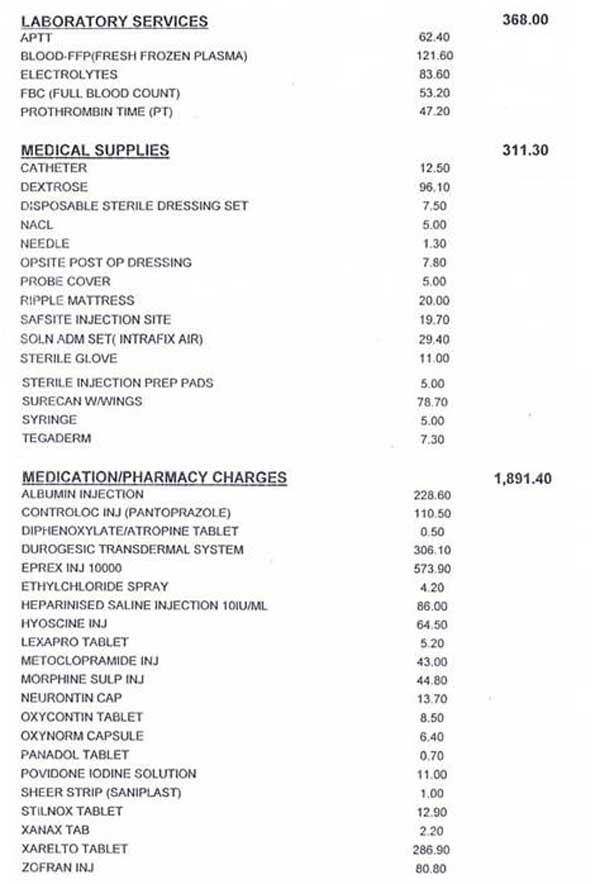
The cost of a hospital stay consist of: room charge, doctors’ fees, nursing care, laboratory services, medical supplies, medication / pharmacy charges, procedures – dressing or nursing, X-ray and CT scan charges.

Laboratory services RM (Ringgit Malaysia)
CA 125 85.20
CA 19.9 85.20
Full blood picture 53.20
Liver Function Test 47.20
Creatinine 39.60
Prothrombin time (PT) 47.20
Cancer Treatment Monitoring Profile 220.40
Blood-screening and processing 304.00
Blood transfusion 100.00
 Imaging 
CT scan 880.00
X-ray Charges 800.00
Professional Services 
Doctor attendance fee 80.00
Dietetic for follow up 35.00
Nursing care 60.00
 Lodging & Physical Facilities
Lodger 20.00
Room – single 310.00
Regular meal – single room 60.00
Clinical waste 10.00
Ripple mattress 20.00

 4.  The Week of Chemotherapy in Hospital

The Week of Chemotherapy  
18 September 2012 4,000.80
19 September 2012 2,389.80
20 September 2012 1,479.50
21 September 2012 4,041.70
22 September 2012 2,055.30
23 September 2012 1,856.60
24 September 2012 3,016.20
Total cost for the week 18,839.90


On 18 September 2012 MS underwent chemotherapy.  The drugs used were Carboplatin and Intaxel (generic Indian paclitaxel). And these are the drugs that matters – trying to “kill” the cancer. Take note that the cost of Carboplatin and Intaxel are only RM 363.30 + RM 363.30. But the total cost for the day in hospital was RM 4,000.80. Just imagine, it would be most wonderful if Carboplatin + Intaxel were not toxic – treating cancer would be cheap and everyone could afford it! But the problem is, chemo drugs are toxic, i.e. poisonous! Because of that a lot of other drugs are needed to support and keep the patient alive! Study the details of the costs and types of drugs used for that day.

Itemised bill of 18 September 2012

After receiving the chemo injection, patients generally suffer side effects. Three days later the situation had probably become severe and the patient needed more support.  The total bill for the day shot up to RM 4,041.70. Then three days later, further support was needed and this time the bill came to RM 3,016.20

Itemised bill of 21 September 2012

Itemised bill of 24 September 2012

(For information on what these drugs are for, go to Part 2 of this story)

From the above, I learned that to administer a drug to “kill cancer” which costs only RM 363.30 + RM 363.30, patient had to spend more than RM 18,000 in the form of supporting drugs and services. Again I say, how nice it would have been if that RM363 + RM 363.30-chemo-drugs were not toxic to healthy cells. Then we don’t need all those supporting drugs and don’t have to incur all those additional costs.

Can someone “invent”, synthesize or make a drug for cancer that is entirely safe? Or it is AGAINST their vested interest to look into such a proposition? I am not naïve when I ask these questions.  Read the quotations below:

When you get into the hospital, know this ….

Professor Stoller’s Cancer Experience

Book Review: Stranger in the Village of the Sick


Professor Paul Stoller is an interesting man and he wrote a very interesting book.

Why is he an interesting man?

He wrote: As a child my parents immersed me in the culture of Judaism. I attended Hebrew school. As a young man, my graduate education assimilated me to the culture of anthropology. I learned how to write research proposals, conduct ethnographic research and “write up” the results. I have been a professional anthropologist for more than twenty-five years. When he was a young anthropologist Stoller went to Niger, Western Africa, to study the culture of the Songhay, the main ethnic group that form the Songhay Empire – one of the largest Islamic empires in history, sometime in early 15th to the late 16th century. The Songhay practises sorcery – the art of black magic or witchcraft and use supernatural power to heal or to control others.  Stroller was initiated into sorcery by Adamu Jenitongo.  Perhaps they are like bomohs or village shamans in this part of our world. Stoller wrote: In Niger, I learned to mix potions, read divinatory shells and recite incantations.

Why is his book interesting? 

Professor Stoller was diagnosed with lymphoma and has undergone chemotherapy. He came out “successful” after his treatment and he wrote vivid accounts about his cancer journey –  his fears, his pains, his worries and how he coped.

  • Stoller wrote: My own religious background, Judaism, gave me a set of abstract principles about the world in which I lived, but provided no concrete formulas for dealing with an unexpected and incurable disease. So Stoller had to rely on his sorcery knowledge that he learned in Africa to see him through his cancer experience. Being thrust into a new world that would change my life forever prompted me to think long and hard about my experience among the Songhay people of the Republic of Niger. In time of despair, over and over again, Stoller found comfort in the words and teachings of his long-gone Master, Adamu Jenitongo. At times, he heard Adamu whispering to him and telling him what to do.

There are many things in Stoller’s writing that cancer patients can learn from. The following (italic) are extracts from his book.

Diagnosis of Cancer

Professor Stoller was diagnosed with non-Hodgkin’s lymphoma in March 2001. He wrote:

  • In a flash, cancer had abruptly taken control of my life and forced me onto a dreadful new path that promised unspeakable pain and endless suffering. The terrifying prospect of a slow and unbearable death made me tremble. These frightening thoughts quickly transformed me into a powerless person.
  • I didn’t notice my surroundings. Like a zombie, I signed in, sat down and waited. I felt like a dead man walking to the gas chamber.
  • In that moment the world that I had known completely crumbled. My head, suddenly heavy and weary, sunk to my chest. I stared at the floor unable to move. Cancer, I said to myself. How could I have cancer? I had done all the right things: good diet, exercise, minimal stress. Would I be dead in six months?
  • Despite improvements in treatment and better rates of survival, a diagnosis of cancer is still perceived as a sentence to a slow and painful death.
  • Now I wondered if I would survive one year, two years, perhaps five. Ten years suddenly seemed like a life time. If only I could have another ten years.
  • My current circumstances had compelled me to spend quite a lot of time thinking about my life.
  • Cancer always makes you confront death. This unwelcome and unexpected confrontation quickly erodes the gender, ethnic and class differences that divide American society… social differences among university professors, construction workers, and secretaries quickly fade away. Cancer makes us involuntary kin in the village of the sick. 

Lessons from the Songhay

  • A fundamental lesson in Songhay sorcery is: One must make careful preparations and be thoroughly protected before undertaking a task – especially with respect to the physical and psychological disruptions that a serious illness can trigger. You expect to confront all sorts of trouble – betrayal , loss, and illness – along your path. Although you cannot expect to evade misfortune … you can try to be prepared for it.
  • Feeling confident about the outcomes of our choices gives us a sense of control over our lives – something that most Americans strive for. Most Songhay people see the world quite differently. They believe that they have little control over what happens to them … uncertainty, rather than certainty, governs their journey through life. Like many Americans, I have a difficult time dealing with ambiguous uncertainty. In our main stream culture, we prefer quick, clear, concrete answers to difficult problem. We’d like to believe that we are able to control our destiny. If we get sick, we expect a quick fix. How many of us are able or willing to jump into a fast-moving stream and let the current carry us to an uncertain destinations? Most of us would feel that we were being foolhardy if we did so.
  • No amount of denial, numbness, or work, though, could erase my awareness of the “undefined mass” growing in my abdomen. I longed to be more like the Songhay. Why couldn’t I let fate carry me away to some unknown destinations? Why couldn’t I live with ambiguous uncertainty?
  •  You have been told that you have cancer, an event that marks a point of misfortune. Events have compelled you to decide which path to follow into the village of the sick. You also know that you alone will bear the consequences of that decision. When I found myself standing on this point of misfortune… I desperately wanted someone – anyone – to tell me what to do. As Adamu Jenitongo would say, they must find their own way. They must choose which path to take and bear the consequences. Cancer patients must make the same fateful choice. That is the reality that the newly diagnosed cancer patient faces; it is a hard reality to bear.
  • Most Americans don’t like to think too much about death. Many of us can’t even accept inevitable changes to our aging bodies, a sign that life is finite, let alone the specter of death. In the world of sorcery, however, illness is ever present in life. In that world, illness is a gateway to learning more about life. As for death, it is your continuous companion.

Chemotherapy Experience

  • I spent hours reading about the side effects of chemotherapy, information that filled me with fear and anxiety. I geared myself up for body-wrenching nausea, bone-weary fatigue, and hair loss. I bought an electric razor to avoid excessive bleeding from a shaving cut – and a soft toothbrush to guard against painful mouth sores. I also read the literature about Rituxan – it, too, could cause serious problems – fever, chills and heart irregularities – especially the first time it was administered.
  • The best strategy, which I followed one day prior to my initial treatment session, was to get a buzz cut to reduce the psychological shock of being suddenly bald.
  • Cancer patients were also advised to use mild shampoos, soft hairbrushes, and low heat setting on hair dryers.
  • Mouth sores, tender gums and sore throat, usually occurred seven to fourteen days after the beginning of treatment. Each person reacts differently. Side effects also depend upon the drug combinations you get.
  • I had appreciated the phone calls and cards I had received from family members after the diagnosis. Their expressions of concern made me feel better.
  • As I prepared to go to bed … I realized yet again that cancer patients – me, in this instance – must live alone with a disease that their own bodies had produced.
  • I had to learn to live with cancer, but somehow not allow it to take over my life.
  • As the chemotherapy agents destroyed healthy as well as malignant cells … my body would throb, especially in the neck, shoulders and back. In time, my throat would burn. I might get sores on my tongues, cheeks and lips. Periodic fevers would make me sweat. Rashes might spread over my body. And just as my body had cleansed itself of the poisons that precipitated this misery, I’d once again have to drag myself to the Cancer Centre … I’d be hooked up for another treatment and another three-week cycle of side effects.
  • I now knew that my life would never return to “normal.” Cancer and chemotherapy treatments would leave their mark on me. “You can stop the chemotherapy anytime you want,” one of my friends asserted after hearing vivid descriptions of the side effects. “Yes,” I said, “but what’s the alternatives?”
  • In treatment the world slows down. You must sit for hours as the chemotherapy drugs drip into your bloodstream. The drugs make your body ache. They make you tired. You have to pace yourself. They force you to be patient. Patience is the password in the village of the sick. Cancer patients have no choice. They have to confront their weariness and make the necessary accommodations. It is a humbling exercise.
  • As I went through the last phase of chemotherapy, though, the going got tough – more bad than good days. I developed periodic sore throat. A line of painful mouth sores developed on the blade of my tongue, making it difficult to swallow. My bones throbbed, and I developed such pulsing pain in my right knees. Pain and restlessness made a good night’s sleep a gift to be savored. Numbness became more and more noticeable in my feet and hands. Hand and foot cramps froze my joints in painful positions.  …chemotherapy’s side effects were cumulative.
  • No formula can wash away the pain and suffering that comes with the diagnosis and treatment of cancer.

Lessons from the Songhay

  • I somehow managed to make it through the last six weeks of treatment…. In my dreams, I’d see myself seated next to my teacher in the shade of his conical straw hut. The world is patience, he’d say. The world is patience. Never before had I realised the importance of this adage.
  • Although my own middle-class suburban American upbringing had paved the way for my professional life, it had not prepared me for the pain and suffering of cancer. Instead, the wisdom of Songhay sorcery helped me to deal with the devastation that cancer brings to life. It calmed me in stressful situations. It enabled me to be patient in circumstances that provoked impatience. It gave me strength and determination in times of physical and emotional stress. And, as odd as it may seem, it showed me how to incorporate cancer into my life so that I could use it to grow both physically and emotionally.

Success – Remission!

CAT and PET scan results showed Professor Stoller was lymphoma-free. He was in complete remission.

  • How many years of good health, exactly? How long could I expect to remain in remission? You could be in remission for two years, five years. In some cases, people remain in remission for ten years. In other cases, the lymphoma comes back in six months. (Note: from the Internet, I learned that Professor Stoller is still healthy. His success is most outstanding. It has been 11 years now).
  • At the end of treatment, the side effects of chemotherapy drugs slowly fade away. The aches and pains dissipate. The mouth sores disappear. Your throat clears. The fevers fade away. Your appetite returns. Energy surges through your body. Even though you feel “normal,” you still think about cancer every day – if only a little  while.
  • When cancer patients enter the zone of remission … you are in a space between the comfortable assumptions of your old life and the uncomfortable uncertainties of your new life. You have long left the village of the healthy … Once you enter the village of the sick, you can never fully return to the village of the healthy.
  • Restoration of health does not make you a conqueror.

Lessons from the Songhay

  • If a Songhay develops a serious illness like cancer, he or she is likely to build respect for it. Respect for cancer – or any illness – does not mean that you meekly submit to the ravages of disease.  Following the ideas of sages like Adamu Jenitongo, illness is accepted as an ongoing part of life. When illness appears, it presents one with limitations, but if it is possible to accept the limitations and work within their parameters, one can create a degree of comforts in uncomfortable circumstances.
  • Remission can also be like a prison from which the cancer patient cannot escape. Confronting remission’s impermanence is not easy. There are junctures during remission that remind you what a delicate state it can be.  Once in remission, waiting for the results of regularly schedules CAT scan can become exceedingly stressful and can plunge you into depression. If the results come back normal, remission continues. If the scans indicate the return of malignant cells, you may need an additional, more powerful toxic treatment. You may even need palliative care to ease the journey toward your ultimate demise – a destination we all share.
  • My experiences in the world of Songhay sorcery have helped me to cope with the diagnosis of and treatment of lymphoma. What’s more, Adamu Jenitongo’s soft voice comes to me regularly in dreams. He reminds me to accept my limitations and remove resentment from my mind. He tells me to be patient in a world of impatience. He encourages me to be humble and refine my knowledge so that others might learn from it. 

Balance and Harmony

  • In Songhay philosophy, internal and external harmony enables a person to see life more clearly.
  • When you learn you have cancer, the world spins out of control. You are thrown into a world of medical procedures and inconclusive diagnoses. What’s more, you have to interact with technicians and medical professionals, many of whom can be insensitive.
  • You find yourself in the vortex of a whirlwind. No matter what kind of support you have from friends, family and professionals –  ultimately  you … must face your fate alone. No matter the degree of support that they gave, cancer patients must confront their illness alone.
  • Optimism, which can be learned, enables people to live longer, healthier, and happier lives, as compared with the experience of pessimistic people. Pessimism can lead to a sense of helplessness and trigger depression. Helplessness and depression, in turn, weaken the immune system, priming the body for serious illnesses and even premature death.
  • Being optimistic should not blind us from reality. You can be pessimistic, but not in a way that clouds your vision completely. Above all, you should attempt to be prepared to confront whatever life presents – pragmatic optimism laced with a practical pessimism.
  • I attempted to see things – including myself – more clearly. I attempted to prepare myself for what had appeared on my path. I read widely about my illness and possible treatments for it. To keep myself going, I tried to eat well and get plenty of sleep. I continued to write and do my work. I tried to enjoy my life. Although these measures did not wash away my worries about pain and death, they did sustain me through eight months of chemotherapy. They sustain me now that I’m in remission. And yet I realize that in the future I will face trouble for which I must be prepared. If the medical literature is accurate, it is only a matter of time until lymphoma cells reappear in my body. When that happens I will have to undergo more diagnostic test and more treatments. Despite the “darkness” of my future, I hope that my tempered optimism will enable me to enjoy the pleasures of good health for as long as I can.
  • Among the Songhay, clear vision also embodies a sense of humility. Arrogance, I have learned, can do a person great harm. The medical stance toward illness is militaristic. Illness is an invading force, a foreigner attempting to colonize the body. That alien force must first be subdued and then eliminated. Medical science has developed an impressive array of technological weapons to kill invading cells … which leads to the belief that we have the capacity to eradicate illnesses like cancer. In Balinese and Songhay society, by contrast, people have a more humble take on illness …. To respect the power of illness, which means that they attempt to incorporate it into their lives. If illness is incorporated into one’s life, people can use it to become stronger in body and wiser in spirit.
  • Cancer propels you down a difficult path on which it is important to be humble. If you are arrogant about life and believe that you can master illness, a disease, like cancer, can force you into a needlessly desperate corner.
  • The world of cancer is particularly fraught with war metaphors. We are fighting the war on cancer. Cancer cells attack and overwhelm healthy cells. Oncologists then send a sortie of chemotherapy agents on search-and-destroy missions. These agents destroy the enemy, but also kill healthy bystanders – collateral damage. These missions often result in heavy casualties. Although the technological marvels of modern medicine may make you the survivor of many battles, can you ever win the war? Adamu Jenitongo told me that one needs to respect illness as a part of life. If you respect illness, you can use it to develop your being.
  • Illness is a part of life; it lies within us and waits for the right moment to appear. The ideal for Songhay is to learn to respect the unalterable presence of illness and live with it. If you learn to live with illness, your being becomes stronger and stronger. The idea of living with an illness runs counter to major themes in American culture. No one wants to live with an illness. If we contract an illness, we want to conquer it.

Lessons from the Songhay

  • My teacher always said that there are many paths to well-being. I now understand more fully what that meant.
  • Confronting cancer is a frightening lonely proposition. How do you deal with your isolation? Songhay sorcerers have one suggestion; they say that you should diligently perform personal rituals. Each of us has his or her personal rituals. Doing certain things when we wake up or go to sleep may help to set the world straight and bring us a sense of calm. Where we are able to perform these personal rituals, they give us a good feeling … we can generate and maintain a measure of control over our lives. Engaging in personal rituals, of course, cannot guarantee a successful course of chemotherapy, but it can assure, I think, a certain sense of personal control, which goes a long way toward maintaining quality of life. Any cancer patient can engage in this kind of ritual …  you might recite a certain prayer or poem … that gives you comfort. You might wear clothing that makes you feel confident. You might bring music that sends you on a soothing dreamlike journey … They can bring you peace, so that you can be ready for what life presents on your path.

Finding Meaning in Your Cancer

  • Having been diagnosed with and treated for lymphoma forced me to reflect deeply about the meaning of my life. It is unthinkable to be grateful for a diagnosis of cancer. No one desires the pain and suffering that come with a serious illness. But once you’ve got it… why not incorporate it, as the Songhay would say, to bring to your being a deeper understanding of life’s forces and meanings? Cancer can be used, and my example is one of many thousands, to grow and change. 
  • Cancer compelled me to see myself – my being – more clearly.
  • As odd as it may seem, the unanticipated and devastating presence of cancer in my body opened a pathway to personal growth and development. It deepened my spiritual beliefs, refocused my professional visions and forced me to understand more realistically the symbiotic relationship between illness and health. In time, my experience of cancer toughened my body and strengthened my resolve.

What I Learned from Professor Stoller

I benefited a lot from Stoller’s writing. He showed me in words what it means to live with fear, in anxiety,  and what it was like to suffer pains associated with a diagnosis, treatment of cancer and even after the doctor had said you are cancer-free (really, cancer-free?).

For sixteen years, I saw how patients suffer from their cancer but I have not read any book that describes in detail their cancer experiences.  What Stoller wrote impacted me very much. It helped me to understand more about my patients’ sufferings – mentally, emotionally and physically.  As healers or caregivers, we experience cancer as a by stander – just from the outside, and we are not really involved. We assumed that we understand the patients’ sufferings – generally we don’t. We only learn about their problems through our “textbooks.” We don’t feel how they feel although we think that we know and care. The truth is – we are not supposed to be involved. The medical term for this attitude is detached concern.

These words that  Stoller wrote had made an impact on me: When I found myself standing on this point of misfortune… I desperately wanted someone – anyone – to tell me what to do. As Adamu Jenitongo would say, they must find their own way. They must choose which path to take and bear the consequences. Cancer patients must make the same fateful choice. That is the reality that the newly diagnosed cancer patient faces; it is a hard reality to bear. 

Here it was, an educated man – a professor of an American university, wanted someone – anyone – to tell him what to do.  He lived in America and had access to the best of medical facilities, why did he need someone – anyone – to advise him? It just shows how vulnerable we all are. I recall one patient who had cervical cancer. She did not know what to do after her diagnosis. Through the phone we talked to each other every day – and I was guiding her all the way. Even before going into the operation theatre, I had to talk to her to encourage her to take things easy. After the operation she called to say thank you and said that she benefited very much because I was there “by her side” all the way. Well, I took what she said as the usual compliment. After all, I thought, it is my job to help people. Let me put it right – this job is provided without any fee! But I still call it my job – perhaps social responsibility is more appropriate? However, after reading what Stoller wrote this responsibility acquired a deeper meaning. I felt more empathy for those who come to seek my help (which previously I called shopping spree) – for they are really lost and need someone – anyone, to guide them. I wonder, like Stoller – why don’t they go to the hospitals and consult the “real” professionals?

From this, it dawned on me that the role of CA Care has evolved to yet another level. Two days ago, two patients flew in from Makassar, Indonesia. They came to ask what to do. By right, they should have gone to see doctors in the hospitals, why come to CA Care? Their problem is they don’t even know where to go and what doctor to see! This time, I felt more empathy for them. I now realize that they are desperate and lost.  I have to be patient. They needed someone to guide them – like Stoller too. And these patients are far less educated than Stoller and they come from a much less developed place than America!

Last night, while I was writing this article, a lady with breast cancer called. She had undergone a mastectomy and wanted to know what to do next – to go for chemo or not to go. I told her not to panic or be in a rush to do things. Take it easy and ask her to come and see me with all the medical reports.  She replied: No, I am not afraid. I don’t panic either. I am glad that I have you to guide me from the very beginning. I am okay. Her words brought a different meaning to me – after reading Stoller’s book.

Professor Stoller benefited from the wisdom of his Master, Adamu Jenitongo. How could this be – a professor from America learning from an African bushman?  Listen to the wise words of Adamu: We all live on borrowed time. We should make the most of our borrowed time. To accomplish this feat, we need to pick our battles very carefully and exert our force when it is important to do so. A true sorcerer must not waste energy on needless battles.  You must avoid conflict as often as possible. When you do fight a battle, make sure it is an important one. Knowing when to fight is the mark of courage; it prepares you for battles worthy of your power.  Winning is not the goal of everyday confrontations. Cancer patients, old and young, male and female, have often learned to live with their illness and accept the difficult fact that death is part of life. Those lessons have enabled them to maintain their dignity and improve the quality of their lives. For me, that is the mark of courage.

I urged you to reflect deeply those words in bold. I for sure also benefited from this great, wise, 100-year-plus-old man, who came from the bushes of Africa.

Some Quotations

  • Given the realities of the American medical system, patients are often treated with insensitivity … “patients” must be “patient” for they have few rights and limited importance. Arthur Frank (The Wounded Storyteller) suggests that patients are subjects who are colonized by medicine.
  • Truth, I learn, is an unstable condition. To paraphrase William James, truth is like a check. It’s good only as long as there is money in the bank.
  • Skepticism has been central to the Western pursuit of knowledge. They tend to be skeptical of alternative medicine or nonscientific approaches to healing the body. It makes them cautious about diagnosis, a practice … that is laced with uncertainty and doubt. From within the village of the healthy, skepticism makes good sense; it has advanced our knowledge of and control over the world by leaps and bounds.  From within the village of the sick, in which death is our constant companions, skepticism fades away … you begin to wonder if skepticism is good for your body.
  • You look, but you don’t see. You listen, but you don’t hear. You touch, but you don’t feel – it takes a lifetime to learn how to “see,” “hear,” and “feel” the world.
  • You must earn knowledge. To earn it, misfortune must test your courage. Knowledge is greater than we are. You have to learn it slowly. You have to respect its power.
  • The Songhay realise that knowledge they acquired is borrowed and that their responsibility is to refine what they have learned and pass it on to the next generation. 

Get It Right: Can Chemotherapy Really Cure Cancer?

If you are a scientist, and if you have done many scientific experiments / research in your life, and if you have a bit of common sense (never mind about having a Ph.D. — these days you can buy one easily), you will know that something is not right with the current medical way of treating cancer using poisonous drugs.

Well, I am not a medical doctor – in a way, that is a blessing because I can critically “see” that something does not add up.  Why?

But, let me also say this. You don’t need to be a scientist to “see” what I see and to know what I know.  Hear what a broadway playwright and a movie star has got to say:

In this article, I am not trying to tell you how bad or how good chemo is.  I think you have had enough of that. I am going to bring you yet another different but related message.  I hope you can learn many things from what is written below.

The recent website of the Dana-Faber Cancer Institute, Boston, USA, had this headline: Advanced cancer patients overoptimistic about chemotherapy’s ability to cure, study finds

http://www.dana-farber.org/Newsroom/News-Releases/Advanced-cancer-patients-overoptimistic-about-chemotherapys-ability-to-cure-study-finds.aspx

A study was conducted and led by medical researcher, Jane Weeks, who is also a professor of medicine at Harvard Medical School and Professor of Health Policy and Management at Harvard School of Public Health.

Others in the research team are Deborah Schrag, MD, MPH and Paul Catalano, ScD, Angel Cronin, and Jennifer Mack, MD, MPH, of Dana-Farber; Matthew Finkelman, PhD, of Tufts University; and Nancy Keating, MD, MPH, of Brigham and Women’s Hospital.

What Did They Study?

  • The study was conducted by surveying 1,274 patients at hospitals, clinics and treatment centers across the USA. Participants were recruited from geographically diverse populations and health care systems in order to systematically evaluate cancer care delivery in the U.S.
  • Study participants had been diagnosed with metastatic lung or colorectal cancer at least four months earlier and had received chemotherapy for their disease.
  • They studied their records in great detail.

The Results of the Study 

They found that 69 percent of patients with advanced lung cancer and 81 percent of patients with advanced colorectal cancer did not understand that the chemotherapy they were receiving was not at all likely to cure their disease. Their expectations run counter to the fact that although chemotherapy can alleviate pain and extend life in such patients by weeks or months, it is not a cure for these types of advanced cancer except in the rarest of circumstances.

  • Patients with advanced lung or colorectal cancer are frequently mistaken in their beliefs that chemotherapy can cure their disease.
  • Inaccurate expectations about the role of chemotherapy were found among patients from varied backgrounds treated in many different health care settings across the U.S.
  • Surprisingly, patients who rated their communication with their physician highly were the most likely to hold overoptimistic views about chemotherapy’s curative potential.
  • Strikingly, those patients who rated their physicians as worse communicators were more likely to have a realistic view of the potential benefit of their chemotherapy.
  • While there is no doubt that communication about prognosis in advanced cancer is challenging, a sizeable minority of study participants did grasp the incurable nature of their cancers.
  • Dr. Weeks noted: “If patients do not know whether a treatment offers a realistic possibility of cure, their ability to make informed treatment decisions that are consistent with their preferences may be compromised. This misunderstanding may pose obstacles to optimal end-of-life planning.”
  • Dr. Deborah Schrag said: “skilled clinicians can set realistic expectations without their patients’ losing either hope or trust.”

This study was published in the Oct. 25, 2012 issue of the New England Journal of Medicine. The study was funded by grants from the National Cancer Institute and by a grant from the Department of Veterans Affairs

Mass Media Response To The Results Of This Study

  1. Are cancer patients’ hopes for chemo too high? http://www.reuters.com/article/2012/10/24/us-cancer-patients-idUSBRE89N1M220121024 
  • At least two thirds of people with advanced cancer believed the chemotherapy they were receiving might cure them, even though the treatment was only being given to buy some time or make them comfortable.
  • Their expectations are way out of line with reality,
  • Perhaps ironically, the patients who had the nicest things to say about their doctors’ ability to communicate with them were less likely to understand the purpose of their chemotherapy than patients who had a less-favourable opinion of their communication with their physicians.
  • This is not about bad doctors and it’s not about unintelligent patients.This is a complex communication dynamic. It’s hard to talk to people and tell them “we can’t cure your cancer.”
  • Doctors find it uncomfortable to hammer home grim news and patients don’t want to believe it.
  • It was a reminder to doctors to slow down and take some time to realize how hard the issue is.
  • If patients actually have unrealistic expectations of a cure from a therapy that is administered with palliative intent, we have a serious problem of miscommunication we need to address.

Hossein Borghaei, an oncologist at the Fox Chase Cancer Center in Philadelphia said:

  • What are you supposed to do, stand in front of someone with advance disease and argue with them? It’s not productive.

Thomas Smith and Dan Longo of Johns Hopkins University School of Medicine wrote:

  • The results are probably due, in varying degrees, to patients not being told their disease is incurable.
  • Patients not being told in a way that lets them understand.
  • Patients choosing not to believe the message, or patients being too optimistic.
  • Many patients think they are going to beat the odds.

2.      Many cancer patients mistakenly believe chemotherapies will cure them, new study says

http://www.boston.com/dailydose/2012/10/24/many-cancer-patients-mistakenly-believe-chemotherapies-will-cure-them-new-study-says/P4Sv84A5u4syPuWeD9ANUI/story.html

  • A majority of patients with advanced lung and colorectal cancer harbor the fundamental misperception that treatments that can extend life and alleviate pain might also cure them.
  • But the study couldn’t pinpoint where it occurs: whether patients receive unclear information from a physician or fail to fully comprehend what they are told, or whether there is a kind of clinical “collusion” in which the discussion moves rapidly from a dire prognosis to a focus on what can be tried, leaving patients with an inflated sense of hope.
  • The issue here … thinking that a treatment offers a chance of cure when in fact it doesn’t. This deprives these patients of the opportunity to weigh the risks of chemotherapy, including the chance of some rough side effects, against the true benefits, perhaps some symptom relief and a few months longer life but no chance of cure.

Dr. Eduardo Bruera, chair of the Department of Palliative Care and Rehabilitation Medicine at the University of Texas MD Anderson Cancer Center, said:

  • A bearer of good news might be seen in a more welcoming way; that might explain why sugar-coating might make people more liked by their patients.

Dr. Deborah Schrag, a colorectal cancer specialist at Dana-Farber and co-author of the study, said:

  • We had this hypothesis when it comes to giving bad news: Doctors who work at an integrated health care network, they’re not an independent practice, they’re more free to disclose the unvarnished truth, without worrying about the ramifications of, ‘If I’m not super cheerful and positive and optimistic, my patients would not like me.

Dr. David Ryan, chief of hematology/oncology at Massachusetts General Hospital said:

  • You have to provide the information about whether a situation is curable or not curable, and what the odds of doing well are for a long period of time.
  • But you also have to provide hope, and it can be difficult sometimes to convey that difficult information and also provide hope.

Oncologists said it was crucial to find where and why the misunderstanding takes root so that doctors can be sure their patients are making informed decisions.

3. Many Terminal Cancer Patients Mistakenly Believe A Cure Is Possible http://www.capradio.org/news/npr/story?storyid=163572138 

  • A survey finds that the majority of advanced stage lung and colon cancer patients believe chemotherapy might cure them, when it can actually only buy them a few months. Oncologists are worried about how this impacts end-of-life decision making.
  • Doctors are often called upon to deliver bad news to patients, and there isn’t much that’s worse than a diagnosis of an advanced-stage cancer for which there is no cure.
  • A large majority of patients who receive this news don’t fully comprehend it, or perhaps willfully choose to ignore it.
  • When people have unrealistic expectations they’re much less open to discussing end-of-life planning.
  • But patients always want positive news. In the short term, people will be happier if you give them happier news.”

Sandra Swan an oncologist at the Washington Hospital Center said:

  • Ultimately the doctor’s responsibility is to ensure that their patients fully understands what’s happening to them.
  • There needs to be continued communication about the prognosis and it needs to be done early on. I don’t think physicians do it particularly well. … Many physicians just have a very hard time communicating that they’re not going to be able to cure the patient.
  • Doctors need do a better job of helping terminally ill cancer patients let go of false hopes without squashing all hope.
  • You don’t want to take away hope from patients. They’re not going to be cured but it’s not like they’re going to die instantly. So it is a really hard balance to achieve.

4.   Most patients with incurable cancer still think they’ll survive, study finds

http://www.cbsnews.com/8301-204_162-57540242/most-patients-with-incurable-cancer-still-think-theyll-survive-study-finds/

  • Many patients who receive chemotherapy for incurable cancers still believe they can beat the disease, a new study suggests. The researchers behind the study question if patients are simply in denial or doctors are skirting the truth with their patients’ prognoses.
  • The research also highlights the problem of overtreatment at the end of life — futile care that simply prolongs dying.
  • For cancers that have spread beyond the lung or colon, chemo can add weeks or months and may ease a patient’s symptoms, but usually is not a cure. This doesn’t mean that patients shouldn’t have it, only that they should understand what it can and cannot do, cancer experts say. But often, they do not.

Dr. Thomas J. Smith of Johns Hopkins University School of Medicine and Dr. Dan L. Longo, question:

  • Whether patients are being told clearly when their disease is incurable. Patients also may have a different understanding of “cure” than completely ridding them of a disease – they may think it’s an end to pain or less disability.
  • If patients actually have unrealistic expectations of a cure from a therapy that is administered with palliative intent, we have a serious problem of miscommunication.

How should doctors have this difficult conversation with patients?

Smith told CBS This Morning that doctors should operate on an “ask, tell, ask” basis when patients are faced with a life-threatening illness. That means doctors should ask patients up front how many details they want to know about their illness. Then, they should tell patients in understandable terms their prognosis, such as by saying “based on people like you, you may have weeks or months.”

While some patients may have positive attitudes and think they’ll still beat the disease, Smith says he’ll tell patients that doctors won’t stand in the way of miracles, “but we can hope for the best but still need to plan for the worst.”

The study raises concerns about unnecessary but costly medical treatments for dying patients.  Smith said having the difficult conversation with a patient about their end-of-life care may lower these costs because many patients may want to be comfortable at home, and not in a hospital. This really isn’t about saving money, so much as honoring people’s choices.”

Read more on CBS: Doctors unveil “Choosing Wisely” campaign to cut unnecessary medical tests  http://www.cbsnews.com/8301-504763_162-57409204-10391704/doctors-unveil-choosing-wisely-campaign-to-cut-unnecessary-medical-tests/?tag=contentMain;contentBody

Should parents’ belief in miracles trump medical expertise in end-of-life decisions? http://www.cbsnews.com/8301-504763_162-57493154-10391704/should-parents-belief-in-miracles-trump-medical-expertise-in-end-of-life-decisions/?tag=contentMain;contentBody

Truth Is a Bitter Pill – Hard For You to Accept Reality

Chemotherapy Game Changer for Stage 4 Cancer http://www.envita.com/cancer/finally-chemotherapy-game-changer-for-stage-cancer/?UA-29060687-1

  • The current model and approach being used by numerous cancer centers and hospitals is the “germ theory.” This model aims to focus on destroying cancer cells using a “one size fits all” protocol.
  • The doctors at Envita explain that each person’s cancer is unique and cannot be put into one category or group even if patients have the same type and stage of cancer.
  • So why are cancer centers not using this approach to treatment? It is very difficult for large structured institutions and pharmaceutical companies to move quickly with the world’s modern technologies because they have so much invested in the old system.
  • The doctors at Envita noted that when patients were tested, over 75% of them were on the wrong treatments prior to coming to the center. No wonder so many patients are struggling with cancer!

The war on cancer

Back home in Malaysia, this is what Dr. Amir Farid Ishak wrote in his Star column. http://thestar.com.my/health/story.asp?file=/2012/10/28/health/12226744&sec=health 

  • Chemotherapy is not necessarily the best strategy to fight cancer.
  • In several previous articles, I quoted several major reviews on chemotherapy, reported in the top peer-reviewed journals that concluded that chemotherapy only helped 2-7% of the cancer patients, at the cost of so much additional suffering, and enormous financial burden.
  • Oncologists and the medical community in general continue to believe that chemotherapy protocols should be continued despite the overwhelming scientific evidence to the contrary.
  • They then convince cancer patients that chemotherapy is essential if they hope to prolong their lives or recover from the disease. Yet, the scientific studies show that what is believed by the oncologists is not always the same as what is proven by the studies.
  • The most recent comprehensive review of the effectiveness of chemotherapy was published by three oncologists in 2004 in the top cancer journal Clinical Oncology (16:549-560), and the conclusion was that overall, chemotherapy contributes just over 2% to improved survival in all the cancer patients in Australia and the US.
  • In 2004, most of the other oncologists neither refuted nor changed their reliance on chemotherapy despite the conclusive evidence. Now eight years later, although no similar comprehensive review has shown any significant improvement, that review is said to be outdated by some oncologists.
  • What I lament is the painfully slow progress in cancer therapy, such that many are not saved. The US is arguably the most advanced nation medically, yet for 2012, the American Cancer Society expects almost 600,000 deaths from all types of cancer (including 160,000 from lung cancer, 50,000 from colorectal cancer, and 40,000 from breast cancer). One in four deaths in the US is due to cancer. There will be about 1.6 million new cancer cases this year. Those figures certainly show that we are far, far away from winning the war on cancer.
  • Have we won the war? Or have we the lost war?
  • I strongly encourage readers to read War on Cancer – A Progress Report for Skeptics (Feb 2010) by Dr Reynold Spector, clinical professor of medicine at the Robert Wood Johnson Medical School, US (www.csicop.org/si/show/war_on_cancer_a_progress_report_for_skeptics/). His conclusion: “… unlike the successes against heart disease and stroke, the war on cancer, after almost 40 years, must be deemed a failure with a few notable exceptions.”
  • While the oncologists continue to look for the latest chemo and smart drugs, it is my duty to highlight the fact that while the next promising drug will be amply funded to prove its effectiveness, the next promising nutritional therapy is likely to be abandoned because nobody wants to spend money on something that cannot be patented in order to recoup the costs, as well as make a handsome profit.

Comments

For the past 16 years, we at CA Care have been spreading the above message. Now, I am glad to say that cancer experts in the US are saying the same thing. I don’t think I have to add any more messages!  But let me just share with you our frustrations over these years.

  1. Almost all cancer patients who came to us have undergone all medical treatments. Most of them are “medically written off.”
  2. And 70 percent of them come expecting us to cure them – they are seeking the elusive magic bullet. There is nothing wrong with wanting to find hope or not giving up hope, except that they are also the kiasu (only want to win) type . For this group of people, we would rather they go and find help elsewhere.
  3. The kiasus want healing on their own terms.  They only want to hear what they want to hear. They want things easy and cheap. Boiling the herbs to help themselves is a big chore to handle. They don’t want to take responsibility for their own well being. They want a cure but they want to eat anything they like.
  4. Only 30 percent of those who come benefit from our therapy.  They know what they are up against after being told the truth. They are determined to heal themselves and are willing to try. I have great respect and admiration for such patients.
  5. We are fully aware that patients come here to find hope. And telling them that they don’t have any more hope is a disaster. So we know we need to strike a balance. Correct, we cannot cure your cancer, because I believe that no one on earth can cure cancer either! That is the reality. My auntie had cancer. She had surgery and radiation. She thought she was cured. Thirteen years later, the cancer recurred in her lungs and she died. Where is the cure? And do I need to hide that reality to cancer patients?
  6.  Make no mistake, I don’t want to mislead them or cheat them. But by telling patients this, do I deprive them of hope? Yes or No, depending whether you are a kiasu or not! If you are the one who only want to win and would not want to lose, you would not like what I say. You don’t want to face reality.
  7. By telling you the truth – that I cannot cure you, does not mean that you are going to die now! If you have been reading the stories in our CA Care’s website, you will note that those patients were told to go home and die, but they do not die. They continue to live! That is hope! At CA Care we have seen miraculous healing week after week and month after month. But, make no mistake, this healing is NOT cure – the cancer can come back again if you become complacent and irresponsible.  But the unfortunate part is that many patients are just irresponsible. Period.
  8. So, by being honest and asking you to face reality we are not depriving you of that hope – on the contrary we provide you with new path and take you through another journey of hope.  The only problem is this – the journey is not easy to travel and is not meant for the kiasu.  I have enough documented stories to show you that you need not have to die yet if you are prepared to take the responsibility of your own healing into your own hands – you do your best and we do our best. And together we take this journey. Many remain healthy for years. Click on the success stories of our cancer patients and hear them tell you their stories. Just one example –  I like to tell you the story of this sweet lady from Makassar. https://cancercaremalaysia.com/2012/05/05/cervical-cancer-stage-3b-health-restored-after-taking-herbs-and-giving-up-chemo-radiation-treatments/
  9. The kiasus like to hear only things that they want to hear. For example:
    1. Cancer can be treated! Many patients don’t realize that to be treated is one thing. To get cured is another. While writing this article, I have a lady who came for help. She brought her sister for treatment in a private hospital  here and had already spent RM 100,000. A few hours ago, the doctor told the sister to bring the patient home quickly. She was not getting any better – in fact her health had deteriorated. Cancer can be treated for a long as you have the money to pay the bills (and preferable if you have a fat health insurance coverage!)  Read my articles: Part 1: The High Cost of Staying Alive in a Private Hospital. Part 2: One or Two Dozens of Drugs A Day Could Not Help Her?
    2. With chemo, you have a 80% chance of curing your lymphoma!  Patients love to hear that message of hope. And they believe such statistics!  Here is one example. A lady with cervical cancer was told that she had a 98 percent chance of cure with chemotherapy and radiotherapy. She believed her doctor. Four months later the cancer spread to her lungs. And that is cure? I hear this kind of stories very often. https://cancercaremalaysia.com/2012/05/02/cervical-cancer-eighty-nine-percent-chance-of-cure-vanished-with-the-collapse-of-her-right-lung-four-months-after-radiotherapy-and-chemotherapy/

Here is another example. A breast cancer lady underwent chemotherapy, radiotherapy and took Tamoxifen for five years.  Then cancer spread to her bones. She asked the doctor why she was not cured. The answer was:  It is your fate.  But the recurrence has nothing to do with what you eat. It is just your fate. Believe that? Where is the so-called science in cancer treatment? https://cancercaremalaysia.com/2012/05/12/breast-cancer-when-a-so-called-cure-was-not-a-cure/

Let me end with these quotations:

Take note, the author, Dr. Dan E. Chestnut, is a medical doctor of 44 years.