CANCER’S COLLATERAL DAMAGE: PART 4–WHY THE RICH AND FAMOUS DIE FASTER WHEN THEY HAVE CANCER

by Yeong Sek Yee & Khadijah Shaari

Yes, the rich and famous (and insured) do die faster when they have cancer…more from the collateral damage due to the conventional (and scientifically proven?) cancer treatments than from the original cancer itself. A classic example is the sad story of Mrs. Jacqueline Kennedy Onassis who was diagnosed with Non-Hodgkin’s Lymphoma in January 1994 and died in May 1994, just barely 5 months after diagnosis.

In the best-seller, HOW WE DO HARM, Dr Otis Brawley, an oncologist and Vice-President of the American Cancer Society, bluntly stated that….”If you are rich and insured, you face another menace. Ironically wealth can increase your risk of getting lousy care. When wealthy patients demand irrational care, it’s not hard to find a doctor willing to provide it. If you have more money, doctors tell you more of what they sell, and they just might kill you. “

Below is a list of 15 (there are many, many more) rich and famous personalities who have succumbed to cancer and the average period from the date of diagnosis to death is less than 2 years. How is it that the scientifically proven/tested conventional cancer treatments did not help them? Did their cancer treatments come along with excessive collateral damage to their body system or were their cancers just too aggressive?

Likewise, you may remember that Malaysia’s most famous and leading oncologist, the late Dr Albert Lim, succumbed to prostate cancer on March 8th 2013 after less than a year of scientifically tested cancer treatments. He had metastasis to his pelvic area, liver and lungs as well. Was there excessive collateral damage or was the prostate cancer too aggressive??

HERE ARE THE 15 RICH AND FAMOUS WHO TRIED BUT DID NOT SURVIVE:

1) JO ANN DAVIS, 57

Jo Ann was a US Republican Congresswoman for Virginia and was diagnosed with breast cancer in 2005. She underwent chemotherapy treatments and a mastectomy. In early 2007, she suffered a recurrence. When the cancer returned, she underwent chemotherapy again. Jo Ann died on Oct 6, 2007.

Summary Point—From diagnosis to death: 2 years

2) LINDA McCARTNEY, 56

Linda McCartney, wife of Paul McCartney died in April 1998, less than three years after it was announced that she was treated for breast cancer. Although her chemotherapy treatments had seemed to have her cancer in check, she took a turn for the worse in March 1998 when the disease spread to her liver.

Summary Point—From diagnosis to death: Less than 3 years

3) HEATHER CLARKE, 39

Heather was the wife of Darren Clarke, a PGA Golfer. She died in August 2006 after a two year battle with breast cancer that had spread to her bones and liver. She was treated at the Royal Marsden Hospital in London.

Summary Point—From diagnosis to death: 2 years

4) MIRIAM ENGELBERG, 48

Miriam, a well-known US cartoonist was diagnosed with breast cancer in 2001 at the age of 43. Three years later, the cancer had spread to her brain and she died at age 48.

Summary Points—a) From diagnosis to recurrence: 3 years  b) From diagnosis to death: 5 years 

5) ELIZABETH EDWARDS, 57

Elizabeth Edwards, wife of John Edwards (a US presidential candidate) was initially diagnosed with breast cancer in 2004 and was treated with a combination of chemotherapy, surgery and radiation. In March 2007, a recurrence was discovered after she cracked a rib and a subsequent X-ray showed spots on another rib, on the other side of the chest.

Summary Point—From diagnosis to bone metastasis: Less than 3 years.                            

6) KING HUSSEIN OF JORDAN, 63

In July 1998, King Hussein was diagnosed with non-Hodgkin’s Lymphoma (NHL) and immediately underwent chemotherapy at MAYO Clinic in US. He was treated there for six months and returned to Jordan in January 1999.

In late January 1999, King Hussein returned to MAYO after his doctors found evidence that the lymphatic cancer had recurred. King Hussein underwent two bone marrow transplants with cells from his younger brother and sister (in December 1998 and January 1999).

In February 1999, King Hussein returned to Jordan for palliative care and subsequently passed away on February 7, 1999.

Summary Points—a) From diagnosis to recurrence: 6 months  b) From diagnosis to death: 7 months. 

7) FREDDY FENDER, 69

Freddy Fender, singer of hits like “Before the Next Teardrop Falls” and “Wasted Days and Wasted Nights” was diagnosed with lung cancer (two lemon-sized tumors) in January 2006. He underwent chemotherapy but later decided to stop treatment because of severe effects on his body. Following Fender’s initial round of chemo, he had a PET scan which showed that the tumors had shrunk, but also revealed that he had nine other tumors. Freddy Fender died on October 14 2006.

Summary Point—From diagnosis to death: 9 months. 

8) SUZANNE PLESHETTE

On August 11, 2006, Suzanne Pleshette was treated for lung cancer at Cedars-Sinai Medical Centre and the hospital claimed that the cancer was the size of “a grain of sand” when it was found during a routine x-ray, that the cancer was “caught very much in time,” that she was receiving chemotherapy as an outpatient. She was later hospitalized for a pulmonary infection and developed pneumonia, causing her to be hospitalized for an extended period ……as part of her treatment, a part of her lungs was removed… Pleshette died in January 19, 2009of respiratory failure.

Summary Point—From diagnosis to death: 1 year 5 months

9) DAN FOGELBERG, 56

Dan Fogelberg, a singer and songwriter, discovered he had advanced prostate cancer in 2004. He underwent hormonal therapy and achieved a partial remission but failed to completely eliminate the disease. Dan subsequently died on December 15, 2007.

Summary Point—From diagnosis to death: 3 years

10) LUCIANO PAVAROTTI, 71

Pavarotti, opera singer was diagnosed with pancreatic cancer in July 2006 and required emergency surgery to remove the tumor. On September 5, 2007, Italy’s AGI news agency reported that Luciano Pavarotti’s health had deteriorated and the singer was in a “very serious condition”. He was reported to be in and out of consciousness multiple times, suffering kidney failure. He finally passed away on September 6, 2007.

Summary Points—From diagnosis to death: 11 months 

11) DANA REEVE, 44

Dana Reeve, wife of Christopher Reeve (Superman), was diagnosed with lung cancer in August 2005 and passed away on March 6, 2006.

Summary Point—From diagnosis to death: 7 months only 

12) TONY SNOW, 51

Tony Snow, a White House spokesman, was treated for colon cancer in 2005 at which time his colon was removed and subsequently underwent six months of chemotherapy. In March 2007, doctors determined that the cancer had spread to his liver. He died in July 2008.

Summary Points: a)   From surgery/chemotherapy to liver metastasis: 1 ½ years  b)   From surgery /chemotherapy to death: 2 ½ years

13) MICHAEL LANDON, 54

Michael Landon was the star in the hit series “Little House on the Prairie” and “Bonanza”. On April 5, 1991 he was diagnosed with inoperable pancreatic cancer that had spread to his liver and lymph nodes. He underwent three sessions of chemotherapy but subsequently died on July 1, 1991.

Summary Point—From diagnosis to death: 2 months 

14) ARCHBISHOP CHRISTO DOULOS, 69

The Archbishop fell ill in June 9, 2006 and medical tests showed that he suffered from advanced cancer in the LARGE INTESTINE (COLON) and an unrelated malignant growth in the liver. A first operation to remove the intestinal cancer was deemed successful but later a liver transplant in the US was abandoned after discovery that the liver cancer has spread. The Archbishop passed away in January 2008.

Summary Point—From diagnosis to death: 1 ½ years 

15) MARTIN D. ABELOFF, 65

Dr Martin Abeloff, an international authority on the treatment of breast cancer and chief oncologist and director of the Sidney Kimmel Comprehensive Cancer Centre at John Hopkins University for the past 15 years, died of leukemia on September 14 2007. His leukemia, a form that is sometimes slow to grow, was diagnosed a year before that (i.e. approx September 2006).

Summary Point—From diagnosis to death: 1 year 

In his book, Dr Otis Brawley revealed a secret: Wealth in America (and elsewhere as well) is no protection from getting lousy care…in fact, wealth can increase your risk of getting lousy care.

Do you fancy getting some collateral damage?


Information about Cancer: Don’t Panic!

stupid defined 2

If you or your loved ones happened to have cancer, there is no need to panic. Take time to learn by reading from different sources. There is  NO right or WRONG way to handle cancer. It is only your way.

So without knowledge or information, how can you handle this situation? Read, Ask, Think and Reflect and Make Your Choice using your COMMON SENSE.

At the end of it all, it is you and you alone who pay for the consequences of your own choice.

We have written 3 comics to help you understand the “Cancer Game.”

Page_01

Available: http://bookoncancer.com/productDetail.php?P_Id=76

Page_01

Available: http://bookoncancer.com/productDetail.php?P_Id=78

Page_01

http://bookoncancer.com/productDetail.php?P_Id=79

Given honest answers … about surgery, chemotherapy or radiotherapy … the chances are high that the patients will “run away” from them!

YB is a 52-year old lady. About three and a half years ago she was diagnosed with breast cancer and had a mastectomy in Kuala Lumpur. It was a triple negative tumour. YB went to Singapore for follow up treatments. She received 6 cycles of chemo using FEC. Then she had 12 more cycles of chemo using Taxol and Carboplatin. No radiation was indicated.

When YB started chemo, she also took our herbs and took care of her diet. The side effects she suffered was much less compared to others. She was alright after the chemo treatment.

Unfortunately things did not turn out right. YB took a trip home to Kuala Lumpur (she was staying in Singapore) to visit relatives. She felt dizzy and started to vomit. Her condition deteriorated. Whenever she moved her head, she would feel dizzy or had severe headaches and would start to vomit.  She had to lie down. As long as she did not move her head, she was okay.

YB did a CT scan and MRI. There were tumours in her brain.

YB’s daughter wrote: 11 January 2014.

Dear Dr Chris,

My mother has a relapse of her cancer to the brain. MRI shows 3 lesions in her brain. One of them is approximately 3 cm which caused swelling and subsequently dizziness, vomiting and headache. Meanwhile, she’s been given steroid to reduce the swelling. We are planning to see you right after the full report is out.

12 January 2014::

Dear Dr Chris,

CT scan result is out and it seems that the primary tumor is from the left lung. However, my mom has not suffered any symptoms or difficulties with breathing.

What would you do if she was your mother and given the following details?

1. The neurosurgeon suggested surgery to remove the big tumour in her brain. According to him,  the two small tumours cannot be removed  surgically and YB has to undergo radiotherapy. Surgery would cost SGD6,500 and radiation cost SGD 2,000 to 3,000 (foreigner’s rate. Singapore citizen pay much less).

2. Can surgery cure her brain cancer? The surgeon said, NO, the tumour will recur. Because of that YB has to go for radiation. Whatever  it is the family was told that YB will eventually die.

3. Did the doctor indicate how long your mom could survive? The surgeon said this,

a. If patient does nothing and is only on steroid, she has 2 months to live.

b. If patient undergoes chemotherapy and radiotherapy, she has 6 to 7 months to live.

c. If patient undergoes surgery, chemotherapy and radiotherapy, she has 6 to 7 months plus 3 months.

According to the surgeon these are based on statistics and also on the assumption the surgery goes not well without any complications.

What does the family want to do now? Everybody in the family decided to give up further medical treatment. They would rather go on herbs.

Did the doctor give you such information out front? No. We have to ask questions after questions and we get answers bit by bit. Nothing is laid out neatly like the above.

Comments:

Bravo to patient empowerment!  For you to make a decision you need honest answers. You do not get honest answers if you dare not ask! So patients, learn how to ask questions. Don’t just be satisfied with just an answer! Ask and ask, dig and dig until you are satisfied.  This is because it is your life and you have to bear the consequences of that intervention not your doctors.

After you get the answers, use your common sense to make your decision. Follow what your heart says.

It seems very clear. If doctors give honest answers … about surgery, chemotherapy or radiotherapy … the chances are high the patients will “run away”!

What would you do if you are told that chemotherapy spreads and makes cancer more aggressive?

What would you do if you are told the following about radiotherapy?

  • Radiation makes cancer more aggressive. 
  • Radiation reprogrammed less malignant breast cancer cells into Induced Breast Cancer Stem Cells (iBCSCs). This explains radiotherapy actually enriches the tumor population with higher levels of treatment-resistant cells.  Researchers UCLA Jonsson Comprehensive Cancer Center said radiation treatment killed half of the tumor cells  treated. The surviving cells are resistant to treatment and become iBCSCs. They were up to 30 times more likely to form tumors than the non-irradiated breast cancer cells. 
  • Radiation gives a the false appearance that the treatment is working, but actually increases the ratio of highly malignant to benign cells within that tumor, eventually leading to treatment-induced death of the patient.

In Cancer: Is Doing Nothing Not Better than Doing Something

28 February 2013: Dear Dr. Chris,

How are you? I hope you still remember me. Last November 2012, I went to meet you at your center with my family.

Last month on 25 January 2013, I went for another surgery to close my colostomy. Currently I face quite a number of problems like stomach pain, can’t eat (weight loss 5 kg in a month) and diarrhea. These few days the stools came out with blood clots. I went to see a few doctors in the government hospital but they can’t solve my problems.

Dr. Chris, I am seeking your advice and please tell me what to do as its really hurt. Awaiting your prompt reply.

Reply:   Yes, sure I remember you. Let me ask you some questions first:

1) Before this surgery, did you have such problems,  like pains, etc.?

2) When did your problems start? If after surgery, how many days after surgery?

3) Are the problems getting worse or getting better.

Let me know and we shall go from there.

1 March 2013: Dear Dr. Chris,

Thanks for your prompt reply.
1) No, I don’t have these problems — pains and etc.,  before my surgery.

2) After surgery, on the 3rd day, initially I thought it was my gastric problem as I didn’t take any food at that time. But it’s not coz the pain in my abdomen still continued. It is so painful that I can’t sleep at night. The doctors only gave me Tramadol and also Morphine to ease my pain.

3) It’s getting worse especially theses two days. Thick and sticky blood came out. I am very afraid and don’t know what to do.

Reply: Thanks for your reply.

a) It looks like the problem is due to the surgery. And we don’t know what they did wrong there. Did you go back to the surgeon and ask? It looks like they only give you painkiller and morphine.

b) Coming out with thick and sticky blood is something not right, especially if this happen so long after the surgery. I wonder if they leave anything behind / inside when they close you.

My advice: We need to know the reason why and what went wrong. Why not go back to the surgeon again. Well, he can’t know unless he takes another CT scan. Okay for this time, you need to do the scan to know what really happen so that he can fix the problem for you.

Please let me know what happen if you do this. I am not sure what I can do or give you to correct this because I too don’t know what has gone wrong. Take care.

13 March 2013: Dear Dr. Chris,

I’ve just been discharged from the hospital. My condition is not good. I will meet you in your Center this coming Friday (15 March 2013) at 10:30am. I will bring my latest CT scan report. I hope you can help me.

Patient came to Penang again on 15 March 2013. While of this visit, we put patient on the e-therapy . The following is the recording of our conversation that day.

17 March 2013: Dear Dr. Chris,

I’ve just come back and arrived KL last night. Thanks very much for helping me and me. My  family and I are very grateful and appreciate for all your kind assistance. Yesterday I started to take Cap A, B, C, D.  I shall take the other herbs today when I go back to my home in JB. Last night the whole night I couldn’t sleep coz I had to move my bowels.

There are a lot of bowel movements and the stools are dark in colour and very smelly. My stomach feels much tender. I feel very, very weak after going to toilet so many times. I think more than 10 times till morning. I can hardly walk.  I had also started on my diet according to your advice.

Dr. Chris, l will arrange to meet you again next week after my one week on herbs and continue to do the e-therapy as what you have said. By the way, can I take morphine 10mg x 2 if I feel pain in my tummy? Till now my tummy is painful maybe becoz of too many times moving my bowels. Another thing is that I can hardly pass urine and it’s so painful during urination. Please advice.

Reply: 17 March 2013:  Thank you for your feedback.

a) I am glad that you started to move your bowels, meaning it is not blocked.

b) For this one week you will suffer from all the cleansing process. Take it easy.

c) Yes, you can take pain killer if you cannot bear the pain BUT did I not give you Pain Tea to take? Take Pain Tea 6 times a day and see if it helps.

d) Travelling is bad and staying in a new place is also bad for you. So I suggest you don’t come to Penang yet. Take the herbs for 2 to 3 weeks first. The first week you will suffer healing crisis. Second week I hope you get better and by the third week I hope you get much better. Even if you come now there is nothing much I can do because we need to allow the body to heal itself and this takes time. There is NO magic bullet. So you should think of coming here only in about 3 weeks from now to allow the herbs to work first. As it is it, it is too SOON.  Write again after one week and let me know your progress and then again after two weeks.

23 March 2013: Dear Dr. Chris,

It’s the first week after I took your herbs and also had strictly kept to my diet i.e. no sugar, salt, oil and meat. I only took fruits and vegetables. Here’s the outcome after taking the herbs and Cap A, B, C, D.

1) Tummy still bloated but these two days felt more tender.
2) Both legs are still swollen.
3) Difficult to urinate and is painful.
4) Bowel movement is difficult and a lot of blood comes out.
5) Good appetite.
6) Fever on and off.
7) My Pain tea had finished and seems to work as I took 6 times a day like what you have said. Dr.,

Last two days I went back to hospital to see the surgeon as I wanted to know how he would explain my condition in detail. During conversation, I made notes for your reference as follow:

Leo:   Dr. what actually had happened to me? Can you explain in more detail? I thought this was only a minor surgery to close my colostomy (in January 2013). You said everything was fine. The only thing is in the future I would have a little bit of difficulty moving my bowels because my rectum is narrow.

Dr. X:  Your cancer tumors spread too fast after surgery although we have checked it before surgery.

L:  Why these few days I passed out stools with a lot of blood (50% stools and 50% blood) and the anus burnt and so was painful?

Dr. X:   Oh, your anus is painful every time you pass stools is because it’s too narrow to pass through. There’s blood in your stools because your cancer tumors had spread and its messy inside your colon. This I can’t help you as you had stage 4 CA Rectum although it has been removed in 2012. It had recurred.

L:   Can you do another surgery to open the colostomy like I had previously? I don’t want to suffer like this.

Dr. X:  The risk is too high. Maybe only 30 percent chance of survival if I do the surgery again because your intestine had burst and moreover the tumors are everywhere in your colon. You will die on the table due to severe bleeding.

L:  That means I would have to leave it like this, everyday suffering from tummy bloatedness and waiting to die one of these days? Do you think how long can I can survive?

Dr. X: I’m sorry we really can’t do anything. Go home and spend your precious time with your family while you are still able to now. Maybe you have less than three months to live or even shorter.

L:   I am really disappointed with what you have said as I had full confidence in you. But after all these, you say you can’t do anything. Since last year my CEA till January this year it never exceeded 6 ng/mL. The lowest was 2.5 ng/mL. One last question:  why is it now there are stools coming out from the wound that you closed the colostomy.

Dr. X:   Stools do come out sometimes because you can’t move your bowels at the down part. Once you can move it, there won’t be any more stools coming out again. It will close by itself if everything is fine one of these days.

Dr. Chris, I won’t give up just like this. I will continue to take your herbs for every time you said CA Care is the last stop for people like us. I know your herbs are not a magic bullet but I believe if I continue to take them and stick to your diet, my life will be prolonged. I didn’t ask for much and I have prepared myself. It’s all God’s will. 

Reply:  Thanks so much Leo for giving me the update of your conditions. Okay, after taking the herbs for a while now, has your condition improved or not?

27 March 2013: Dear Dr. Chris,

Dr. Chris, I’m planning to visit you this coming Sunday to do the e-therapy. I feel better after I did it that day in your center. Regarding the video taken, it is not necessary to cover my face because I want to share with others …. After all, these are true.

Note; The last e-mail I received from Leo was 20 April  2013. I was later informed that Leo died.

Stop and Think

When I talked to Leo, I asked him many times, “Before the surgery, were you okay?” The answer: Yes, very well and no problem. After the surgery Leo suffered complication and he died soon afterwards.

Many people could not and would not accept that at times it is better to do nothing than to do something.  I am sure Leo would not have suffered if he did not go for the operation. Leave thing the way it was. And I am sure that he would have lived longer if he “did nothing.”

Another story come to mind. Terry (not real name) had recurrence of his lymphoma. His red blood counts were low. According to the doctor it was very dangerous and he must come to the hospital and do something.  Talking to Terry, I also knew that he bought up this idea wholesale. But when he was talking to me, me he looked pale but was okay … could walk, talk, no pain, etc. So my advice was to take it easy. If there is no emergency, don’t fix it! Take the herbs and papaya leaf tea and see what happen in the next few weeks.  But people generally want quick fix. He went off, landed in a hospital and a week later was dead.

IS DOING NOTHING NOT BETTER THAN DOING SOMETHING? The choice is yours, it is your life.

Malaysia’s Well Known Oncologist Died of Cancer

Yesterday I got a shock when I received an e-mail informing me that Dr Albert Lim Kok Hooi died of cancer. The first thing that struck my mind was: How could this be? Is it a hoax? I wrote back to the one who sent me the email that I could not believe the information. He then sent me this link: http://thestar.com.my/news/story.asp?file=/2013/3/9/nation/12815175&sec=nation

In the article is the photo of Dr. Lim, the oncologist – this is my first time knowing how he looks like. From the article too I learned that his funeral was held at Trinity Methodist Church, Petaling Jaya. If this was in Penang, this is also the church Im and I worship in every Sunday – Trinity Penang.

I must say I do not know the late Dr. Lim at all, but I suspect we have “heard “of each other through our mutual cancer patients – he, an oncologist and I an alternative medicine practitioner (often referred to as quack or snake oil peddler)  who is on the other side of the great divide. Our patients went to see him for consultation and his patients came to see us after all those “scientific” treatments have failed them.

I also “know” him through his writing in the Star column. Dr. Lim was a prolific writer. And from his writings I learnt that his was an ardent and staunch supporter of “scientific medicine.”  I first learned of Dr. Lim as being the leading oncologist in Malaysia some 16 years ago when patients came to see me after consulting him.

As I surfed the Internet, I also stumbled onto what Dr. V. M. Palaniappan,Ph.D.  (I also do not know him as a person) wrote in  http://ecohealingsystem.blogspot.com/

I read a sad news today in The Star (Malaysian, p.16, Saturday, 9 March 2013). This reports the death of Dr. Albert Lim Kok Hooi, a great Consultant Oncologist who was just 60, due to CANCER. It seems he was passionate about many issues, including animal and human rights, the rights of underprivileged, unhealthy lifestyles and habits of people, and the like. Reading all about Dr. Lim, it appears he had been a wonderful human being, and has contributed to the society to the fullest. If he lived for another one or two decades, with this caliber and good soul, he could serve a lot more to humanity. I sincerely regret his loss. May God bless his soul, and to rest in peace!

Likewise, I too felt sad to know that Malaysia has lost one of its outstanding sons “too soon”. At age 60 because of cancer.  Allow me to extend our sincere belated condolence to his beloved family. As children of God, we believe his soul now finds rest and peace with the Lord.

I spent days surfing the Internet trying to find out more details or hints of what had really happened. Unfortunately, I was NOT fortunate. I could not find any information about his illness, although I had access to the articles that he wrote. The link to the 10-page listing of his articles are in:  http://archives.thestar.com.my/search/?q=Dr%20Albert%20Lim%20Kok%20Hooi

Dr. Lim also has his own blog: http://dralbertlim.wordpress.com/page/6/ And his most recent posting was on 13 January 2013. And he died on 9 March 2013 – that is, just about two months after that posting?   Sounds like a heart attack rather than cancer.

The questions that strike the mind are: When did he get his cancer? What cancer? What treatment did he undergo?  These, I believe, are fair questions to ask. I went through his articles trying to find out if he ever disclose or give any hint that he had cancer in his writing. I do not seem to find any.

Let me say that even though I have never met Dr. Lim, I found some of what he had written interesting, especially coming from an oncologist! I wish many doctors and oncologists have similar views like him.  Let me highlight what Dr. Lim wrote over the years in his articles in the Star. In fact, he was spot on regarding the issues below – and I hope cancer patients do take note of his advice seriously.  These are good advice!

Cry me a river, 9 December 2012

  • The cancer has been growing in your body for decades. It takes 10 to 20 years for the first cancer cell to transform to a mass of detectable and diagnosable cancer.
  • Take at least two weeks to a month to work things out. Do not embark on any treatment – surgery, radiotherapy, chemotherapy and targeted therapy – until most of your questions are answered. And until your emotions are no longer on a roller-coaster.
  • Never be pushed to see any doctor against your wishes.
  • Choose your surgeon wisely. You should also choose your radiologist and your pathologist.
  • Needless to say, you choose your oncologist. Change your attending oncologist by all means if you are not satisfied with him/her.

http://thestar.com.my/health/story.asp?file=/2012/12/9/health/12417247&sec=health

A sickly sweet life, 7 October 2012

  • Sugar is as harmful to our health as tobacco and alcohol, and yet, by comparison, so little bad press is given to it. There is much science behind the harm of sugar.
  • All the food we take (even if it does not taste sweet) has sugar in it. Fruit and vegetables contain sugar to a varying degree. Eating fruit (whole, not canned or bottled) and consuming a healthy diet (fruits, vegetables, whole grain, blah blah blah) is more than sufficient for our caloric requirement.
  • The sugar and the sweetened condensed milk we spoon into our coffee and tea are harmful. And so is the sugar in sodas, rose syrup and other sweet drinks. Not to mention the sugar in candy, sweets, chocolates, doughnuts, cakes, nyonya kuih and biscuits encrusted with sugar.
  • All this sugar is refined sugar as opposed to unrefined sugar, which is found naturally in fruit, vegetable and meat. Refined sugar is usually made from cane sugar, but stripped of all its natural goodness.
  • The copious amounts of sugar we consume through all the sweet drinks and food make up another approximately 90 pounds (40.8kg) or more of sugar a year. This 90 to 100 pounds of refined sugar (whether sucrose or fructose) is, to use an accurate term, a poison, i.e. a harmful substance that has no benefit.
  • For starters, we should avoid all processed meats, including bacon (bak kua in our local context) and most sausages.

http://thestar.com.my/health/story.asp?sec=health&file=/2012/10/7/health/12127186

Fat chance of cancer, 13 July 2008

  • It also advises against eating more than 6 gm of salt per day. I can’t imagine what 6 gm of salt is but I do not add any salt at the table and I would reject all foods that taste perceptibly salty.
  • How do you tell the common folk that their 10 favourite foods are a no-no from the scientific health-wise point of view? Nasi lemak, roti canai, curry mee, wanton mee, burger, doughnuts, fries, char kuay teow, chicken rice and mee goreng are out.

http://thestar.com.my/health/story.asp?file=/2008/7/13/health/1567884&sec=health

Something about Dr C, 6 January 2013

  • Dr C also taught me a lesson in healthy eating. Whenever we dine together, I notice he attacks fruit and vegetables before all else. I begin with the canapés, he starts with the fruit. I end with the Coeur a la Crème, he ends with fruit.
  • You don’t know how very guilty I feel whenever I dine with Dr C. He tells me that the fruit will fill him up. That would make it difficult for him to consume much else. He drinks water mostly.

http://thestar.com.my/health/story.asp?sec=lifeliving&file=/2013/1/6/health/12522144

Only human, 10 June 21012 

  • My failing as a doctor is my impatience with the pronouncements of alternative and traditional medicine. I feel bad each time I try to explain science to my patients and know that at times I have hurt their feelings.
  • The rights of a patient matter a lot to me. This includes the right of privacy, and the right not to undergo treatment.
  • To me, it was her fundamental human right: to be treated, not to be treated, to map the rest of her life, to die at a time and manner of her choosing.

http://thestar.com.my/health/story.asp?file=/2012/6/10/health/11421917&sec=health

Of course, I must say you cannot expect me to agree with everything that Dr. Lim wrote. That is understandable. We stood at the opposite, extreme ends of the pole.  Nevertheless, let not our differences of knowledge, training or upbringing divide us. As human beings we are merely travelers on a journey of learning experience as we walk through life on this earth. Once our job is done, we are called HOME. No one lives forever. Doctors also get sick like any other mortals. And CANCER doctors do get cancer too. And they also can die of cancer. This is the reality or irony of life.

I am not a medical doctor. After teaching and researching in the university for 26 years I got involved with the alternative management of cancer. I used my scientific knowledge trying to find truth through a non-conventional view.

Dr. Lim’s death had brought forth one question I often ask myself. If one day I were to be inflicted with cancer – like those thousands who have come and to seek my help – would I keep this illness a secret? My blunt answer is: NO.  This is because I am here on earth for a reason – and I am on a journey to gain experience. I would want to share my trials   and tribulations with my fellow travelers. I believe it is important and fair on my part that I share with you not only my successes but also my bitter experiences. I take the view that my experiences would be useful lessons or examples for others to learn from. If I fail I have to tell you and warn you of the pitfalls of my journey. Some of you may not agree with my personal beliefs. That is perfectly okay with me too.

Recently, I interviewed a cancer patient and at the end of our conversation I asked if he would want me to cover his face for our video presentation. He said NO, there is nothing to be ashamed about if you have cancer. I did not commit any crime!  I have full respect for this patient and am very impressed and proud of such an attitude. To me, failure to win over cancer is not a failure.  I come to this conclusion because I have learned early in my cancer career that there is NO such thing as a (permanent) cure for cancer. You get cancer, you die. You may have a remission but that is not a cure. That seems to be the scenario all over the world today.

President Hugo Chavez died of cancer after four surgeries and lots of chemotherapy.  Jacqueline Kennedy Onassis had non-Hodgkin’s lymphoma and she died after much chemotherapy.  Ted Kennedy died of brain cancer. In this blog, I have written about Tony Snow  who died of colon cancer that had spread to his liver. Then there was a story about Steve Jobs who died of pancreatic cancer. In fact the list goes on.

The world’s most iconic scientist of our time, Nobel laureate James Watson also has (prostate) cancer.  And I was told he refused to undergo the standard medical treatment. In his recent talk, Dr. Watson said: There’s now pretty good research that suggests that if you take a baby aspirin a day, you get less cancer … So every morning, I take an anti-inflammatory, to the laughter from the audience. He joined in with his own distinctive, raspy chuckle and shrugged, asking: Why not?  Watson also takes Metformin. The drug is normally taken by people who have type-2 diabetes, but research shows that fewer of those taking the drug get cancer.  He said: If this is right, this is a bombshell, and all chemotherapy should be done with Metformin.

 Source: http://today.ucla.edu/portal/ut/PRN-watson-and-cancer-193383.aspx

In his blog, Dr. Palaniappan raised some interesting questions about Dr. Lim’s “secret adventure” with his cancer. This is what he wrote (http://ecohealingsystem.blogspot.com/):

  • With all the credentials, Dr. Lim must have been a real … capable radiologist and oncologist…. how can Dr. Lim, a CANCER SPECIALIST, die of CANCER?
  • If a heart specialist, a child specialist, a skin specialist … dies of cancer, he/she can be excused … How can a CANCER specialist die of CANCER? How can a cardiologist die of heart attack?
  • If such best brains do not have the capacity to guard themselves, how are they going to protect the common people? How can we accept them as guardians of our health? Great and disturbing doubts appear to have risen.     

You may wish to ponder what Dr. Palani’s said. You may agree or disagree with him.

To me, Malaysia has lost a good doctor. If Dr. Lim were to leave behind his legacy by writing about his “battle” against cancer it would be a greater help to all of us.  If scientific medicine, which he believed in so ardently, has been so effective against cancer, what is it that went wrong that he had to die of cancer? I am sure this is the question that most, if not all, cancer patients want to know.

I am reminded of what happened in France in the 19th century at the time of Louis Pasteur and Claude Bernard – two great scientists of that period. Pasteur was a chemist and microbiologist, who put forward the germ theory. According to him diseases are caused by infectious microbes, that impair the functioning and structures of different organ systems. This paradigm is the basis for the use of antibiotics today.

Pasteur’s contemporary and friend, an equally great scientist, Claude Bernard was a physiologist. He argued the germs are not as important as the body’s internal environment – what he called le milieu intérieur. According to Bernard, The constancy of the interior environment is the condition for a free and independent life. Bernard thought that the body becomes susceptible to infectious agents only if the internal balance – or homeostasis as we now call it – is disturbed. After all, there are billions of microbes and bacteria inhabiting our guts, our blood, our whole body. Why do we sometimes get sick from them and sometimes not? When a bacterial or viral agent is “going around,” as we say, why do some people fall sick while others remain healthy?

History has it that when Pasteur was on his death-bed, he said:  Bernard is right. The microbe is nothing. The environment is everything.  With that confession, the world is left a bit wiser!

Source:  http://greenearthfound.blogspot.com/2009/09/louis-pasteur-versus-claude-bernard-on.html

Healing of Cancer is About You As A Person

The author of this book, Tami Boehmer is a Stage 4 breast cancer patient. She wrote: I fought off depression and was haunted by the sinking feeling I was going to die. I felt useless and empty. I was searching for meaning in life. On one of my daily morning walks, an idea popped into my mind. “Why not write a book about other advanced stage cancer patients and how they beat the odds?” I thought it would not only be therapeutic for me, but it could help others. I knew from experience that people needed to hear success stories and the importance of hope in fighting cancer.

These miracle survivors taught me cancer doesn’t have to be a death sentence. From them, I learned cancer was the beginning of a new way of life filled with appreciation, hope and discovering my potential.

Common attributes of “miracle survivors”

My biggest question was: What sets people apart who beat the odds of a terminal or incurable prognosis? As I was putting the stories together, I noticed many similarities among survivors. Rather than passively accepting their circumstances; they decided to transform them by:

  • Refusing to buy into statistics and the death sentences.
  • Never giving up, no matter what.
  • Relying on support from family, loved ones or support groups.
  • Choosing to look on the bright side and see the gifts that cancer brings.
  • Giving back and making a difference in other people’s lives.
  • Having a strong faith in God or something larger than themselves.
  • Being proactive participants in their health care.
  • Viewing their lives as transformed by their experience.

There are 27 chapters written by 27 outstanding cancer survivors. Let me quote what some of these champions said.

Greg Barnhill, 56 years old, intraocular melanoma and mesothelioma

I’ve had two rare diseases. Now to be alive and well – it’s a miracle. From the fall of 2001 to December 2006, I’ve had seven surgeries. I have no gallbladder, spleen, omentum, or left eye, but thanks to the man upstairs taking good care of me, I’m here. I believe it’s for a reason. My faith had a lot to do with my survival.

I’ve read we all have gifts and we should use them. Mine is compassion, and until now, I didn’t realize I had it. If this building burned down, I could tell you what you’d need to rebuild it. That’s not a gift, it’s skill. Compassion is a gift. I know what it’s like to lie there wondering if you’re going to live or die. Some of the patients I see don’t get any visitors because they’re from out of town. I can be there and let them know someone cares and understands.

Deb Violet, 55 years old, stage 3A lung cancer

I feel there was a reason I had lung cancer. Why did I get it, and why did I survive? I think it was so I could give back to society, help people with this disease, speak up and give them encouragement that they, too, can survive.

I wake up in the morning and thank God for the day because every day is a blessing. And when I crawl in bed at night, I thank God for the day, no matter how good or bad it was. Cancer has blessed me to be able to do that.

If I have inspired others and given them hope, I know my work is well worth it.

Cathy Winebrenner Wolfe, 38 years old, ovarian cancer

This experience has changed forever who I am as a person. It makes the little things seem nonexistent. I know what the big obstacles can be; I’ve already climbed that mountain. I am thankful for each and every day.

Bob Kiesendahl, 39 years old, chronic mylogeneous leukemia (CML)

It wasn’t a matter of IF I was going to survive, it was WHEN I survived. And I knew when this was all over; I wanted to do something to help others affected by cancer.

By sharing my story, I can say, “Cancer rearranges your priorities in life and puts things in perspective. I tell them how my cancer has never left me. It may have left my body, but it is always in the back of my head. I have chosen to embrace how the experience has changed me for the better, not what it has taken from me.

Brenda Michaels, 60 years old, cervical and breast cancer

I began to look at the emotional and spiritual components of disease. It opened my eyes, and I had a profound awakening as a result … and I wanted to share that with others. I never prayed, “God help me with this.” I always prayed from the position that, “Okay God, this is what’s happening. I am asking for guidance, and I’m open to receive.”

I started feeling grateful for all the good in my life, including my cancer. In that moment, cancer was the right thing for me to be experiencing because it was part of my waking-up process.

I was always trying to control everything. It’s incredibly fatiguing to try to control everything in life when in actuality there’s no control. I realised that while I couldn’t control events in my life, I COULD control my response to them. I could learn from it. I used to always have to be right as opposed to letting my spirit guide the ship. I’m not about being right anymore.

People think if you surrender to cancer, it will kill you. But that’s not true.

Paul Falk, 32 years old, acute myeloid leukemia

They gave us the choice of standard treatment protocol or an experimental one called the Denver Protocol. We chose the latter.

To kill the cancer, you have to prune the tree severely without killing it.

Lisa (mother): But when he was going through that, I started praying the rosary. I dozed off and woke up at 2 a.m. There was a beautiful lady dressed in white and she was sponging Paul’s head … and murmuring to him softly. The next morning … we knew that he (Paul) was going to be all right. We didn’t discuss it for a year because I thought I was nut. The woman in white obviously wasn’t a nurse. I have a friend who prays to Mary … (My friend) said, “… Mary has been here.”

We asked the doctor what happened to the other kids in the Denver Protocol. She told us ninety-seven had died, two were close to death, and one made it – that was me.

I believe I survived because I fought the disease and stayed positive. I understand now that even in grief and sorrow, God works through all our experiences.

Ann Fonfa, 61 years old, Stage 4 breast cancer

One of the things I like least about the medical establishment is when a doctor says, “You have two months to live.” They can’t know absolutely, so don’t believe it. Don’t accept it. Spit on it! Stomp on it! They’re wrong.

People used to call me and say, “I’m dying from cancer.” I’d say, “Wait, let’s have an attitude adjustment. You’re LIVING with cancer. Get that dying stuff out of your mind.

It is all how you look at it, not what is happening.

The big thing for me is to be able to help people in a meaningful way. I have that joy in my life ever day. Making a difference in people’s lives; that’s what keeps me going. It’s an incredible feeling.

Evan Mattingly, 43 years old, Stage 4 neuroendocrine cancer

One oncologist said I had three to five years to live; another said five to eight. I thought, “They’re both liars; I’m going to live longer than that!”

Steve Scott, 48 years old, Stage 4 colon cancer

You can talk to friends or relatives all you want, but they aren’t in the same orbit. You need to talk with others who are going through it. I saw other people going through this, and found there was something I could learn from each one of them.

We need to make a difference in the world. We understand now material things aren’t what we need in life. Connections to other people, empathy, and helping others are what’s important.

My advice to people who are going through a similar diagnosis is to never let a doctor take your hope away.

Jonny Imerman, 34 years old, Stage 4 testicular cancer

Cancer has taught me to live one day at a time. If you wake up happy and go to bed happy knowing you’re helping people, you can be grateful for that.

There is no question in my mind I had cancer because I was supposed to figure out a way to make the system better. I think people go through certain things because there’s a larger purpose. They see a gap and get passionate about filling it. I’m one of those guys. That’s what gets us stoked and motivated: knowing we’re making a difference.

Dave Massey, 51 years old, Stage 4 germ cell cancer

When my cancer was first discovered, my fate seemed sealed. The doctor told me if I wanted to live even six months, both my legs would need to be amputated at the hip … The doctor didn’t even determine what type of cancer I had. His motto appeared to be, “When in doubt, cut it out.”

Thankfully, I found another doctor who disagreed. I was successfully treated with legs intact.

The doctors told me they could save my legs, but the chemo would be very harsh. At times it felt as though they would figure out how much chemo would kill me, dump a little bit out, and give me the rest. In fact, the chemo almost killed me twice.

Once you’ve had cancer, everything else seems easy. It’s amazing how when you change the way you look at the world, the world changes. You just have to have faith it’s going to work out, and it always does. 

Charlie Capodanno, 10 years old, Stage 4 chroid plexus carcinoma (CPC)

Mother (Deirdre Carey): We believed in miracles and the power of prayer and held on to that one glimmer of hope. If his chances were one in a million, our thought was, there’s no reason he can’t be the one. We had our faith, which absolutely carried us through.

Attitude is the driving force of every action you take. You can live in a world of doom and gloom or you can rise above it.

Daniel Levy, 50 years old, oligodendroglioma

From my experience and from talking with other cancer survivors, I realize you must accept that you may die before you can do what’s necessary to go on living. Otherwise, you may freeze and not do everything you can to beat this or any other “terminal” illness.

The mind has a tremendous capacity to heal. I believe the act of participating in getting well helps make that happen.  I discovered I have to be my own primary care physician. You go to the doctors for their expertise, but they are fallible. I knew I need to make the final decision about what happens to me. I took charge of my own health and my treatment. That’s why I’m here today.

Mary Jocobson, 55 years old, adenocarcinoma

Actually, you have a 5 percent chance of surviving. When we cut you open, it’s going to spread. You already have about forty tumours all over the area. If we don’t do the surgery now, you’re not going to make it.

I didn’t die on the table, but I didn’t wake up from the surgery either. I was in a coma for two years. Doctors and nurses at San Diego Balboa Hospital kept me alive with feeding tubes, while treating the cancer with chemo, full-body radiation and hormones.

While doctors were studying my case, they found fifty other women with my type of cancer. But most women had died because they didn’t know how to treat it.

With all the hormones they gave me, I had gained a whopping 152 pounds. I was 160 pounds when I was admitted and left weighting 302. (My daughter told me) “Mom, the cancer didn’t kill you, but the weight will.”

… I went to the gym…within six months I slimmed down to 180 pounds … by the end of it … my body weight was down to 165 pounds.

Over the years, I made a name for myself. People thought it was a joke … I became the first woman to pull a 250-ton (500,000 pounds) train.  Today I hold the title as the world’s Strongest Woman in my age group.

It’s not a matter of how strong I am. I’m a normal, everyday woman. We’re all strong if we put our minds to it.

Buzz Sheffield, 59 year old, Stage 4 carcinoid cancer

I don’t wake up and fear dying; I don’t even think of dying. We’re all going to die. I know with Spirit guiding me, I’m strong enough to survive anything. If there’s a will, God always has the way. That’s what motivates me to keep going. Even when I’m in pain, I know it’s serving a purpose – usually it’s a reminder to slow down because I’m a very active person.

How long I’m here, it’s up to Spirit. I think there is one reason why I’m doing so well: God does not want me yet.

Denny Seewer, 60 years old, Ewing’s sarcoma

I began to vomit just driving to the office for the next chemo. The smell of the place made me nauseous. Everyone in the waiting room looked like I did – emaciated.

There were times when I felt totally alone. Even my wife could not truly understand how I felt since I was the one with cancer. I didn’t understand why it happened to ME. Most days I doubted that I would ever survive.

I remember a turning point … but it was not a pleasant one. I felt so utterly ill from treatments, I didn’t know if I wanted to live any longer. I was sitting on the toilet and vomiting into a bucket at the same time when I specifically asked God to either heal me or take me home. I had enough.

My advice to anyone facing a grim cancer diagnosis is to please never give up. God didn’t create you to go through this life and its unexpected turns all alone.

A word from Bernie Siegel, M.D.

Self-induced healing is not an accident or a spontaneous lucky occurrence. It takes work, and the work is learning to love ourselves, our lives, and our bodies. When we do that, our bodies do the best they can to keep us alive. Remember life is uncertain, so do what makes you happy and eat dessert first.

Foreword by Doug Ulman, survivor of chondrosarcoma  – President and CEO of Lance Armstrong Foundation

If all you do is share your story, you are doing a great deal. It is such a powerful testimony … its significance can’t be measured. Sharing your experience is almost always therapeutic for you, and the benefits to others are far-ranging … Knowing others have been down the same road is very powerful. People want to be inspired and hopeful.

Comments

These are stories of exceptional people. We honour them. Science cannot explain why they survived their terminal cancer. Neither can science hope to duplicate or replicate these successes. Theirs are stories about the resilience and endurance of the human spirit. Success is more than just undergoing surgery, chemo or radiation.

What strikes me most about these survivors is their desire and willingness to share – to give rather than to take all the time. This is indeed a rare human quality.

How many of us appreciate that at times it is more blessed to give than to receive?

At CA Care we receive many phone calls and emails every day. It is all people asking for help all the time.  We choose to set up CA Care to help others, so we have no complaints. We understand our role – most of the time being a doormat.

Let me share with some of my thinking about what cancer is all about.

Our Message For All Cancer Patients

The last chapter of this book:  My Patients, My Teachers

Human mind is so wrapped up by pride and prejudice

 that proof can rarely penetrate it ~ Dr. S.I. McMillen in None of These Diseases

I have learnt many things from the hundreds of patients who come and see me. Each and every one of them will somehow bring me a lesson that I learn from – that is if I am willing enough to decipher the message. Therefore I always have to open my eyes and ears at all times. There are two levels of my learning. From the physical aspect, I learnt about the truth of the medical treatment of cancer. This truth is not commonly talked about or rarely documented – if at all, especially in medical journals. But come and sit with me every Friday and Sunday and hear what patients have got to say about their medical treatments. You will be shocked. Dr. Nicholas Gonzalez, a medical doctor in New York, USA (in Knockout by Suzanne Somers) had put it very aptly when he said: It is hard for me to believe that an oncologist who has gone through four years of college, four years of medical school, three years of residency, and then three years of oncology post-residency training can’t connect the dots. You have to be an idiot not to be aware that for most of the cancers chemo isn’t doing anything. It’s all in the journals. It’s not like it’s a secret. The fact of the matter is that 95 percent of the patients who call my office haven been brutalized by the orthodox system … my staff just sits there dumbfounded by their stories, story after story, over and over again. Everyday.

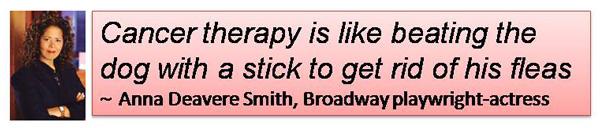
You don’t need to be a doctor to know what the current medical treatments could do to patients. Try not to be blind and deaf and you may probably learn something. Anna D. Smith, a Broadway actress and playwright said: Cancer therapy is like beating the dog with a stick to get rid of his fleas.

I have learnt enough and have said enough about that physical aspect of cancer treatment, and I could go on a meaningless bashing spree. But this is not the purpose of this book. Let me remind you there is also a spiritual aspect of cancer. Pain, joy, and life have inner and deeper meaning. The lessons I learnt have indeed enriched and strengthened my belief in the Almighty Healer – call him God or whatever names you may wish. Things happen for a reason. The sooner we know the sooner we can find healing.

In the story of Ben (Chapter 3), I have learnt my first lesson about God’s way. Ben benefited from the herbs. His doctor said he only had two months to live. He did not die within the two months, instead he got better! For a raw, naïve, non-medical person – that was a great achievement – to be able to prove that the doctor was wrong. Ego gets into the head believing that now you are a hero! I ate my humble pie when Ben died a year and three months later. I wanted to give up CA Care – No use, I can’t cure Ben. It was then that I realized –Am I playing God? Life or death is not for man to decide. It is God’s prerogative. At best – however smart we may think we are, we can only postpone or defer death for only a while. When Ben was in the hospital, he told Cindy that there was no need for any more heroic act, he was ready to go. And he felt at peace. In retrospect and after much reflection, I believe that Ben was meant to be my first cancer teacher. I was raw and naïve and knew nothing about cancer. He was there to lead me. After he had finished his job, he left.

Cure and Magic Bullet

Many patients come to us – not wanting to see the left or right – they have only one aim, expecting and wanting us to cure their cancer. No, we cannot cure you! Don’t ever expect that after you have taken our herbs the cancer will go away the next day or a few weeks or months later. Such expectation is ridiculous. The situation becomes even more ridiculous when patients who come had already undergone all the medical treatments and failed. Yet when they come to us they expect a miracle – to be cured!  When I think of this – and it happens very often – I am flabbergasted. Simple common sense tells you that it is not possible and unreasonable.

Patients generally want to hear only what they want to hear. And they only want to find what they are looking for. We, at CA Care, spend hours talking to patients trying to help them – trying to make them see what has gone wrong and how to go about living again. But all too often it is just a waste of our time. After a week or two they write back and ask: Why is my CEA still high? Why has my tumour gone bigger? Why is my pain still there? Mind you, these are people who have failed in their medical treatments.

The next favourite question patients often asked is: What are the herbs doing for me? They would like to hear us say: The herbs are going to kill all the cancer cells, or The herbs are going to stop the cancer from spreading, etc., etc. Better still: The herbs are going to cure you of your cancer! These words are pleasing to their ears. But I know, right down in my heart, there is no truth in such claims. So, I would give patients this straight answer: I don’t know. I know they don’t like that answer but I am not going to sell my soul and tell them lies for the sake of being able to sell our herbs.

Let me quote what Dr. David Agus, an oncologist and professor of medicine and engineering at the University of South California (in The End of Illness) said: If you come to me for help in treating advanced cancer detected late … your game is likely to be over soon… I say it because it’s the truth … it’s a shame that the technology and innovation in medical research and treatment are so archaic, outdated, and, dare I say, in some cases barbaric.

Nobody has ever shown that most chemotherapy actually touches a cancer cell. It’s never been proven. Doctors such as myself arrive at solutions through plain old trial and error, and therefore we can’t always explain how things work. I can’t always tell you why a certain drug works or how it works other than to say I have seen results proving that it does. I also can’t always give you’re a straight answer as to which course of therapy might work for you. In fact, doctors – myself included – don’t actually know why these drugs kill cancer cells at all! There’s a lot of trial and error in my business.

Medical science and even an outstanding oncologist cannot answer with honesty this all important question that patients asked. And I am not going to give you half-baked answers to mislead you.

The reason why I say this goes back to spiritual integrity. I can get away by giving you cooked up answers that you want to hear, but is that right? I am reminded of the words of Harold Kushner, a Jewish rabbi: There is the morality of cleverness and wit, in which success means getting the better of the other person by means of a slick business deal or a clever answer. There is the morality of righteousness, in which the highest good is thoughtfulness toward others.

To me, cancer is not just about a tumour in your breast, lung or liver. It is about you, as a human being. There is a quotation: There is no incurable disease, only incurable people. I often tell patients: After talking to you for five minutes, I would probably know if I can help you or not. Many patients come with a lot of personal baggage – this has to be cleared off. Perhaps this personal luggage could be the source of the problem.

Healing on Your Own Terms

After helping thousands of patients over the years, I have learned that almost 70 percent of them are here to find a magic bullet or wanting to find cure on their own terms. Our therapy is not easy to follow. You need to heal yourself – and it is you and you alone who can heal you. Others can only help but you decide you own fate. No two persons taking the same path would end up at exactly the same destination. Cancer is about you as a person. If you are not able to change your mental attitude, your diet, your lifestyle, etc. no one else can help you. You are a goner if you come and tell me: If I cannot eat meat life is not worth living; I have no time to cook the herbs; The herbs taste awful, etc. There is another quotation: You can choose your ways but you can’t choose the result. No amount of money that you have can ensure that you get the result that you want when it comes to cancer.

Complacency

One frustrating lesson that I have learnt and seen happened over and over again is complacency. This problem arises because patients misunderstood or are misinformed that cancer can be cured. This misinformation is further compounded by the doctors’ pronouncement that everything is alright: I have taken off all the tumours; After five years you are cured, etc. There is no truth in such statements. Patients go home with false assurance and continue to live their previous lifestyle. Unfortunately, soon afterwards, they suffer a relapse i.e., the cancer comes back. One breast cancer patient asked her doctor: Why the recurrence? The doctor answered: Oh, it is just your luck.

We know of cases where cancer relapses even after ten to fifteen years of remission. This implies that there is no certainty of a complete cure for cancer. Perhaps cancer patients are not aware or have not been properly told of the disturbing fact that conventional medical treatments can only help, not cure. In her book, (The Activist Cancer Patient) Beverly Zakarian said: One of the few things known with certainty about (ovarian) cancer is that it is uncertain.

Do not be misled. If you think that you are done with cancer, cancer may not be done with you yet. So, do not be complacent. We take the view that patients need to consider the change to healthy lifestyle and diet as permanent. From our experience, we know that most patients would ask for their unhealthy and forbidden food the moment they feel well enough to talk and eat. This is indeed most regrettable and disappointing. It makes no sense to revert back to an old lifestyle or habits at the first sign of regained health. Also, patients may need to continue taking the herbs and cleanse the body for a long time yet. There are people who would reduce or totally stop taking the herbs after the initial signs of recovery. The risk of a relapse is too great to take any chances. We have numerous stories to tell you about cancer recurrence – and all too often being due to complacency.

Be Grateful

At CA Care we do not set a lofty goal. I hope the picture below impart our message to all of you. You need to cultivate your own well-being or your healing. You need to have time for yourself. After you follow our CA Care Therapy, you may lead a life without pain. And if you can eat, sleep, move around and move your bowels and pass your urine, then I say to you – What else do you want? Be grateful for what you are and what you have. Be grateful for being able to wake up in the morning and have another day.


However, CA Care is a wrong place to come and seek help if you want to see your cancer cured and gone forever. We just don’t have that cure you are seeking for. Go elsewhere and find someone else. And if you can find one who can cure your cancer, please let us know so that we can send all our CA Care patients there too.

Accept Reality

We fully understand that cancer patients want to live as normal a life as possible. They don’t want to be treated as sick people everywhere they go. They want to do what everyone else does. But this is where, common sense comes into play. You have to accept the reality of your situation. If you have cancer, there are things that you can do and things that you cannot do; no matter how well you may feel.

I recall one educated, professional man with pancreatic cancer. He came to see me after his surgery and said: I did the surgery in Singapore. My surgeon said he had removed all the cancer. He came home very confident after such reassuring words from his doctor. However, his medical report indicated that the head of the pancreas and gallbladder had been removed in addition to a part of his stomach, duodenum and proximal jejunum. This is indeed a serious case. Anyway, I did not want to say much, neither did I want to deflate his hope even though I knew that pancreatic cancer is one of the worst anyone could ever have. There is no cure for this. I was very aware that his man was in a denial mode.

I prescribed him herbs. He took the herbs and followed our diet. I must say he was fortunate to have a loving wife and family who cared for him and his food. And he lived in a lovely home.

His blood results for the first six months after taking herbs had been most encouraging. In these six months his CA 19.9 was around 1.0 and all his liver function enzymes were within normal range. However, on 2 November 2003, this patient, his wife and sister-in-law came and presented the results of his blood test and wanted to know why everything suddenly had become bad. Can anybody explain that? In the period from June to November, his CA 19.9 shot up to 417, and all his liver function enzymes were elevated. I told him: I am not god and I do not know everything. Worse still, I cannot fix everything when things go wrong! You have to pay the penalty for whatever wrong you have done! And I asked him point blank: Honestly, tell me what did you do differently in July, August, September and October? I did not know what you did, so I cannot guess. Tell me honestly what happened in those months. Then I drew a chart of his CA 19.9. From June to November, the value had shot up to 417. Why? How could this happen? I told him – You are an educated man and a professional. We all can agree that this graph does not tell a lie.

Reluctantly, he told me that in August 2003, he moved his job position from Penang to Kuala Lumpur because he had won a project. In January to July he lived in his home in Penang with his family. His wife took care of

him and kept an eye on his diet. In August he had to live in a hotel in Kuala Lumpur and needless to say, he was living on hotel food. Although he did not tell me, I came to know that he also traveled to some countries in Europe on business trips. All this happened after August 2003. And in November – barely three months after that, we could see the damage done.

As much as we would like to help, there was nothing much that we could do for him. The last time I saw him was on 2 November 2003 and he died in March 2004.

I often faced such situations – patients coming to me asking why their condition had deteriorated. My standard question is: What “sin” have you committed? Go back and think about what you have done – what you ate and what you did that you were not supposed to do – the answer is there. There is no need to pretend or try to play innocent.

This pancreatic cancer patient tried to justify his move to Kuala Lumpur by saying that he had to work to enable him to support his children’s university education. Granted, we all understand our obligations. But the sad truth, I learnt after his death, was that he was not a poor man. He left millions in his bank account! His only problem was he had NOT learnt life’s lesson – Enough is enough! I also learnt that greed often drives people to disaster.

I said this again and again, we at CA Care can only help you. Your healing is yours to seek and achieve. To those who truly need our help, we say this: Live and don’t give up hope. There is an option. There is hope. But if you want healing on your own terms and refuse to learn and change, then there is nothing much anyone can do to help you. 

This book is available in printed form at our centres only. E-book is available at

http://bookoncancer.com/productDetail.php?P_Id=56


Part 3: She Found Hope in CA Care

In mid-May, our sister-in-law in Singapore called to inform us that her sister had just been diagnosed with pancreatic cancer. She became the fourth person in her family down with cancer. She requested to see us. Of course, we are here to help those who need our help.

We were indeed happy to know that after two and a half hours of conversation with us, Corinna had found hope in what we are doing. We did not promise her a cure – but we promised to do our best to help her! Are we just providing “false hope”? To cancer patients and skeptics, we have this message for them:

As we talked to Corinna that day, we saw the transformation in her! Watch this video!

Let me reproduce the e-mails that Corinna wrote.

26 May 2012

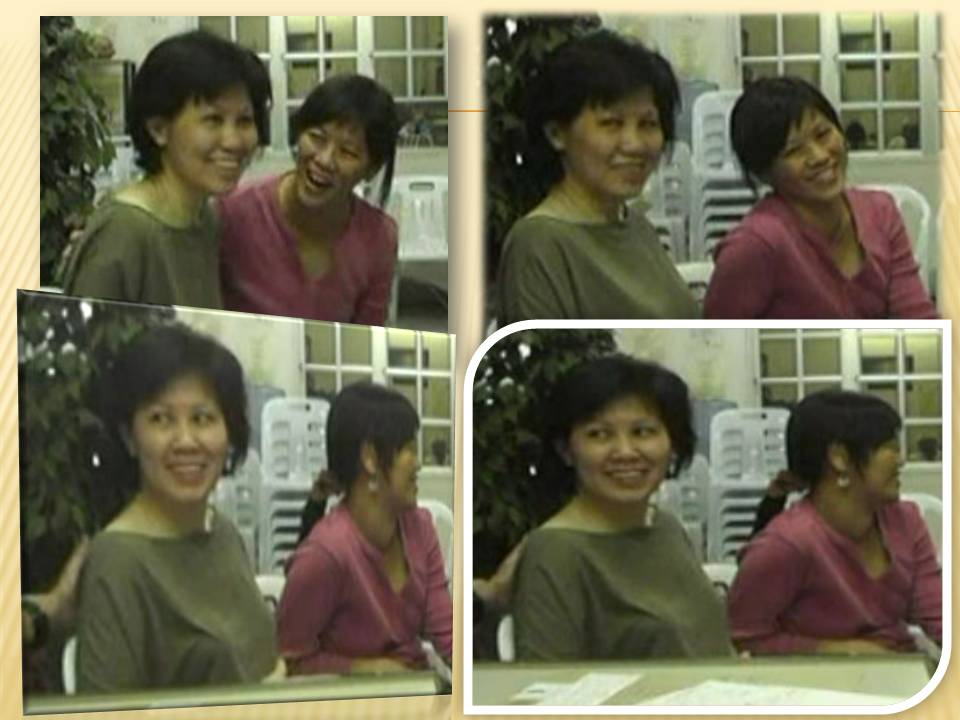
Hello Corinna, I spent the whole of Saturday editing your videos. What stood out is that the first hour at CA Care was probably the darkest hour of your life — never even smile! Then after that there was magic! You put on your sweet, infectious smile! What happened? Look at those photos —  would you like to tell us what happened inside you? We can share that will those who are going to read your story!

                                                         Her first hour of gloom

                                                     The break of dawn!

Dr Chris,  Thank you very much for the photos.

The first two pictures clearly reflected my fear, my frustrations and confusions.

Having been told by the Singapore oncologist that I have no hope and he couldn’t cure me, I was on the verge of giving up. Will this man (you,Dr Chris) who is talking to me now offer me any solution and hope? I was praying then that GOD will show me HIS direction. The 3rd photo showed my eyes closing talking to GOD.

When you started talking, I became more alert and your words slowly flowed to me and I experienced calm and peace.

I just felt at that moment GOD was communicating to me through you. God was telling me that HE will not abandon me, HIS child. You told me you are not the one curing me but GOD. Your words already healed me then as I have never spoken to any human who puts GOD above himself.

You have helped so many cancer patients, yet you are so humble and did not claim any credit for yourself but gave all to GOD as you believe HE did all the healing. You believe and witnessed many miracles. You helped reinstall my faith in GOD. I was lost but I found my way.

The last 4 photos showed my joy in knowing that it is not the end of the world. I will fight this battle with GOD’s help for my family, all who show me so much love and to you Dr Chris who brought life back to me.  

19 May 29012  Hi Dr Chris/Beng Im,

My husband Gerard, daughter Andrea and I would like to thank you both for the great hospitality on 17th May.

Prior to seeing you, I was lost and confused. I wanted very much to go ahead with chemo despite knowing that my chances of survival were extremely slim, if not zero. I am glad to have made the trip to Penang. You and your wife gave us so much warmth and love.

My faith in GOD has strengthened tremendously after hearing all your talks and stories. I felt like GOD was talking to me through you. I knew immediately then that if GOD brought me to this world so beautifully, why do I want to destroy the clean and pure body that he gave me with chemicals? We always say, Let Nature takes its course – so why don’t I let the herbs and plants from Nature and God Almighty heals me.

I have started taking all the herbs on 18 May and they are so sweet smelling, reminds me of what our parents used to give us when we were young. I didn’t feel any pain throughout the day except vomited once in the evening, probably receiving too many visitors and tired myself out.

I slept last night from 11pm to 3.30 am without taking any further painkiller. My sleep was probably disturbed by my colleague sms  telling me that she lost her job. I felt sorry for her as she is under great pressure.

This morning, Gerard and I went to the beach for a stroll. My back was aching but I feel so great now after taking your herbs. I have faith in all your herbs and GOD above will help me walk this difficult path too.

Thanks once again for everything Dr. Chris and I will continue to update you on my progress. May GOD Bless you and Beng Im always as this world needs you both to bring joy, hope and happiness.

Warmest regards
Corinna

22 May 2012  Good afternoon Dr Chris,

Guess who called me earlier? I was shocked that he called me personally — The Oncologist !!!!! He asked me why I didn’t follow up with him after seeing him last Monday 14 May. He said I should go for treatment as he thinks there is still hope for me (??????).

I told him I have decided to go for herbal and he repeated that I should reconsider chemo. He said he has read my blood and urine test and I should seriously consider chemo. He asked me to go down to his clinic for further advice as he feels I should give him a chance to talk to me.

I am surprised that someone who dashed my hope reversed his gear so fast. Suddenly he thinks there is hope when in the first place he didn’t even read all my test reports last week when I was in his clinic. I would have waivered if not for the faith you built in me. I am glad that I am strong enough to know what I myself want.

I have already put all my trust in GOD and in your herbs and I will stand by my own decision.

Today is my 5th day on your herbs and I am already feeling so much better. The pain has sudsided a lot and I am much stronger, happier and able to sleep well at night.

Once again I thank you very much for helping me and enlightening me in my most difficult time of my life.  

24 May 2012  Dear Dr Chris,

Thanks very much for your reply and great advice. I would like to update you on my progress as today is my 7th day taking yr herbs. For the past few days, I am able to go to the beach for a walk every morning for half to an hour. But when I am back, I will feel a little tired, on/off nauseous and some discomfort when I cough with spasms from my abdomen once or twice. Strangely thereafter, I would look forward to taking your herbs and every day after the first bowl, all my tiredness, nauseating and discomfort disappeared.

By noon, I become very lively and energetic and I don’t even feel that I’m sick. I know that the herbs are working well on me as my appetite has improved tremendously. I’m following the strict healthy diet recommended by your wonderful wife and I’m glad I have the discipline to do so.

Yes, you can go ahead and write my story even with my name / identity and face. There is no need to mask my “pretty” face – ha, ha, ha!!!! I give you my full approval. I believe God sent you to heal me as you give me so much joy and comfort at my darkest moment in my life when I’m lost and confused. I would have given up and surrendered if not for my prayers been answered by GOD to show me direction to find life again.

Tks vm

Warmest regards, Corinna

Her full story:

Part 1: An Encounter with an Oncologist – A great disappointment

Part 2: Conversation with Chris Teo in Penang

Part 3: She found Hope in CA Care 

Note: After taking herbs for 2 to 3 weeks, patient decided she wanted to go for chemotherapy. While of chemo, she died in the early morning of 12 December 2012.

Not All Cancers Are the Same

It looks like I am really dumb trying to write an article with such a title. Everyone knows that there are many different types of cancers. Some people have breast cancer, others have lung, liver or brain cancer. Who doesn’t know that all these are different cancers? Yes – you are right on this score, at least on the first level. However, know this – that the more you know, the more you don’t know! Let’s see what you may not know when we start to “dig in” deeper .

  1. Cancer is not a single disease. Cancer has one name, but many illnesses. It is not a single disease but probably a mix group of more than 200 different diseases. By definition, a disease is called cancer when the cells have lost their ability to control their rate of duplication. Secondly, a cancer has an abnormal ability to spread to distant sites. 
  2. Different cancers in different organs are different. For example, skin cancer is different from liver cancer. Everyone should know this!
  3. Not all cancers that develop in the same area of the body are the same. This is what I mean by “not all cancers are the same”. For example, not everyone with breast cancer has exactly the same type of cancer, meaning not all breast cancers are the same. Similarly, not all cancers in the brain are the same and not all lung cancers are the same.

The following two statements are very important aspects of cancer which we all need to know.

     4.  Not all cancers have the same growth rates – some are fast growing while others grow slowly.

     5.  Not all cancers eventually grow out be become full blown cancers that can kill us.

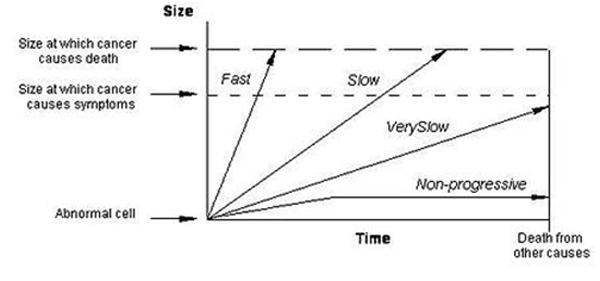
The above statements can best be explained by the diagram below:

Source: Gilbert Welch, Should I Be Tested for Cancer? pg.55

  1. The arrow labeled “Fast” represents a fast growing cancer. This type of cancer can quickly cause problems and kill us fast.  No treatments can save us from this type of cancer.  No matter what we do, we will die.
  2. The arrow labeled “Slow” represents a slow growing cancer. It takes some years to cause us problems and eventually kill us. With treatment we may be able to influence or modify the path and outcome of disease. This is the type of cancer we hope can be helped by treatments – be it medical or alternative therapies.
  3. The arrow labeled “Very Slow” represents a cancer that never causes problems because it grows very slowly. This cancer grows slowly enough that we may just die with the cancer (not die because of the cancer). We may die of other reasons, such as heart attack, diabetes, accident, etc.
  4. The arrow labeled “Non-progressive” represents a cancer that NEVER causes problems because it is not growing at all. In other words, they are only cellular abnormalities. The “experts” say we have something that meets the pathologic definition of cancer. Such “cancer” may even stop growing or perhaps even shrinks or disappear later in our life. We don’t have to treat such harmless “cancer.”

From the above it is clear that all cancers are not created equal. Some grow rapidly and invade other tissue, others grow slowly and remain non-invasive, and some don’t grow at all or may even recede. Unfortunately doctors will not be able to know with absolute certainty which cancer belong to which type although they do carry out some tests to try and differentiate them.

I am indeed glad that I got to read and understand this idea in Dr. Gilbert Welch’s book, Should I Be Tested for Cancer?    

Implications for Treatment of Cancer

Now we have a few more things “on our plate” and let us think critically.

  1. Not all cancers are the same – agreed? Some need to be treated aggressively some need gentle treatment while others may not need treatment at all (i.e. just wait and see!)
  2. In the same way, can we say that not all cancer patients are the same? Different people will react to treatment differently.
  3. In more of the same way, can we say that not all cancer doctors are the same? Yes? Different doctors do and also tell us different things about a cancer. Different doctors offer different approaches to solving the same problem. No?

Where do these statements lead us to then?

  • First, it appears to me the appropriate word to describe the situation is UNCERTAINTY – in cancer, nothing is predictable – there is no black or white answer. Every cancer is a different shade of gray.  Is it not chaotic, having to deal with different cancers, different doctors and different patients all at the same time? It is like going into a race, each fighting for his / her own survival.

  • Second, a cancer treatment that works for one patient need not necessarily work for another patient. And yet we are being taught that modern medicine is proven and scientific. They give you a one-size-fits-all-treatment. No?

I often wonder and ask myself.

Patients ask their doctors if the chemo-drugs that they are about to receive for their cancer are going to be effective or not. Often the answer given is, “There is no guarantee! Just try and it all depends on the person.” Such answer sound rather odd, primitive and even unscientific!  Why do I say this? Oncologists administer chemo to hundreds of patients everyday or every month. And they have been doing this for years. In other words, they have been administering this treatment for years to thousands and thousands of their patients.  I would want to believe that in their hearts, they can sense (and know for sure) that what they are doing is going to be effective or not. After all they have the blood test results, CT scans, MRI or/and PET images to guide them.  I am sure there must be a certain “feeling” in them  or their sixth sense, to say that based on their vast experience what they are about to do is going to be helpful or not. But in spite of that, patients often get this standard answer, “I am not sure. I cannot guarantee. Let’s try.”

I understand why oncologists provide evasive answers. Initially I thought they have to safe guard their rice bowls.


But now I understand. Their answer reflects the reality of the complex situation. How can anyone know the exact outcome of the treatment when the cancer is actually different even if it is given the same name called cancer? To make things more difficult, the patients are also different – they react differently to the treatment.  Doctors treating the disease are also different.  The only same thing is the poisonous chemo-drug.

Because of complex variables involved we see that some patients survive while some patients die even before the cancer is done with; some are “cured” while for others the cancer spread to other organs.

Unfortunately, no one is able to predict with absolute certainty what is going to happen after the treatment is administered to a patient.  No one is sure of the real “ingredients” that make good successful treatment. One patient was told, “It depends on the One Upstairs!”  Now, they say it all depends on God!


Breast Lump: Get It Out

Let me reproduce an e-mail which I received from a lady in Italy on 26 June 2010.

Dear Dr. Teo,

My sister has a lump in her left breast. She found out about this lump, it was the size of a dollar coin, three years ago. Last year when she finally decided to tell us, her family, about it, it was already one breastful, 8cm in diameter. But she has decided not to do any surgery. It’s hard to accept her decision. My parents are very sad, but I’m trying to live with this. I know she’s very afraid but tries to act as if nothing’s happening.

I succeeded to bring her to a hospital to have a breast USG while I was home last year. I live in Italy and she lives in Jakarta, and it’s a bit complicated when you’re far from each other.

I’m writing to ask whether we could consult you. Reading from your website, I haven’t found anyone who hasn’t done any surgery prior to taking your herbs. Is it necessary that we do a complete blood test and bring it to you? The only medical record we have is the USG result done last year.

If you could give us some of your time, I’d like to arrange a visit with you for my sister in August 2011.

Thank you very much,

Yours truly,

YL, Italy

Reply: She has to remove the tumour. It is too big. Herbs cannot make the tumour go away.

Once in a while over the years, we have ladies coming to us with tumour(s) still in their breasts, like the case above. They had these tumour(s) for some months or years and did not do anything about it (them).  Okay, some did something like going to see certain alternative practitioners who assured them that there was nothing to worry about. They were told, Take this or do this and the lump will go away! And they believed these practitioners. Sad tragedy follows.

If you are one such lady, let me tell you this: Don’t be dumb! If you have a lump or lumps in your breast, please go and see a doctor and have it determined if it is malignant or not, i.e. whether it is a cancer or not.  If it is a cancer, my next advice is: Have a surgeon remove the tumour or your whole breast.

After surgery, it is a different “ball game” whether or not you want to undergo chemotherapy or/and radiotherapy. But to me, surgical removal is a wise option in dealing with a breast tumour. I recall many instances of ladies who came and “asked me to agree” that they don’t go for surgery. I told them: There is no way I would agree with that.   You come to me for advice and I give you my advice free of charge, based on my years of experience dealing with breast cancer. Some of them were disappointed because I insisted that they go for surgery. Some became  angry with me for not “supporting” them.

These are two main reasons why I thought the tumour has to be removed surgically.

  1. It is better to have the tumour removed for psychological reason. After the surgery, the lump is gone. You don’t have to see or feel it is there in your breast anymore. But if the lump remains in your breast, every day or perhaps every time of the day, you are being reminded of your “fatal disease”. Would that not make life miserable for you?
  2. There is no guarantee that herbs, change of diet, exercise, prayer, supplements, etc., can make a malignant tumour disappear. The bigger the tumour, the chance of it disappearing is even more remote. A lady told me that after taking herbs for some months the tumour in her breast “burst.” Another lady said her tumour “dropped” out and left a hole in her breast! All these do not solve the problem. Some patients say the herbs seemed to stop the tumour from growing but in other instances, the tumour kept growing in size. See the pictures below and decide for yourself if this is what you want.


We hope we have made CA Care’s position clear. Please go for surgery and have the cancerous lump removed. After this is done, we can discuss whether or not you want to undergo chemotherapy, radiotherapy or take tamoxifen, etc. You have the option to make that decision.

We shall present you with two more reports on breast lumps – so, stay tuned.


Cancer: What It Takes To Be A Winner

Anne (not real name) is from Indonesia. She was diagnosed with lymphoma and underwent eight cycles of chemotherapy. She suffered severe side effects. The treatment did not cure her. About five months after the completion of her chemotherapy, the cancer recurred. There was a 2x2x3 cm mass in her left cheek and a swelling in her left neck. The doctor asked her to undergo radiotherapy and chemotherapy again. She refused.

She came to CA Care for herbs and changed her diet. After two months, Anne came back to Penang and reported that her health had improved tremendously. We then put Anne on the e-Therapy for a week. Her health improved further. A detail account of her healing is reported in another write-up, Lymphoma: Herbs and e-Therapy Brought Her Back to Good Life Again After Eight Chemos.

At the end of her stay in Penang, we pointed out to Anne that her improvement is all about herself. It was her attitude and her choice that made her well! We and people around her can only help but ultimately her success or failure depends entirely on herself – the patient.  Listen to our conversation that day.

There are three important lessons we can learn from this case.

1. Enough is enough. Eight cycles of chemos did not cure her cancer. She was asked to go for more chemos plus radiation. Anne took a step back and re-evaluated her path. What could more chemo do for her given that eight cycles did not help? Do you want to say enough is enough, or do you want to allow yourself to be led like a lamb to the slaughter? Of course, you and you alone will have to make THAT CHOICE  and bear the consequences of  your decisioin.

After the chemos Anne suffered pains. The only thing the doctor could do was to prescribe her painkillers and gastric medication for her bad stomach. She started to read the websites. She heard horror stories from friends about how patients died after the chemos, and she reflected on her own experiences. To Anne, chemotherapy had adverse side effects. It did not cure her. So she decided not to go through it again. She was afraid. Her husband said, She decided to go for Dr. Chris’ herbal therapy.

2. Get your priority right. Help yourself first before others can help you. Anne came to seek our help. She benefited tremendously from the herbs and change of diet. We did not expect Anne’s healing to happen so soon. But it did. We thank God for this blessing. On the night of her second visit here, we asked Anne if she would stay a few days longer in Penang so that she could do the e-Therapy. Anne readily agreed – I would stay here for as long as you want me to do so. It was indeed a positive attitude that brought more healing to her.

Many patients come to Penang. They would go shopping or go elsewhere first. On the last day of their stay, they would drop by CA Care. The next day they are booked to go home. Given such a situation, there is nothing much we could do to help them. Where and what is their priority? We told Anne, That night when you came, we did not plan to put you on the e-Therapy at all. If you had decided to go home the next day you would have missed your healing! But you made the right choice of wanting to stay back. And you benefited from the e-Therapy.

3. Read and gather information for yourself.  A friend gave Anne our book. She read it. Then she went into our websites. She read the healing stories. She was inspired by the story of a lawyer who had lymphoma like herself. Anne said, I read her story and I prayed and ask God if this was the way to go. Then I decided to go for herbs. I don’t want more chemo.

Unfortunately not many people are like Anne.  We receive many e-mails every day from almost every corner of the globe. Most of them expect information to be dished out to them on a silver platter. It becomes obvious to us that they don’t read. All that they wanted to know are already written in our websites – www.cacare.com or www.CancerCareMalaysia.com . They just need to read them.

Of course, there are those who just like to sit in front of the computer in the comfort of their home and expect us to send them herbs. And then want to know answers for every problem that might crop up. They seem to throw their problems at us and expect us to do the chores for them.  Go to our website: www.ADayWithChristeo.wordpress.com and these are examples of such e-mails.

This e-mail just came in while I was writing this article:

Dokter  Chris, kenapa dada pak sakit sampai kepunggung. Sudah beberapa hari tidak bisa tidur. Miring ke kanan sakit, miring ke kiri juga sakit. Saya R, anaknya di Jakarta (Doctor Chris, why is that my father has been having pains in the back for the past few days until he was not able to sleep. Could not turn to the right or left).

My reply: Before this no pain? What did he do wrong? Bad diet? Before this he was doing fine. The question you need to ask is: What did he do wrong just before the pains occurred?

Iya dokter, makan makan papa sedikit salah. Karena sebelumnya kondisi tubuhnya lemah tidak ada tenaga. Jadi dia ada makan sedikit pantangan untuk memulihkan kondisi tubuhnya. Apa yang harus kami lakukan dokter? (Yes doctor, a bit of wrong diet. He felt he did have energy. So he ate foods that were “forbidden”. What do we do now?)

I did not want to be cruel by telling him to go and jump into the sea. So my answer was, Take it easy. Let us hope that the pain will go away with time. Try the Pain Tea. Hope it helps. I did not remind him to stop taking the bad food, believing that he has learned it the hard way.

Let us remind you this. Cancer is not just about a tumour in your breast, lung or liver. It is about you, as a human being. There is this quotation, There is no incurable disease, only incurable people.

Unfortunately our experience tells that only 30 percent of patients who come to us benefit from our therapy, the remaining 70 percent cannot. We emphasize the word again, CANNOT. You may wish to ask us why cannot. We hope patients know that one of the most important criteria for success is the person himself. It is not just about the herbs. Many patients come to us with a very high expectation for finding a magic bullet. There is none here.

We have refrained from giving advice or prescribing herbs through the net. It is just a futile effort. If your problem is serious enough, or if your loved one is precious enough, come and see us face to face. Bring along your medical reports and we shall try to help you out. By doing this, we would be able to assess the patient (or those taking care of the patient) as a person.

After knowing the medical history, we would then prescribe the herbs. Prescribing herbs is a very simple thing to do. We often tell patients, After talking to you for five minutes, we would probably know if we can help you or not. Perhaps, most patients don’t even understand what we meant by this. Patients come looking for a magic bullet. They want to find a cure on their own terms. They carry so much baggage and they don’t realize that.

Our experience tells us that if you want to heal yourself, one most important thing you must do is CHANGE – change your attitude, your lifestyle and your diet. There is no two ways about it.

We can only guide you, but patients must take care to heal themselves!

CANCER: How to Make Decisions to Increase Your Odd of Winning

We make decisions every day. Some decisions are just over trivial matters. For some people, their decisions can be a “mother” of all decisions – especially if you or your loved one is being diagnosed with dreadful diseases like cancer.  The consequence of your decisions can be a matter of living or dying.  I always say this to cancer patients, Listen to whatever comments or advices others give you, but remember that at the end of it all, you and you alone are going to bear the consequences of that decision. YOU suffer or you die, NOT them. 

Out of curiosity, before setting out to write this article I “googled”, How to make decisions to increase your odd of winning. The returns obtained were about roulette, blackjack, poker, betting, slot machine and investment, nothing about cancer!

The reality is that obtaining a cure for cancer is just like “striking the jackpot” (quoting a well known oncologist in Singapore).  His statement implies that undergoing cancer treatment is not much different from going to a casino.  The outcome is as uncertain as rolling the die. There would be losers and winners. And we know the odd of winning is very low indeed.  In fact, any honest and seasoned oncologist would not even use the word “cure” for cancer treatment – they only talk about remission.

Researchers, scientists, doctors, etc. follow different protocols when making decisions. But the essential element is the same – it must be based on research data. By studying the data we hope to be able to increase our odds to win.

Theorist Versus Frequentist

Professor Stephen Schneider (in The Patient from Hell) explained this very well.

“In every course I teach I like to demonstrate the difference between two ways of thinking by using the example of a coin toss. I flip a coin onto the back of my hand and cover it. “What is the probability of the coin under my hand is heads?” “One-half”, someone always shouts out. “How do you know?” “Well, the coin has two sides”. You’re a theorist!

“Suppose you didn’t understand the coin toss theory and didn’t realize that there was an equal chance of flipping heads or tails? You just keep flipping it and count the number of heads and tails. You’re a frequentist! You want to put together a frequency chart … make a table with a column for heads and a column for tails and them you want to flip the coin multiple times. If you flip it often enough and the coin is unloaded, you’ll end up with frequency statistics showing an approximately 50 percent chance of flipping heads or flipping tails.”

“This is how scientists like to work: They like to have masses of data they can use to create probability distributions that depict the likelihood of potential outcomes… then scientists can make estimates that have high confidence levels. It’s the same in medicine. Doctors like looking at data from clinical trials performed on hundreds of patients over many years, which can provide clear evidence as to whether certain treatments are effective, on average.”

“Unfortunately, the questions … can’t be solved using … frequency data, because they involve many components of deep uncertainty.”

Professor Schneider concluded:

“Some scientists, including many medical doctors, still seem to be living in the nineteenth century in this respect, thinking that for any question, infinite sets of replicable experiments should be performed, providing them with data from which they can calculate probabilities … and “scientifically” tackle the problem at hand. Unfortunately, in the real world, as topics of inquiry become increasingly complex and involve questions about the future, scientists do not always enjoy the luxury of extensive, comprehensive and reliable frequency data when they need them.”

Intuition and Commonsense

At CA Care, I have a different view about how to solve problems.  While data based on clinical trial is a good way to indicate our chances of obtaining certain benefits or survival, etc., the data need NOT apply to you as a patient. For example, if you undergo chemo, the 5-year survival rate is 30%. You may belong to that 30% who survived or you may belong to the 70% who don’t survive. Nobody can tell for sure which group you belong to. So research data like that only provides you with a confidence level, saying that what you are going to do has a certain degree of probability that you are right.

So at CA Care I tell cancer patients to make decisions based on intuition and common sense.  Experiences show that at times certain thing happens beyond the understanding of science, yet the “heart” seems to “sense” it. Patients come to me asking if they should undergo chemotherapy or not. My answer is: What does your heart say? I do not ask, What did your doctor say or what did your relatives or friends say. My advice is, Follow your heart or the Inner Voice within you.

This does not mean that I ask you to ignore scientific data. Bear in mind that I was once a researcher and a scientist. But I also know that science deals only with the physical realm. You and I and life are made up of the sum total of the physical and spiritual realms.  The spiritual realm is superior to the physical realm. The spiritual realm impacts the physical realm. Science believes the opposite – the physical is everything and the spiritual does not exist and is totally ignored.

So for any life and death decision, I believe you cannot ignore your spiritual self. Also, I urge you to use your commonsense. There is a saying, Educated men need not be wise, and wise men need not be educated. Each of us is capable of making wise decision – you don’t need to be a scientist to make wise decisions. In order to guide you to make decisions, I say you need to consider the pros and cons –  a more scholarly term is to carry out a Cost-Benefit Analysis. Count your costs and weigh them against the benefits. Decide for yourself what you really want out of this life. Doctors have their own perspectives of what is good for you. Their value judgment may differ greatly from yours or may be even opposite of yours.  Following totally the doctors’ advice means you totally agree with their value judgment. Is this what you really want?

The function of CA Care is to provide you with honest, unbiased information of the various options available to you. Having done that, it is up to you to make your own decision based on what you think is right for you. We do NOT talk the language of doctors. We don’t think like them too. But this does make us anti-doctors. CA Care is not anti-doctors.  Everyone who comes to see us is advised to consult his/her doctor first.  If you want to do chemo, radiotherapy, etc.  and etc., go ahead and do it. The only thing we tell you is, You are responsible for the consequences of your decisions. Don’t use our herbs your scapegoat. If is most unfair to come back and blame us when things go wrong. Unfortunately some patients do that.

I am not alone in advocating such practice.  Let me quote Professor Schneider again:

“What is “dangerous” is a value judgment …  It is the policymakers  who need to decide whether risks are acceptable … or should be ignored …. We scientists can provide policymakers with information on which they can better make these decisions. In a medical setting, the science comes from medical research studies and doctors’ opinion based on their experience with data on, and knowledge of the subject. The “policymakers” are the patients, who, working together with their doctors, must make value judgment about what health risks to take.”

Experience of a Near-Missed Flight

Let me relate what happened to us a few days ago while wanting to fly home from the US. Our flights involved Delta 1097 from Raleigh-Durham (RDU) to Los Angeles (LAX) – Taipei – Penang. It does not take a scientist to know that if Delta 1097 is delayed, we would have missed the other connecting flights. I knew where the “weakness” was. And we must be well prepared for it.

From the Airline’s website, we studied the history of Delta 1097. For the past eight days (Table below) DL 1097 had always left RDU at about 8 pm and arrived LAX by about 10 pm.  Since we have to be at the check-in counter of China Airlines by about 12 midnight for the connecting flight to Taipei, I figured out I have ample time. So our risk of missing the connection is very slim. There would be no problem!   So my daughter bought the Delta ticket with full confidence that everything would be alright.

27-June
Raleigh-Durham (KRDU)
Los Angeles
09:56PM EDT
11:35PM PDT
4:39
26-June
Raleigh-Durham  (KRDU)
Los Angeles
08:15PM EDT
09:59PM PDT
4:44
24-June
Raleigh-Durham  (KRDU)
Los Angeles
07:51PM EDT
09:54PM PDT
5:03
23-June
Raleigh-Durham  (KRDU)
Los Angeles
08:39PM EDT
10:31PM PDT
4:52
22-June
Raleigh-Durham (KRDU)
Los Angeles
08:48PM EDT
10:38PM PDT
4:50
20-June
Raleigh-Durham  (KRDU)
Los Angeles
08:12PM EDT
10:22PM PDT
5:10
19-June
Raleigh-Durham (KRDU)
Los Angeles
08:07PM EDT
10:04PM PDT
4:57
17-June
Raleigh-Durham (KRDU)
Los Angeles
07:52PM EDT
10:07PM PDT
5:15
16-June
Raleigh-Durham (KRDU)
Los Angeles
08:12PM EDT
10:12PM PDT
5:00
15-June
Raleigh-Durham (KRDU)
Los Angeles
08:10PM EDT
10:04PM PDT
4:54

Somehow on the evening of 25 June, I did not feel good about our flight home on 27 June. Something in me – my intuition – was saying that something was going to go wrong.  I requested our daughter to find an alternative flight – probably taking the flight a day before or a flight in the morning on the same day. This would mean we could be in Los Angeles well ahead of time. I was fully aware that my request made my daughter “go crazy.” Daddy must be mad to cook up something like this. Why push the panic button unnecessarily? This is what they call “borrowing worry.” But anyway, we tried to “fix” my concern the next day. Unfortunately we could not find any slot in spite of the many possible flights out of RDU.

Looking at the flight data above, the worse delay that had ever occurred so far was on 22 June. The flight was delayed by about an hour due to poor weather in Atlanta – thus causing a chain reaction. My son (in training to be a scientist too, doing Ph.D. in Cancer Biology at M.D. Anderson!) assured me that based on the above data, there should NOT be any reason why I should lose my sleep. He predicted the flight would go as schedule. The previous delay was due to weather condition. But in my case, the weather was fine.  Disruption by weather condition in summer is rare.  So in theory the odd against serious flight delay is minimal in my case.  So, we made a “scientific decision” just like oncologists do when they give patients chemotherapy or radiotherapy.

Before going to the airport, I was tracking the flight schedule at home. Everything seemed to be okay. With confidence, on 27 June, we drove to the airport to catch our DL 1097. It was about 5 pm then and we were about to arrive at the airport. My daughter’s mobile phone rang. She picked it up. Then there was a sober silence.  I asked,  Delta called? Flight delay?   Irene (a Clinical Psychology Ph.D. intern at Duke University), being a very gentle lady that she always is, said, Papa, please don’t panic. Yes, the flight was delayed until 9.15 pm! In actual fact, it was not really 9.15 pm. The flight only took off at 10 pm.  This was the worst delay ever recorded. I told my daughter, My intuition turned out correct. We will take it easy. This thing happened for a reason. But it  not as critical as those cancer patients whose lives have been turned upside down and inside out after being told they have cancer. Take it positively.

In theory this delay put the probability of us missing our connecting flight as extremely high. I remember thinking what would happen to all those cancer patients who wanted to see me on Friday, I July afternoon. They had bought their tickets to fly in from Indonesia and Singapore hoping to see me.  They would be disappointed.

Our “fighting” instinct took over.  We were supposed to go for our dinner first before arriving at the airport. We had already checked in on-line. Because of what had happened we drove straight to the airport. We talked to the Delta people and asked for possible alternative routing or airline. Unfortunately, there was no other option left. We still have to take Delta 1097 and bet on our luck.

Imagine the predicament I would face – what was I to do after landing in Los Angeles in the middle of the night? Where to go? How to find another flight to come home?

To cut the story short, we did not miss our connection! On Wednesday 27 June we landed home safely in Penang as scheduled. How did we pull this off?

These are the reasons why.

  1. We did not panic and kept our cool. Instead of cursing Delta, we accepted the situation.
  2. We started to take positive actions to solve the problem – taking the bull by the horn! We drove to the airport right away instead of going to dinner first. We had to find the solution to our problem and did not allow the problem to revolve by itself or taking it “lying down.”
  3. We talked to the Delta staff. David, the gentleman who handled our case, was very helpful but he could not offer any alternative flight. They were either all full or not suitable.  But one thing David did right, which I believe helped increased our odd at “winning”. David offered to transfer our baggage from Delta to China Airlines without us having to wait at the baggage area and collect it personally. This is something the airline does not normally do because we have separate tickets for both flights from different airlines. No doubt about it, if we have to wait to collect our baggage, we would definitely miss our connecting flight.
  4. Then, we worked out a back-up plan, should we miss the connecting flight. This provided us with peace of mind. We knew exactly that we would have to do. The fear of being left stranded in the big Los Angeles airport in the middle of the night evaporated. After this was sorted out, we went for our dinner. I ordered an extra-large bowl of Vietnamese noodle – and there were no butterflies in my stomach!
  5. Looking at my watch before the plane was about to land in Los Angeles, I felt we would miss the connecting flight. I made another move.  I relayed our problem to the flight attendants and asked for help.  I requested to pick up my hand-on and let us be the first ones to get out of the plane. The male steward listened to my request and shrugged his shoulders. Either he did not understand me or he was dumb or was not the helpful type. I then talked to the female attendant in charge and she understood me.  She made an announcement requesting other passengers to hold on to allow us to leave first.  I looked at my watch again. We only had 10 minutes to get out of the plane and rushed from Terminal 5 to Terminal 3 where China Airlines is. That was a big deal.
  6. My daughter took another positive step. She informed the China Airline counter about our problem. So when we arrived at the check-in counter at 12 midnight, we were attended to right away.
  7. Three weeks earlier, when my wife and I arrived at the Los Angeles airport, I did my homework. In preparation for such anticipated problem, I took time and walked around to study the layout of the airport. I made sure I know how to get to the International terminal from the Delta terminal.  I had to turn left not right! So I have done my homework well ahead of time.

What a relief after being given the boarding pass by China Airlines. There was no more fear that we would miss our flight!  My wife and I went through the security check.

Feeling relieved, I became complacent. I blindly followed other passengers to the boarding gate and couldn’t careless to check what our depart gate was, as printed on our boarding pass. After all the planning and rushing, you believe that Chris Teo would do such a silly thing? We ended going to the wrong end of the terminal. The China Airline boarding gate was on the opposite end of the terminal.  I should have checked first and turned right instead of left. I did not do that and was complacent. I should not have followed other passengers blindly! Again, it was a mad rush. The plane took off about 30 minutes late, not because of my fault though – it was a full-load and that took time to get everyone on board.

Lessons We Can Learn

I have never been in such a predicament before. But I must say, my predicament was not anywhere near what cancer patients experience after being told that they have cancer. I am also not saying that the way I solve my problem is the best way. You may have your own way – so be it. Nevertheless, I believe there are some basic ingredients in every successful endeavor – whether missing a plane flight or having cancer.  These are some important points to remember.

  1. Don’t panic when confronted with a problem.
  2. Everything in life happens for a reason. Later on you may want to find that reason but for the moment, it is not the time to find that reason. No need to ask why. No need to find a scapegoat.
  3. Take positive actions to resolve the problem. Give your best shot. This is your problem. If you do not show much interest to help yourself, don’t expect others to help you.

I receive e-mails from patients every day. Indeed I felt disappointed reading some of them. Many like to throw their problems at me and expect me to solve their problems while they sit in front of their computers at home! My answer has always been: If I can help you, please come and see me. If you cannot come and see me, how do you expect me to give you my full attention?

Please read the e-mails below.

  • Hi Dr Teo, Thank you for your prompt response. I am from Singapore. In fact, I had placed an order for Rodent Tuber capsules from one supplier in Malaysia as my mother had problem taking the grinded fresh rodent tuber plant since she complaint of biting on the tongue and throat. Besides this plant, she is constantly seeking TCM treatment.

Reply: That stuff cannot possibly be from CA Care. We don’t do things like that. Patients need to come and see me with all the medical reports before we give out our herbs.

  • Thanks for your reply. I had gone into your homepage. In my mom’s case, there was no biopsy done. It’s merely from the X-ray done that the doctor concluded that it’s advanced stage lung cancer (both sides). If I can get hold of the X-ray results and emailed to you, is it possible for you to give some recommendation?

My reaction: How serious or valuable is her mother’s life? Sitting in front of a computer is not going to help much.

 4.    Formulate a back-up plan in case the first plan fails. This is the reason why I often tell patients, If you do not get any better or benefit after two weeks of taking the herbs and changing your diet, please go to someone else for help.  

Goh is a 58-year male with multiple myeloma. He received 22 cycles of chemo and suffered a relapse. He was asked to undergo 32 cycles more of chemo. After 6 cycles of the second round of chemo, he gave up due to severe side effects. What does commonsense tell you about such a case?

5.    Share your problems with others. There may be opportunities that you may not know about.  If presented courteously, those in the position to help may offer extraordinary help to solve your problem. In my near-miss flight, David at the RDU airport and the female flight attendant had contributed positively. Without their help I am sure we would have missed the connecting flight.

6.    Do your homework. This again is one thing that upset me after reading e-mails from patients. People who wrote me did not read our website carefully enough. Most of the things you need to know about cancer and how to go about it, can be found in our website. What you need to DO is just read them – and I know most of them don’t read. They want me to serve them the information on a silver platter. Remember that knowledge is power. There is a Chinese saying: Dig your well before you become thirsty. Do that if you are wise.

7.    Don’t be complacent. I almost had to pay for my own foolishness. Many cancer patients become complacent after they get well – they think they have already solved their problem. Such people would then go back to their old ways and fall into the same hole again. Cancer can recur. To me, there is no such thing as a permanent cure for cancer.  So don’t be misled.

Let me give you one example. There was this elderly lady with colon cancer. She refused chemotherapy and was with us for more than three years now. She was doing very well. Lately, she told her family that she was fed up taking the herbs besides having to take care of her diet. She and her family came to see us. I gave her a big smile and laughed. And I said, It is fine with me. It is your life and if you wish to “go home early” that is okay too.  After all many of us believe that living in this world is nothing else but suffering. But if you want me to agree to what you want to do, I must say you are foolish. Why do you want to change something that has made you well in the first place? Anyway, if the cancer comes back, you can always go for chemo. You have not done that yet!  The problem with cancer is that we do not know when it will strike back again. There is no room for complacency.


Dissecting Chemotherapy Part 6: Avastin Does NOT Cure Cancer

The Story of Avastin That You Need to Know

On February 26, 2004, the FDA approved Avastin (or  bevacizumab) as a first-line treatment for patients with metastatic colorectal cancer, i.e., cancer that has spread to other parts of the body. Avastin  was shown to extend patients’ lives by about five months when given  as a combination treatment along with standard chemotherapy drugs for colon cancer (the “Saltz regimen” also known as IFL). IFL treatment includes ironotecan, 5-fluorouracil (5FU) and leucovorin.

Source: http://www.cancer.gov/cancertopics/druginfo/fda-bevacizumab#Anchor-Approva-23287

Take note of this fact carefully and serious ly – nowhere in the medical literature does it say Avastin cures cancer. It does not. When given with IFL, Avastin made patients lived longer by about five months. That was all. And the average time before tumors started regrowing or new tumors appeared was four months longer than patients receiving IFL alone.

Avastin Approved As Second-Line Treatment of Metastatic Colorectal Cancer

On June 20, 2006, the FDA granted approval for Avastin for use as second-line treatment of metastatic carcinoma of the colon or rectum. This recommendation is based on the demonstration of improvement in  overall survival  (OS) of patients receiving Avastin plus FOLFOX4 (5-flourouracil, leucovorin, and oxaliplatin) when compared to those receiving FOLFOX4 alone.

Mean overall survival of patients receiving Avastin + FOLFOX4 was 13.0 months while those receiving FOLFOX4 alone was 10.8 months.

Source: Source:  http://www.cancer.gov/cancertopics/druginfo/fda-bevacizumab#Anchor-Approva-51277

Take note again. Patients receiving Avastin + FOLFOX4 lived longer by only 2.2 months. Avastin did not cure. It only extended life by 2.2 months. Is that what patients want? Do oncologists clearly tell this fact to patients before they give them Avastin?

 Each Avastin injection cost a lot of money. It is NOT cheap for most people. Money is one point, Avastin comes with a bunch of devastating side effects. The most serious, and sometimes fatal side effects of Avastin are:

  • gastrointestinal perforation,
  • wound healing complications,
  • hemorrhage,
  • thromboembolic events,
  • hypertensive crisis,
  • nephrotic syndrome and
  • congestive heart failure.

The most common adverse events in patients receiving Avastin are:  asthenia (fatigue or weakness), pain, abdominal pain, headache, hypertension, diarrhea, nausea, vomiting, anorexia, stomatitis, constipation, upper respiratory infection, epistaxis (nose bleed), dyspnea (shortness of breath –SOB), exfoliative dermatitis and proteinuria (excess proteins in the urine).  Source: http://www.avastin.com/avastin/patient/crc/index.html#/crc/treatment/

Avastin for Colon Cancer – Any good?

A posting on 19 September 2010 has this heading:  Second Avastin Trial Shows No Benefit in Early Stage Colon Cancer. Adding Avastin to chemotherapy for early stage colon cancer didn’t reduce the risk that cancer would return. Source: http://fightcolorectalcancer.org/research_news/2010/09/second_avastin_trial_shows

A statement released by the drug company, Roche of Switzerland (http://www.roche.com/investors/ir_update/inv-update-2010-09-18b.htm) stated that:

  • A study known as AVANT evaluated the use of Avastin plus chemotherapy in the adjuvant treatment (immediately after surgery) of early-stage colon cancer. The results did not show that it improved disease-free survival in stage III colon cancer.
  • Evaluation of Avastin in the early-stage setting, the AVANT study shows that standard chemotherapy plus one year of Avastin is NOT effective in reducing the risk of relapses in early-stage colon cancer.

In another posting on 25 Janruary2011,entitled: AVANT Says No Avastin Benefit in Stage III Colon Cancer

Source:  http://fightcolorectalcancer.org/research_news/2011/01/avant_says_no_avastin_benefit_in_stage_iii_colon_cancer

A second randomized clinical trial has confirmed what the first one found — adding Avastin to standard chemotherapy does not reduce recurrences after surgery for stage III colon cancer. In presenting the trial results at the 2011 GI Symposium, Aimery De Gramont, MD, PhD, concluded:

  • The addition of Avastin to FOLFOX4 or XELOX did not improve disease-free survival  (DFS) in the adjuvant treatment of Stage III colon cancer.
  • Immature overall survival data suggest a potential detriment.
  1. In the first year, there was a transient favorable effect.
  2. The treatment effect became unfavorable after one year.

What the Mass Media Said

Avastin Falls Short in Test as Colon Cancer Medicine. Source: http://www.nytimes.com/2009/04/23/health/23avastin.html

Andrew Pollack of the New York Times, wrote on 22 April 2009: In results from a widely watched clinical trial, the drug Avastin failed to show a significant effect on preventing the recurrence of colon cancer.  Avastin had sales of $2.7 billion in the United States alone last year.

Melly Alazrakip of Daily Finance wrote: Roche’s Avastin Fails in Early-Stage Colon Cancer Study

Source:  http://www.dailyfinance.com/2010/09/20/avastin-cancer-drug-roche-fails-colon-study/

The top-selling cancer-fighting drug Avastin, which was once believed to have the potential to help treat many cancers, has hit another roadblock in testing. In a recent Phase III study, Avastin failed to improve disease-free survival in early-stage colon cancer patients when administered immediately after surgery.

Roche, the world’s largest maker of cancer drugs, said data from the study showed that adding Avastin to standard chemotherapy for one year after surgery wasn’t effective in reducing the risk of relapses. Indeed, the data showed better outcomes for standard chemotherapy alone.

As the world’s best-selling cancer drug, Avastin recorded nearly $6 billion in sales last year.
Avastin has experienced other setbacks this year, including Great Britain again refusing to approve Avastin for colorectal cancer on the basis of its poor cost-effectiveness, and another late-stage study showing Avastin failed to extend survival in men with advanced prostate cancer, compared to current treatments.

Take note here: Avastin is not allowed in Great Britain on the basis of poor cost-effectiveness.

In the poor developing countries, Avastin can be used? Is that logical?

Avastin for Other Cancers

In spite of its poor performance, Avastin had and is being used rather commonly for the following cancers:

  1. Metastatic Renal Cell Carcinoma (mRCC)
    Avastin is indicated for the treatment of metastatic renal cell carcinoma in combination with interferon alfa.
  2. Non–Squamous Non–Small Cell Lung Cancer (NSCLC)
    Avastin is indicated for the first-line treatment of unresectable, locally advanced, recurrent or metastatic non–squamous non–small cell lung cancer in combination with carboplatin and paclitaxel.
  3. Brain cancer.
  4. Just not too long ago, Avastin was also approved for the treatment of breast cancer.

Castle Built On Sand – Avastin for Breast Cancer

Andrew Pollack of the New York Times (23 February 2008,http://www.nytimes.com/2008/02/23/business/23drug.html)

reported that the FDA approved Avastin as a treatment for breast cancer – a decision that appeared rather baffling to the common mind.  But as always, we know that a FDA  approval  means an additional hundreds of millions of dollars of annual sales to Avastin.

As a breast cancer treatment, Avastin costs about UD$7,700 a month, or US$92,000 a year.

Let us look at the results of the clinical trial on which the approval was based.

  • Women who received Avastin in combination with the chemo-drug Taxol (or paclitaxel) had a median of 11.3 months before their cancer worsened or they died, in contrast women who received Taxol alone had a median of  5.8 months. This means Avastin only delayed cancer worsening by 5.5 months.
  • Women who received Avastin lived a median of 26.5 months, compared with 24.8 months for those getting Taxol alone — life extension that was not statistically significant. This means Avastin prolonged life by 1.7 months which is meaningless and this difference could just be due to chance and not real.
  • Moreover, the women receiving Avastin suffered more side effects. And 5 or 6 of them out of 363 died from the drug itself.

In spite of such miserable performance, Avastin was approved for breast cancer treatment. And many patients in this part of the world, including Malaysia, were given Avastin by their oncologists.

A castle built on sand would not last! 

Matthew Perone of the Associated Press, on 15 December 2010 wrote:  http://www.msnbc.msn.com/id/40702735/ns/health-cancer/t/avastin-shouldnt-be-used-breast-cancer-fda-says/

Federal health authorities recommended Thursday that the blockbuster drug Avastin no longer be used to treat breast cancer, saying recent studies failed to show the drug’s original promise to help slow the disease and extend patients’ lives.

The ruling is a significant setback for the world’s best-selling cancer drug and will likely cost Swiss drugmaker Roche hundreds of millions of dollars in lost revenue.

The FDA approved Avastin for breast cancer in 2008 based on one study suggesting it halted the spread of breast cancer for more than five months when combined with chemotherapy. But follow-up studies showed that the delay lasted no more than three months, and patients suffered dangerous side effects.

Roche sells the drug at a wholesale price of $7,700 a month. When infusion charges are included, a year’s treatment with Avastin can run to more than $100,000.

Comment 

Avastin – it is all about big money but the results of Avastin are just miserable. It falls far short of the patients’ expectation. They expect the chemo drug to cure their cancers or at least prolong their lives for many more years! The truth is, Avastin does not and cannot do that!

Why Patients Refused to Undergo Chemotherapy, Part 3

A continuation from Part 1: Why Patients Refused to Undergo Chemotherapy, https://cancercaremalaysia.com/2011/04/19/why-patients-refused-to-undergo-chemtherapy-part-1/

Part 2: Why Patients Refused to Undergo Chemotherapy, https://cancercaremalaysia.com/2011/05/03/why-patients-refused-to-undergo-chemotherapy-part-2/

Case 9: Uncle Died After Chemo

A lady came to see us on behalf of her mother who was diagnosed with cancer. The surgeon said that her mother had to undergo chemotherapy. The family refused chemotherapy.

Why the family refused chemo:  Why did you not want her to do chemo? Because of her age – she is already 75 years old. Her brother, that is my uncle, had lung cancer and he was then only 68 years old. He died – could not take the chemo. He went for chemo – after the first chemo he became very weak. Then during the second chemo, he became unconscious and died.

The first time he was already weak – why continue with the second one? I don’t know la. Within two weeks – the first chemo and the second chemo – only two weeks and he died.

What do you mean? The first chemo was the first week, and the second chemo was one week later.

Within two weeks he died? Ya


Case 10:  Niece Died After Chemo

This lady was diagnosed with Lymphoma and the only treatment available to her was chemotherapy. She refused chemotherapy.

Why she refused chemotherapy:   The daughter of my younger sister had cancer. She had an operation followed by chemotherapy.  She died. My sister pleaded with me: “Sister, please … please listen to me. Do not go for chemotherapy. You will die.” My niece had two or three times of chemo and she was bald. Then she died. My sister told me not to go for chemo. I also do not want to go for chemo. My husband and children also told me not to go for chemo.


Case 11: My Friend Died After Four Cycles of Chemo

This young man is from Indonesia. He was diagnosed with colon cancer two years ago. He was asked to undergo chemotherapy. He refused.

Why he refused chemotherapy:  I do not want chemo! Doctors in Medan asked me to undergo chemotherapy since 2009 (i.e., two years ago). I refused.

Why did you refuse: Because of the adverse side effects!

How did you know the side effects were bad? From friends! One of my friends had colon cancer and another had breast cancer. Both of them had surgery. Then they went for chemo. The one with breast cancer was bad. She died. She received four cycles of chemotherapy and she died never completing the full treatment. The one with colon cancer received two cycles of chemo. Then he gave up. And he is still alive today.

What could have happened if he was to continue with chemo? May be dead by now (laugh). That is why I refused to go for chemo. My friend is alive and alright today. It has been three years now.


Case 12: I saw and I knew that chemotherapy did not cure cancer

Guat had breast cancer for many years.  It started with a small lump in her breat. When the tumour grew bigger (almost half a kilo!), she agreed to go for surgery but refused chemotherapy or radiotherapy.  She kept herself alive doing what she thought was good for her. She took herbs, supplements, etc. and had a very positive outlook of life. She learned to live with her breast cancer for more than ten years. Later, the cancer spread to her lungs and she eventually died.

We had a chance to talk to Guat. She shared her experiences and views about medical treatments for cancer.

Why she refused chemotherapy and medical treatments: I have seen many people with cancer. After chemo they also died in less than two years! I have seen many such cases. They suffered while undergoing chemo but at the end they all died anyway. So why suffer? After my surgery I was asked to go for radiotherapy to prevent recurrence, according to the doctor. I declined. Let it recur first and then we deal with it. I refused to go for chemo. Assuming after the surgery I would die within two years. It’s okay, at least I don’t have to suffer. If I go for chemo, there is no guarantee of a cure.

From what you observed – people who had chemo or radiation, don’t they benefit from the treatments? They suffered so much. I would rather not suffer and prefer to die sooner without   chemo. It is okay for me. I don’t want to suffer. For example, with chemo I would survive for two and a half years, without chemo two years. I would chose two years of quality life. You can take that half a year away. It is okay if I die sooner.

You made all these decisions on your own or were you influenced by others? I made my own decisions based on my observations of what happened to others. Many people tell me many things. I listened to their stories but at the end I made up my own mind. For example when I had a small lump in my breast, I decided to take chances and dealt with it the way I thought was right for me.  The lump grew bigger and bigger. I knew then that there was no hope that it would go away. So I decided to go for surgery. But when the doctor suggested radiotherapy to prevent recurrence, I said no. I told him, if there was to be a recurrence, we would deal with the problem as it occurs, not now. Even with radiation, I have seen many cases of recurrences.

I knew a few patients who had cancer. They underwent chemo – and all of them died, including your own distant relative – you remember?

When you see the doctors, they tell you to go for chemo. But there is no guarantee that chemo can cure. It cost RM 30,000 for the treatment. For a poor patient it is a lot of money. One doctor said this to my friend: “It is your mother, why don’t you want to “save” her? True, even a dog, we also want to save its life let alone a mother. But when the treatment cost so much money, where to find the money? Worse still, there is no guarantee that chemo can cure anyway. Unfortunately, many “village folks” don’t know how to respond to such “scolding” from their doctors. I am not angry, but I think doctors should not talk like that!


Read more about what they say about chemo …

  1. Killer cancer treatment: How toxic chemotherapy kills both cancer cells and cancer patients http://www.naturalnews.com/012727.html
  2. Can you trust chemotherapy to cure your cancer? http://www.ener-chi.com/trustchemo.htm
  3. Questioning Chemotherapy: How chemotherapy does not cure cancer or extend life.  http://www.drheise.com/chemotherapy.htm
  4. Argument against chemotherapy. http://www.canceractive.com/cancer-active-page-link.aspx?n=255


One reader sent us this comment:
My niece passed away this morning.  No, not from cancer! From chemo !!!   Her chemo did not even last her more than two months!! This is why so many holistic doctors say our modern GOLD-CLASS CANCER TREATMENTS kill faster than smoking.   More: http://twitpic.com/4wjd8f

I know of another who died after one and a half years of chemo (stomach cancer). He was barely 25.  And another…they let him have sleeping drugs instead.  He was my uncle… Sleeping drugs killed him in four day (he had advanced cancer in pancreas, liver and lungs).
WHERE IS THE FIGHT AGAINST CANCER?
If a fruit doesn’t cure, they say the person who promoted the fruit is a quack!
But when it comes to cancer medicine and therapy, if it does not work, it is not quackery!
Is there SOMETHING WRONG with our medical industry?  YOU TELL ME!

Note: We have documented 12 cases of why patients refused to do chemo – so, enough is enough?

 “For those who believe, no proof is necessary.

For those who don’t believe, no proof is possible.”