Brain Tumour: An Amazing Healing Experience

AN is a 33-year-old Indonesia. About 5 years ago he started to have headaches (but no vomiting or double vision). The problem dragged on until January 2014 when AN had a seizure at 4 a.m. He became unconscious. He woke up to find himself in the hospital. MRI showed a 4.0 x 4.2 x 4.6 cm tumour in his brain.

Brain-Andy

According to the doctor it was an Astrocytoma. AN was referred to a neurologist who said operation was not indicated. He  only prescribed AN anti-seizure medication.

In February 2014, AN came to a hospital in Penang for further consultation. He was told to undergo an operation to remove the tumour. This would cost RM 25,000. In addition AN was told that after the surgery he might end up paralysed or may even lose his speech totally — i.e. become dumb. AN declined surgical intervention.

AN went for Helmet Therapy (terapi helm) offered by an alternative healer in Java. AN paid IDR 11 million for the helmet which he had to wear on his head. It is supposed to “kill” the cancer cells. AN used this helmet for about one and a half years.

Did the therapy helped you? AN replied: Not sure if it was good or not for me. This is because he used to have a seizure once a month, and later it progressed to once every 2 weeks and then once a week. Also the tumour had gone bigger, 4.3 x 4.7 cm. This is in spite of using the helmet.

AN explained that before the Helmet Therapy, the right side of his head and body were affected during the seizure.  But after the Helmet Therapy, only his head was affected. The head was pulled towards the right. The seizure usually lasted 30 seconds to a minute. His left eye became swollenl and the eye lid became narrower.

In addition to the Helmet Therapy, AN also took Soursop leaf tea and Rodent tuber capsule (not from CA Care).

During AN’s first visit to our centre, he presented with:

  • Headache after waking up in the morning.
  • Eyes felt numb. This lasted for about 4 hours, every morning.
  • Sometimes felt dizzy and this may last for 3 days, all day long.
  • Nose blocked after waking up and lasted until 9 a.m.
  • Humming sound in left ear for about 4 hours.
  • Unable to sleep well.
  • Sometime had difficulty breathing if sleeping flat on the back.
  • He felt tired easily.

TWO MONTHS LATER – an amazing healing experience

AN and his wife walked into our centre. I could not recognised AN. He looked good and told us that his health had improved!

  • Headache was much lighter. Before the herbs his head felt heavy and tight.
  • Eye numbness lasted only an hour as opposed to 4 hours before.
  • He was able to sleep very well.
  • Ear humming only about 1 hour a day.
  • Blocked left nose only once a week, not every day like before. Also after an hour, the blockage disappeared.
  • Seizure became mild but occurred every day instead of once a week. During seizure it only involved pulling of the facial muscle and lasted about 30 seconds.
  • No more draining of energy after seizure.

Healing Crisis

We had warned AN that he might suffer healing crisis in the first week after starting the herbs. We told AN: Please don’t call or email us if this happen. There is nothing we can do about this. Everyone has to go through this crisis! But the healing crisis will gradually go away after a few days.

Indeed, AN suffered severe headaches for a few days after drinking the herbs. He was unable to work and had to sleep all day. In fact his headache had become more serious! Although he was so afraid and uncertain of what to do next, he dared not call us because we had told him not to do that!

After a week, the healing crisis started to subside and his condition started to improve. By the third week, AN felt well again. And his condition improved much more than before taking the herbs.

AN shared his experiences in the videos below (speaking in Bahasa Indonesia). We would like to thank AN for his permission to use these videos without having to hide his identity.

Part 1: First Visit


Part 2: Two Months on CA Care Therapy


Stage 4 Breast Cancer: No surgery, radiation or chemo! Only on hormone and CA Care Therapy

Our three earlier posts are on breast cancer — two “rotten cases” and one “rewarding” case. Here is another one for you ponder on. 

e-mail:  10 October 2015

Dear Dr. Chris Teo,

My name is D. I am 37 this year and currently residing in Singapore. Out of desperation from searching for information about my mum’s breast cancer, I came to know about you and CA Care.

Having bought and read a few e-books from CA Care, I am well aware of the healing process suggested by CA Care.

Background:  Sometime this year, my mother (J, 56) noticed a lump on her left breast. Only until Sep 2015, she decided to visit K Hospital for check up. Upon investigation, the doctor in K Hospital diagnosed her with breast cancer and she was being referred to Singapore National Cancer Centre.

Last week, we had the first appointment at NCC. Doctor confirmed that it was early stage 4 breast cancer.

At the moment, no surgery, chemotherapy and radiation treatment were ordered. My mum is currently prescribed hormone therapy (Letrozole Alvogen) with next follow up appointment in Nov 2015.

Note: Letrozole is also known as Femara.

Attached are her medical reports.

Mammogram, 3 Sept. 2015: There is an ill-defined … mass …in left breast at 12:00 – 1.00 position. It measures 50x 35 mm.

Several other nodules are seen are both breasts. They are all subcentimetre .. and have well-defined borders.

At least two abnormal lymph nodes are seen in the left axillae.

Left breast core biopsy, 9 Sept. 2015: Invasive ductal carcinoma.

FNA left axillary lymph node: Metastatic carcinoma.

Hormonal status: Estrogen receptors positive, Progesterone receptors negative, CerbB2 negative.

Bone scan, 15 Sept. 2015: Increased tracer uptake in the right humeral head / proximal shaft.

I have spoken to my mum about your work and she is willing to heed your advice. Therefore, may I bring her over to Penang to see you asap? Dear Chris, please advice her and save her… 

Reply: If you think I can help you, yes– come with all medical reports and scan …. Monday to Thurs at 11 a.m. 

e-mail:  2 November 2015

D from Singapore here. It’s almost a month since we visited you in CA Care. I have to thank you for helping and speaking to my mum with regards to her breast cancer …  my mum will be having her 2nd review (blood test) at NCC tomorrow, 3rd November. I will update you.

e-mail: 31 January 2016

Hi Chris,

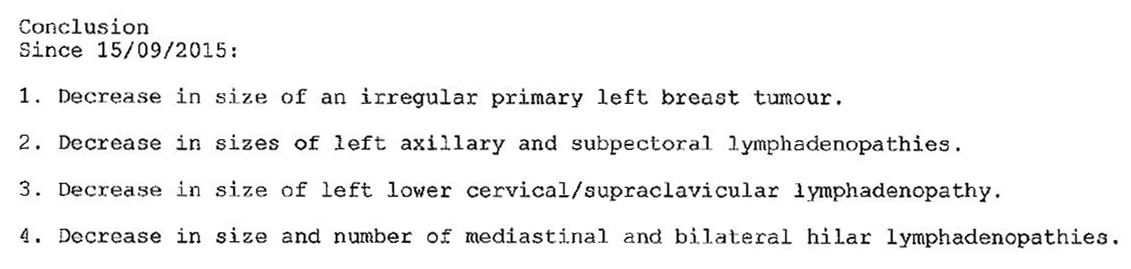
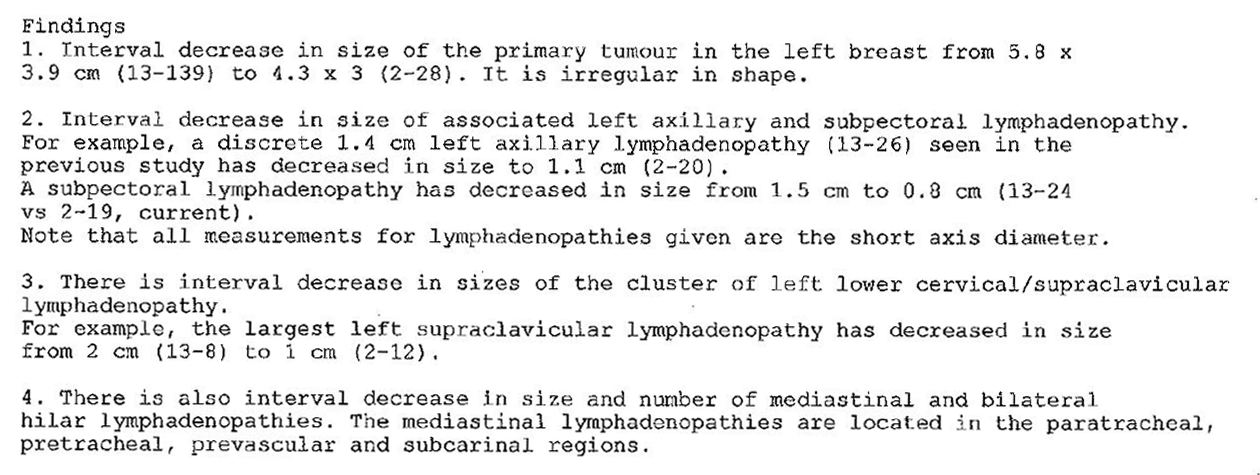
Attached is my mother’s latest scan in Dec 2015. Verified that all tumors had shrunk in sizes and some had even disappeared.

To recap, my mother had been taking your herbs since Sep 2015 + Aromatase Inhibitor (Letrozole Alvogen) to block the estrogen. Any comments for the progress?

1 Finding 2 Conclusion


Comments

This is indeed a unique and amazing case! Why?

If you have a lump in your breast, it is most likely that you will be asked to have it removed. Then after the surgery, you will be asked to go for chemo and radiation. Then and only then would you be asked to take Tamoxifen or Femara for 5 years! That’s the norm — especially if you are to go to a private hospital and have the money to pay for the medical bills.

When this “healthy” 56-yer-old lady came and told us that she got none of these invasive treatments (except Femara) we were surprised — can this be an improved, non-money-driven-therapy? How great it would be if most women were treated this way!

After about two months on CA Care Therapy and Femara, the tumours shrunk and some seemed to have disappeared (listen to video). That is amazing.
And what is even more amazing is that the oncologist did not object to the patient taking herbs! In fact he was supportive of her doing so. Rarely can you find such a situation! Generally, patients are scolded and told NOT to take “unscientific and unproven” therapy like herbs. Patients are often told that herbs can destroy the liver or kidney!

In the U.S. some doctors would label alternative healers as quacks or snake oil peddlers. We are glad to learn that alternative healers do have some “friends” among the medical doctors in modern, no-nonsense Singapore! Bravo!

This patient came to see us twice. On both occasions she looked healthy — there was nothing much that bothered her, apart from knowing that there are lumps in her breasts, around the neck and chest. But as we always tell patients — let us learn to live with the cancer, not declaring war on the cancer!

If you can eat, can sleep, can move around and have no pain then be grateful for what you are. As it is this patient still has a job and is happily working! Imagine what happens if she was to undergo chemo and radiation — quality life gone but the cancer would not be cured anyway. Or possibly the cancer may even spread more extensively and aggressively after these treatments!

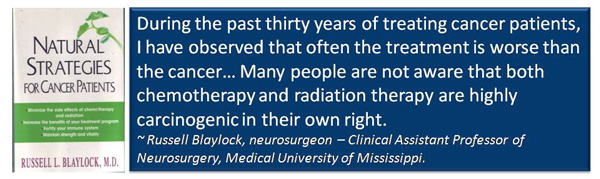
29 Treat cancer-notpatient

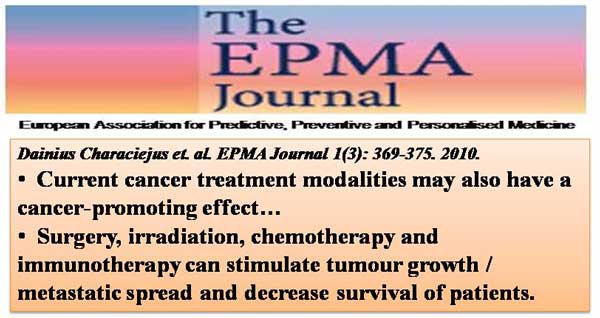
5 Chemo-and-radio-crude

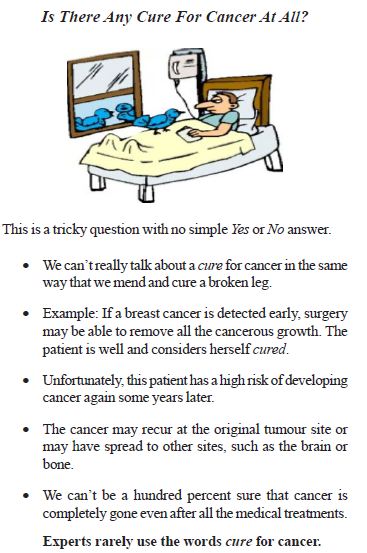
34 Treatment-worse-than-ca-Bay

52-surgery-radiation-etc-cau (3)

25 Some-body-must-be-iying

Breast Cancer: Four Years On Without Chemo or Radiation. She is still fine!

At CA Care — for some days in a week it is just frustrating stories that we get to hear from patients. But let us assure you that NOT all days are cloudy and gloomy. If it is so, we would have closed CA Care long, long time ago. There is no reason for us to be around pretending to help patients by taking them for a ride!

Let us share with you what it is like on certain blessed day when the sun shines brightly.

On 1 March 2016, one gentleman came to our centre with a friend who had cancer. We were curious and asked this gentleman: How do you know us? Who asked you to come here?

His reply:

  • I brought my mother to see you four years ago! My mother had breast cancer.
  • She is okay now, leading a normal healthy life.
  • Follow-up blood test showed tumour makers were normal.
  • She wakes up at 5.30 every morning to exercise.
  • She is on good diet.
  • It has been four years.
  • She seriously takes care of herself very well.

What a blessed day and a great news. This is what CA Care is all about. To be able to teach and help patients to get well. But remember, you need to put in a lot of efforts to help yourself to get well. Good health does not come easy!

Her Medical History

SK was 67 years when she was diagnosed with breast cancer by doctors in Singapore.

The biopsy report on 16 December 2011: Core biopsy, right axillary node: Metastatic carcinoma.

The tumour cells are ER positive, PR negative and cerB2 positive.

A CT scan done on 19 December 2011 showed: a spiculated enhancing nodule in the soft tissue of the right breast measuring around 2.8 x 2.0 cm. In the right axilla there is a lymph node with a asymmetrical thickening, highly suspicious for tumour involvement. A  subcentimetre hypodensity seen in the spleen is too small to characterise.

SK underwent a right mastectomy with axillary clearance. The report on 13 January 2012 showed:

  • Invasive ductal carcinoma Grade 3.
  • Invasive / whole tumour 25 mm.
  • Lymphovascular invasion present.
  • All margins clear.
  • 2/8 axillary nodes positive with extranodal extension.

SK was asked to take oral chemo-drugs for 5 years. She refused. She was also asked to undergo radiotherapy. She also refused. She came to see us in early February 2012 and was started on our CA Care Therapy.

Just A Reminder!

SK was indeed blessed and ought to be grateful to be able to survive 4 years without having to undergo chemo or radiation — this is in spite of the fact that she had metastatic breast cancer. She cannot ask for more although we pray that she can continue to live for many, many more years to come. We are glad to know that she is taking care of her health and is serious in wanting to stay healthy.

Let me ask you to read what I wrote earlier in Understanding Cancer War and Cure.

h i j


Her Breast Cancer Came Back After 14 Years

Last week (early March 2016) we had a call from a lady. Let’s call her Nancy.

Nancy called to say that her husband wanted to see us. Is her husband having any problem?  Her daughter explained that  was the one having problems and her mother wanted to come and see us with her husband. Okay come to the centre now if you like, was our answer.

Our Patient 14 Years Ago

Nancy was 54-years old when she was diagnosed with with Grade 2, infiltrating ductal carcinoma of the right breast in May 2002. After a lumpectomy, her doctor recommended a total mastectomy – just to be safe! The pathology report indicated no residual malignancy or lymph node metastasis. No chemotherapy or radiotherapy was indicated but the doctor wanted to put her on tamoxifen (for five years!).

Nancy and her husband were fully aware of the side-effects of tamoxifen and declined to take the drug. But her doctor told her: You have only one in a million chance of getting cervical cancer! Nancy responded: That one could be me! Nancy’s is a case of once bitten twice shy. Two years prior to her diagnosis, at the onset of her menopause, she was on hormone replacement therapy (HRT). She was well aware of the risk of breast cancer while on HRT. Her doctor checked and monitored her breast health every month to ensure that everything was under control.

But it was not to be. Two years on HRT, cancer reared its ugly head in her right breast. Nancy came to seek our help in May 2002 and was started on CA Care Therapy. Nancy was in excellent health since then. But after 5 years we never get to see her again.

After all Nancy learned from her doctor and friends that if you survive 5 years then you can be considered cured. You will now learn from this story that you-are-cured-after-five-years-doctrine is an illusion, faulty and without basis.

It was one morning in early March 2016 — Nancy, her husband and daughter were sitting in front of me with her CT scan report (19 February 2016)  which said:

  • There are lobulated mass lesion in the right breast 4 x 6 cm invading the pectoralis muscle and underlying chest well.
  • Multiple nodules seen in both lungs 5 to 15 mm.
  • Multiple enlarged right axillary lymph nodes seen.
  • Multiple enlarge mediastinal lymph nodes seen.
  • Mild right pleural effusion.
  • L2 compression fracture with spinal canal stenosis.
  • Multiple lytic bone lesons seen involving the sprine, sternum, ribs, pubic bones and left iliac crest.

Immunohistochemistry stains profile supports the diagnosis of high grade metastatic adenocarcinoma from the breast.

Blood test results on 19 February 2016

Platelet 353
Alkaline phosphatase 270  H
Aspaartate Transaminase   42  H
Alanine Transaminase   15
Gamma-Glutamyl Transferase    64  H
CA 125 50.7  H
CA 15.3 171.3  H


I was in despair not knowing what to say or feel. It was a frustrating morning indeed. It is hard to see apparently “successful” case turning rotten. Over the years we have warned our patients that there is no cure for cancer. One day if you do something “wrong”, the cancer will come back again. If you are well, continue to do what you are doing and don’t let go. For most people it is hard. They want to go back to their old lifestyle, they want to eat what they like again, they don’t want to take the herbs any more — in short, they just want to do whatever they like, believing in this faulty idea that the cancer is gone forever after surviving 5 years.

My aunty had cervical cancer. She survived 13 years and then started to cough for 2 years without anyone at home suspecting that something had gone wrong!  Most tragic of all. there was a doctor living in the house! A CT scan showed the cancer had spread extensively to both her lungs. It was too late. After 8 months on herbs, one morning aunty died peacefully without any pain.

Over the years, we have seen such tragedies being repeated over and over again. But not many people want to learn. Everyone wants to believe what their doctors tell them —You are cured after 5 years!

This is another story: Breast Cancer: When a so-called “cure” was not a cure. MT had breast cancer in 2005 and underwent a mastectomy followed by 6 cycles of chemotherapy and 30 radiation treatments. Then she was prescribed Tamoxifen, which she took for 5 years. MT was told by her doctor that her breast cancer was at an early stage and that she had a 90 percent chance of complete cure with the treatments that she had undergone.

MT believed her doctor and did exactly as what she was told to do. Each year she came back to her doctor in Melaka for routine checkup. At every visit she was told that she was fine. After 5 years, MT was told to stop Tamoxifen because she was already cured.

Barely a year later, in April 2011, MT started to have pains in her tail bone and shoulder blade. She ignored the problem and did not go back to see her doctor. Then she started to take “jamu” (Indonesian herbal). The pains did not go away but rather became more intense. Then her legs started to hurt as well. She became breathless and was unable to walk far. In February 2012, MT returned to her doctor in Melaka. Examination indicated her cancer had recurred.  MT asked her doctor why the cancer recurred when she was told earlier that she had been cured. The doctor replied,  I do not know why. But don’t blame yourself. It is your fate.  Also the recurrence has nothing to do with what you eat. It is just your fate. Yes, when modern medicine failed, God gets the blame!

Looking at things from a positive angle, at least Nancy was already lucky or blessed. Her cancer recurred only after 14 years. Many people even died 3 to 4 years after undergoing all the medical treatments of their cancer.

Nancy had radiation to her backbone and this helped ease the pains. She was told to undergo chemotherapy but she refused, prefering to take herbs again. We are out front with Nancy — we can only do our best to help her live a pain-free happy life but we cannot cure her. We urged her to seek medical help if necessary (whatever that means).

(UPDATE: Nancy died on 9 June 2016)

Let me ask you to ponder what I wrote earlier in Understanding Cancer War and Cure.

cure 1

cure 2 cure 3


Listen, there is NO cure for metastatic cancer!

For the past few weeks, patients who came to seek our help presented with very depressing stories. For a start let us highlight two cases of breast cancer — among the many more other stories.

Patient from Sabah

This is an email.

Hi Dr Chris Teo,

How are you? I have heard of your cancer treatment through a friend, and would like to consult you for my mom. She is currently residing in Sabah and is 60 years old.

Please allow me to describe the situation for your understanding:

  1. Mom was diagnosed with Stage 4 right breast cancer on 09 May 2015, metastasis to axillary, supraclavicular nodes, right hilar nodes and lungs.
  2. Right mastectomy on 13 May 2015. Specimens report – Invasive ductal carcinoma, no specific type (NST), Grade 3 (Bloom and Richardson), largest tumour diameter 85mm, 9 out of 24 lymph nodes show tumour metastasis with largest tumor deposit of 20mm.
  3. Did not proceed with suggested chemotherapy. Did Gerson therapy for 6 months, including Essiac tea, with monitoring of blood tumor markers every 2 months. No improvement, tumor marker CA 125 on increasing trend, latest report dated 02 Feb 16 results is 316..
  4. Weakness and fatigue last week. Saw doctor and CT scan showed more metastasis to brain, lungs, lymph. Doctor prescribe Radiotherapy and Chemotherapy immediately. First Radiotherapy started today.

Can we arrange an appointment with you for consultation and your suggested treatment as soon as possible? Thank you for your time, please let me know as soon as possible.

Patient from Indonesia

This is a 57-year-old Indonesian lady. Sometime in 2010,  she found a small lump in her right breast. She came to a hospital in Penang for consultation. The doctor told her the lump was not cancerous. Happily she went home rest assured that it was all fine. With time, the lump grew bigger.In July 2014, she went to a hospital in Surabaya. By that time, the lump was already 5 cm in size. A biopsy confirmed that it was cancerous. Patient underwent 4 cycles of chemotherapy. The tumour shrunk and in November 2014, she underwent a mastectomy.

After the operation, patient received 4 more cycles of chemotherapy followed by 30 times of radiation. Then she was put on Tamoxfen and took this pill for 1 year.

A follow-up check in October 2015 showed normal results. But this turned out to be untrue because 3 months later, January 2015, patient had breathing difficulties and abdominal discomfort.

She went back to her oncologist again. Her CEA was 1.55 (normal) but her CA 125 was 88.8 (high). A PET scan showed extensive metastasis to the lymph nodes, lung, liver, bone and left adrenal. There was fluid in the lung and the pericardium.

Composite

Her cancer had metastasized extensively (images above). The patient was asked to undergo 12 cycles of chemotherapy. She had one cycle of chemo on 5 February 2016 and gave up. Her condition deteriorated ( dropped) after the treatment. One cycle of chemo cost her family IDR 12 million.

She also underwent pleural tapping — about 1000 ml of fluid was removed from her lung.

The daughter was told that her mother would have only six months to live.

In late February 2016, patient came to Penang for further treatment.  The oncologist in Penang suggested the following treatments:

  1. Undergo 6 cycles of chemotherapy. Each cycle cost about RM 14,000.
  2. Take injection for her bone.
  3. Take hormonal pill, possibly Fermara.

It was at this point that the daughter of the patient wrote us an email asking to see us. It was surprising that the patient was rather “healthy-looking” and did not have much complaints. She felt a slight tightness in her chest (previous operation site) and was breathless when walking.

Lessons We Can Learn From These Cases

  1. Dr. David Agus, an oncologist said this in his book, The End of Illness: Don’t put blind faith and trust in your doctor. Be your own doctor first. When this Indonesian patient found a lump in her breast, she came to Penang and consulted a doctor. There was nothing wrong! She went home with full faith that the doctor was right. But with time the tumour in her breast grew bigger. Why allow it to grow bigger? This is human attitude — people want to believe only in good news. They want to hear or believe what they only want to hear or believe. My doctor said this, my doctor said that — after all my doctor said I have no cancer. Within 3 years the breast lump grew to 5 cm. The doctor was wrong! That was what happen if you put blind faith and trust in just one so-called “expert”.

Kathleen Phalen, in Integrative Medicine, wrote: We’ve been misguided into thinking that our doctors … are deities capable of performing the greatest of miracles.

Our advice:  Don’t just doze off after hearing what you want hear. Watch out if your condition has turned worse or better. Go for second or third opinion.

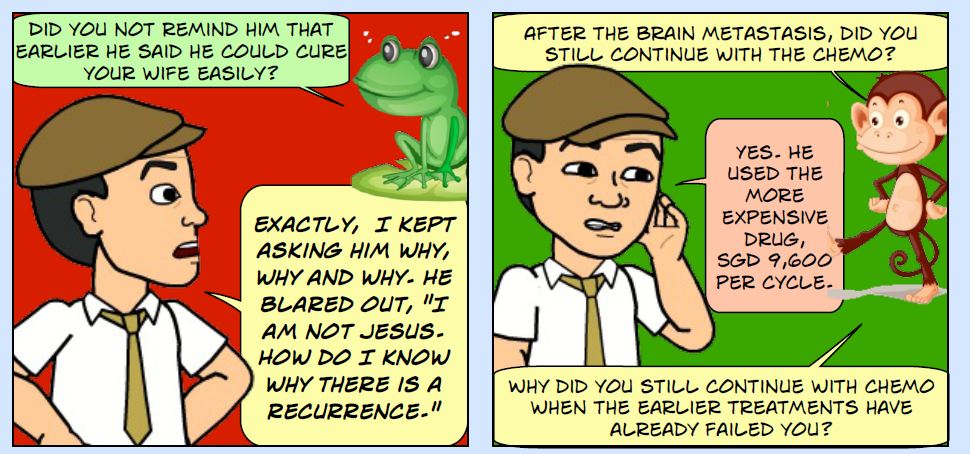
  1. Ask this question before you undergo any treatment. What is the aim of the treatment being offered? This is what patients want to hear and believe. It is going to cure your cancer. It is going to stop the cancer from spreading. It is going to prolong your life. With such sweet assurance, patients are “bought” wholesale. They would jump into the “sea” when told to do so. Read the story of this unfortunate young man below.

a

c

d

e

f

So, evaluate what you are told carefully. It is good if you can tap into your own commonsense and ask — Is this guy after my cancer or my money? For all the promises made, ask — At what cost — physically, emotionally and financially?

Remember, cancer is a big business — there is plenty of money to be made in the cancer healing industry. The young man above, found out that he had been sold an empty promise after spending RM 500,000. And his wife died. An expensive mistake indeed.

  1. Surgery does not cure any cancer if it is done too late. And surgery could be just meaningless if the cancer has already spread. Take the case of this Sabah patient. She had 4th stage breast cancer. The cancer had already spread to the lungs. She underwent a mastectomy and was told to undergo chemotherapy which she refused. Ask — what is the aim of the surgery? Can it not make the cancer more aggressive? Can it spread more cancer?

The Indonesian lady also had surgery followed by chemo, radiation and Tamoxifen. These treatments did not work either.

  1. When first and/or second line of treatments failed, you may be offered more of the same treatments — more aggressive, more expensive drugs, more of the so called targeted “magic” drugs. Ask — would this make any difference to your condition? Are these “additives” going to cure you? Learn from the experience of the late Amy Cohen below:

4 Amy-Cohen-No-cure

  1. If there is anything we learn about the treatment of breast cancer, here are what the experts said:

13-Same-treatment-different

3 No-right-or-wrong-journey

  1. What then is the role CA Care with regards to the above two cases who came to seek our help?

These are what we usually tell patients when they come to us.

  • We cannot cure you. There is no magic bullet to cure your cancer — Worse still, most of you come to us when all those standard treatments failed! Nothing else worked, then you come expecting us to cure you. No way! We know many leave our centre disappointed. Yes, it is better to be blunt and honest rather than taking you for a ride.
  • At CA Care we try to help you heal yourself — we don’t cure any cancer because cancer is not the real problem. Cancer is just a symptom that something had seriously gone wrong within your. For that reason, just removing the tumour does not always work. And radiation or chemo does not work most of the time.
  • While you are told that chemo or radiation is done to kill all the remaining cancer cells or to stop the cancer cells from spreading, we believe you are being mislead. Diligent search of the medical literature shows that sometimes radiation makes cancer more aggressive! Similarly, chemotherapy has been shown to spread and makes cancer more aggressive!
  • Knowledge is power — it can save your life and your money. But it is up to you to work hard to find your own solution to your problem after you have read. But unfortunately, most patients or their loved ones who are not sick, don’t want to know or read. Sad.
  • At CA Care, we tell patients to accept reality and learn how to live with their cancer. If after following our therapy, you can eat, can sleep, can walk and have no pain — what else do you want? In a situation when no one can cure your cancer, perhaps that is the only alternative you have — to be able to lead a normal, pain-free life for the remaining time that you have on this earth. Remember, no one lives forever. All of us will have to die — irrespective of whether you have cancer or not.
  • Patients heal yourself. No one can heal you except you, yourself. We realise this is a tall order. Many patients just don’t know how to take care of themselves to get well while some don’t even want to put in any effort to get well — they just want to find the easy-to-swallow-magic bullet that does not exist! To be able to heal yourself means, you have to change your lifestyle, your diet and your mental attitude. After seeing cancer patients for well over 20 years, we came to a conclusion that healing cancer is about healing a human being, the tumour is secondary. There is something in you that is not right that creates the cancer. Are you prepared to change?

Let’s ponder the following quotations:

 10-Live-with-your-illness

4 Holistic-therapy-benefit

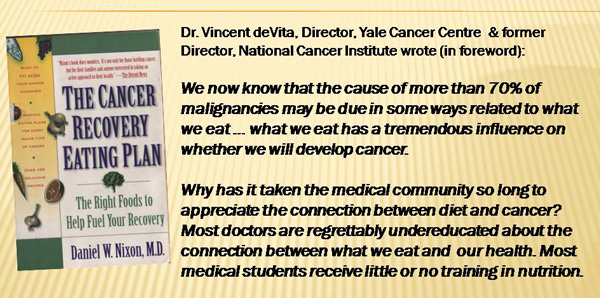
1 deVita 2-Medical-profession-which-


From God’s Awesome Natural Pharmacy — papaya leaf for stubborn high fever!

10 pm Friday 4 March 2016

Im and I were on the Jet Star heading for Singapore. It was sort of an emergency trip. Albert, our “going-to-be-a-medical-doctor-son” was down with a painful throat infection and was running a stubborn, high fever — body temperature  at 39oC and above,

At such a high body temperature Albert was like a zombie — terribly sick and not able to do a thing all day. In fact after a dose of Panadol or Ibuprofen the high temperature subsided a little (down to 38oC or 38.6oC) for a while only to come back again. This  had been going for a few days.

When he first got the sore throat, we never thought it was a big deal — just see a doctor and it will be done! But it was not to be. Albert had seen the clinic doctors twice and was given antibiotics and painkiller. Unfortunately these did not work. His temperature persisted and his sore throat was getting worse — his neck appeared swollen.

The normal body temperature is 37oC plus minus 0.6 oC. If your body is running on a high temperature for days this could be very damaging. Like running an overheated car engine, it is a matter of time when everything just shut down — stalled.

I remember what our patients told us some years ago..

  • A husband of one cancer patient had high temperature. No one thought much about it and after three days, he just died!
  • A husband of another patient took Panadol for his high temperature. Then he went to sleep hoping the problem would go away. He never woke up again.

What are we going to do now?

We took time to calm down and planned our strategy. We came up with two options:

  1. We shall fly to Singapore immediately with a supply of Sore Throat tea, Appetite & Fever tea and 6 papaya leaves. Albert shall take these teas immediately. If these teas do not help by the afternoon of the next day, then we have NO choice but to bring Albert to the hospital (no use consulting the GPs anymore). A tall order indeed. The cut-off point is 12 hours for the herbs to show their effects!
  2. We thought the throat infection was the cause of his persistent high fever. Since oral medical did not work, probably the better option is an infusion with a strong antibiotic. So the only way is to get admitted into a hospital in Singapore or immediately fly Albert home and get him into a hospital in Penang.

12 mid-night Friday 4 March

We arrived at Albert’s apartment at mid-night. Yes, his temperature was high and he was drained of energy, preferring to just lie down unable to do anything for himself! And he is living alone.

Without wasting any more time, these were what we did:

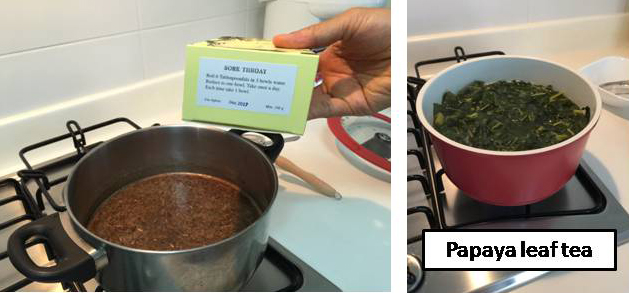
1) We took the three young papaya leaves (that we plucked from our tree in Penang) and blended them with a bit of water. And Albert drank it all down. Ooh, indeed very bitter!

2) Then without wasting time, Im started to boil 6 tablespoonful of Sore Throat tea. After about half an hour it was done. Albert took a cup of this tea.

1 Teas

Healing Process Started

About half an hour later, Albert felt better! We were hopeful and encouraged. Praise God!

We all went to bed. Throughout the night, Albert started to sweat profusely. He had to change his shirt twice. The mattress was soaking wet like someone had poured water on it. The next morning Albert woke up and his temperature was 37 oC — normal, the high fever was gone!

After bowel movements, Albert felt even much better but still weak. For the past few days, he had been having a little diarrhoea (due to the antibiotic that he was taking??). Now, after the herbs, his stools were well formed — normal!

To be on the safe side, Albert took another glass of boiled papaya leaf tea on Saturday morning. As said earlier, we also brought along from Penang, 3 matured, papaya leaves. We cut the leaf into small pieces and boil with plain water. Wah, this concoction was difficult to drink! Very bitter! Worse than the juice of the young shoots.

12.00 noon Saturday 5 March

We, as a family, went out for lunch at a near-by market place. By that time, we were more than hopeful that we need not go to the hospital anymore! Nevertheless with the heat, Albert felt a bit tired after the walk and came back to rest. Then, he took another cup of Sore Throat tea.

Evening Saturday 5 February

Albert’s temperature was at 37.5C and he did not have much appetite. He did not eat much for the past few days. We cut up  half a papaya leaf (2 lobes) and boiled it with 4 tablespoonful of Appetite & Fever tea.

The family had a good dinner. Albert was back to normal. He started to sit in front of the computer to study for his exams. He had missed classes and exams for almost a week and he had a lot to catch up. Good luck son!

12 noon Sunday 6 March

The family had lunch together and Im and I were packed to fly home. Thank God, our mission accomplished! Indeed, this morning, we saw Albert back to normal — unlike the sick and tired person he was some 36 hours ago! His sore throat did not bother him anymore and the swelling in the neck was gone!

Comments

For the past 20 years, patients came back to tell us that the herbs did help them. We know that herbs do help our cancer patients. We also know that our Sore Throat tea is extremely effective. We also know that papaya leaf is good for putting down high body temperature. For years we have been telling patients with dengue fever to take papaya leaf. And many who did got well after that.

When we flew to Singapore that night, we were full of hope and we know that God will bless us in His own way.

But we do not wish to take things for granted. So we had a back-up plan. If for any reason the herbs don’t work — Albert needs to go to the hospital and ask for help. That has always been our stand at CA Care. And we were ready for that eventuality.

As it turned out we did not have to do that, Indeed we remain grateful to God for this blessing.

Indeed the effect of papaya leaf as outlined above is very, very dramatic! Some people may not want to believe this story. Some people would argue that there is no science or research done to substantiate what we have written — Ah, another blooney story!  For all that you know, it was just luck — fluke shot that Albert got well!

We don’t need to convince the skeptics. If you want to know the real science of it, let’s not waste time debating — get on to work on this and see what is it in the papaya leaf that has such healing properties. For those who cannot do the research, perhaps it would be a good idea to just take time and learn how to grow a papaya tree in your backyard. One day who knows you may need the leaf of this wonderful plant when medical drugs fail you!

Here are the pictures of our two papaya trees from where we took the leaves. For your information we grow many papaya trees around our house.

2 Papaya leaf


Cancer Recurred After Liver Surgery: The same story again and again!

In the past few weeks, three liver cancer patients came to seek our help. These are their stories and we hope readers and patients can learn from their tragic experiences.

Case 1

Patient is a 66-year-old man from Singapore. He did not have any symptoms. His liver function was normal but a CT scan in September 2014, showed he had liver problems. Patient was referred to a liver specialist in a government hospital. MRI was done and on 26 February 2015, patient underwent a laparoscopic liver resection of segments 5, 6, 7 and 8 of his liver. At the same time, he also had a cholecystectomy (removal of gallbladder).

Histopathology report confirmed a hepatoceullular carcinoma (HCC).

Five months later, 14 July 2015, MRI showed new foci of the HCC seen in segments 7 and 2/3 of the liver. The cancer had recurred.

In August 2015, patient underwent a second liver surgery. This time it was a wedge resection of segments 6 and 7 of his liver. At the same time FRA (radiofrequency ablation) was performed onthe tumour in segment 2/3.

Three months later, 13 November 2015, MRI showed the cancer had come back again — “interval progression of disease with numerous bilobar foci of HCC in the remnant liver.”

Patient was told another surgery was not an option anymore. He could go for TACE (transarterial chemoembolization) or a liver transplant.

Patient and his son came to seek our opinion. We told the patient: “If you come here expecting us to cure you, then we are sorry to say that we have no magic bullet to cure you!”  Patient went home disappointed.

Case 2

Patient is a 73-year-old Malaysian. Sometime in December 2014, he had jaundice. A CT scan showed his liver was really bad.

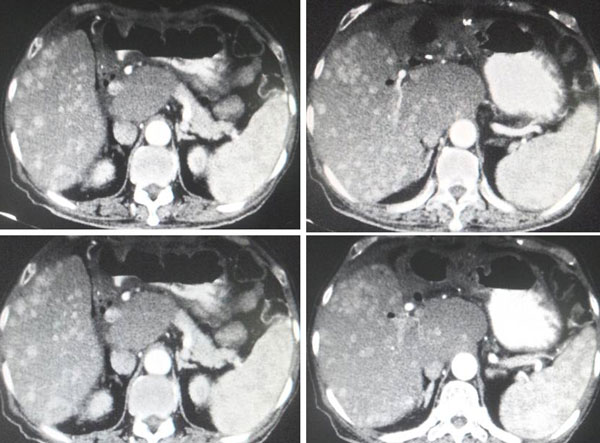
CompositeOoi

On 29 January 2015 patient underwent surgery in a government hospital. His gallbladder was removed. Segment 3, 4B and left lateral section of his liver were also removed.

Histopathology report confirmed hepatocellular carcinoma (HCC) with foci of angioinvasion.

Two months later, March 2015, a CT scan showed a few spots in his liver. The doctor suspected recurrence.

A CT scan on 1 December 2015, showed “innumerable arterially enhancing nodules seen in both lobes of liver. Disease in progression.”

Patient was referred to a private hospital in Penang and was offered to participate in Phase 3 Clinical Trial — Selective Internal Radiation Therapy (SIRT)  versus Sorafenib.

Sorafenib (also known as Nexavar) is a so called targeted oral chemo drug. Normally it cost RM 15,000 to 20,000 per month. The SIRT (radiation) would normally cost RM 50,000.

Can the above treatments cure patients? This patient was told it would just prolong life. Prolong for how long? No one does not seem to know! Patient was also told that he “qualifies” to participate in this clinical trial, Nexavar would be provided to him for free but he was pre-warned about the following side effects of Nexavar.

Case 3

Patient is a 67-year-old Malaysian. On 16 December 2014, he had biliary sepsis (infection of the bile duct which is generally followed by obstruction of the bile duct). A biliary sphincterotomy was performed (Sphincterotomy is a complex procedure…. involves deep cannulation of the bile duct followed by severance of the sphincter of Oddi with the electrocautery).

Unfortunately, his problem persisted. On 29 January 2015, his blood test returned the following results.

Globulin 40     H
Alkaline phosphatase 135   H
ALT 46     H
GGT 363   H
AST 46     H
CA 19.9 85.17  H

A CT scan on 20 February 2015, showed an ill-defined hypodense lesion in the left lobe of the liver and para-aortic lymphadenopathy. Findings are suggestive of cholangocarcinoma (bile duct cancer) and bile duct obstruction.

Blood test on 23 February 2015 showed his condition had deteriorated.

Total bilirubin 239.8  H
Direct bilirubin 169.0  H
Indirect bilirubin 70.8    H
Alkaline phosphatase 245  H
ALT 91    H
GGT 666  H
AST 92    H
CA 19.9 85.17  H

On 23 February 2015, patient underwent another operation — a left hemihepatectomy and radical choledochectomy (removal of a portion of the common bile duct).

2

1


Everything seemed to work well for a while. Patient returned to his surgeon for routine check-up every 3 months. Unfortunately, 9 months later, the cancer started to recur in his liver again.

A CT scan on 7 December 2015 stated: There are “at least 9 low attenuation lesions in the right lobe of the liver, largest at anterior segment 8 measuring 4.1 x 3.8 cm. These could be due to recurrent tumour and metastases.

Patient spent RM 74,910 (covered by medical insurance) for the above failed treatment.

Like the patient of Case 2, this patient was referred to the same oncologist and was offered the following options:

  1. Sorafinib or Nexavar
  2. TACE – transaterial chemoembolization
  3. SIRT (Selective Internal Radiation Therapy).

Daughter Told About CA Care

While flying from Penang to Singapore, the patient’s daughter was seated next to an Indonesian lady who is our patient. During their casual conversation, the patient’s daughter came to know about CA Care. As a result, father and daughter came to seek our help and decided not to pursue further medical treatment.

Comment

For the treatment of HCC, Harrison’s Principles of Internal Medicine, 15th Edition, page 589 says:

  • Surgical resection offers the only chance for cure; however, few patients have a resectable tumour at the time of presentation.
  • Randomized trials have NOT shown a survival advantage after chemoembolization.
  • The liver cannot tolerate high doses of radiation.
  • The disease is not responsive to chemotherapy.

If there is a tumour in the liver, the answer is probably “CUT it out”. But take note that cutting does not necessarily cure your cancer because in the first place it is not suitable for cutting — it could be too big in size or the cancer has already spread too extensively. But cutting seems to be the only sensible option.  And many patients, like the above cases, have gone through it. Disaster.

One important aspect of liver surgery which you should know is that, as in the above cases, the cancer can come back again 3 to 9 months after an apparently “successful surgery.”  Patient No: 2 spent RM 75,000 for the operation and 9 months later, 9 new lesions were found in his liver.

After surgery has failed, patients are offered the next “useless” line of defence — Go for TACE, i.e. chemoembolization, radiation or chemotherapy. The above medical textbook says, all these are not effective.

Reflect on these Quotations

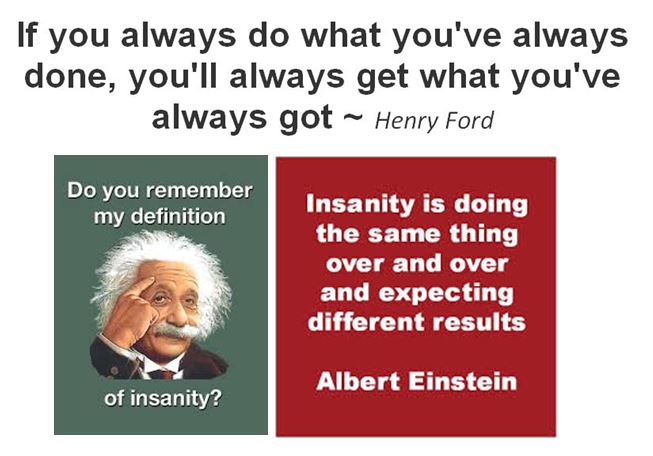
Insanity both

5 Ssurgery come back again


Looking at Cancer From a Christian Perspective by Larry Burkett

Larry Burkett was an American author and radio personality whose work focused on financial counseling from an evangelical Christian point of view.

Born-again Larry left his electronics company to join the staff of a nonprofit ministry, Campus Crusade for Christ, as a financial counselor. In 1976 Larry left Campus Crusade to form Christian Financial Concepts (CFC), a nonprofit organization dedicated to teaching the biblical principles of handling money. In September 2000, CFC merged with Crown Ministries, creating a new organization, Crown Financial Ministries. Burkett served as Chairman of the Board of Directors until his death. Burkett died of heart failure after a long battle with cancer and other health problems.

His book, Hope When It Hurts, contains many advices to fellow Christians who are facing life-threatening illnesses such as cancer. After all, the author himself had surgery to remove his cancerous kidney and shoulder blade.  After reading though this wonderful book, I was much taken aback by his sound, down to earth advice. I have learned and was blessed by his advice and outlook about what it means having to go through life with cancer. To my Christian friends, I say — Read this book!

Hope when it huerts Larry Burkett

Here are some quotations from Larry’s book.

Peace with God

  • In the years since I was diagnosed with cancer, I can honestly say that God has been good to me. He hasn’t chosen to rescue me from this difficulty but rather, has sustained me through it.
  • I have never asked God WHY this happened. It really doesn’t matter why. Instead, I have asked WHAT God would have me to do as a result of having cancer.
  • We’re all going to die some day; that is NOT a choice. We can choose to live in fear or anger or pity or in the peace of God. that’s OUR choice. I choose to live in God’s peace, enjoying each and every day as best I can. I sincerely pray that all of God’s people will choose to do the same. Happiness REALLY is a choice.
  • There are times when I was afraid … I trusted God and still felt afraid. Perhaps it was the fear of the unknown. Usually the things we fear are those things that haven’t happened yet. Almost all of us are able to cope with the present, no matter how good or how bad it might be. Franklin Roosevelt once said, “The only thing we have to fear is fear itself.”
  • Courage is not the absence of fear. Courage is the ability to look fear in the face and proceed with your life.
  • When emotional storms raged in my heart, I prayed to Him with words similar to the disciples, “Lord, don’t you care what’s happening?” He did and He blessed me with His peace. My testimony to you is that God is in control. He is holy. He is righteous. He is completely sovereign. He never makes a mistake and He is completely worthy of your trust.
  • (After cancer diagnosis) … I knew that as long as God wanted me on this earth and He had a plan for my life, nobody could take me. And when God’s plan for my life was finished and God no longer wanted me here, nothing could keep me here … That’s why I … always temper my prayers with the caveat “if it is Your will.”
  • Most of all I asked the Lord for peace, His peace. I have experienced a lot of trauma in my life, and I know what it’s like to live with God’s peace and without it.
  • To receive a blessing from the Lord in your time of need, I point you to John 14:27, John 16:33 and Philippians 4:4-7.

God’s Ways

  • Often God uses natural things to rescue His people. They are not always those instantaneous, miraculous answers that we see sprinkled through God’s word.
  • We helped one another to be strong. When one of us got down, the others comfort, console, encourage and pray…That’s why God put other people in the world to be able to help you when you aren’t functioning at 100 percent.

What will happen to the ministry if I die?

  • So what does happen to a major Christian ministry when the leader becomes gravely ill …or dies? That was on my mind, as well as the minds of many of our supporters.
  • The ministry of Christian Financial Concepts is not my invention or my creation. Instead, this ministry exists because of a calling from God … As is the norm in our society, people give praise and accolades to teachers and writers, but I have tried over the years not to let that go to my head because … we’re stand-ins for what the Lord wants to accomplish.
  • If the ministry is built solely on me, and if it cannot survive without me, then it’s not the work of God. I have consistently told my staff: “This is God’s ministry and He will supply our needs. The day He stops supplying our needs is the day we will close our doors, because there will no longer be a need for what we do.”

Note: Many people (and I too)  have asked a similar question, What is going to happen to CA Care when Chris Teo is gone! Yes, the answer is with Go. We are just His stewards. My wife and I are just as happy to close CA Care ANYTIME  if this is His will — Let your will be done, Lord.

Prayers Make A Difference

  • I cannot overstate how much it meant to know that God’s people were praying for me. I could literally feel their prayers. I could sense God’s hand upon me.
  • Though God didn’t remove the tumours supernaturally, He certainly did provide what He promised to me, and that was His peace. I believe it came as a direct result of God’s people caring and praying.
  • When ask how could (others) pray for me, I replied with four items: that God would grant my doctors mercy and grace in the upcoming surgery; that the cancer would not return; that God would sustain us in His supernatural peace; and that He would use the circumstances to draw us closer to Him.

Why People Become Ill

  • I personally believe there are at least four reasons why people become ill.
  • First, we live in aging bodies in a fallen world, which results in sickness and suffering. If I drive my car long enough, I know the parts must eventually be replaced and the same is true with our bodies.
  • Second, some people get sick because of sinful behaviour which is, in fact, harmful to their bodies.
  • Third, God allows an illness to come upon people for the benefit of the kingdom of God. Obviously God didn’t cause (the) injury, but He allowed.
  • Fourth, God sometimes allows Satan to buffet Christians to determine the caliber of their faith. The clearest example of that in Scripture is Job.
  • The idea that no Christian should ever be sick or experience any kind of problem …. except as the result of unconfessed sin, is not biblical and it comes very close to heresy. Certainly God “allowed” .. . cancer because He knows about everything that happens to each of us. Probably none of us will know WHY these things happen. But I don’t believe that God goes around zapping His people with disease as a reminder of their previous sin.
  • Be careful when you box God into one, and only one, way of responding. He is sovereign, meaning He is completely free to rule and act as He chooses. He is not a magical genie to be called out of an old lamp to rescue us upon demand.
  • We also can be presumptuous with God when we conclude that only good things happen to His people. I disagree with the basic premise that bad things never happen to good people.
  • If you are building your Christian foundations on the idea that your commitment to God will automatically insulate you from suffering here on earth, you’re in for a big shock.

Bear Witness

  • …Even if you have cancer or some other terminal illness, live in such a way that others can detect the hope that is within you, and then be prepared to tell the reasons behind your hope… Don’t be phoney about it; just ask God to grant you joy and peace in your affliction.
  • Let God’s grace and strength transform what looks like a problem for you into an opportunity to witness to other people.
  • It’s true that we can be discouraged, but we’re never in despair … Our Lord promised: I will not leave you as orphans; I will come to you. John 14:18.
  • God is faithful. He is a forgiving God. God is merciful. He cares about the pain and suffering you are experiencing, whether it’s physical, mental, emotional or spiritual. Trust Him and He will give you peace.

Thoughts from Judy Burkett

  • Few things in life are as upsetting as having a loved one facing a serious or life-threatening illness and not knowing what the outcome will be.
  • It didn’t occur to either of us to ask God, “Why is this happening?” Instead … we began to focus more on “How are we going to cope with this?”
  • We prayed steadily that God would give us His peace in the midst of the turmoil.
  • There are times when we worried and were upset. And we prayed for God’s peace on my occasions, particularly when we were afraid or things seemed to be spinning out of control. And the results seemed to be the same each time: We felt like God was literally holding us in the palm of His hand.
  • So if you’re in turmoil right now … let me encourage you to diligently seek God’s peace. Pray specifically for it, and ask others to pray for you.
  • Knowing .. that God is no respecter of persons (Romans 2:11) we did not assume that Larry has “special status” with the Lord. Sometimes God heals people outright; at other times, though faithful, godly saints succumb to serious illnesses.
  • God, show us the way. …Our prayers was for God to supply wisdom and guidance to us… we faced many decisions without the luxury of time to think them over.
  • We needed wisdom to clearly discern what God was responsible for and what we were to take responsibility over.
  • Clearly discerning the things God was responsible for helped us to identify the things we need to relinquish to Him: the first was Larry’s life. Neither I, the doctors, nor anyone else could keep Larry here on earth one second longer than God desired. That’s one major issue I had to give back to the Lord. Doing so also relieve a great deal of pressure, because that meant God, and no one else, was responsible for keeping Larry alive.
  • God, give us strength. Coping with a medical crisis is exhausting. Sleep patterns are interrupted. Comfortable daily routines get cast aside. Watching a loved one hurt is hard work too. … we assumed the posture of faith — trusting God to meet our needs and to supply what we could not supply ourselves. And true to His Word, God raised us up and enabled us to endure days that we never thought we’d see the end of.
  • God, you will be done. Our deepest desire was that God would be glorified through the circumstances we faced. I know that’s easier said than done.
  • I conclude with this thought: God made you. He knows what you can and cannot handle. He promises never to give you a burden you cannot bear without a way of escape. When you find yourself overwhelmed and exhausted by the stress of it all, you may well be taking on more than God want you to assure. Remember, you’re just a part of God’s plan.

Words from CA Care to All Patients

You and I have to die one day. We cannot

run away from this reality. It is how we die that matters.  If you can eat,

can sleep, can move around and have no pain; what more can we ask for? You want

a cure, but there is no cure! Let us learn to be grateful for what we are each day.

Read more:

Cancer — What to do next?

Larry Burkett’s Cancer Experience: The Undemocratic and Monopolistic  American Medical System for Cancer Treatment


Larry Burkett’s Cancer Experience: The Undemocratic and Monopolistic American Medical System for Cancer Treatment

Larry Burkett was the founder and president of an nonprofit ministry called the Christian Financial Concepts. In early 1995 he was diagnosed with kidney cancer that had spread to his shoulder blade. He shared his cancer experience in his book, Hope When It Hurts.

Hope when it huerts Larry Burkett

The following are quotations from his book.

  • In the space of three weeks – Monday, March 13 to Monday, April 3, 1995 — doctors not only discovered two malignant tumours in my body, but I underwent radically invasive surgeries to remove them.

Round one – removing my right kidney

  • March 20, 1995 – my right kidney removed. The procedure itself lasted for nearly four hours, and it was completed without a hitch. The results came in a “good-bad news” format. The bad news — the tumour was definitely renal cell carcinoma … the good news was the lack of any other detectable cancer in the tissues surrounding the kidney.
  • I left the hospital within four days.
  • Little did I know at that time that the surgery, called a radical nephrectomy, would cause me great grief over the next year. It seems that one of the primary nerves from the area of incision got trapped inside the scar tissue and it became inflamed. As a consequence, it has hurt ever since.

Round two – removing my left shoulder blade

  • Two weeks to the day after my kidney surgery I went back to the operating room, this time for removal of my left shoulder blade (scapula).
  • Prior to my second surgery, the doctors explained that I would have very limited use of my left arm after my scapula was removed. A total scapulectomy is a very rare procedure. The scapulectomy itself went smoothly, even though it lasted nearly five hours. The aftermath was much more painful than the first surgery.
  • The doctors could find no evidence of cancer in the surrounding tissues. Their report was, “We got it all.”
  • In fact, the doctors were quite mystified about how the primary kidney tumour metastacised to my left shoulder but failed to spread other tumours elsewhere. Normally when a soft tissue tumour has metastacised, cancer has spread into other organs of the body.
  • Five days after my left shoulder blade was removed, I was released from the hospital.
  • Everything became an effort. It was an effort to sit up. It was an effort to move. Every day presented a new battle with pain. Sleep was elusive. I was so fatigued that I’d doze off, only to be awakened by the intense pain.
  • I found myself getting depressed as I viewed the future. The combination of still facing a future with cancer, as well as a significant disability, began to weigh me down.

The road to recovery

  • About a week or so after my second surgery, I returned to Emory University Hospital for a check-up and to get the staples removed from my shoulder.

Dr. Graham, who specialises in cancer of the urinary tract … shared a very sobering statistic with me.

  • Only some 20 percent of renal cell carcinoma patients who had a metastasis like I did survive more than two years, and only a small fraction survive more than five years.
  • Once my kidney and tumour had been removed … there were very few treatments available for renal cell carcinoma, and most of those didn’t work very well. Traditional chemotherapy would be of no virtual value to me … radiation wouldn’t be of much value. In fact, when renal cell carcinoma is exposed to radiation, although the tumours do shrink back, they very rarely ever disappear.
  • So, essentially, I was looking at a cancer for which there is no treatment, outside of surgery, and virtually no cures anybody knows of.
  • The next logical question I asked Dr. Graham was, “What do we do next?”
  • “Wait,” he said. “There’s nothing else to do. If something else shows up in your body, then we will aggressively try to treat that. In the meantime, you just have to wait.”
  • I felt this was like asking a skydiver who had just jumped out of an airplane without a parachute to wait and see if he could land on something soft when he hit the ground. Possible, but the chances aren’t very good.
  • Weak as I was physically, I left the doctor’s office that day with a renewed determination to find some type of proactive treatment — something that I could do to strengthen my body’s war against the reappearance of cancer cells.

Search for an alternative treatment

  • Bill White …. said, “Larry, I would like to share something with you. A good friend of mine has been diagnosed with cancer … his doctor gave him only a few months to live. His son … started looking all over the world for any treatment that might help. After careful research, they settle on one in Prague in the Czech Republic.”
  • All too often, we have the tendency to think if we aren’t doing something here in America, then it can’t be done, and that’s simply not true. Doctors in other nations are doing excellent research also.
  • A friend said, “But Larry these alternative treatments are untested and unreliable. We don’t know what risks they present. There are no hard statistics on how effective these alternative treatments are.”
  • Larry asked, “Okay, how about this? One treatment I heard about is toxic to the human body. Doctors typically purchase it for $50 per dose and sell it for $2,000 per dose to the patient, and many patients who take this treatment do not survive more than five years. Would you allow doctors to continue treatment like that?”
  • I just described what many patients on chemotherapy are facing. The FDA is applying a more stringent standard to new treatments than they have to traditional chemotherapy.
  • Somehow, there has to be a better way to treat cancer than chemotherapy and radiation, without all the negative side effects. And until we can find it, it seems logical to me that we as Americans should be able to choose a treatment of choice, especially if it can be proved that the treatment is not inherently harmful to the human body.
  • In the United States we still employ the same basic treatments that we available twenty-five years ago, namely, chemotherapy and radiation. Based on the number of people I’ve known who didn’t survive these debilitating therapies, I have to ask myself, “Is this the best we can do? Are the current cancer treatments good enough …?
  • Obviously medical experts are looking for better treatments, but the complex rules established by the FDA leave only the largest companies with the resources to get new therapies approved. I suspect that all too often the incentive to develop cheaper, less toxic treatments conflicts with the return needed on previous drugs.
  • You must take the initiative to become informed and take responsibility for your treatment.

The three criteria for alternative therapies

  • To evaluate all of the options, I narrowed my search for an alternative treatment by establishing three criteria.
  1. Scientific Merit: The treatment I chose to use had to have some scientific merit. It couldn’t consist of chicken bones, chants, or magic potions. When examined, the information had to have some scientific proof, based on repeatable, verifiable data.
  2. No Harm: The treatment I chose should pose no further harm to my body. On other words, it had to be nontoxic.
  3. Referrals. I insisted on talking to people who had taken the treatment and survived. From the scientific viewpoint, that’s called anecdotal or testimonial data. There had to be survivors with whom I could talk. In other words, it had to have some measurable degree of success.

Alternative Treatment in Prague

  • The treatment offered in Prague, Czech Republic, caught my attention for (these) three reasons… and the more I learned, the more convinced I became to try it.
  • The treatment in Prague was very simple. I received twenty injections over a twenty-four day period. After that initial treatment, I have to take booster shots about once every six months. That’s all.
  • The entire trip, including treatment, airfare, lodging and meals for two costs about the same as one day in the hospital here in the US!
  • The cost was quite reasonable (about $2,000 at that time, plus travel and lodging).
  • I’m not in a position to make claims and promises for anyone else regarding this treatment. What I can tell you is that six other people who were diagnosed with renal cell carcinoma at about the same time I was have all died within the last year. I’m still alive.
  • I feel good and I’m not suffering from cancer at this point.

It’s time to reform the FDA

  • I personally think it’s ridiculous that this treatment and others like it are not available to patients here in the United States. The treatment is not legal because it can’t pass the stringent requirements passed by the FDA.
  • I might add that the many chemotherapy drugs, vastly more toxic and harmful to the human body than the majority of these alternative treatments, are legal and available.
  • Although the FDA asserts they’re trying to protect the interests and well-being of the public, the fact is that they continue to make it difficult and costly to use new, NONTOXIC cancer therapies, while continuing to approve the use of highly potent and toxic chemotherapy drugs.
  • One can only conclude that money, and not the well-being of patients … dictates what will and won’t be available on the market.
  • In my judgment, if a particular treatment can be proved to be nontoxic, and it has a reasonably verifiable track record of helping people, the FDA should get out of the way and let American citizens make their own decisions about what treatment to pursue. This is a free country, and we’re supposed to be free people.
  • Even if a particular treatment doesn’t cure cancer, I should still have the right to make my own choice. What upsets me is that there are existing treatments that CAN help people but the system won’t even allow doctors to mention them.
  • I am concerned that the current system exists to protect some large and politically influential financial interests, rather than to serve hurting people who are desperate for help.
  • I know there are literally thousands of cancer patients around the country who are dying because they either can’t tolerate the traditional medicines — chemotherapy or radiation — or because they don’t work for them. There is no excuse for such limitations on medical options for people living in a free country.
  • Is there a risk associated with alternative therapies? Of course. There’s a calculated risk regardless of the treatment you choose. But if you’re a terminal patient dying with cancer, you’ve got a 100 percent risk of dying if you do nothing.
  • So the way I see it is, if all normal options are exhausted, any risk you take can only improve your opportunity to live longer, with a better quality of life. If the price is reasonable and the patient agrees, I say, “Go for it.”

FDA- Protecting Patient’s or Protecting Cronies’ Interests?

  • Martin adds the following insight into why scientific studies have been so difficult to come by to validate alternative treatments. “To understand why a lot of therapies have not be tried to date is to understand the relationship between the academic centres and the corporate centres. For instance, if you tell a professor you would like to do a certain study, he likely would reply, “I don’t know where to get the money.” But if you suggest using a drug from a certain corporation (for the study), he knows where he can get the money.
  • According to Ralph Moss … the pharmaceutical companies have been in collusion with some of the big cancer treatment centres in the country and they are out to disprove all EFFECTIVE natural cancer therapies. Naturally, the big drug companies don’t want competition, and the easiest way to undermine any new effective treatments is to get some well-funded medical school to prove the treatments don’t work.
  • The pharmaceutical companies in America have a huge vested interest in pushing their drugs, which yield billions of dollars in annual profits. Ant it’s certainly not in their best financial interests to pursue inexpensive alternative therapy that might work.
  • I think the problem boils down to greed: the simple love of money.
  • He who has the gold, makes the rules — the result is that medical students are never taught methods of treating cancer, other than the “big three” treatments — chemotherapy, radiation and surgery.
  • It is a criminal offense for doctors to engage in medical treatments that lack FDA approval, which is the case for a great many alternative cancer therapy treatments.
  • Remember, many of these doctors have spent more than a decade in their preparation to practise medicine .. a great many doctors find themselves in quite an ethical bind. Do they …keep the priority of seeking the health and well-being of their patients? Do they take the risk of being jailed here in the US or being fined by the FDA or losing their medical license? Many elect to remain quiet, sticking to what they were taught in medical school, where they learned to dismiss the field of alternative cancer treatments as “quackery.”
  • Most oncologist stick to surgery, chemotherapy and radiation as the only options available. Some literally don’t know any better. Others are motivated by their own financial gain and … use fear tactics to get their patients to do what they want. “Choose anything other than these three choices, you’ll die” they say. What they don’t say is that chemotherapy and radiation can kill just as readily as the actual cancer.
  • I asked Dr. Dan Clark, about the toxicity of chemotherapy and he reflected, “How can you cure cancer with poison? When you read about (chemotherapy drugs), every one of them causes cancer … They cause a destruction of the intestinal tract lining, cause damage to the liver cells, interfere with the endocrine gland function, cause sterility and weaken the immune response … So how can that work? It’s illogical.”

The Big Bully and the FDA Raid

  • Let me say here that I was taking an alternative therapy available in Tennessee. This therapy consisted of an electromagnetic device invented by an acclaimed physicist. The device had been proven harmless … the physicist had used it on himself and it did no apparent damage to him. The magnetic field that he was using was only a fraction as powerful as that used in an MRI machine.
  • Unfortunately, either through ignorance or otherwise, he began accepting terminally ill cancer patients as test subjects before FDA investigative device permits were sought (he later told me the potential costs were prohibitive).
  • As words got out, this physicist found himself with cancer patients knocking on his door — many of whom had been given up by the medical system— asking if he could help them. Not having the heart to turn them away, he began to treat patients.
  • I personally had been treated on this machine several times and though I didn’t have any visible tumours, I did have some indication that the machine was helping me.
  • The FDA, along with state and local authorities, raided the facility where this machine was located, leaving behind them a federal court summons. The charges were operating harmful devices without permit, extorting money from patients, and using unapproved medical devices for the treatment of cancer.
  • The friend who … was operating this facility never charged anybody a dime.
  • My question is, isn’t this still a free country? And shouldn’t consenting adults … be allowed to choose the therapies they want, provided those therapies can be shown to be no more harmful than the traditional therapies now being used by the medical society….?

They Did it Again

  • Let me share with you another story that was told to me by an attorney.
  • In 1993, a physician in Atlanta and a cardiologist from Emory University invented a machine that he was going to use to treat cancer.
  • A terminally ill AIDS patient was provided to this doctor and went through the same procedure: recycling the blood through an external heating machine, then cooling it back down and putting it onto the patient’s body. The effect was that the patient showed no HIV indications subsequent to the treatment.
  • With that success … a second patient was provided and the same procedure was repeated with the same results.
  • The anesthesiologist who assisted (in the procedure) was so impressed by what he saw that he … called one of the local newspapers and one of the local TV stations in Atlanta and explained what the doctor had done — a revolution in AIDS treatment and a potential cancer treatment as well.
  • In a few weeks, this doctor’s office was raided by a combination of the FDA and local law enforcement agencies.
  • The machines were confiscated … all records were confiscated and this doctor’s licence was suspended.
  • Pressure was brought to bear, to force this doctor to recant any involvement that he’d had with the machine… he was pressured to sign a statement that the device was fraudulent and would not work on other patients. The threat behind that was the loss of his medical licence for the rest of his life.
  • The physician who had referred the two patients was pressured under the same threat: If he did not sign a document stating that these two patients DID NOT have AIDS …his medical license would also be denied and he could no longer practise medicine within the United States.
  • The doctor who invented the machine was fired from his hospital with the research university.
  • I have no personal, firsthand knowledge of these events, but I know (the attorney who told me this story) very well. He’s an honest, ethical man and he represented the doctor who invented this machine and assures me that the scenario that I just explained to you did happen.
  • These are just two of the many horror stories of what has occurred throughout the United States. In my opinion, it’s time we put a stop to it and reasserted our rights as American citizens to choose the treatment we want, as long as we’re knowledgeable, consenting adults.

Note: Unfortunately the Aliatos clinic in Prague, Czech Republic has since disappeared!

Read more:

Cancer — What to do next?

Looking at Cancer From a Christian Perspective by Larry Burkett


Cancer – what to do next?

In early 1995 Larry Burkett, founder and president of a nonprofit ministry — Christian Financial Concepts, was diagnosed with kidney cancer which had spread to his shoulder blade. Larry had surgery – his right kidney and  left shoulder blade were removed. No radiation or chemo was indicated because these treatments would not be helpful for this type of cancer. Larry ventured into alternative therapies. He lived for 8 years. According to the facebook information, Larry died in mid-2003.  In his book, Hope When It Hurts, Larry shared his cancer experiences and provided many helpful and insightful advices. I learned a lot from him! If you have a chance, take time to read this great book!

Hope when it huerts Larry Burkett

In Chapter 12, Time Out! Larry shared his wisdom, as follows:

When people find themselves in a medical crisis … the result is confusion or what I call “systems overload.” There are people to call, doctors to see, decisions to be made — usually under stress and in a short period of time. Add to that the clouds of emotion and shock.  That’s how I felt, and I needed to take a time-out — just to get away by myself, in a attempt to regain my equilibrium and sort out the impact of what I was facing.

  • Feeling overwhelmed: I felt overwhelmed – I had to make some major decision in a very short period of time, based on a limited amount of information. I knew very little about cancer. Yet, before me stood two highly trained doctors, suggesting that I have my kidney and shoulder blade removed.
  • If I had to do it all over again, I think I would diffuse these feelings by allowing some time to pass before I made any major decisions. I would stand back and say, “Okay, I’ve had this cancer for a while … maybe up to three years or more. What difference would it make if I waited another month? Well, now I know it probably wouldn’t have made any difference.
  • One of the best things any cancer patient could do is to take a time-out, get a medical reference book and read it. I encourage anyone to take the time to thoroughly analyse his or her situation.
  • What, if any, alternative treatments were available for this? You wouldn’t buy an automobile the first time you saw it, so don’t buy an operation the first time you hear of it. Take time to pray about it.
  • The news of a serious illness can throw people into a frantic pace to do things. Emotions become exaggerated. Everything becomes urgent and must be settled immediately — trigger a flurry of activities that tend to minimize, deny or fix the situation. Unfortunately, usually none of our solutions can remedy or change the truth of what we’re really facing.
  • The rush of anxiety: I know people can’t be laughing all the time in the midst of critical health situations, but laughing every once in a while surely can lighten the load, keep things in perspective, and relieve built-up tension. So, I passed the time with one of my favourite activities: watching old movies … and laughed until my sides hurt! But I think laughing helps. We know that it releases endorphins in the body that actually help you to feel better.
  • Rely on others: Many of the decisions I faced were beyond my ability to comprehend. Not only could I not comprehend all the medical data involved in making some decisions, I was not able to concentrate as I normally would. How was I supposed to make a major decision about metastatic kidney cancer when, in fact, I didn’t even know what it was a short time before?
  • So I had to rely on other people. I began by calling friends in medicine and asking their advice …. seek out a second or even third opinion. At the very least buy a good guide to medical terminology.
  • Relinquish matters beyond your control. Don’t worry about things that are beyond your control. Stop worrying about the things you can’t change and concentrate on getting well. I just had to tell myself that over and over again, “Don’t worry about it.” That’s a hard task for someone with my personality, but I had to keep a clear perspective of the things I could control and yield to God the things I couldn’t.
  • Don’t worry about the future. You may be in a situation in which you have several small children and naturally one big concern will always be, How will my children make it without me? Of course that preoccupies your mind because you love them. But God’s not going to abandon them. Will your children face difficulties and sorrows in the time ahead? I’m sure they will. But isn’t that true of life anyway? You can’t spend your time worrying about it because, in the end, you can’t change it. If there is anything within your reasonable ability to do, then do it.
  • Take time to back off. To accommodate the changes taking place with your health, you need to back off and change your priorities. Either you fight change and be miserable, or you can go with the flow an enjoy to the fullest each day God provides. You don’t have to control everything. Take time to face one’s own mortality can really bring the essential issues of life into focus … I resigned as God’s manager of the universe — a position to which I was never appointed anyway.

At CA Care we tell you not to panic after being told that you have cancer. http://www.cacare.com/

CANCER ! Don’t panic !

Haste is from the Devil ~ Arab saying.

Why do you visit this website? We believe you are seeking information to enable you or your loved ones to make certain decisions about his/her cancer. Our advice is: Read as much as possible. Gather information from different sources. Cast your net wider and read what others from different disciplines have to say about the same subject.

Get out of the box and view your problem in a different light. Often, in the face of fear, hopelessness and panic we forget to use our commonsense. Calm down. A decision made in haste or under pressure is never a good decision.

Remember, you don’t get cancer just only yesterday

When helping patients at CA Care, I sometime get a note requesting that I do not tell the patient that he/her has cancer. I am indeed saddened by such attitude but to respect the family’s privacy and wish, I refrained from telling patients the truth! In Chapter 3, Larry wrote about the need to Talk About It.

  • It was not easy for me to tell my family and friends that I had cancer. The counsel I had from some friends was NOT to tell anybody about my health condition. If you have an initial resistance to talking about troubling medical news, you’re not alone. I know what that feels like. But let me encourage you that the healthiest thing to do is to talk out the situation you’re facing with those who are closest to you. There are a number of reasons why:
  • Telling others about your predicament helps you peel back layers of denial. It’s easy to think there’s a mistake with the tests, that it’s all a bad dream, or to rationalize it all away. Talking about it … had a powerful, beneficial impact on me: It helped me to face reality. You can have a thousand different thoughts and intentions floating around in your head, but they never seem to become reality unless your vocalize the thoughts. Obviously you can overdo discussion, and some people dwell so much on their problems that’s all they ever want to talk about. I think it’s one thing to talk about your problems and to be honest with people, but it’s quite another thing to make that the centre of all your conversation for the rest of your life.
  • Problems can multiply exponentially if we ignore reality. For instance, it’s not unusual for people to ignore symptoms of poor health — blood in urine, rectal bleeding, etc — hoping that the problems will go away. And rather than talk to their doctors or even their families about the symptoms, a mental wall of denial is constructed, leaving a smoldering fire to erupt into a huge, perhaps life-threatening inferno.
  • If you talk about your health, your family and friends also will feel free to talk about it.. If you clam up, deny it, or act like nothing is wrong, it’s likely others will too.
  • I think sometimes people hold back from talking about the prospect of dying, believing that if they talk about dying, it might make it happen; or if they don’t talk about it, that might prevent it from happening.
  • Pretending that nothing is wrong will not make your circumstances change.
  • I don’t what to talk about cancer. I don’t have cancer. I choose to deny it. I rather suspect that a great many people who have done that in the past have died of their illnesses when, in fact, God had a cure that would have worked for them.
  • When you talk about your real needs, others may know how to help you. I’ve seen people sit around and sulk … because they have needs that are being overlooked. Even though they are desperately lonely or afraid, their pride confines them to silence, thus cutting off the very help they need. Often overtime they become bitter and resentful because their needs are not being met. It that sounds childish, it is. That’s just the way little children act.   
  • If you know what your needs are, then say so. Even if you don’t know what your needs are, voice the fact that you are hurting. That’s why God put other people in the world — to be able to help you when you aren’t functioning at 100 percent.
  • Talking encourages honesty with yourself, with your family and with God. From that day forward, I have tried, to the best of my ability, to be totally honest with everybody …. My goal has been .. “What you see is what you get,” rather than “What you hear is different from who he is.” Talking with others about your situation breeds honesty and I would encourage you to be honest about your thoughts and feelings.
  • One piece of advice I would give anyone: Open up, share with your family and let them help. Make them insiders to what is going on. Don’t make them outsiders. They’ll feel a lot more comfortable, they’ll understand better, and they’ll be there to help.
  • We helped one another to be strong. When one of us got down, others could comfort, console, encourage and pray. The ability to talk openly was the key that allowed us to minister to one another.

Read more:

Larry Burkett’s Cancer Experience: The Undemocratic and Monopolistic  American Medical System for Cancer Treatment

Looking at Cancer From a Christian Perspective by Larry Burkett


Why the ‘Best’ Conventional Cancer Treatment Will Never Cure You from Cancer

Posted by: A Von Butz in Cancer 101Treatments/Healing

Chemotherapy Doesn’t Cure Cancer − It Causes It!

By pumping patients full of toxic chemicals, it was believed, cancer tumors wouldn’t stand a chance at survival. And for some types of cancer, it appeared as though this hypothesis was correct − at least to an extent, and in the short-term. Chemotherapy does, in fact, kill cancer cells. But it also kills healthy cells, along with a patient’s immune system and, really, anything else that crosses its path.

Truth be told, chemotherapy … damages human DNA. And damaged DNA is a leading cause of cancer, as per the “mutational theory” of cancer that is widely accepted among scientists as the impetus behind cancer’s emergence and spread.

What this means is that when chemotherapy is introduced into a person’s body, it causes mutational changes to occur at the cellular level that actually promote the growth and spread of malignant cancer cells. Unlike the various selectively cytotoxic anti-cancer compounds found naturally in certain herbs and plants, non-selectively cytotoxic chemotherapy chemicals destroy both good and bad cells leaving aggressive cancer cells behind and leaving patients prone to more cancer.

Most popular chemotherapeutic drugs currently on the market are classified by the World Health Organization (WHO) as human carcinogens illustrates the backwards nature of conventional cancer treatment. Tamoxifen, for instance, one of the leading chemotherapy drugs used in the treatment of breast cancer, not only causes more cancer (along with more than 24 other deadly side effects), it is also often ineffective.

Radiation is Equally Ineffective as a Cancer Treatment

The same is true for radiation treatments, which are increasingly being shown to trigger secondary cancers in patients within years after administration. Let’s use breast cancer as an example. Women who opt for radiotherapy often end up developing more serious cancers like cancer of the lungs later on down the road. This is due to the fact that irradiating breast tissue induces cancer-causing DNA damage at the cellular level.

When a breast tumor is exposed to radiation, the cells within that tumor are not uniform, but have great heterogeneity,” writes Sayer Ji of GreenMedInfo about the intricacies of how cancer tumors work, and the failure of currently accepted cancer medicine to properly address them.

Some of the cells are fast-replicating, whereas some are slow-replicating and benign. Some cells are older, technically senescent, and by their very existence are keeping neighboring cells within the tumor and with great potential for malignancy from breaking out into invasive growth.”

In other words, the idea that simply blasting an area of tissue with radiation in the hopes of eradicating all malignant cells and curing cancer is exceptionally short-sighted. Cancer cells are smarter than both radiation and chemotherapy. They tend to find other ways of surviving and growing stronger when targeted with poisonous therapies that destroy the body’s own natural line of defense against cancer − the immune system.

This is why we rarely hear about patients actually being cured from cancer when opting for chemotherapy and radiation. At best, these treatments might help extend a person’s lifespan by a few weeks, months, and sometimes years − albeit with serious side effects and greatly reduced quality of life. At worst, such treatments kill patients more quickly than if they had chosen not to undergo them at all.

There’s No Money in Cancer Prevention, Only Cancer Treatment

So why do oncologists continue prescribing chemotherapy drugs like tamoxifen and deadly radiation treatments to their patients? Because these are the only cancer treatment methods accepted and endorsed by the federal power structure as legitimate cancer medicine. Even though evidence continues to mount showing their ineffectiveness.

Ever since former president Richard Nixon declared a national “War on Cancer” in 1971, very little progress has been made in actually curing cancer − and this is no accident. The primary focus has remained on how to capitalize on cancer rather than cure it. Hence the reason why the general public has been offered only drugs and radiation as opposed to curative protocols centered around therapeutic nutrition and lifestyle changes.

As many as 90% of all cancer-related deaths have nothing whatsoever to do with cancer − that’s right, 90 percent! Cancer-related deaths are a product of cancer treatments killing patients over time through the destruction of immunity and a failed “management” system that gives patients a false hope of survival, all while enriching the drug industry.

“The focus is on fine-tuning drugs rather than investigating how cancer functions,” maintains physician and cancer expert Dr. Josh Axe. “The most narrow focus is rewarded rather than a systemic view; cooperation and collaboration are absent and there is too much emphasis on some magic bullet of a cure (pharmaceutical drugs) rather than prevention.”

There’s no money to be made in prescribing prevention advice like eating fewer chemicals and exercising more. The “bread and butter” of the cancer industry is unleashing the next, latest-and-greatest cancer drug. Not telling you how to avoid cancer in the first place.

This is why it’s up to you to take matters into your own hands, rather than rely on a failed corporate system that’s more concerned with making money than with keeping you and your loved ones healthy and cancer-free.

Read more:  http://thetruthaboutcancer.com/conventional-cancer-treatment-never-cure-cancer/


Eighty-Two-Year-Old Colon Cancer Patient Shares His Story

This is a happy story about a 82-year-old colon cancer patient. To us, he is known as Penang Hill Uncle (PHU). This is because his hobby is hill climbing and he has been doing this everyday for the past 30 years! Even today he still goes hill climbing, never mind that he has cancer!

PHU came to see us in October 2012 after undergoing surgery for his colon cancer. He refused chemotherapy. He said. “Chemo is difficult. I prefer to try my chances with your herbs.”  After 3 years, we sat down with PHU to recall what he had gone through. And PHU said he was very happy to share his story with us.

November 2015:

Chris: Uncle, we are going to write your story. Is it okay with you? For the video, we will mask your face so that they don’t know your identity.

PHU: It is okay. No need to mask my face! I am not ashamed. I am not a thief. Let everyone know about this!

So here goes, PHU’s story.


Initial Problem and Hospital Experience

In July 2012, 79 year-old-PHU did a colonoscopy followed by a  CT scan. The result showed the presence of a 3.1 x 3.0 x 3.3 cm fungating mass at the sigmoid colon, in keeping with a primary tumour. There was no evidence of distant metastasis although the cancer had spread to the surrounding nodes.

The only option for PHU was surgery. But before surgery, PHU was told that the procedure could be risky. He might suffer a heart attack, stroke or may even die. However, PHU had no choice but to go under the knife. He survived without any problem! The surgery was done in August 2012 and it only cost him RM 3,000 (in a government hospital).

Two days after surgery, one of his leg became numb and was unable to move! One doctor asked him to take Hacks. The problem was resolved. He was discharged from the hospital after a week.

The histopathology report confirmed a rectosigmoid colon cancer – well-differentiated with visceral peritoneum involvement and lymph node metastases (7/12); pT4,pN2,pMx. PHU was told his cancer was Stage 3 (going to Stage 4).

No to Chemotherapy, Took His Chances with Herbs and Diet Change

PHU was asked to consider undergoing 8 cycles of chemotherapy. But the doctor did caution him about the risks involved.

PHU also was also told that the benefit of chemotherapy is only 10 percent. Without chemo, the chances of the cancer recurring and spreading is 50 percent. If PHU were to undergo chemotherapy, the chances of recurring and spreading is 40 percent.

Due to his old age and also him being without any symptom, PHU and family opted to “watch and see.” No chemotherapy! He said, ” I decided to take my chances with your herbs and therapy.” That was when PHU came to seek our help in early October 2012. He was started on the herbs for his colon and metastatic lymph nodes.

PHU went back to see his doctors at the general hospital for monitoring every few months. All was well. The doctors were also aware that PHU was on herbal therapy and they did object about this.

In September 2013, PHU had his heart checked. Look at what the doctor wrote below:

Fit-and-Healthy

The AcuGraph readings over the years showed improved energy levels.

16 Nov 12

16 November 2012

14 Nov 13

14 November 2013

18Dec15

18 December 2015

(Note: AcuGraph 4 was donated by Dr. Adrian Larsen of Miridia Technology Inc., USA. Use of AcuGraph at CA Care is free of charge)


The following are his blood test results over the years.

Date CEA Remark
13 Aug 2012 10.1 Before surgery
18 March 2013 3.2  
20 Nov. 2013 2.8 Started herbs & good diet, October 2013
20 Jan. 2014 4.5 Started to eat outside food
13 June 2014 2.1  
4 Aug. 2014 5.4  
26 Nov. 2014 5.6  
18 May 2015 9.1  


Sudden Rise of CEA to 9.1

After 3 years of “doing well” PHU told us that his CEA had started to increase from 2.1 to 9.1. PHU said in the first year after surgery he was very strict with his diet. So his CEA was well within normal limit, below 5.0. But as he got better and better, PHU started to eat  “outside” food. It was then that his CEA started to climb out of normal range.

Such development is not surprising at all. It happened most of the time with most patients. This reflects human nature. Since he is already 80 plus, so be it! We hope that his problem will not go out of control!
Each Day, I Never Think About My Cancer or that I Am Going to Die

Chris:  Uncle, does this cancer bother you every day? Does it worry you? Do you ever think that it is going to die because of this cancer?

PHU: No, it does not worry me. People who does not have cancer also die. So why worry so much? Also people tell me that too much worry can kill you!

Hill Climbing – My only job!

Chris: What do you do every day? Hill climbing?

PHU: Yes, Monday to Friday I go out to climb the hills. I started off about 3 pm and come home at 5.30 pm. Every day I do that. I have been doing this for the past 30 years! It has become my job!


20 QUESTIONS FOR YOUR ONCOLOGIST

20 QUESTIONS FOR YOUR ONCOLOGIST

Wark-family-photo-1

Do you know the right questions to ask?
This free guide could save your life.


In 2003, I was diagnosed with stage III colon cancer.
I was 26 years old, and clueless about cancer treatment.

The first oncologist I saw didn’t tell me the risks, lied to me about the success rate, and told me I was “INSANE” if I didn’t do what he recommended.

I was afraid that I had no other options, but my wife and I accidentally asked two questions that in hindsight helped save my life….

In the last 12 years, I’ve talked with hundreds of cancer patients. Many reach out to me after treatments have failed them, worse off than when they started, and wishing they had taken the time to read and research before blindly following their doctors advice.

Here’s what I’ve learned.

Most cancer patients have NO IDEA what they are geting into

They have no idea how effective the treatments will be. They have no idea what the real risks are. They have no idea how much suffering is involved. They have no idea about the long-term damage the treatments will inflict on their body…

Patients are often mislead and misinformed, and told they have no other options

Doctors aren’t telling patients everything they need to know, and patients don’t know the right questions to ask. Like I said, my wife and I accidentally asked two questions that helped save my life.

You need the truth, the whole truth, and nothing but the truth

The truth is your compass. With it, you can make an informed decision, and chart your course of treatment with confidence.

Without the truth, you are like a ship lost at sea, hoping and praying you’re headed in the right direction… Sadly, this is the position that many cancer patients find themselves in, because they didn’t ask the right questions in the beginning.

This free guide will arm you with POWERFUL questions that cut straight to the truth

20 Questions For Your Oncologist is a compilation of essential questions submitted by doctors, survivors, patients and their loved ones. The guide includes a 1-hour audio program, a transcript to follow along and take notes, and a printable question list.

Your next steps could be critical to your survival, or the survival of someone you care about. Don’t let fear, uncertainty and helplessness influence the decision-making process. Get the guide.

To your life and health,

Click here: http://www.chrisbeatcancer.com/20-questions-for-your-oncologist


Breast Cancer: IDR 4 Billion Gone, One Breast Lost

Jenny (not real name) was 44 years old when she found a lump in her right breast. A mammography done in a Singapore hospital on 21 December 2009 indicated no mammographic evidence of malignancy.

An ultrasound done on 22 December 2009 in another hospital showed the following:

Right breast

  • 1 o’clock palpable nodule, 2.15 x 1.8 x 0.9 cm
  • 2 o’clock nodule, 0.72 x 0.56 x 0.39 cm
  • 12 o’clock nodule, 0.36 x 0.54 x 0.29 cm

Left breast

  • 4 o’clock nodule, 0.84 x 0.72 x 0.41 cm
  • 10 o’clock nodule, 0.45 x 0.74 x 0.22 cm

Bilateral axillary lymph nodes

  • Right – 1.07 x 1.35 x 0.66 cm
  • Left – 1.31 x 1.44 x 0.55 cm

A lumpectomy was done and the histology report showed:

  • Extensive high grade ductal carcinma-in-situ with foci of stromal invasion.
  • Largest grade 3 invasive ductal carcinoma is 12 mm across.
  • Lymphovascular involvement suspected.
  • Multiple resection margins involved.
  • Tumor is positive for estrogen and progesterone receptors.
  • There is HER2 and p53 over-expression.

In September 2010, Jenny and her husband came to seek our advice. We told Jenny to go and have her entire right breast removed. She hesitated and we did not get to see Jenny again until 5 years later.

In November 2015, Jenny and her husband came to seek our help again and shared with us her IDR 4 billion adventure with the oncologists in Singapore.

Listen to our conversation that day.


Gist of our conversation.

Chris: You came in 2010.

Husband: Dr. Chris asked to go for mastectomy. My wife did not want to go for the operation. She had chemo.

C: Wait, first there were lumps in her breast. Why did you not want to go for operation?

H: Afraid.

Chemo and More Chemo — Bleeding Financially

C: After you consulted us, you went home and then went to see an oncologist in Singapore. You had chemo. Did you ask if the chemo was going to cure you?

H: The doctor said, yes can cure — guarantee!

C: Oh, that oncologist guaranteed that the cancer could be cured? Another breast cancer patient also went to this same oncologist — also guaranteed a cure! But unfortunately, after chemo and more chemo the cancer went to her brain. She eventually died (see story under comment). So for you, chemo after chemo — also can cure?

H: The lump was gone.

Jenny: Normal.

H: Normal but the oncologist kept wanting us to have more chemo. So we ran away from that oncologist.

C: Why did you run away from that oncologist?

H: Cannot afford to pay anyway — we were bleeding financially.

C: Oh, you ran away because you could not afford paying for the treatments. That was after how long of receiving the chemo?

H: Almost one to one and half years of chemo like in the chart below (chart prepared by husband).

1-chemo-injections

Note: From 25 October 2011 to 14 June 2012, Jenny received:

  • 12 injections of Herceptin.
  • 16 injections of Navelbine.
  • 20 injections of 5-FU.
  • In addition, she was given Eprex and Gran (self administered at home) to deal with her low blood counts. Refer to comment section to know what this blood boosting injection is all about.

Another oncologist: Don’t worry. We have a lot of medicine to treat you!

C: You ran away from the first oncologist and found another one. This oncologist once told a patient, “Don’t worry, we have a lot of medicine to treat you!” And this oncologist gave you one drug after another? When one medicine is not effective, change to another one? So you were started on oral drugs. Was it cheaper?

H: Ya, much cheaper because my wife just need to swallow the pills.

Jenny: Cheaper!

C: Did you ask the oncologist if the medicines were going to cure you?

J: Just to control.

C: How long were you taking these medicines — one type after another?

H: A long time, from January 2013 to November 2015. When the first round of oral drugs failed, the oncologist started her on Herceptin injections as well.

2-Oral-1

  • January 2013 to November 2013: On Cyclophosphamide + MTX. PET scan showed failure.
  • December 2013 to July 2014: On TS1 + Herceptin injection.
  • July 2014 to October 2014: On Herceptin injection + Kadcyla (Trastuzumab emtansine)
  • October 2014 to November 2014: Back to oral drug TS1 again + Tykerb (lapatinib).

3-Oral-2a

  • January 2015 to June 2015: On Herceptin injection + Tykerb (lapatinib) again.
  • July 2015 to September 2015: On Herceptin injection + Perjeta (pertuzumab) + Taxotere + Filgratim (Gran).
  • November 2015: On Aromasin (exemetane).

C: What happened after taking all those oral drugs for more than a year?

H: The cancer came back again. The oncologist then started her on Herceptin injection again. She had a total of 7 injections.

C: Did you ask if this kind of injection was going to cure her?

H: The oncologist said the medicine given earlier did not work. Because of that the medicine had to be changed and changed. After one medicine failed another different medicine was tried. Then the doctor tried Kadcyla injection. This too did not work and the doctor changed to lapatinib. After lapatinib failed it was back to chemo injection again.

C: Then what eventually happened?

H: When the cancer did not go away in spite of all those treatments, Jenny had to remove her breast. After the mastectomy the doctor wanted to continue giving her chemo again — more Herceptin and pertuzumab (Perjeta).

Confused

C: I am really confused!

H: Me too. I also know that Herceptin can adversely affect the heart.

C:  When you first came to see us, I asked you to remove your breast. But you did not do that. You opted for chemo. Then after chemo and more chemo and also spending a lot of money you also lost your breast. How much did you spend for all those treatments?

H: A lot of money, about IDR 4 Billion.

C: Do you think the oncologists are good?

H: They spin money!

J: More and more chemo, until we have no more money!

Comments

When injecting toxic chemo drugs into patients, the oncologists also gave their patients Eprex and Gran. These are blood boosting shots. Perhaps this was done as a precaution because chemo could make the platelets, red and white blood go down. Perhaps too this is also a way to keep patients happy and well. Of course patients pay for such injection. But what is not known to patients is that this “red juice” and “white juice” may encourage tumor growth! Dr. Otis Brawley is an oncologist. Read what he wrote below:

Read juice

Different Oncologist, Different Business Model but Similar Pathetic Story

  1. Cure Guaranteed!

APT 1 APT 2 APT 3

From: http://bookoncancer.com/productDetail.php?P_Id=76

 2. We have a lot of medicine to treat you!

Hw 1

Hw-Composite-1 Hw-Composite-2

Hw 2

From: http://bookoncancer.com/productDetail.php?P_Id=75

One final note. IDR 4 billion — I could not imagine how “big a sum” this is. A patient who went to China for treatment of his lung cancer also spent a similar amount. And he came home just as disappointed. According to his wife, IDR 4 billion is worth 2 bungalow houses if you live somewhere around Medan.


Colon Cancer: Stress and bad food — recipe for disaster!

SY was 62-years-old when she was diagnosed with colon cancer. Her problem started with severe LIF (left iliac fossa) or left abdominal pain with difficulty in bowel movements and vomiting. There was blood in her stools. She struggled with her problem for about 3 months before going to see a doctor.

A colonoscopy done in August 2012 showed a sigmoid tumour with extensive colitis and ulceration extending from the tumour site to the ascending colon.

SY immediately had a surgery.

Colonscopy-sketch 5

1

The histopathology report confirmed an infiltrating, ulcerating, moderately differentiated adenocarcinoma. The surgical margins were not involved but 5 out of the 12 mesenteric lymph nodes contained metastatic tumour. The omentum was free of tumour. This was a Stage C1 or Stage 3 (T3N2Mo) cancer.

SY was asked to undergo follow-up chemotherapy. Her family refused chemotherapy.  SY late husband had nose cancer and underwent radiotherapy and chemotherapy. He suffered badly from the treatment. Not too long ago, a relative had cancer, underwent surgery and chemo and then died. So the children did not want SY to go through the same journey. SY’s children came to seek our help in September 2012.

The first week of taking our herbs, SY had diarrhoea 7 to 8 times a day. But this problem resolved by itself after a while. She complained of poor appetite. After taking Capsule E, this problem was resolved after a week. She gained 1 kg after this. Apart from this, SY did not have any more problems. We never get to meet with SY at all because the family did not want her to know that she had cancer.

SY’s progress was monitored through blood tests as follows:

Date Platelets CEA CA 19.9 CA 125 ESR Remark
27 August 2012 582  H
26 Sept 2012 346  H On herbs 7 Sep 12
9 Oct 2012 n/a 4.0 n/a n/a n/a
13 April 2013 215 0.5 11.7 4.2 20
3 Jan 2014 276 5.0 11.2 5.5 15
23 Sept 2015 3.5
13 Nov 2015 9.5 Stress and bad food

For three years on CA Care Therapy, SY was doing fine. Her CEA was always within normal limit (below 5.0). Then in November 2015, SY’s children were alarmed as the CEA had increased to 9.5. They came to ask why for the past 3 years, SY was doing fine, and now the CEA was starting to increase? My answer to them is blunt and simple: What sin have you committed? Your mom must be eating all those bad food that we tell you not to eat!

At first, the children’s reaction was “to defend the indefensible.” No, she is on her proper diet! Really? No need to think too far behind. In September 2015 her CEA was at 3.5 and 2 months later it shot up to 9.5. What did you eat these past 2 months or what did you do wrong?

Slowly, we begun to unearth the answers of what went wrong!

  1. SY started to eat things like tosai, huat koi, kaya pau, putu mayong, chee cheong fun, poh piah, biscut, etc. Her justification was why can’t she eat all these since she is healthy now? She did not get any cancer anyway! (Note: those of you who do not want to tell your dad or mom that he/she ever has cancer, please take note!).
  2. From 2 October 2015, one of SY’s children opened a shop to start his business. SY was tasked with baby-sitting her grandchild. She was stressed out by this. She became bad tempered and she slept late, even as late as 1 a.m. and woke up as early as 5 a.m.

Our advice to SY’s children: Go home and have a family meeting.

  • Decide whether you all want your mother to live a longer life or you want to continue to make her a baby sitter and she will be dead soon after that.
  • Also if she wants to get well again, stop eating bad food.

Listen to our conversation that day.

Part 1: Three years on doing fine with CA Care Therapy


Part 2: Stress and bad food — recipe for disaster!