Utero-Ovary-Lungs Cancer, Part 1: She Almost Died After Spending Two Billion Rupiahs on Chemotherapy in Singapore

Soon after undergoing chemotherapy in Singapore in December 2011, she ended up in a hospital in Medan. Is this the final destination after a long journey – one and half years of chemo and spending about two billion rupiahs? On 17 December 2011, all family members from various parts of Indonesia flew home to be with her. She was gasping for breath and unable to recognise people around her – her eyes rolled upwards and were not responsive. The doctor told the family members to just pray.

On 18 December 2011, a miracle happened – three days after taking Lung 1 and Lung 1 plus Lung Phlegm. Breathing normalized and she did not need oxygen anymore. On 20 December 2011 she and her family flew to CA Care Penang. For more, read Part 2 & 3 of this story.

Quotation: According to Big Pharma and the cancer industry, death from chemotherapy is acceptable as long as standard chemo protocol has been adhered to ~ Dr James Forsythe, The Compassionate Oncologist, pg. 91.

——————————————————————————————————————–

RJ is a 55-year-old female. She was a tennis champion.  Sometime in April 2010 she accompanied her daughter to Penang. Her daughter came for a checkup regarding her pregnancy. RJ ended up undergoing a checkup herself.  The gynaecologist suggested that RJ remove an 8 cm tumour in her uterus.  So, RJ underwent a THBSO procedure (total abdominal hysterectomy-bilateral salpingo-oophorectomy).  There was no mention of cancer after the surgery.

About 3 months later, RJ was asked to do a CT scan and PET scan. It was then that she was told she had cancer. She was asked to undergo chemotherapy. She refused.

Not satisfied, RJ went to Singapore for consultation.  A PET scan indicated metastasis to her lungs. RJ underwent chemotherapy  —  a total of about 20 cycles (not sure, lost count) spread over a period of over one and half years.  The drugs used were:  Gemzar & Docetaxel and Doxorubicin & Avastin.  The family was told with chemotherapy, there was a 40 percent chance of cure.

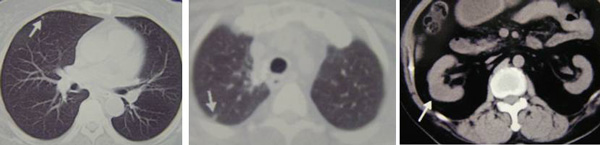
A PET scan on 16 February 2011 indicated:

  1. Multiple bilateral nodules in the lungs (3.2, 2.1 cm) while the smaller ones are likely below the resolution of FDG PET.
  2. No pleural or pericardial effusion noted.
  3. FDG uptake in the rim of a nodule in the right side of the pelvis, abutting the sigmoid colon and superior to the bladder.
  4. Paraaortic and mesenteric nodules.

The doctor told her that her lungs were clear of cancer. But in spite of that, RJ was asked to take the oral drug, Iressa for 3 months. She suffered severe Itchiness throughout the whole body.

She went back to Singapore again – and this time to another hospital. She was told that her problem was due to Iressa and she should stop taking the medication.

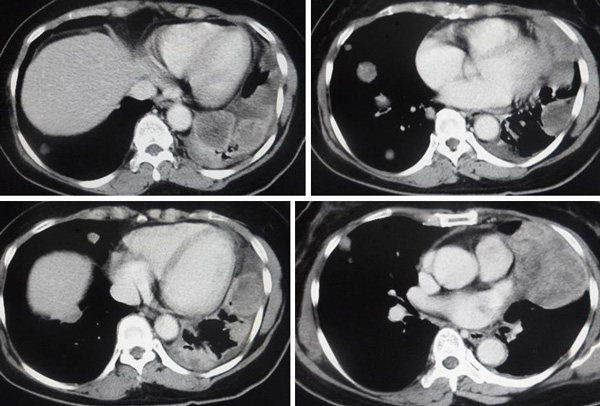
A CT scan on 29 September 2011 indicated:

  1. Nodules of sizes ranging from 0.5 cm to 2.9 cm in both lungs. The largest mass in the lingual lobe measures approximately 7.2 x 5.8 cm. This abuts the adjacent pericardium. There is also small amount of pericardial effusion.
  2. There is also a tiny left pleural effusion.

CT of 29 Sept 2011

A medical report written on 5 October 2011 reads: “Depression Counselling:  Cannot accept impending demise. Can’t sleep. Hoping for cure.”

RJ was asked to undergo more chemotherapy. She did as told. She received her last chemo in early December 2011. Two days after returning home from Singapore she started to cough and had fevers. She was hospitalised in Medan on 8 December 2011. While in the hospital her condition deteriorated and she became breathless. In spite of being given oxygen, her breathing was difficult and she was breathing like a fish gasping for air. Her eyes rolled and she was unable to recognize people around her.

At that point, a visitor told her family: “Why don’t you go and see Dr. Teo?” The next day, 14 December 2011, her two daughters flew to CA Care Penang to seek our help. The following is our conversation that day.

Acknowledgment: Permission to use videos and pictures without having to mask the patient’s face is granted by the family.


Cost of Medical Treatment

The daughters told us that in all the treatment cost almost 2 billion rupiahs.  Below  is the cost to undergo chemotherapy in Singapore (value in Singapore dollars. S$1.00 = RM 2.43, S$1.00 = 6,991 IDR).

Table 1: Estimated cost for chemotherapy with Docetaxel + Gemcitabine.

Table 2. Cost of a cycle of Gemcitabine (Gemzar) + Docetaxel
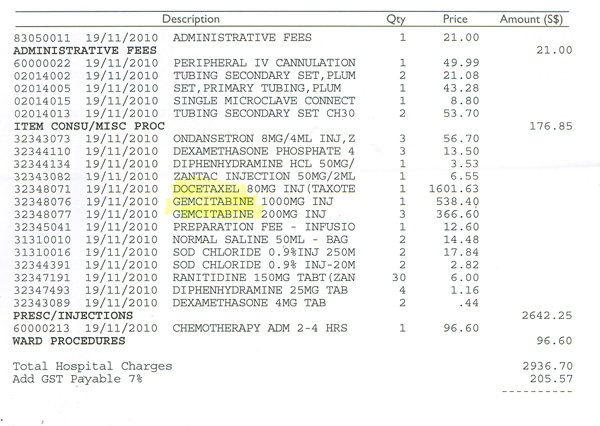
From the above a cycle of chemotherapy would cost approximately S$5,000. For a regimen of 6 cycles the total cost would be about S$45,000. Plus expenses for scanning etc. add in another S$3,000. So all in all, a patient should expect a total cost of about S$50,000 or RM 120,000 or IDR 350 million for the first round of chemotherapy.  But first round may not be good enough. Patients may need more rounds.

The cost goes through the roof when Avastin is used like in this case. But what actually is the benefit of Avastin? Do you know? Click this link to know: https://cancercaremalaysia.com/2011/05/27/dissecting-chemotherapy-part-6-avastin-does-not-cure-cancer/

Table 3.  Cost of a cycle with Avastin was about S$ 12,000 (RM 29,000 or IDR 84 million).

Some questions for you to ponder on

  1. Having spent about one and a half years on medical treatments in addition to a big bundle of rupiahs –  what do you think of this case? They say the treatment is proven and scientific – but what is the reality? What is proven?
  2. Being alive for one and half years but spending most of the time in and out of the hospital – is it worth it? Have you read this posting – How much is life worth? https://cancercaremalaysia.com/2011/05/27/dissecting-chemotherapy-part-4-how-much-is-life-worth-erbitux-for-lung-cancer/
  3. Do you believe that chemotherapy has a 40 percent chance of cure as claimed by the doctor? What percentage of success would you give in this case? What does the medical literature say about cure for lung cancer?
  4. This is an era of information technology. Check with the internet and ask if chemo-drugs such as Gemzar, Docetaxel, Doxorubicin and Avastin ever cure this kind of cancer? Patients – you should empower yourself!
  5. Often, alternative practitioners are accused of being charlatans, snake oil peddlers and worst of all provider of false hope! In this case, is the pot calling the kettle black? Who is actually giving false hope to patients?
  6. Does it ever occur to you to ask this question – What if I just DO NOTHING? Do you think you would end up almost dead after one and half years? Read this story about Ella https://cancercaremalaysia.com/2010/12/11/an-evening-with-ella-our-patient-our-friend/

When RJ’s daughters came to us on 14 December 2011, this was what I told them: “In such a situation (mother about to die in the hospital) I really don’t know what to say or do. I can give some herbs and you go home and try them. If she survived, come back again with all the medical reports. Now, what I can say is – just try. If you are lucky and with God’s blessing she might come out of the hospital alive, otherwise I really don’t know.”

This is not the first “about-to-die” case being brought to us. We encounter such cases very often. When nothing else can be done, family members come to us for help. What can I do? Pretending that I am a superman?  Or,  a god of some kind?  Since CA Care’s mission is to help the helpless and the lost, we generally do not turn them away. Make no mistake at all – we do not promise you a cure. We also do not promise we can resolve your problems. What we can do is try our best to help you the way we know how.  We understand that you have suffered enough and also have spent enough money on those medical treatments. CA Care is not here to “suck you dry” of your last dime before you die. We have no intention of misleading or cheating you. If we can provide you with some sense of “last” hope, we are here ready to help – often at the “risk” of being labeled a charlatan or quack. Nevertheless, the risk we take sometimes turn out to be a satisfying success – a miraculous blessing as you will see in this case.
Update: We received a sms informing us that the patient died in the early morning of 21 February 2012.

The Cold Hard Facts About the US Cancer Program, Part 2: Misguided and Ineffective

Have you read our earlier write-up: The Cold Hard Facts About the US Cancer Program, Part 1: Misguided and Ineffective?

Townsend Letter, the Examiner of Alternative Medicine, is a magazine published in Washington, USA. It is written by researchers, health practitioners and patients. Its editorial staff is headed by Jonathan Collin, a medical doctor. The aim of this magazine is to provide a forum for discussion on the pros and cons of alternative medicine.

The October 2011 issue of The Townsend Letter has another (continuing) article, The US Cancer Program and Specific Types of Cancer, 1975–2007: A Failure – Part 2. This article is written by Anthony D. Apostolides, PhD, and Ipatia K. Apostolides, BA. (Part 1 and 3 of their papers were published earlier). You can access their papers by clicking this link: http://www.townsendletter.com/Oct2011/cancer1011.html#.TsDAmpB2S7A.email

Dr. Anthony D. Apostolides is a researcher and teacher of health-care economics. He received a doctoral degree in economics from the University of Oxford, UK, and a master’s degree from the University of Pittsburgh.  Ipatia K. Apostolides has more than 15 years of experience in the field of cancer (Cleveland Clinic Foundation, and Children’s Hospital, Cincinnati). She has a bachelor’s degree in biology from Case Western Reserve University.

The authors assessed the US cancer program by analyzing the overall incidence and mortality rates of 24 specific types of cancers. The assessment, based on a long time period (1975–2007), provides results that are more comprehensive and thus more reliable than those based on shorter time periods.

The criteria used for assessing the effectiveness  of the National Cancer Institute (NCI) program were:

  1. The incidence rate and the numbers of Americans afflicted by a cancer. A constant or increasing incidence rate over time, along with increased numbers of those afflicted, indicates a failure of the program.
  2. If the incidence rate declines, but the number of people afflicted increases, the program is deemed to be a failure.
  3. A declining incidence rate, along with a declining number of those diagnosed with the cancer, indicates success in the prevention of that cancer.
  4. A constant or increasing mortality rate of a cancer over time, along with increased number of deaths, indicates a failure of the NCI in the treatment of that cancer.
  5. If the mortality rate declines over time but the number of deaths increases, then the program for the treatment side is shown to be a failure.
  6. If the mortality rate declines over time and the number of deaths decline, this indicates success in the treatment of a cancer.

Definition:cancer incidence or mortality rate is the number of newly diagnosed cancers or number of reported cancer deaths of a specific type occurring in a specified population during a year (or group of years), usually expressed as the number of cancers per 100,000 population at risk.

Here are some of the facts that the authors presented regarding some of the common cancers that we hear of in Malaysia (read the authors’ three papers to know more on other types of cancer).

Brain Cancer (Invasive)

  • The overall incidence rate of brain cancer increased from 5.9 (per 100,000)  in 1975 to 6.6 (per 100,000) in 2007. That rate is 12% higher than in 1975.
  • The number of people afflicted by brain cancer surged from 12,634 in 1975 to 20,004 in 2007. From 1975 to 2007, the number of Americans afflicted with this cancer was a marked 558,716.
  • The number of Americans who lost their lives to brain cancer was 8,876 in 1975, and this number rose significantly to 12,732 in 2007.
  • On average 60% of the people who get brain cancer will die from it – a dismal outcome.

Cancer of the Female Breast 

  • The overall incidence rate of in situ breast cancer in 1975 was 5.8, and this rate climbed sharply, that in 2007 it had reached 34.8. The rate of this cancer soared 500% over the analysis period, a phenomenal rate of increase.
  • In 1975, the number of women diagnosed with in situ breast cancer was 12,591, while in 2007 an immensely higher number of women, 105,057, received the unpleasant diagnosis. During this period, the total number of women getting this cancer reached a stunning 1.7 million.
  • With regard to invasive breast cancer, the overall incidence rate of that cancer rose substantially from 105 in 1975 to 126 in 2007.
  • The number of women afflicted by invasive breast cancer also grew significantly. In 1975, the number of women diagnosed with that cancer was 226,923. This number climbed steadily over time and reached 381,125 in 2007. The total number of women diagnosed with the cancer between 1975 and 2007 was an astounding 10.6 million.
  • With regard to mortality of invasive breast cancer, the overall mortality rate increased from 31.5 in 1975 to 33.2 in 1990. Subsequently, the rate decreased to 22.8 in 2007.
  • In 1975, there were 67,924 deaths from this cancer, and by 2007 the number had reached 68,911 deaths. This means that the decline in the mortality rate was not large enough to offset increases in the population. The total number of women who died from this disease from 1975 to 2007 was a shocking 2.5 million. 

Cancer of the Colon and Rectum (Invasive)

  • The overall incidence rate of colon cancer declined by 33% over the period of analysis.
  • The number of people diagnosed with colon cancer in 1975 was 128,547, and in 2007, the number reached 136,616, still higher than the number in 1975. During the analysis period, a total of 4.8 million Americans had contracted colon cancer. This is a stunning statistic.
  • The overall mortality rate of colon cancer decreased by 39% over the course of 1975–2007.
  • The annual number of deaths from colon cancer decreased from 60,667 in 1975 to 50,447 in 2007. However, the total number of deaths from this cancer during the period of analysis was 1.9 million. This indicates that of the Americans diagnosed with colon cancer 41% will die from it on the average.

Leukemia

  • The overall incidence rate of leukemia increased from 12.8  in 1975 to 14 in 2007.
  • Even if the incidence rate of leukemia had stayed the same over time, it would still indicate a failing program of prevention. Consequently, even a relatively small increase in the incidence rate is a definitive sign of failure in prevention.
  • The other negative development of this cancer is that the number of Americans afflicted with leukemia increased steadily and significantly over time. In 1975, the number of people diagnosed with leukemia was 27,601 and this climbed markedly to 42,270 in 2007. The total number of people diagnosed with leukemia during the analysis period totaled a significant 1.1 million.

Cancer of the Liver and Intrahepatic Bile Duct (Invasive)

  • Data on liver cancer clearly show a dismally failing program. The overall incidence rate of liver cancer rose significantly from 2.6 in 1975 to 7.2 in 2007.
  • The number of Americans stricken with liver cancer rose rapidly from 5,702 in 1975 to 21,844 in 2007. This represents an amazing 283% increase and proves that the cancer program failed in preventing liver cancer.
  • The total number of Americans afflicted with liver cancer during 1975-2007 was 378,311.
  • The mortality rate grew by 1.3% annually. But the situation worsened in 1988 to 2007, the mortality rate increased by 3.2% annually.
  • The rising mortality rate of liver cancer increased from 6,069 in 1975 to 16,202 in 2007.  This represents a 167% increase.
  • On average, 88% of Americans afflicted with liver cancer die from the disease; that is indeed a horrendous statistic, showing the abysmal failure of the NCI program in treating this cancer.

Cancer of the Lung and Bronchus (Invasive)

  • The overall incidence rate of lung cancer rose from 52 in 1975 to 61 in 2007. This indicates an increase of 17% over the analysis period.
  • In 1975, the number of Americans diagnosed with lung cancer was 112,867. That high number increased rapidly over the years that followed, reaching 183,895 by 2007. As a result of these increases, the number of Americans diagnosed with lung cancer during the period of analysis totaled a shocking 5.4 million.
  • The number of Americans who died annually from lung cancer increased tremendously. In 1975, the number of Americans who died from this cancer was 91,918, and by 2007 that number jumped 66% to reach 152,539. The total number of deaths from this cancer during the period of analysis was a shocking 4.6 million.
  • On average, 85% of Americans diagnosed with the disease, will die from it – a horrible statistic.

Non-Hodgkin’s Lymphoma (NHL)

  • In 1975, the overall incidence rate was 11, and by 2007, it had climbed 91% to 21.
  • The rapidly increasing incidence rate resulted in ever-rising numbers of Americans being afflicted by NHL over the analysis period. The number afflicted with this cancer was 23,887 in 1975 and climbed significantly to 63,028 by 2007. The number of Americans afflicted with NHL during the period of analysis totaled a significant 1.5 million.
  • Data on the mortality rate of NHL also indicate a failing US cancer program in treating this cancer. The overall mortality rate increased from 5.6 in 1975 to 6.5 in 2007.
  • The number of Americans who lost their lives to NHL increased significantly over time. In 1975, 12,000 Americans died from the disease and this number grew by over 100% to reach 24,235 in 1997; it then decreased to 19,672 in 2007. The total number of Americans who lost their lives to NHL during the period of analysis totaled 622,451. This indicates that on average, 42% of Americans diagnosed with NHL will die from it.

Cancer of the Ovary (Invasive) 

  • The overall incidence rate of ovarian cancer declined over the analysis period from 16.3 in 1975 to 13 in 2007. However, the decline in the overall incidence rate of ovarian cancer over time was not large enough to offset the effect of the country’s population increase; consequently, the number of women afflicted by ovarian cancer increased over the period of analysis.
  • In 1975, the number of women afflicted with ovarian cancer was 35,247 and by 2001 the number had reached 41,649. After 2001, the number of diagnoses declined slightly to reach 39,132 in 2007. That number was still markedly higher than in 1975. During the 1975–2007 period, a total of 1.3 million women were diagnosed with ovarian cancer.
  • The overall mortality rate of ovarian cancer declined over the analysis period. In 1975, that rate was 9.8, and it hovered around 9 for over two decades before declining in the last few years of the analysis period to reach 8.2 in 2007.
  • The number of women who lost their lives to ovarian cancer increased over the period of analysis. This is similar to what was observed for the overall mortality rate. The number of women who died from this cancer was 21,252 in 1975, and by 2007, that number had risen to 24,801. The number of women who died from that cancer during the 1975–2007 totaled 770,398. This indicates that on average, 61% of the women diagnosed with ovarian cancer die from their cancer – a dismal statistic. Based on the mortality rates, the majority of these women are from the “65 plus” age group. 

Cancer of the Pancreas (Invasive) 

  • The overall incidence rate of pancreatic cancer increased over 1975–2007, from 11.8 to 12.4. The number of Americans afflicted by pancreatic cancer also increased significantly over time. In 1975, the number of people diagnosed with pancreatic cancer was 25,571 and by 2007 that number jumped to 37,292. The number of Americans afflicted with this cancer during the period of analysis totaled 984,698.
  • The overall mortality rate of pancreatic cancer essentially stayed the same over the period of analysis, at 10.7 in 1975 and 10.8 in 2007.
  • The constant overall mortality rate of pancreatic cancer contributed to increases over time in the number of Americans who lost their lives to that cancer; that number rose from 23,023 in 1975 to 32,525 in 2007.
  • The number of Americans who died from pancreatic cancer during the analysis period totaled 899,943; this was very close to the number of people diagnosed with the disease at 984,698. On average, 91% of the pancreatic cancer patients die from their cancer. This is indeed a most dismal statistic, showing the failing NCI program in treating this cancer. 

Cancer of the Prostate (Invasive) 

  • The incidence rate of prostate cancer show a big failure in the US cancer program in preventing this cancer. The overall incidence rate rose rapidly from 94 in 1975 to a high of 237 in 1992; subsequently, it declined to 171 in 2007, still much higher than in 1975.
  • The number of men diagnosed with prostate cancer in 1975 was quite large, at 203,058. That number increased rapidly over time, reaching a stunning 610,000 in 1992. This was followed by a decline to 515,569 in 2007, which was still much higher than in 1975. The number of those afflicted by prostate cancer over 1975–2007 grew by a remarkable 154%.
    • The total number of men diagnosed with prostate cancer during the period of analysis was the highest number observed of all the cancers – an unprecedented 13 million.
    • The overall mortality rate of prostate cancer increased from 31 in 1975 to 39 in 1993. Thus, during the first 19 years of the analysis period, the US cancer program in treating this cancer was a failure. After 1993, the mortality rate began to decline; and by 2007, the rate had dropped to 23.5. Thus, after 1993, there was some success in the treatment side of this cancer.
    • In 1975, 66,887 men died from prostate cancer, and that number rose to 102,384 in 1993. After 1993, the number of deaths declined, reaching 70,903 in 2007; that number, however, was still higher than in 1975. The number of men who died from prostate cancer during the analysis period totaled 2.8 million. This indicates that on average, 21% men diagnosed with prostate cancer will die from it.

Cancer of the Stomach (Invasive) 

  • The overall incidence rate of stomach cancer decreased over the analysis period, from 11.7 in 1975 to 7.1 in 2007. This indicates that the US cancer program was successful in the prevention side of that cancer.
  • The decline in the incidence rate of stomach cancer also resulted in a decrease in the numbers of Americans afflicted by that cancer over the analysis period. In 1975, the number of people diagnosed with stomach cancer was 25,226 and by 2007, that number had declined to 21,512. The total number of Americans afflicted with this cancer during the analysis period was 794,935.
  • The overall mortality rate of stomach cancer declined, from 8.5 in 1975 to 3.6 in 2007. The declining mortality rate of stomach cancer resulted in a decrease in the number of Americans who lost their lives to that cancer over time. In 1975, that number was 18,379 and by 2007, it had dropped to 10,892. The total number of people who died from that cancer during the analysis period was 481,716. This indicates that on average, 61% of people diagnosed with stomach cancer will die from it – a dismal statistic.

Comments 

On 23 December 1971, President Nixon declared War on Cancer. He promised the American people and the world that victory against cancer would be achieved within five years. Forty years have passed. That declaration still remains an empty promise, typical of statements made by politicians everywhere.   Billions and billions of dollars have been poured into this War with no victory in sight.

In 1975, Nobel Laureate James Watson said, It produced no promising leads. It‘s a bunch of shit. Linus Pauling, a two-times Nobel Prize winner said, Everyone should know that the War on Cancer is largely a fraud.  An article in the New England Journal of Medicine came to a similar conclusion, Cancer remains undefeated … and the war on cancer is a qualified failure.

Dr. Richard F. Taflinger wrote, “Statistics are a prime source of proof that what you say is true. Statistics are based on studies. There are, of course, problems with using statistics as evidence. Let me remind you of a famous saying: “There are three ways to not tell the truth: lies, damned lies, and statistics.”   http://public.wsu.edu/~taflinge/evistats.html

In this case, can we ever lie with such hard facts? Actual numbers tell better truth than the manipulated and massaged statistics put out by drug companies and their cohorts.  Ask this question – Is the US War on Cancer a roaring success or a great dismal failure?

Show me the hard facts and numbers please!


Breast Cancer: Herbs and e-Therapy Restored Her Wellbeing After 106 Times of Radiation Treatments Part 7: My Journey of Ignorance

Acknowledgment: Permission to use this video without having to hide her identity is granted by the patient.

This is a bitter-sweet story of Le, a 37-year-old female from Indonesia. She came to us on 14 October 2011 after having been diagnosed with breast cancer that had probably spread to her lungs. She had undergone 106 radiation treatments besides taking a variety of supplements.

1. I found a small lump in my breast in 2003. I ignored it. In 2009, the lump grew bigger and I felt it while lying down. I went to see a doctor who told me to do a biopsy. I declined. I did not want to do chemo or radiation.

2.  Why did you go and see the doctor then? Le: Just to know if the lump was cancerous or not!

3. The doctor confirmed it was a cancer. I declined medical treatment and opted for supplements and alternative therapies instead.

4. I took “something.” I did not what the concoction was. This cost me six million rupiah per month. The tumour grew bigger.

5.  After taking the concoction, the tumour grew bigger – didn’t you realize that you were not on the correct path?  Le: No, I never thought of that!

6. I didn’t know where else to go. I bought all kinds of products to take. One supplement that I took for a year cost me 700,000 rupiahs per day – each gulp of this supplement cost 700,000 rupiah.

7. The tumour grew bigger and eventually burst.

8. I had no choice. I agreed to go for radiotherapy.

9. After the radiation the tumour shrunk. But four months later another tumour recurred at the collarbone. It was a small lump and then grew bigger until I had a very big lump around my neck.

10. Why did you wait for it to grow so big before going for another round of radiation? Le: I was hoping by taking the supplements the lump would shrink.

11. Since the lump grew bigger and bigger when you were taking the supplements, why did you continue taking them – even when they didn’t seem to help? Le: I just continued taking them. I waited and waited until the lump grew bigger and bigger. 

12. Then I went for more radiation (in total I had 106 radiation treatments). Later they radiated my ovaries for six times. 

13. Before the completion of all my radiation treatments, another lump recurred in my abdomen. 

14. While undergoing the radiotherapy, I was asked to take Tamoxifen. Ten days on Tamoxifen my wrists swelled and I could not bend my fingers. After a month on Tamoxifen I could not walk. 

15. I had to use the wheelchair and my husband had to carry me.

16. My good friend from Makassar called. She told me my body could not take the radiation anymore. I should stop the treatment. But where do I go? I have tried all the alternatives and failed. My friend to me, “Go to Chris Teo. You can check him out on the internet.”

17. Let me ask you this question – if you were to start all over again from 2009 when you felt the lump in your breast – what would you have done? Le: I would come to see you. I would not want to go for medical treatments.

18. When you had that small lump, you went to see the doctor but why did you not want him to do something for you? Le: I went to see a “sinseh”. He told me I had this disease because of my sins. What kind of “sinseh” was that?

19.  What I wanted to know is, do you know that if you have a cancerous lump in your breast, the best option is to have it removed by the doctor? Le: If I were to have met you then, it is most likely that I would follow your advice and have the lump removed. Because after that I can take the herbs, okay – that I would agree. But I don’t want to go for chemotherapy or radiotherapy after the surgery. Unfortunately, I did not know about you then.

It is with sadness to learn that Le had to be hospitalized after her return to Surabaya because the cancer had spread to her liver. She died on 6 January 2012

Read her full story:

Part 1: Well Being Restored After Two Days on Herbs and e-Therapy

Part 2: Alternative Therapies  –  My Twenty-One-Million-Rupiah Per Month Treatment

Part 3: Why I Declined Chemotherapy / Medical Treatments 

Part 4: Radiation Helped but Did Not Cure, Tamoxifen Disastrous

Part 5: My Dreams and Near Death Experience 

Part 6: My  Four Days of Healing at CA Care  

Part 7: My Journey of Ignorance


Breast Cancer: Herbs and e-Therapy Restored Her Wellbeing After 106 Times of Radiation Treatments Part 5: My Dreams and Near Death Experience

Acknowledgment: Permission to use this video without having to hide her identity is granted by the patient.

This is a bitter-sweet story of Le, a 37-year-old female from Indonesia. She came to us on 14 October 2011 after having been diagnosed with breast cancer that had probably spread to her lungs. She had undergone 106 radiation treatments besides taking a variety of supplements. She presented with aches and pains throughout her body, especially the joints. She could not bend her fingers.  She could not sleep well and she had coughs.

My Dreams

Before I came here, I used to have dreams everyday when I slept. My sleep was not good and disturbed.

What did you dream about? Le: My relatives and loved ones who have died visited me. They told me they have already built a house for me there and invited me to come “home” with them.

Are you sure? Le: Yes. So according to religious belief, I would have to put flowers at the road junction to make peace with the spirits so that they don’t come back again. I did that.

You dreamt of your loved ones asking you to come “home” with them? Le: Yes. But I told them I didn’t want to go. We even sat down together to have a feast – eating together but I told them I did not want to stay there. In one dream, my husband and I visited the “Garden of Eden.” He was carrying a big luggage containing all my clothes.

Oh, it seems your time is not up yet! And after you came here, you took the herbs and did the e-Therapy for four days. Did you still dream? Le: I could sleep very well and soundly. I did not dream anymore.

My Near Death Experience

One night in March 2010, as I opened the dressing of my breast wound, blood suddenly “shot” out from the wound  – one hole was on top of my breast and another below my breast. The blood spurt out rather far off. I had to use eight towels to soak up the blood. I tried to use ice to “cool” it down and stop the bleeding. It did not work. Then my son suggested that I only use the bandage and nothing else. I pressed on the wound and the bleeding stopped. My ears made a “hissing” sound and my vision became blurred and withdrawn. I started to float away – far, far away.

Like you went through a tunnel? Le: Yes, yes. Then I found myself on a white vehicle but there was driver. I was alone on the vehicle. It drove pass the clouds and I floated around, among these clouds. It was all white. I did not feel any pain or anything. It was just absolute emptiness – total blank with no feelings.

When or how did you come back? People around me were singing hymns. Then my daughter tugged my arm and said, “Mama, please do not leave me.” I then woke up. When I regained consciousness, I felt dizzy. My vision was blurred and I saw multiple images.

Read her full story:

Part 1: Well Being Restored After Two Days on Herbs and e-Therapy

Part 2: Alternative Therapies  –  My Twenty-One-Million-Rupiah Per Month Treatment

Part 3: Why I Declined Chemotherapy / Medical Treatments 

Part 4: Radiation Helped but Did Not Cure, Tamoxifen Disastrous

Part 5: My Dreams and Near Death Experience 

Part 6: My  Four Days of Healing at CA Care  

Breast Cancer: Herbs and e-Therapy Restored Her Wellbeing After 106 Times of Radiation Treatments Part 4: Radiation Helped but Did Not Cure, Tamoxifen Disastrous

Acknowledgment: Permission to use this video without having to hide her identity is granted by the patient.

This is a bitter-sweet story of Le, a 37-year-old female from Indonesia. She came to us on 14 October 2011 after having been diagnosed with breast cancer that had probably spread to her lungs. She had undergone 106 radiation treatments besides taking a variety of supplements. She presented with aches and pains throughout her body, especially the joints. She could not bend her fingers.  She could not sleep well and she had coughs.

You did radiotherapy – how many times of radiation did they give you? Le: One hundred and six.

Are you sure? Is that correct? Le: Sure, correct. I received 25 treatments on my left breast (a), then another 25 times below my collarbone (b). Another lump appeared on my right breast and I again had 25 treatments for my right breast (c). Then they radiated my ovaries – that was done for six times. The cancer spread again to my left breast and I again had 25 treatments (d). Actually I have just completed the 106th treatment a few days ago. Then I came here.

You got one treatment a day, so this means you have been going to the hospitals for at least 106 times then? Le: Yes.

Do you want some more radiation? Le: Oh no. I don’t want anymore. That is why I came here. Every time I went for radiation, I prayed, “O god please help me to stop this radiation treatment”.

While undergoing radiation, you were told to take Tamoxifen? Le: Yes, before they radiated my right breast. Husband: About three months ago, around August 2011.

So in August 2011, you started taking Tamoxifen and at the same time had radiation? Le: Yes and ten days after taking Tamoxifen my left wrist swelled. It was a soft swelling – not hard. Then my right wrist also swelled. This was bigger than the one on my left wrist. I had pain when I bent my wrists.

Did you ask the doctor why this swelling? Le: The doctor said the cancer had spread to my wrists. Husband: No, the doctor said the cancer had spread to all her bones.

And you still continued to take the Tamoxifen? Le: Yes. Then within a month, I lost my strength. Husband: The swellings in her wrists were “hot”. Le: Every joint  in my body felt “hot”.  After a month of taking Tamoxifen I was not able to walk.

You couldn’t walk? Le: Yes, I could not walk (demonstrate her physical disability).

Before you took the Tamoxifen, were you able to walk? Le: Okay, no problem. I could exercise and do the “Thian Kung”. Husband: After taking Tamoxifen, she could not walk.

Then what did you do? Le: I took supplements and drank coconut water. The situation improved.

Did you become normal again physically? Le: No, not until I came here (CA Care Penang). After I took your herbs and did the e-Therapy, I can now stand up straight. Before this I could not do this.

Read her full story:

Part 1: Well Being Restored After Two Days on Herbs and e-Therapy

Part 2: Alternative Therapies  –  My Twenty-One-Million-Rupiah Per Month Treatment

Part 3: Why I Declined Chemotherapy / Medical Treatments 

Part 4: Radiation Helped but Did Not Cure, Tamoxifen Disastrous

Part 5: My Dreams and Near Death Experience 

Part 6: My  Four Days of Healing at CA Care  

Breast Cancer: Herbs and e-Therapy Restored Her Wellbeing After 106 Times of Radiation Treatments Part 3: Why I Declined Chemotherapy / Medical Treatments

Acknowledgment: Permission to use this video without having to hide her identity is granted by the patient.

This is a bitter-sweet story of Le, a 37-year-old female from Indonesia. She came to us on 14 October 2011 after having been diagnosed with breast cancer that had probably spread to her lungs. She presented with aches and pains throughout her body, especially the joints. She could not bend her fingers.  She could not sleep well and she had coughs.

1.  My 42-year-old friend with breast cancer died after chemotherapy

Le:  My friend also had breast cancer like me. She died after two years. She went to Singapore to find the best medicine for her breast cancer. It started with just a tiny tumour. She had it removed and then underwent chemotherapy and radiotherapy. She was okay. Then the cancer spread to her bones. They installed a chemo-port in her and she continued to receive more chemo. She took the best “bird nests”  to help her cope with the side effects of chemo. After this chemo, there were spots all over her skin.

Are you sure? Was she you friend?  Le: Yes. Even with such effects she continued to receive more chemos. In total she had 38 cycles of chemotherapy. After that she looked okay, okay but her nails were all dark. Then the cancer went to her backbone and spread to her brain. Then she continued with radiotherapy and more chemo in Surabaya. She died. 

How old was she? Le: Forty-two.

I fully understand, I understand.

2.  Four of my friends already died after medical treatments

Le: Four of my friends already died of cancer. Two of them had breast cancer, one had colon cancer and the other one had cancer of the uterus.

They were all your friends? Le: Yes, they died. They were all below their 50s. And they all had operation and chemotherapy.

They all died, and because of this you decided not to go for an operation and chemo? When did this happen – while you had your cancer? Le: When I had my breast cancer and they also had their cancers.

Oh, at the same time. They took a different road and you took a different path? Le: Yes, exactly.

I understand. I fully understand you. That is the reason why I did not want to push anybody who come here to go for chemo or radiation. The stories you have told me are being repeated over and over.

3. Uncle died after spending 6 Billion Rupiahs

Le:  My uncle had lung cancer. He went to Singapore for treatment. In all, he spent 6 miliar (billion) rupiahs. He also died. After so many chemos, even the veins in his arm seemed to disappear. He did not take care of his diet. He ate anything he liked. At the same time, I also had my cancer. He told me to eat what I liked but I refused to listen to his advice.

And your uncle died? Le: Yes, died after three years.

And at the same time, you also had your cancer. And is it because of this that you did not want to go for medical treatment? Le: No, no. There is a feeling inside me wanting to reject chemo.  These people did not die because of their cancers. They died because of their chemos. Their haemoglobin, platelets and white blood cells were all down and gone!

I understand you, I truly understand. But what I want to say is we should not totally reject medical treatments. At times we need the doctors to help us. We can use certain things that doctors do to help us. And we can reject those that are harmful to us. This is what I would tell patients.

 4.  See what happened to me now when I believed the doctor!

Le: I would agree to go to the doctors to check where my tumour is. But if they prescribe medication, I would not take it. See this is what happened to me  – this is the evidence! This is the first time I believed the doctor and this is what I get (figures unable to bend and later unable to walk after taking Tamoxifen for a month).


Read her full story:

Part 1: Well Being Restored After Two Days on Herbs and e-Therapy

Part 2: Alternative Therapies  –  My Twenty-One-Million-Rupiah Per Month Treatment

Part 3: Why I Declined Chemotherapy / Medical Treatments 

Part 4: Radiation Helped but Did Not Cure, Tamoxifen Disastrous

Part 5: My Dreams and Near Death Experience 

Part 6: My  Four Days of Healing at CA Care  

Breast Cancer: Herbs and e-Therapy Restored Her Wellbeing After 106 Times of Radiation Treatments. Part 2: Alternative Therapy – My Twenty-One- Million-Rupiah Per Month Treatment

Acknowledgment: Permission to use this video without having to hide her identity is granted by the patient.

This is a bitter-sweet story of Le, a 37-year-old female from Indonesia. She came to us on 14 October 2011 after having been diagnosed with breast cancer that had probably spread to her lungs. She presented with aches and pains throughout her body, especially the joints. She could not bend her fingers.  She could not sleep well and she had coughs.

You found a tumour in your breast in February 2009. Did you ever felt the lump before that? Le: I went to the Cancer Organisation for a Pap smear in 2003. At the same time they also examined my breasts and told me to come back for check up  a year later.

What did they say about your breasts? Le: There was a small lump in my breast but the doctor said it was not cancerous – only something suspicious. I was asked to come back to a reexamination after a year.

You did not go back to see them again? In 2004? In 2005 and 2006? Le: No, I did not go back to see them. I received a letter from the Cancer Organisation in 2007, reminding me to come for a check up. I also did not go back to see them.

What did you do in 2008? And what about 2009? Le: In 2008, I did nothing. In 2009, I felt a lump in my left breast while I was lying down in bed. I used to examine my breasts while bathing. I did not feel any lump.

Was there any retraction of the nipple? Any discharge? Any pain? Le: No, nothing.

What did you do after you found this lump? Le: I went to consult an oncologist. After an ultrasound he told me there was a 80 percent chance that the lump was a cancer. The possibility of it being a benign tumour was 20 percent. I was asked to do a biopsy. I refused to do anything at all.

You were told that the lump was cancerous and you declined medical treatment – then what did you do?

Husband: She started to take vitamins and supplements.  Le:  I took supplements and stopped eating meat but I still ate organic chicken.

Oh, chicken is not meat? Right? Le: (no reply, quiet and embarrassed).

After you took supplements, did the tumour not grow bigger and bigger? Husband: Yes, it grew as big as my fist.

When you discovered the lump, what was the size? Le: Size of my thumb.

Okay, after taking the supplements, and supplements and supplements … did the tumour grow bigger and bigger?   Le: Yes. It grew to the size of a duck’s egg.

Oh, you took supplements and the tumour grew bigger – were you not afraid? Le: I was afraid. Husband: Afraid to die.

Le: In November 2009, I came to Kuala Lumpur for a check up. The oncologist told me he was 100 percent sure that the tumour was a cancer. He asked me to do a biopsy and then go for an operation. I refused and returned to Surabaya.

Why did you ever come to Kuala Lumpur in the first place if you didn’t want to follow the doctor’s advice? Le: I just went for a check up.

What is there to check up? In Surabaya you were told the lump was probably – 80 percent cancerous. And in Kuala Lumpur you were told it was probably 100 percent cancer. What is the whole idea of coming to KL? Waste of money? Le: In Februay 2011, I went to see an alternative practitioner. Husband: She also took other types of capsules besides the supplements.

What did the alternative practitioner do? Le: He tapped the area around my breast. He also gave me some herbs to drink. I did not know what these herbs were. After one month on his treatment, the tumour grew bigger and it eventually burst.

When he saw the tumour growing bigger, what did he say to you? Le: He asked me to go for radiation. But I refused.

Did he warn you that the tumour might just burst? Le: Yes, he did tell me that without radiation the tumour could burst. But I refused to go for radiation.

What happened after the tumour burst? Le: The alternative practitioner wrote me a referral letter to go to the hospital for radiotherapy.

And you still did not want to go for radiation? Le: This time I agreed for go for radiation.

Cost of Alternative Therapy

How much did you have to pay for all these alternative therapies? Le: A lot of money.

How much is a lot? Le: I took a lot of supplements. Husband: For taking this supplement alone it cost 700,000 rupiahs per bottle per day. Le: That is RM 250 per bottle per day.

How many bottles have you consumed? Le: Hundreds.  Husband: She was taking this for about six months. Le: No, I took it for about a year. For one month this supplement cost me twenty-one million rupiahs.

You spent twenty-one million per month for this supplement and you took this for a year? Le: Yes.

Read her full story:

Part 1: Well Being Restored After Two Days on Herbs and e-Therapy

Part 2: Alternative Therapies  –  My Twenty-One-Million-Rupiah Per Month Treatment

Part 3: Why I Declined Chemotherapy / Medical Treatments 

Part 4: Radiation Helped but Did Not Cure, Tamoxifen Disastrous

Part 5: My Dreams and Near Death Experience 

Part 6: My  Four Days of Healing at CA Care  


Breast Cancer: Herbs and e-Therapy Restored Her Wellbeing After 106 Times of Radiation Treatments Part 1: Well Being Restored After Two Days on Herbs and e-Therapy

Acknowledgment: Permission to use this video without having to hide her identity is granted by the patient.

It all began with a small lump in my left breast. I ignored it. Some years later, I went to see an oncologist. He asked me to undergo a biopsy and later operate. I declined. I opted for alternative therapy. I took all kinds of supplements (See Part 2: Alternative Therapies  –  My Twenty-One- Million-Rupiah Per Month Treatment).

The lump grew bigger and eventually burst. It was then that I went to see a radiologist and underwent radiotherapy. I had my first radiation treatment in November 2009. I received 25 treatments for my left breast. The tumour shrunk and eventually disappeared.

Three months later, another lump grew just below my neck. It grew bigger and bigger. I again received another 25 radiation treatments for this. The lump also disappeared after the treatment.

Four months later, two more tumours appeared, one on each of my breasts. I again received 25 radiation treatments for each of my left and right breasts.

I also received 6 radiation treatments for my ovaries.

While on radiotherapy, another lump appeared just below my left collar bone but this eventually disappeared after I completed the radiation treatment for my two breasts. However, now I have another lump in my abdomen.

While undergoing the later stage of radiotherapy, I took Tamoxifen.  After two weeks on Tamoxifen my fingers became stiff and it was difficult and painful to bend them. After a month on Tamoxifen I was unable to walk. Also, my neck muscles became stiff.  Before the Tamoxifen I was agile and had no mobility problems. I could exercise. I stopped taking Tamoxifen after a month. My doctor told me the cancer had gone to my bones.

Early this month, a good friend in Makassar called me. She advised that I have had too much radiation already and my body would not be able to accept it anymore. I should look for other alternative treatment. But all this while, I had been on alternative treatments. I took all kinds of supplements. My friend suggested that I go to Penang and meet a Chris Teo.

The above is a bitter-sweet story of Le, a 37-year-old female from Indonesia. She came to us on 14 October 2011 after having been diagnosed with breast cancer that had probably spread to her lungs. She presented with aches and pains throughout her body, especially the joints. She could not bend her fingers.  She could not sleep well and she had coughs.

Le was prescribed Capsule A, Breast L and Breast M teas, Pain tea, Lung 1 and Lung 2 teas besides Cough # 10. She was put on the e-Therapy with Detox #2. That was on Friday evening.

On Sunday night (two days later), Le came back and reported as follows.

I went back to my apartment and slept through the night, from 7 pm to 6 am. I woke up just to eat and drink the herbal teas and then went back to sleep again.

Before this therapy, were you able to sleep? Le: Difficult.

On Saturday (no e-Therapy but only on herbs) did you sleep through the day? Le: Yes. I slept, woke up to eat and then went back to sleep again. I ate corn and fruits.

When you were at home, could you sleep like this? Le: No. At home when I woke up from sleep, I would feel pains. Now, I have no more pain. I could sleep in any position or posture, I had no pain. I was unable to do such a thing when I was at home.

Did you really sleep well – soundly? Le: Yes. I also passed out a lot of “gas” … boot, boot. I would walk to and fro from Kenny’s apartment to the market. I did not have any problem walking. I could not do such thing at home. I would become breathless if I walk like that.

Now, when you walk, did you become breathless? Le: No. Now, I can also hold the broom and sweep the floor. I can now make my bed and fold the blanket. I could not do that before. I could not even lift the blanket let alone fold it. This morning, I even “hit” the pillows.

Now, what other problems do you have? Le: Coughs. Before, I was not able to twist my body around – to the right or left. I would have muscle pull or cramp. Now, no more cramps. After taking the herbs for two days, there are no more body pains.

No more pain anywhere? Le: No more.

So, for the past two days, do you really feel well? Le: Yes. Strong (taking a deep breath).

Do you have any other problem? Le: Only cough now.

Read her full story:

Part 1: Well Being Restored After Two Days on Herbs and e-Therapy

Part 2: Alternative Therapies  –  My Twenty-One-Million-Rupiah Per Month Treatment

Part 3: Why I Declined Chemotherapy / Medical Treatments 

Part 4: Radiation Helped but Did Not Cure, Tamoxifen Disastrous

Part 5: My Dreams and Near Death Experience 

Part 6: My  Four Days of Healing at CA Care  


Breast Cancer: From Despair to Hope in Five Days

1: Healing In Five Days

2: Her Tragic Story

Acknowledgment:  Permission to use these video clips without having to close the patient’s face is granted by the family.

The gist of our conversation:

1.  Breast lump, ten years ago and she did nothing about it.

She discovered a lump in her breast more than   ten years ago but did nothing about it. The lump grew bigger. In 2008, she went to Kuching, Malaysia for a full-body check up. At that time she did not experience any serious discomfort. However, the check up revealed a stage 4 breast cancer since it had probably spread to her bones.

Did she suffer any pains before the check up? Yes, she had pains around the shoulder blade. After a massage the pains disappeared.

2.  Trips to China to find the cure.

The doctor in Kuching suggested chemotherapy. She refused. The family decided to bring her to China for medical treatment. She received treatments such as chemotherapy, cryoablation and radioactive seeding  in the Chinese hospital.

She stayed about one to two weeks in China during each trip there.  She returned home feeling “alright” only to go back to China again for more treatment each year.

Did they teach you to take care of her diet? No, she was told to eat anything she likes. They did not teach her anything about the diet.

3. A Minor Fall

In January 2011, she had a minor fall. This cause one of her legs to become swollen. But even before the fall, she always had pains in her legs. She consulted a doctor in Kuching about this problem and was told that nothing was wrong with her leg but she probably had cancer in her colon.

4.  Leg Operation

Since February 2011, she was not unable to walk and remained immobilized at home. One of her leg was in pain and the other was swollen. She was unable to place her feet on the ground and stand up because of pains.

She went to Jakarta for further consultation.  Subsequently she underwent a surgery intervention for both of her legs.

Two months after the surgery she was able to walk. There were no more pains in the foot when she stepped on the ground. But the pains in the lower parts of her legs persisted.

 5.  Did no return to China anymore

 Did she go back to China again after this? No. We made a total of six trips to China.  In 2008, she went to China thrice, in 2009, twice and in 2010 once. No use – at every visit they asked us to do PET scan, chemo, etc. She became tired, vomited, etc.

6.  Hospitalization – September 2011

In late September 2011, she had pains in her abdomen and was unable to walk again. She had to be hospitalized. The oncologist suggested a PET scan to find out what was wrong with her. The family declined.  By this time she was taking a variety of medications prescribed by the oncologist, bone specialist and neurologist.

3.  CA Care Penang – 9 October 2011

She was wheel chair bound. She had to be carried up into the airplane. She was unable to stand up by herself.

She was unable to sleep and had pains in her legs throughout the day and night.  After listening to her story that 9 October night, we could only say this to her family, I really don’t know what I can do to help you. But I shall try my best. It was indeed a hopeless and helpless case.

After five days on the e-Therapy and herbs, her conditions improved.  The pains in her legs were almost gone. She was able to sleep and above all she was able to stand up by herself with minimal help.

Update: On 26 October 2011, her daughter-in-law called to say that patient (now at home in Jakarta) is able to walk by herself with the help of a walking stick. On the day when she returned home, she was able to slowly walk into the airplane – no need to be carried into the plane like the week before. 

Kidney-Lung-Brain Cancer: Sutent = Heart Damage

MF (H614) is a 49-year old male.  He and his family came to seek our help on 27 May 2011. Watch this video and listen to his story.


Gist of our conversation.

  • MF was diagnosed with kidney cancer in June 2004. As a result his left kidney was removed. This operation cost him RM 8,000. After the operation MF was told that everything would be alright since the cancer had been removed. He was told not to worry and could go back to his normal life again. After all, the cancer has been cured.
  • It was not to be.  Three years later, June 2007, the cancer had spread to his lungs. MF received 10 times of radiation treatments. Then he was told that there was no further treatment.
  • MF turned to herbs. He received fresh herbs from a farm in Johor. He took the herbs for almost one a half years. According to MF, his lung cancer did not improve, but he did not get worse either.
  • But a CT scan done on 1 April 2009 showed the mass had increased in size from 5 x 5 x 7cm to 4 x 11.5 x 6 cm. The lymph node increased (?) from 2.5 x 4.5 x 6 cm to 3 x 3 x 4 cm. Impression: Features are suggestive of progressive enlargement of the right hilaar mass with lymph nod metastasis. Suspicious right main pulmonary artery thrombosis.
  • MF turned to medical treatment again. In May 2009, he was accepted into a Patent Assistance Program on Sutent offered by a local university hospital. For the first three months on Sutent, MF had to pay a total cost of RM 51,000 for the drug. After that, Sutent was supplied free of charge.
  • A CT scan on 4 September 2009, i.e.,  after about four months on Sutent – showed the right lower lobe is much smaller now …  measures approximately 5 x 4.4 cm.  Impression: Left renal cell carcinoma with lung metastases post nephrectomy and chemotherapy showing good response to chemotherapy as evidenced by significant reduction in size of the lung metastases.
  • MF was on Sutent from May 2009 until March 2011. He took 4 pills a day for 4 weeks followed by 2 weeks of rest. Then the cycle was repeated. He suffered numerous side effects after taking Sutent. Among them are:
  1. swollen and bleeding gum
  2. fingers of skin became thin and peeled off
  3. legs with blisters with fluid. It was painful when he stepped on the floor.
  4. rashes on the body
  5. breathing was slow
  6. coughs with blood clot
  7. skin became yellow like jaundice
  8. his black hairs and eye brow turned white
  9. urine with bubbles
  10. the worse side effect was heart failure – currently on heart medications.

He wrote, “This problem (heart failure) was detected in February 2011. And the doctor advised me to stop Sutent indefinitely. Now, I am looking for an alternative treatment. Hopefully you can help me.”

Update


3 June 2011

Dear Dr. Chris,

My father, from Malacca who visited you last Friday (27 May 2011) at Penang was admitted to Melaka General Hospital today. He doesn’t have energy to walk, lost the power to speak and see everything in blur ways. May I know what causes all these? My mother gave him the herbal tea to drink as you told. And he lost his appetite. Thus when the doctor checked his sensitivity, his left side of body is less sensitive than his right side of body. Are these the symptoms of having mild stroke? Hope you can reply me as soon as possible. Thank you.

Reply: I cannot tell you exactly what happen — because I am not there to know what actually was going on … even more so when after all the drugs that he was taking …. he is the one who took Sutent and got the heart attack right?

7 June

Dear Dr.Chris,

My father’s cancer cells from the kidney which spread to the lungs a few years ago, now has spread to his brain. I found this from the doctor after doing the CT scan yesterday. The doctor says that there are many white spots on his brain and he has a high level of calcium. Doctor says that maybe it has spread to the bone too, but unfortunately, they don’t have the machine for the bone scan in Melaka General Hospital. And, my father keeps on complaining about his headache. What should my mother and I do right now?

Reply: I think I have already told you this … from the Kidney it goes to the lungs and from the lungs it goes to the brain. That is the way it goes and Suntent makes things worse. I am in the US now and shall only come home in July. I really don’t know what else to say.

Lessons we can learn from this case

1. Surgery does not cure any cancer. It is a big mistake to think that after a surgery, the cancer is gone. It is most unfortunate that patients are not forewarned of this possibility of recurrence.  Even if you are told that the cancer has all been taken out, please take this with a pinch of salt! The cancer can come back again. And if you are told to go home and eat anything you like, remember that may not be a good advice at all as in this case. Read another story, Kidney Cancer Part 1: Get it removed! …….

2. MF was on herbs for more than a year. He was not getting worse. He said he was not getting better either. For sure, he did not suffer during those months while on herbs. Also he did not have to spend RM 51,000 on the herbs. MF turned to Sutent and he took the drug for over a year. He had to endure all the side effects. Sutent consumption had to be stopped after his heart was damaged. Which is more beneficial – the so called unproven herbs or the so called scientifically proven Sutent? In addition to those side effects, he had to fork out RM 51,000 –  worth it?

3.  After about four months on Sutent, the CT scan showed the lung mass became smaller. The CT scan report reads, “good response to chemotherapy as evidenced by significant reduction in size of the lung metastases”. Unfortunately, reduction in tumour size (although accepted by the US-FDA and medical community as an indicator of effectiveness) is meaningless. After a prolonged consumption of Sutent, in February 2011, MF suffered a heart failure and the doctor advised MF to stop taking Sutent indefinitely. So ended this sad story about Sutent.

4.  Before taking any chemo drugs – this is our advice to all patients. Ask some basic questions first  — such as, Can the drug cure your cancer? What are the side effects of the drugs?  Check with the internet to verify the information provided to you by the doctors.  Be reminded by what Professor Jane Plant said (in Prostate Cancer, page 231), “Much of the advice given to us, even from some government sources, cannot be regarded as reliable, because of the overwhelming influence of vested-interest groups. We must, therefore, rely very much on ourselves and our own efforts to safeguarding our health.”

Below are information obtained from the official website of the Sutent company http://www.sutent.com/

The possible side effects of Sutent are

  1. SUTENT can cause serious liver problems, including death.
  2. SUTENT may cause heart problems, including: heart failure, heart muscle problems (cardiomyopathy) and abnormal heart rhythm changes.
  3. SUTENT may cause high blood pressure
  4. SUTENT may cause bleeding sometimes leading to death. Serious bleeding problem such as painful swollen stomach (abdomen), vomiting blood, black sticky stools and bloody urine
  5. SUTENT may cause hormone problems, including thyroid and adrenal gland problem.
  6. Tiredness that worsens and does not go away
  7. Loss of appetite
  8. Heat intolerance
  9. Feeling nervous or agitated, tremors
  10. Sweating
  11. Nausea or vomiting
  12. Diarrhea
  13. Fast heart rate
  14. Weight gain or weight loss
  15. Feeling depressed
  16. Irregular menstrual periods or no menstrual periods
  17. Headache or change in your mental status.
  18. Hair loss
  19. The medicine in SUTENT is yellow, and it may make your skin look yellow. Your skin and hair may get lighter in color
  20. Weakness
  21. Fever
  22. Gastrointestinal symptoms, including diarrhea, nausea, vomiting, mouth sores, upset stomach, abdominal pain, and constipation.
  23. Rash or other skin changes, including drier, thicker, or cracking skin
  24. Blisters or a rash on the palms of your hands and soles of your feet
  25. Taste changes
  26. Pain or swelling in your arms or legs
  27. Cough
  28. Shortness of breath
  29. Bleeding, such as nosebleeds or bleeding from cuts.

Alert … Beware

I accessed this link on 18 September 2011: http://www.druglib.com/adverse-reactions_side-effects/sutent/seriousness_death/

Sutent (Sunitinib) – Adverse Event Reports – Death

Cases resulting in death (704). You shall see the entry like this …

Suspect drug(s): Sutent

Possible Sutent side effects / adverse reactions in 52 year old male

Reported by a physician from United States on 2010-03-31

Patient: 52 year old male, weighing 70.0 kg (154.0 pounds)

Reactions: Renal Cancer, White Blood Cell Count Increased, Disease Progression

Adverse event resulted in: death

Suspect drug(s): Sutent

Read more: Sutent for Advance Kidney Cancer https://cancercaremalaysia.com/2011/09/18/sutent-for-advanced-kidney-cancer/

Kidney Cancer Part 2: Two Oncologists Two Different Opinions – Is Sutent indicated in this case? https://cancercaremalaysia.com/2011/09/19/kidney-cancer-part-2-two-oncologists-two-different-opinions-%E2%80%93-is-sutent-indicated-in-this-case/

Read more about Kidney Cancer:  https://cancercaremalaysia.com/category/kidney-cancer/

Kidney Cancer Metastatised to Lungs After Seven Years

Ray (M578) is a restaurant owner inIndonesia. In December 2007, at the age of 53, he was diagnosed with kidney cancer. He underwent a radical nephrectomy in a hospital in Melaka. It was a grade 2 RCC (renal cell carcinoma) which had invaded the renal capsule.

After the surgery, Ray was well and life was back to normal again.


Chris: After the operation, no chemo, no nothing? Did the doctor ever ask you to take care of your diet?

Ray: The doctor told me: Eat whatever you like!

About seven years later, August 2007, Ray developed a cough. A CT scan on 17 August 2007 showed 3 lung nodules of size 1 cm to 2.5 cm. One nodule each in left upper lobe and one in anterior segment right lower lobe.

Ray consulted 4 oncologists who differed in their opinions and offered different treatment options.

Onclogist 1: An oncologist in Melaka asked Ray to take Nexavar (sorafenib). This was a new oral drug. Ray declined the medication.

Onclogist 2: Ray’s wife asked Ray to see an oncologist in Subang where a PET/CT scan was done. This oncologist recommended radiotherapy and Ray was subsequently referred to a radiologist who was hesitant to do the treatment mainly because one of the nodules was situated near Ray’s heart.

Onclogist 3: Ray’s friend from London called and suggested that Ray consulted with an oncologist in Kuala Lumpur. This oncologist did not agree that Ray undergo radiotherapy. He suggested that Ray take an oral drug, Sutent (sunitinib). So Ray was started on Sutent in late August 2007 at a dose of 50 mg daily for 4 weeks (to be recycled every 6 weeks).

Within days after taking Sutent, Ray developed severe side effects which he found intolerable. He had diarrhea, his skin turned yellow, his face swelled, he had painful ulceration of his mouth and throat, blunting of taste sensation, hypertension and worse of all severe hand-foot syndrome. His skin peeled off and he could not walk due to severe pains.

Oncologist 4: Not happy with his Sutent treatment, Ray went to see an oncologist in Singapore. This oncologist was surprised to see Ray all yellow. He told Ray that he disagreed with him taking Sutent and then said: In the first instance, I want to be sure that the nodule is cancer. A biopsy was performed which confirmed that it was indeed a lung metastasis. Ray did another PET/CT scan. The results were amazing. The 3 nodules in the lungs had shrunk in size. This Singapore oncologist was lost for words and was not sure what to do next.

Ray decided to go back to Oncologist 3 in Kuala Lumpur for further management. Oncologist 3 told him: You suffered 7 side effects only. According to the drug company’s information, there are 21 side effects. And you “belum apa-apa” (implying that you are not dead yet!). So it is okay. Ray was asked to continue taking Sutent but at a reduced dosage – 37.5 mg or 3 tablets her day instead of 50 mg or 4 tablets per day). However, even at a reduced dosage Ray still suffered and subsequently Ray took only 2 tablets (25 mg) per day. By January 2008, Ray totally stopped taking Sutent because of the intolerable side effects. Even after stopping Sutent, the problems persisted so much so that Ray was unable to stand up and walk. Ray told the oncologist: I am stopping Sutent, I might die because of the drug and not because of the cancer.

A PET/Scan was performed in June 2008. The tumours had since grown back to their original sizes. The oncologist suggested a new oral drug, Afinitor (everolimus) which has yet to be approved for use by the Malaysian Government. This drug cost RM 1,000 per tablet, meaning a month’s supply costs RM30,000 (as opposed to Sutent which costs RM 18,000 per month).

Ray suffered similar side effects from taking Afinitor – ulcerations of his mouth and itchiness of his head, etc.

Realizing that his father was not going anywhere with these doctors, Ray’s son surfed the net and found CA Care. Ray decided not to take any more of his doctor’s medication and came to seek our help on 29 May 2009.

Comments

There are some lessons we can learn from this story.

  1. Medicine is supposed to be scientific and based on solid proof. In this case, where is the proof? Ray consulted 4 oncologists and each gave their own expert opinions. Dr. Robert Weinberg had rightly said: At present, the choice of drugs to be used … is inspired by … intuition or poorly informed guesses. Note again what he said –  based on poorly informed guesses. Perhaps Voltaire was not far wrong when he said: Doctors are men who prescribe medicines of which they know little,   to cure diseases of which they know less, in human beings of whom they know nothing.

Oncologist 1 was for Nexavar. Nexavar, which also costs about RM 20,000 per month, is not shown to cure metastatic kidney cancer. Data showed that Nexevar only increased survival by 83 days (With Nexavar median survival = 167 days, Placebo, median survival = 84 days).

Oncologist 2 suggested radiotherapy for reason only known to himself. Radiotherapy is not shown to cure metastatic cancer. The radiologist was right being skeptic about this recommendation. Radiotherapy could damage the heart.

Oncologist 3 was trying new drugs on Ray. The approval of Sutent by the FDA – USA, was on the basis that Sutent shrank tumors in 26% to 37% of patients. Studies have not yet shown that Sutent improves survival, let alone cure cancer.

When Sutent failed, Oncologist 3 suggested a switch to another drug– everolimus (commercial name Afinitor). This drug was approved for use by the FDA on 30 March 2009. It has not been shown to cure any kidney cancer or even prolong survival. It was said to prolong progression-free survival by about 3 months (PFS survival with everolimus – 4.9 months versus 1.9 months with placebo). PFS means the length of time during and after treatment in which patient is living with a disease that does not get worse.

Oncologist 4 took a different route. He thought he had to make sure that the nodules in the lungs were indeed cancerous. It was indeed a thoughtful act or was it due to some other reason best known to himself? Anyway, he was dumbfounded when he found out the Sutent did indeed shrunk the tumours. It should not be any surprise since medical literature said similar thing, except one ought to ask if shrinkage of tumour has any meaning or significance at all.

Patients ought to be informed or know that the use of such drug like Sutent (which is referred to as inhibitor of tumour angionenesis, anti-angiogenic or VEGF-targeted therapy drug) did shrink tumours in clinical studies. These drugs often prolong survival of cancer patients by only months, without offering enduring cure.  But one most important concern is that in studies with mice, these VEGF-targeted drugs initially inhibited primary tumour growth, but later the tumours showed an unexpected surge in growth and became more invasive and spread widely to other parts of the body.

  1. Ray suffered relapse after 7 years after an apparent cure. Most patients are often misled or lulled into a false security or belief that after treatment they are cured. Far from it. This case proved that surgery does not cure cancer. Period.

Over the years, I have seen many case of relapse after surgery. Let me give some examples. These cases involved patients with right kidney cancer. They had undergone surgery to remove the diseased kidney and did not undergo any other follow up treatment since they were deemed cured.

Patient 1 is a 40-year-old female. Surgery done in March 1996. After 5 years, December 2001,  5 lesions her found in her liver. The largest being 4 cm.

Patient 2 is a 30-year-old male. He had surgery in January 2003. Barely 2 years later, December 2004, the cancer spread to his liver. There were 11mm lesion in Segment 8 of his liver and a 8.7 x 7.8 x 12 cm mass in the left para-aortic region.

Patient 3 is a 53-year-old male. He had surgery in December 2000. About 7 years later, in Agusut 2007, there were three lesions in his lungs.

Patient 4 is a 53-year-old male. He had surgery in March 1997. The tumour in his kidney was 4 cm in size. As of this writing, June 2009, he is still doing well. There is no metastasis.

Study these cases again carefully. Patients 1 to 3 all suffered metastasis after their surgery. Patient 4 did not suffer any metastasis. Do you want to know why? From November 1997 immediately after his surgery he was on herbs and has changed his lifestyle and diet. For his story, click on this link: http://cacare.com/index.php?option=com_easyfaq&task=view&id=248&Itemid=39

They say herbal and dietary therapies are not proven! Is the above not proof enough? The proof is in the healing! The above data also proved that medical treatment for renal cancer is on shaky ground indeed.

  1. Medical literature reports effectiveness of Sutent and other drugs, in terms of tumour shrinkage, median survival, progression-free survival, etc. All these are evasive tactics to distract the real issue. What patients want is a cure, after paying for the drugs through their noses. Tumour shrinkage and all these confusing terminologies are meaningless to patients.

Note:

  1. To view video on side effects of Sutent: http://cacare.com/index.php?option=com_easyfaq&task=view&id=270&Itemid=39
  2. To view video on the side effects of Afinitor: http://cacare.com/index.php?option=com_easyfaq&task=view&id=271&Itemid=39

Everolimus for Kidney Cancer Metastatised to Lungs

Ray (M578) is a restaurant owner in Indonesia. In December 2007, at the age of 53, he was diagnosed with kidney cancer. He underwent a radical nephrectomy. After the surgery, Ray was well and life was back to normal again. About seven years later, the cancer recurred in his lungs. Ray was put on Sutent and suffered severe intolerable side effects. Ray totally stopped taking Sutent.


The oncologist suggested a new oral drug, Afinitor (everolimus) which has yet to be approved for use by the Malaysian Government. This drug cost RM 1,000 per tablet, meaning a month’s supply costs RM30,000 (as opposed to Sutent which costs RM 18,000 per month).

Ray suffered similar side effects from taking Afinitor – ulcerations of his mouth and itchiness of his head, etc.

Realizing that his father was not going anywhere with his doctor, Ray’s son surfed the net and found CA Care. Ray decided not to take any more of his doctor’s medication and came to seek our help on 29 May 2009.


Comments

When Sutent failed, the oncologist suggested that Ray switched to another drug– everolimus (commercial name Afinitor). This drug was approved for use by the FDA on 30 March 2009. It has not been shown to cure any kidney cancer or even prolong survival. It was said to prolong progression-free survival by about 3 months (PFS survival with everolimus – 4.9 months versus 1.9 months with placebo). PFS means the length of time during and after treatment in which patient is living with a disease that does not get worse.

Medical literature reports effectiveness of Sutent and other drugs, in terms of tumour shrinkage, median survival, progression-free survival, etc. All these are evasive tactics to distract the real issue. What patients want is a cure, after paying for the drugs through their noses. Tumour shrinkage and all these confusing terminologies are meaningless to patients.

Sutent for Advanced Kidney Cancer

SC (TK826) was a 53-year-old male. He had a history of pains in his right shoulder for almost a year. An X-ray did not show any problem. Then in October 2008, his right hand became weak. MRI showed tumour in his spine – T1 / T2. Titanium stent inserted to support the crushed T1.  Further investigation indicated the primary as cancer of the kidney. He received 20 radiation treatments. In spite of the treatment, the tumour grew bigger and spread to his liver, lungs and abdomen. He was started on Sutent in January 2009. As of 3 February he had started on the second cycle of Sutent. In spite of the drug, MRI on 11 February 2009 showed a large mass in C3 to C7 and there were more metastases in T1/T2 and T5/T6.


This video was recorded on 9 February 2009. Sadly, SC died on 30 April 2009.

SC suffered the following side effects:

  1. Lost of appetite.
  2. Diarrhoea up to 10 times per day.
  3. Swelling of face.
  4. Ulceration of mouth.
  5. Yellowing of skin.
  6. Difficulty breathing.
  7. Peeling of skin in the feet and hands.

Comments

Below are vital information about Sutent – sunitinib which patients ought to know.

Use: For treatment of refractory unresectable and/or malignant gastrointestinal stromal tumors (GIST) and advanced kidney cancer (advanced renal cell carcinoma or mRCC).

Cost: RM 20,000 per cycle of treatment which last 4 weeks. Take 4 tablets per day. Rest for 2 weeks before starting a new cycle of 4 weeks.

Effectiveness

  • Approval for kidney cancer was based on a review of the drug’s efficacy in reducing tumor size. Approval of the GIST was mainly based on studies showing that sunitinib delay tumor growth.
  • Sutent shrank tumors in 26% to 37% of patients, according to the FDA. Studies have not yet shown that Sutent improves survival.
  • Liz Szabo, USA TODAY Jan 26, 2006, wrote: Sutent doesn’t cure cancer, but experts say it is an important advance – both for patients and for science. Sutent is a product by Pfizer. Another drug used to treat advanced kidney cancer is Nexavar by Bayer.
  • The median OS for patients receiving SUTENT was 26.4 months vs 21.8 months with IFNα (Note: IFN-α has been used extensively in the treatment of metastatic melanoma. Human IFN-α1 is a type I interferon. It is for research use only, not for diagnostic or therapeutic use)

Side effects 
The adverse events included:

The most serious adverse events associated with Sutent therapy included

  • pulmonary embolism
  • thrombocytopenia
  • bleeding from the tumor bleeding or bruising under the skin; coughing blood
  • febrile neutropenia
  • hypertension
  • may harm an unborn baby (cause birth defects). Do not become pregnant. Do not breastfeed while taking SUTENT.
  • may cause heart problems.
  • may cause a hole in the stomach or bowel wall. This could cause symptoms such as painful, swollen abdomen, vomiting or coughing blood, and black, sticky s tools.

Recent research findings on Sutent

  •  Researchers in Canada had reported that Sutent accelerated metastatic tumour growth and decreased overall survival in mice receiving short-term therapy (Cancer Cell 15: 232-239. March 2009).
  • Using mouse model researchers in Spain and California, USA, also showed that Sutent promoted the incidence of highly invasive tumours. The incidence of liver micrometastases was significantly increased by 3.5-fold in treated animal (Cancer Cell 15:220-231. March 2009).


Lung-Brain Cancer: An Impossible Healing Part 3: Reflection and Confession of a Husband

When a lawyer makes a mistake, he loses his case in court; When an engineer makes a mistake, the building collapses; But when a doctor makes a mistake, it gets buried in his patient’s grave  ~ A Cancer Patient

Acknowledgment:  We thank the patient and her family for sharing this bitter-sweet story with us. Permission to use these video clips without having to cover their faces is granted by the patient’s husband.

While Suri was undergoing the e-Therapy at our centre in Penang, we took the opportunity to interview her husband. This is an opportunity to get to know in greater detail about what had really happened.  Below are excerpts of our conversation over a period of three days – 30th and 31st August and 1 September 2011.


1.       The Surrender and Started on Sutent 

  • Actually her problem was detected in 2007. Examination showed a small dot in her lung. She refused to do anything about it. In 2008, while on a holiday trip to China with some friends, she became breathless and vomited. On her return from China she went to Singapore for consultation. Scan showed a large tumour in her lung – probably Stage 3A.
  • She underwent medical treatment for her lung cancer. Unfortunately her health deteriorated. Sometime in February 2011 she complained of poor vision. The eye specialist told her this could be due to cataract. But suddenly she developed severe headaches.
  •  When was she not able to walk? You came to see us in May 2011. About three months before our first visit here. Suddenly her condition just “drop” severely accompanied with severe headache. So when she came here she was not able to walk, her vision was poor – unable to recognize people around her, her left hand and right leg had no strength. Before that she was okay.
  • We brought her to Singapore to do chemotherapy. After the chemo, her condition “dropped” further. We brought her back to Jakarta and did another cycle of chemo.
  •  After that we brought her back to Singapore again to do more chemo. But “someone” up there seems to intervene. She did not have enough white blood cells. So the oncologist could not give her anymore chemo.
  • If her WBC was okay, would you have done the chemo?  We would. I fully believe in the doctor. Daughter: But I never agree to chemotherapy since the very beginning.
  • Daughter: The oncologist surrendered … she gave up. She suggested taking Sutent saying that many of her patients were cured after taking this drug. The doctor told me, “Bring this medication (Sutent) home and try it.”
  • A table of Sutent cost S$210. She took a tablet a day. She had more pains after taking the Sutent. The side effects for her were:  increased blood pressure, headaches and diabetes.  I asked the doctor why she prescribed this drug to her. The oncologist replied, “Many of my patients took it and get well. Go home and try it. If it works it works. If not she just … (gesture with his bent finger).
  • Before she took Sutent, did you not ask if the drug can cure her? No one dares to answer such a question. The oncologist told me, “I cannot say. The only one who knows the answer is the one up there!”
  • After she took Sutent her consumption of Panadol gradually increased from one tablet per day to six tablets per day.


2.       I regretted – Money Does Not Buy Cure 

  • For all the treatments – radiotherapy, Iressa, Tarceva, chemotherapy and Sutent – the total cost came to more or less 2 milyar rupiah (1 milyar is 1,000,000,000 – nine zeros) which is about S$300,000. The cost of one tablet of Tarceva is S$195 and she took this for about 2 years. One tablet of Sutent cost S$210 and she took this for a month plus. One chemo cost about S$7,000. I was curious about one expenditure item of S$120.00. After an enquiry I was told that it was the cost of the chair (plus services provided) which my wife sat on while receiving chemotherapy. The doctor’s consultation cost S$150.00, if I am not mistaken. I was also told to only buy the drugs from the doctor. I was told that cheaper drugs bought outside the oncologist’s clinic could be a fake. I believed everything what the doctor told me.
  • It is okay to spend that kind of money if there was a cure. But there was no cure. I regretted for going to Singapore for the treatment.
  • Let me confess. I was full of remorse. I regretted because even before she went for chemo, my relative in Penang had suggested that we try the herbs. I refused to entertain that idea. In my mind, that is all hocus pocus. How can herbs be better than the doctors in Singapore? Herbs are just traditional stuff and if they are that good then all doctors will have to close shop. So I dismissed the idea of taking herbs as being absolutely nonsensical.  I say again, I regretted this very much.
  • The doctors told her to eat anything – to make her stronger. And when she regained her strength, she got “hammered” with the chemo again. The cycle went on and one. Where do we go from there? On reflection, I begun to see how illogical it is.
  • While we were in the hospital in Singapore, I saw a patient from Medan. This patient had been going in and out for the past eight years – coming for chemo and chemo. There was no end to it. I was afraid to ask the details of what had really happened. Anyway the patient eventually died after eight years of struggle. It struck me – this is a prolongation of a meaningless survival.


3. CA Care, the Last Hope

  • In low voice, Suri’s husband said, “Actually my wife requested that I leave her to die. She did not want to suffer any more.” At that point, a distant relative in Penang called us and suggested that we try CA Care. I had a discussion with my children. We shall abandon further medical treatment and go for herbs. At that time we were hoping for pain relief. We would accept if she dies but not to be in pain.
  • When you first came to CA Care, did you ever believe in what we do? I made it very clear to you from the very beginning that I cannot cure you. What you told me that night was most sensible. Stop taking all the bad food that encourage cancer and then use the herbs to help the body against cancer. This makes a lot of sense to me. 
  • We gave her the herbs for a week. She spat it all out onto our face. My relative talked and joked with her. When she was more relaxed we held her down, squeezed her nose and forced the herbs into her throat. After three days of doing that, there were less headaches. We had more confidence in your herbs.
  • She has been on the herbs for 4 months now, have you got anything to say about that? I would like to say thank you so much for helping us. I don’t know what to say. We have been doing this therapy everyday and you didn’t even charge us (broke down and cried). If you want me to worship you, I would do that.

To this Chris replied, Don’t worship me.  Worship God and give thanks to Him. It is not me who do all these. I was just doing my best to help. My two children are doing well with their Ph.D.s. What we are doing here is not about money. In life money is not all important.

  • It is hard to do “good” for others. If you have not experienced what it is like to get cancer, you cannot understand what we are doing and why we are doing this work. 

I understand. I have gone through this suffering for two and half years now. I know what you mean. That is why I am spreading words around about my wife. Many people saw my wife’s improvement.

  • My job is now done. I have nothing else to offer. Now it is your turn to take care and heal her. Never, never ever make any mistake again. Second, take care of her diet well.

Comments

It is not necessary for me to add any more comment. The story and the videos should convey enough messages.

We recognize that the work at CA Care is at odd with current medical thinking. Modern medicine wants to kill or shrink the tumour. And in the process kill the patients too. In The War on Cancer – an anatomy of failure; Dr.  Guy Faguet , a cancer researcher and medical doctor, wrote, “An objective analysis of cancer chemotherapy outcomes over the last three decades reveals that … the cell-killing paradigm has failed to achieve its objective … a model based on flawed premises with unattainable goal, cytotoxic chemotherapy in its present form will neither eradicate cancer nor alleviate suffering” (pg.89).

Dr. Ralph Moss, Ph.D., a highly respected advocate of non-conventional cancer treatment, said, “  If you shrink the tumour by 50% or more for 28 days you got the FDA’s definition of an active drug …. (but) when you see if there is any life prolongation from taking this treatment what you find is all kinds of hocus pocus … this is the great lie about chemotherapy.”

At CA Care we teach patients to live with their cancers. Concentrate on what matters. We don’t know how to cure your cancer and we don’t pretend we can cure your cancer either. But like in this case, we know how to make your life better – if you can eat, sleep,  walk, have no pains and can have a bit longer of meaningful life– what else do you want? Now, we say – Patients, you have a choice! Whatever you choose, is your prerogative. But it is you, and I emphasize –  you and you alone, who are responsible for that choice.


Read the full story …

Part 1: Hope after a disaster

Part 2: A week of amazing healing

Part 3: Reflection and confession of a husband

Part 4: What it takes to be a winner


Lung-Brain Cancer: An Impossible Healing 1. Hope After a Disaster – when Iressa, Tarceva, Forty Cycles of Chemo and Sutent Did Not Cure Her

Suri (M971) is a 61 year old female from Indonesia. Her family came to seek our help on 8 May 2011. She was wheeled into out centre being unable to walk on her own. She was unable to talk, showed no facial expression and did not seem to know what was going. According to her husband, she behaved like a child. Listen to her husband telling us his wife’s story of tragedy.


Suri was diagnosed with non-small cell lung cancer in 2008.


She had 22 times of radiation treatments in Singapore. No chemo was done. She was given the oral drug, Iressa. She took it for about a year. Her tongue became numb and so she gave it up. The doctor then gave her Tarceva. She was on this drug for about two years.

About a year later, in 2009, the cancer spread to her brain. She underwent chemotherapy. This was also done in Singapore. Her chemotherapy consisted of the following:

  1. 1 cycle of chemo divided into 3 injections, done once a week for 6 months. That means a total of 18 injections.
  2. 1 cycle of chemo every 2 weeks for 6 months. That means a total of 12 injections.
  3. 1 cycle of chemo every month for 6 months. That means 6 injections.
  4. 1 cycle of chemo every 2 months for a total of 3 injections.
  5. 1 cycle of chemo every 3 months. She received only 1 injection.

In total she received 40 chemo injections.

Three months after all these treatments, MRI showed one additional tumour appeared in her brain.


MRI done on 2 May 2011 indicated: “Two small enhancing nodules less than 10 mm noted in the right temporal lobe compatible with brain metastasis.”

Came to CA Care on 5 May 2011

Her husband said, “We knew that chemo did not work for her.  We decided to seek the help of CA Care. Please try and help us. Now the oncologist prescribed this drug, Sutent.  She has been taking in for about a month now. “(Note: after seeing us, the family decided to stop taking Sutent).

She presented with the following serious problems:

  • Severe headaches
  • Vomiting
  • When her two hands are put together, they “fight” trying to tear each other apart.

My comments to the family then were:

  • Based on her medical history, I really don’t know what I can do to help her. We can only try.
  • I don’t want to mislead or cheat you – making your believe that you can find a cure here.
  • If she cannot drink the herbal teas I prescribed, there is no need to bring her here again. There is nothing I can do. But if she can drink the teas, she may benefit from them.
  • As for the prognosis – Don’t think too much or too far! You have spent thousands of dollars and yet they can’t cure you. Don’t expect me to cure you. And I am no magician. But I shall do my best to help. That much I can do.

After Two Months of CA Care’s Herbs

On 17 July 2011, the family brought Suri to come and see us again. Watch the following video and see for yourself the healing that had taken place after two months on our herbs!


Suri’s health had improved tremendously after taking herbs for two month.

  1. Before the herbs, her vision was blurred and she was not able to recognize people around her. But this has since improved. She is now able to recognize people around her again.
  2. Previously she was not able to watch the TV at all. Now, she is able to understand what is going on and can laugh when watching certain programs.
  3. Previously she was not able to comprehend our conversation and was oblivious to her surroundings. Now, she is able to understand and talk to us. She knows what is going on around her. Her sister said, “She can now scold people around her”!
  4. Now she can remember past events and can tell stories based on our old photos. Her husband said, “When she saw our old photos she would talk and talk about it.” But she is not able to remember current events.
  5. In the morning, we bring her for a walk. She can walk 8 rounds of the basket ball court every morning without help. Of course she still lacks strength to walk by herself. Before she couldn’t walk at all.
  6. When sleeping, she can now turn to the left or right. Previously she had to sleep flat and straight unable to turn sideways.

Read the full story …

Part 1: Hope after a disaster

Part 2: A week of amazing healing

Part 3: Reflection and confession of a husband

Part 4: What it takes to be a winner