Are Medical Bills Killing Patients?

Again please?

Medical bills are killing patients?

Yes, medical bills are killing you!

Do I hear it right?

Medical bills are killing you?

But I am sick! Should it not be the disease that is killing me?

You bet!

Times Magazine of 20 February 2013, carried a lengthy article by Steven Brill: Bitter Pill – Why Medical Bills Are Killing Us. I printed out this article – there are 46 pages in all!

You can read the original article here: http://healthland.time.com/2013/02/20/bitter-pill-why-medical-bills-are-killing-us/#ixzz2MjdpIcGO

These are some mind-boggling things that are happening in the hospitals in America today (passages extracted from the said article).

  • 1. Initial Lymphoma Treatment at MDA: $83,900 (approx: RM 251,700)

Sean Recchi, 42-year-old, was diagnosed with non-Hodgkin’s lymphoma. He went to MD Anderson (MDA) Cancer Center in Houston, Texas.

  • Just to be examined for six days so a treatment plan could be devised:  $48,900 to be paid in advance.
  • Sean’s treatment plan and initial doses of chemotherapy was $83,900.
  • Every time a nurse drew blood, the charge was $36.00, accompanied by charges of $23 to $78 for each of a dozen or more lab analyses performed on the blood sample. In all, the charges for blood and other lab tests done amounted to more than $15,000.
  • An injection of 660 mg of a cancer wonder drug called Rituxan was $13,702.
  •  “ALCOHOL PREP PAD” $7 each. This is a little square cotton used to apply alcohol to an injection area. A box of 200 can be bought online for $1.91.
  • Room charge:  $1,791-a-day.

Sean Recchi’s dose of Rituxan cost the Biogen Idec–Genentech partnership as little as $300 to make, test, package and ship. MD Anderson paid  $3,000 to $3,500 for this medicaton, whereupon the hospital sold it to Recchi for $13,702.

As 2013 began, Recchi was being treated back in Ohio because he could not pay MD Anderson for more than his initial treatment. As for the $13,702-a-dose Rituxan, it turns out that Biogen Idec’s partner Genentech has a charity-access program that Recchi’s Ohio doctor told him about that enabled him to get those treatments for free.

2.  False Alarm due to Indigestion: $21,000 (approx: RM 63,000)

Janice is a 64-year-old former sales clerk. She felt chest pains. She was brought by an ambulance to the emergency room at Stamford Hospital about four miles awa. After about three hours of tests and some brief encounters with a doctor, she was told she had indigestion and sent home. That was the good news. But the bad news were her medical bills …

  • The ambulance ride (four miles) came to $995.
  • $3,000 for the doctor and
  • $17,000 for the hospital.
  • In total she had to pay $21,000 for a false alarm.
  • An “NM MYO REST/SPEC EJCT MOT MUL” was billed at $7,997.54. That’s a stress test using a radioactive dye that is tracked by an X-ray or CT scan.
  • An additional $872.44 just for the dye used in the test.
  • The cardiologist in the emergency room gave Janice a separate bill for $600 to read the test results on top of the $342 he charged for examining her.

The regular stress test patients are more familiar with, in which arteries are monitored electronically with an electrocardiograph, would have cost far less — $1,200.

Stamford probably paid about $250,000 for the CT equipment in its operating room. It costs little to operate, so the more it can be used and billed, the quicker the hospital recovers its costs and begins profiting from its purchase. According to a McKinsey study of the medical marketplace, a typical piece of equipment will pay for itself in one year if it carries out just 10 to 15 procedures a day. That’s a terrific return on capital equipment that has an expected life span of seven to 10 years. And it means that after a year, every scan ordered by a doctor in the Stamford Hospital emergency room would mean pure profit, less maintenance costs, for the hospital. Plus an extra fee for the doctor.

The costs associated with high-tech tests are likely to accelerate. McKinsey found that the more CT and MRI scanners are out there, the more doctors use them. In 1997 there were fewer than 3,000 machines available, and they completed an average of 3,800 scans per year. By 2006 there were more than 10,000 in use, and they completed an average of 6,100 per year. According to a study in the Annals of Emergency Medicine, the use of CT scans in America’s emergency rooms has more than quadrupled in recent decades.

The dynamics of the medical marketplace seem to be such that the advance of technology has made medical care more expensive, not less. First, it appears to encourage more procedures and treatment by making them easier and more convenient.

  • 3. A Fall Cost Her $9,400 (approx: approx: RM 28,200) in Medical Bills

Emilia Gilbert is a school-bus driver.  In June 2008 she slipped and fell on her face one summer evening in the small yard behind her house. Her nose was  bleeding heavily and she was taken to the emergency room at Bridgeport Hospital. Gilbert said: I was there for maybe six hours, until midnight and most of it was spent waiting. I saw the resident for maybe 15 minutes, but I got a lot of tests. In fact, Gilbert got three CT scans — of her head, her chest and her face.

  • The CT bills alone were $6,538.
  • A doctor charged $261 to read the scans.
  • Gilbert’s total bill was $9,418 (approx. RM 28,200).

4. One-Day Outpatient Bill, $87,000 (approx: RM 261,000)

Steve, a blue collar worker, was in his 30s at the time and worked at a local retail store. He spent the day at Mercy Hospital in Oklahoma City getting his aching back fixed. He was told that a stimulator would have to be surgically implanted in his back. The good news was that with all the advances of modern technology, the whole process could be done in a day.

  • The Medtronic stimulator cost  $49,237.
  • Basic medical and surgical supplies was $7,882.
  • Bacitracin cost $108. This is a common antibiotic ointment.
  • His total bill was $86,951 (approx. RM 261,000).

Steve ’s bill for his day at Mercy contained all the usual and customary overcharges.

  •  “MARKER SKIN REG TIP RULER” for $3. That’s the marking pen, presumably reusable, that marked the place on Steve’s back where the incision was to go.
  •  “STRAP OR TABLE 8X27 IN” for $31. That’s the strap used to hold Steve onto the operating table.
  • Yet another item, “BLNKT WARM UPPER BDY 42268” for $32. That’s a blanket used to keep surgery patients warm. It is, of course, reusable, and it’s available new on eBay for $13.
  • “GOWN SURG ULTRA XLG 95121” for $39, which is the gown the surgeon wore. Thirty of them can be bought online for $180.

5. Medical Treatment for Stage 4 Lung Cancer: $902,452  (approx: RM 2.2 million)

This is a case of Steven and his wife Alice. Alice makes about $40,000 a year running a child-care center in her home. In January 2011, Steven was diagnosed with Stage 4 lung cancer. The couple knew that they were only buying time now. The crushing question was: How much is time really worth?

Steven died after 11 months of medical treatment at Seton Medical Centre in Daly, California. His wife, Alice had collected his medical bills totaling $902,452 (approx: RM 2.2 million). Alice said:  [Steven] kept saying he wanted every last minute he could get, no matter what. But I had to be thinking about the cost and how all this debt would leave me and my daughter.

Among the items charged in the bills were:

  • $18 each for 88 diabetes-test strips that Amazon sells in boxes of 50 for $27.85;
  • $24 each for 19 niacin pills that are sold in drugstores for about a nickel apiece.
  • Four boxes of sterile gauze pads for $77 each.
  • Intensive-care unit for two days at $13,225 a day.
  • 12 days in the critical unit at $7,315 a day and
  • Total room charges totaled $120,116 over 15 days.
  • $20,886 for CT scans and
  •  $24,251 for lab work.

As 2012 closed, Alice had paid out part of the bills and still owed $142,000 —I think about the $142,000 all the time. It just hangs over my head, she said in December. One lesson she has learned, she adds: I’m never going to remarry. I can’t risk the liability.  In early February, Alice told TIME that she had recently eliminated most of the debt through proceeds from the sale of a small farm in Oklahoma her husband had inherited.

  • 6.  Pneumonia Treatment for $474,064 (approx: RM 1.42 million)

Rebecca and Scott are both in their 50s. On March 4, Scott started having trouble breathing. By dinner time he was gasping violently as Rebecca raced him to the emergency room at the University of Texas Southwestern Medical Center. Both Rebecca and her husband thought he was about to die, Rebecca recalls.

Scott was in the hospital for 32 days before his pneumonia was brought under control. Rebecca recalls that “on about the fourth or fifth day … the medical bill was over $80,000! When Scott checked out, his 161-page bill was $474,064.

  • The top billing categories were $73,376 for Scott’s room ( at $2,293 a day).
  • $94,799 for “RESP SERVICES,” which mostly meant supplying Scott with oxygen and testing his breathing and
  • $134 per day  for supervising oxygen inhalation
  • “SODIUM CHLORIDE  9%”  cost  $84 to $134. He used dozens of this. That’s a standard saline solution probably used intravenously in this case to maintain Scott’s water and salt levels. (It is also used to wet contact lenses.) You can buy a liter of the hospital version (bagged for intravenous use) online for $5.16.
  • $132,303 charge for “LABORATORY,” which included hundreds of blood and urine tests ranging from $30 to $333 each.
  • $24 per 500-mg tablet of niacin. In drugstores, the pills go for about a nickel each.

7.  Immune Booster Shot That Cost $ 7,346 (Approx: RM 22,000) Every 6 Weeks

About a decade ago, Alan  was diagnosed with non-Hodgkin’s lymphoma. He was 78, and his doctors in New Jersey told him there was little they could do. Through a family friend, he got an appointment with one of the lymphoma specialists at Sloan-Kettering. That doctor told Alan he was willing to try a new chemotherapy regimen on him. The treatment worked.  A decade later, Alan is still in remission. He now travels to Sloan-Kettering every six weeks to be examined by the doctor who saved his life and to get a transfusion of Flebogamma, a drug that bucks up his immune system.

  • Sloan-Kettering’s bill for the transfusion is about $7,006.
  • In addition he had to pay the doctor $340 for a session.
  • Each  visit cost a total of $7,346.
  • Assuming eight visits (but only four with the doctor), that makes the annual bill $57,408 (This is approximately RM 172,224) a year to keep Alan alive.

Two basic Sloan-Kettering charges are $414 per hour for five hours of nurse time for administering the Flebogamma and a $4,615 charge for the Flebogamma.

According to Alan, the nurse generally handles three or four patients at a time. That would mean Sloan-Kettering is billing more than $1,200 an hour for that nurse.

Flebogamma’s Profit Margin:  Made from human plasma, Flebogamma is a sterilized solution that is intended to boost the immune system. Sloan-Kettering buys it from either Baxter International in the U.S. or a Barcelona-based company called Grifols.

  • The Flebogamma dose for Alan — “can’t cost them more than $200 or $300 to collect, process, test and ship.”
  • Sloan-Kettering bought this dose from Grifols for $1,400 or $1,500 and charged Alan $4,615 for it!

These are some questions posed by the author:

  • What are the reasons, good or bad, that cancer means a half-million- or million-dollar tab?
  • Why should a trip to the emergency room for chest pains that turn out to be indigestion bring a bill that can exceed the cost of a semester of college?
  • What makes a single dose of even the most wonderful wonder drug cost thousands of dollars?
  • Why does simple lab work done during a few days in a hospital cost more than a car?
  • And what is so different about the medical ecosystem that causes technology advances to drive bills up instead of down?

Read more: http://healthland.time.com/2013/02/20/bitter-pill-why-medical-bills-are-killing-us/#ixzz2MjdpIcGO

My Last Word

This is American – the land where people have great dreams!  In the 1970s, I did my Ph.D. in that great country with the generosity of the US government. Then my two children went to the US to do their Ph.Ds – also courtesy of the American people.  Thank you!

America is a great country – to study and to work in, but it sadden me to know that it is not a great country for the sick – especially if one is not adequately covered by medical insurance as this article tells us.  In my next article on medical bankruptcy the situation is even more depressing.

You may ask me why I try to poke my nose into the “domestic” affairs of the US.  The reality is, what is happening in the US today can also happen in this part of our world! Better that we know now what is going on and be well prepared for a rude shock!

One patient with pancreatic cancer went to see an oncologist. She spent about 10 minutes consulting him and was charged S$700 (that is RM 1,700 – the pay of an average worker for a month!). What was she told during that ten-minute-encounter? Read her story here: https://cancercaremalaysia.com/2012/05/29/part-1-an-encounter-with-an-oncologist-a-great-disappointment/

But S$700 is already cheap! Read this story: Breast cancer: She died even after a multi-million dollar medical bill  https://cancercaremalaysia.com/2011/03/01/breast-cancer-she-died-even-after-multi-million-dollar-medical-bill/

The question under discussion is, what is a fair and reasonable fee a renown doctor can charge his/her patient? These are the figures given by the various medical doctors of Singapore:

  • Dr. Hong Ga Sze  said a reasonable daily fee is $1,000 to $2,000 per day.
  • Dr. Tan Yew Oo, oncologist at Gleneagles Cancer Centre said $10,000 to $20,000 per day.
  • Professor Soo Khee Chee, head of the National Cancer Centre said $100,000 a day is fine and agreed that on a day Dr. Susan Lim could have charged as much as $450,000 per day.

The husband of a patient spent about 2 billion rupiahs for the treatment of his wife’s cancer without success. During our conversation he told me that he was billed S$120 (RM 300) each time his wife sat on the chair in the clinic to receive the chemotherapy drip.

You can read more stories here:

  1. Fancy gadget and half a million ringgit failed to cure her https://cancercaremalaysia.com/2011/01/29/breast-cancer-fancy-gadget-and-half-a-million-ringgit-failed-to-cure-her-%E2%80%93-what-now/
  2. She almost died after spending two billion rupiahs on chemotherapy in Singapore https://cancercaremalaysia.com/2011/12/27/utero-ovary-lungs-cancer-part-1-she-almost-died-after-spending-two-billion-rupiahs-on-chemotherapy-in-singapore/
  3. Surgery-27 cycles of chemo and S$100,000 did not cure her https://cancercaremalaysia.com/2012/01/11/colon-lung-cancer-surgery-twenty-seven-cycles-of-chemo-and-sgd-100000-did-not-cure-her/

Let me close with this quotation by Daniel Taylor:  Medical tyranny is here, and we can’t say we weren’t warned http://www.oldthinkernews.com/2012/11/benjamin-rush-medical-freedom/  Benjamin Rush, one of the signers of the Declaration of Independence, warned in 1787 that medical freedom needed to be included in the American Constitution. Without this protection, Rush warned that the medical establishment would naturally progress – as many of mankind’s institutions do – into an oppressive dictatorship. His words, echoing from over 200 years ago, ring strikingly true today: The Constitution of this Republic should make special provision for medical freedom. To restrict the art of healing to one class will constitute the Bastille of medical science. All such laws are un-American and despotic. … Unless we put medical freedom into the constitution the time will come when medicine will organize into an undercover dictatorship and force people who wish doctors and treatment of their own choice to submit to only what the dictating outfit offers.

Breaking News

As I was about to post this article, someone sent me the link to this article: 

NY, NJ AREA CARDIOLOGIST ADMITS RECORD $19M FRAUD

NEWARK, N.J. (AP) — A cardiologist with offices in New York and New Jersey has admitted taking part in a scheme that subjected thousands of patients to unnecessary tests and treatment and resulted in $19 million in bogus bills, what authorities call the largest case of health care fraud ever by a practitioner in either state.

Read more: http://hosted.ap.org/dynamic/stories/U/US_CARDIOLOGIST_MASSIVE_FRAUD?SITE=AP&SECTION=HOME&TEMPLATE=DEFAULT


Breast Cancer Went Wild After Surgery, Chemo-Radiotherapy. E-Therapy Helped Relieve Her Pains

Eva (not real name) was 33 years old when she was diagnosed with breast cancer. She underwent surgery at a hospital in Hong Kong in June 2009.

The histopathology reports indicated the following:

1.  Left breast mass at 1 o’clock – excision

Diagnosis: Fibroadenosis, Fibroadenoma.

Right breast mass at 1 o’clock, lumpectomy.

Diagnosis: Infiltrative ductal carcinoma, grade 2. No sentinel lymph node metastasis (0/14).

Tumour size: 1.1 + 0.6 cm.

Resection margins clear.

Positive for estrogen and progesterone receptors, highly proliferative activity. Negative for c-erbB-2 oncoprotein.

2.   Right breast lump at 3 o’clock, lumpectomy

 Diagnosis: Fibroadenoma.

After surgery, Eva received 6 cycles of chemotherapy – 3 cycles using FEC (5FU + epirubicin + cyclophosphamide) and 3 cycles of Taxol. This was done in Hong Kong. She received 30 radiation treatments in Macau. There was no further medication after this.

A follow-up mammogram in 2011 showed everything was clear.

In 2012 (i.e. some 3 years later) Eva started to have back pain. MRI in December 2012 showed some spots in her lumbar.

In January 2013, a PET / CT scan showed extensive bony metastasis. She was prescribed Tamoxifen and Xeloda and pain killers.

Medication

After taking Xeloda she was not able to sit down or walk. She had to be hospitalized for a week and given painkiller injection. She was discharged and had to use the wheelchair.

At the end of February 2013, Eva decided to return to her home in Indonesia.

In late March 2013, she consulted an oncologist in Penang. She was told to undergo chemotherapy again using Carboplatin. She has to take an oral drug, Navelbine.  She has to undergo six cycles of this treatment and each cycle would cost RM 7,000. In addition she needs a monthly injection of bisphosphonate for her bone. This would cost an addition RM 1,700 per month.

Can the treatment cure her? The oncologist said: Not sure!

Eva refused further medical treatment. Eva and her mother (who also has cancer) came to seek our help on 21 March 2013. She presented severe pain and was unable to sleep at night. Her movements were very restricted.

Her CA 15.3 results over the years showed an increase from 12.7 to 246.1

Date

CA 15.3

21 October 2011

12.7

29 August 2012

36.8

5 November 2012

80.1

23 January 2013

246.1

The following are the results of her PET/CT dated 16 January 2013.

  1. There is no hypermetabolic lesion noted in the residual right breast.
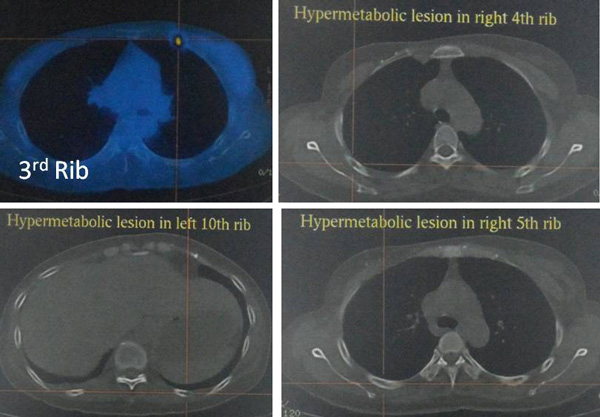
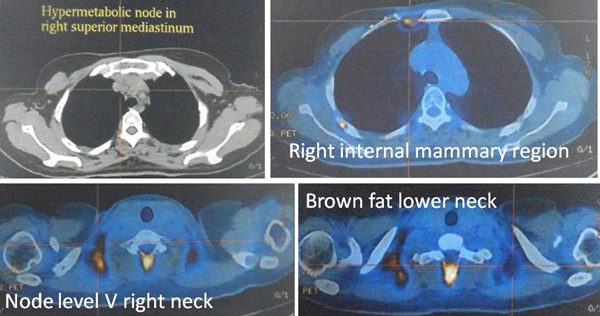
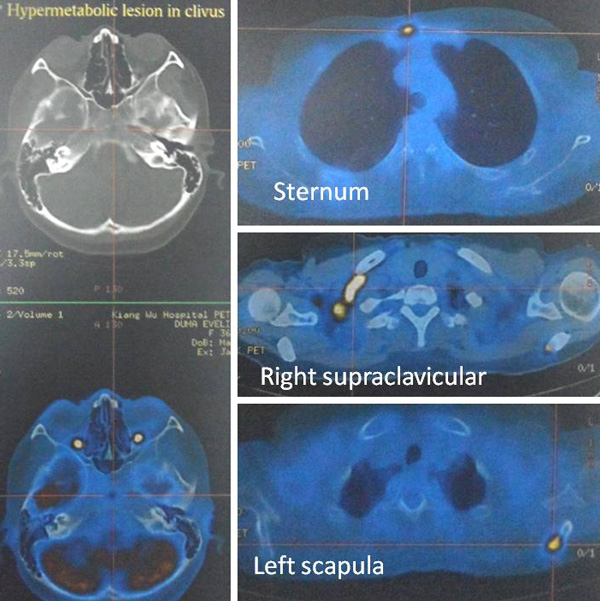
  2. There are multiple hypermetabolic lymph nodes seen over the right internal mammary region, right superior mediastinum, right supraclavicular fossa and lever V of right neck.
  3. No hypermetabolic node found in bilateral axillary regions, left supraclavicular fossa or left neck.
  4. The left breast shows normal FDG uptake.
  5. Hypermetabolic nodule noted in the right pectoralis major at the level of 1st anterior rib.
  6. There is physiologic uptake of brown fat in bilateral lower necks.
  7. Physiological FDG uptake seen in the brain parenchyma.

Extensive bony metastasis

  1. Multiple hypermetabolic deposits are present in:
    1.  bilateral pariental bones and left occipital bone,
    2. Right sphenoid body
    3. Clivus,
    4. Left submandibular ramus,
    5. Sternum,
    6. Left scapula,
    7. Right upper humerus,
    8. Right 4th and 5th ribs,
    9. Left 3rd and 10 ribs,
    10. Bilateral iliac bone,
    11. Left ischium,
    12. Bilateral pubis,
    13. Lesser trochanter of right femur,
    14. Left femoral neck,
    15. Extensive involvement of spinal column from cervical spines to sacrum.

The CT images show:

  1. Lytic destruction at the corresponding area,
  2. And soft tissue mass in some of the lisions.
  3. Focal hypermetabolic mass protruding into the spinal canal and compressing the dura sac, including right lateral aspects of C3 level, anterior aspect of T9 and T10 levels, anterior and right lateral aspect of T11 level as well as left anterior aspects of T12 level.

PET / CT scan showed the cancer had spread to some 29 locations in her body as below

Slide1

Slide2Slide3Slide4Slide5Slide6Slide7Slide8

E-Therapy at CA Care

We really felt sorry for Eva seeing her in such severe pain. We decided that Eva should try the e-therapy right away and requested her to postpone her return home. She needed to stay in Penang for an additional 5 days. And here is her story.

In summary after 2 days on the e-therapy, Eva had less pain and was able to sit up and watch the television for 2 hours. This is something she could not do before. She had to lie down in bed most of the time. With the e-therapy she could sit, walk and move around without much difficulty.  We told Eva to come back to Penang for the e-therapy again if her problems recurred.

Someone wrote: The Oncologist Had Prostate-Bone-Liver Cancer. And He Died

After posting the article, Malaysia’s Well Known Oncologist Died of Cancer, some readers wrote to ask what cancer he had and what he did that he died. Unfortunately, I was unable to answer these two important questions. Then out of the blue, someone wrote to fill in the gap. So here it is – the e-mail (reproduced with the kind permission of the writer).

Another question left unanswered. What medical treatments did he receive and he died because of his cancer or his treatment?  We can never know, one day we may get an e-mail from another angel ?

1st April 2013:  Dear Dr Chris Teo,

I am writing this in response to your post (16 March 2013).

It was indeed a shock for me to read in The Star news that Dr Albert Lim Kok Hooi passed away from cancer at age sixty.

Many questions ran through my mind.

  • What cancer did he die from?
  • When did he find out that he had cancer?
  • How did he treat his own cancer?
  • Why did he discover his cancer at such a late stage? 

I surfed the Internet to try to find more details. When I could not find any information, I contacted friends who knew him and his family.

I was informed that Dr Albert Lim had prostate cancer which spread to the bone and liver. Apparently his cancer was diagnosed a year ago. However he kept it from the public. No one in the hospital was allowed talk about it.

If The Star did not publish the cause of his death, we would not have known that Dr Albert Lim passed away from cancer.

Recently, I came across an online article and confirmed that Dr Albert Lim learnt he had cancer a year ago. http://thestar.com.my/health/story.asp?file=/2013/3/17/health/12844733&sec=health

To quote from the article

He also kept his cancer a secret from acquaintances and friends.

He was a private person in many ways. His cancer was something to be dealt with within the family

Now this brings up some interesting issues.

Why did Dr Albert Lim choose to keep his disease a secret?

As a prolific writer in the papers, he shared his knowledge, medical training and experience to raise the level of public awareness on how to prevent cancer, treat cancer and how to cope with cancer.

Was he doing a social service or was he merely writing to boost his image after his six months suspension from the Malaysian Medical Council?

http://thestar.com.my/news/story.asp?file=/2007/2/23/nation/16951173&sec=nation

What had he hoped to achieve by keeping his cancer a secret?

Normally it is the patient’s prerogative whether to keep the disease secret or make it public. However Dr Albert Lim is no ordinary patient. He is a leading oncologist and a respectable authority on cancer locally and internationally. He was actively running a thriving oncology practice. He had cancer patients who made decisions based on trust and confidence in his prescriptions. Had he disclosed his condition, would some of the patients choose different courses of treatment?

It would seem that there is some implied moral duty or fiduciary duty to disclose his cancer as he is an involved party. Steve Jobs was chided for trying to conceal his pancreatic cancer from the Apple Board and investors. Under stock exchange rules, it was material disclosure as the information would have caused some investors to make their decisions differently.

Here, how do you think his patients would feel? Having faith in a doctor and having spent thousands of ringgit on chemo and other treatments, he read in the newspapers that his oncologist passed away from cancer! And the patient had no inkling that his oncologist had cancer!

It would not be unreasonable to conclude that Dr Albert Lim kept his cancer a secret as it is sheer bad publicity for the medical industry. If the Physician Heal Thyself  maxim, does not work, what faith can the patient have in the doctor? Was Dr Albert Lim worried that his business would be affected?

I am not saying that doctors are not human and that they are immune from diseases. Of course an oncologist can also be afflicted by cancer like anyone else. However, when an oncologist dispenses How To advice, we would expect that the probability of him diagnosing himself at an early treatable stage is higher than anyone else. And if he did get cancer, share the journey with others so as to benefit all.

I read a New Straits Time article dated 26 November 2012 that Dr Albert Lim gave media statements endorsing a new chemo drug which offered hope for late stage prostate cancer patients.

http://www.nst.com.my/latest/hope-for-prostate-cancer-patients-1.176963

It would now seem ironical that four months later, Dr Albert Lim died from prostate cancer. At the launch of the new drug, he knew that he was suffering from late stage prostate cancer. Unless he had tested it himself and it worked, it would seem so inappropriate to endorse a highly toxic drug. Chemo drugs are very expensive. It is unfair to sell hope to poor patients, while not proving its efficacy on oneself. Would the drug company have asked him to endorse the launch of the drug had they known the facts?

I got to know Dr Albert Lim nineteen years ago. He was Head Oncologist at KLGH. He treated my father for terminal lung cancer for six months. During that time I got to know him fairly well on a social basis.

Well, when one meets with an oncologist in a social setting and he is not wearing his professional mask, one gets some interesting insight into the medical industry.

Perhaps in those days, chemo drugs were not as advanced as today.

In the course of conversations, I found that oncologists viewed cancer patients, especially late staged ones as quite hopeless cases. The majority of cancer patients who came to seek treatment would die anyway. Whatever the oncologists do will not make much of a difference. It is a matter of time but the cancer will spread. However since patients came with hope and expect the oncologist to do something, he has to administer the prescribed industry treatment protocols whether he believed in them or not, whether he would practice the same treatment on himself or not!

Maybe the chemo drugs today are more powerful in combating cancer and Dr Albert Lim has changed his views after starting private practice. I do not know. After my father passed away I did not keep in touch. I hear of him on and off from some patients and through reading his articles.

Over the years, I had two close friends and my step mother who succumbed to cancer. They had their share of stories when dealing with oncologists.

Dr Albert Lim and most other oncologists are averse to alternative therapies, labeling anything that is not from Western medicine as quackery. I am not denying that there are some cases where cancer patients have benefitted from oncology treatment. My aunt now in her eighties survived breast cancer for forty years. She could only afford minimal cancer treatments from the hospital and nothing else. Another friend now in his fifties has against all odds battled cancer over twenty years with chemotherapy, stem cell replacement, consuming birds nest daily and mainly a strong willed mind.

However in many other cancer cases, the treatments prescribed by the oncologists did more harm than good. Unfortunately many specialists in private practice run their clinics like running a business. They have high overheads and of course, there is always the thrill of making money like any other business. In private practice, everything revolves around money.

I strongly believe in the mind-body model, the intelligence of the body to heal itself and that diet and herbs are Nature’s gifts to mankind. I do not know you but I have been following your work on and off since the publication of your first book.

At that time, my old classmate and dear friend, suffered from Stage 3 NPC. She went to a famous oncologist and was prescribed a course of radiotherapy. At the end of the sessions, he asked her to say AHHH… looked at her tongue and throat and declared her free from cancer. No other tests were done. I asked her to go to your clinic as additional treatment but she refused.

She was jubilant and went round testifying in the churches that God healed her. Six months later, the cancer came back with a vengeance. She sought treatment from a UH oncologist who gave her chemotherapy but it was too late. I saw her two weeks before she died. She held my hand and said the saddest words I ever heard “I was a fool to believe Dr T ” (the first oncologist who declared her cured). Faith is invaluable but we must be realistic.

Last year, my close friend who is a well known corporate figure, died from Stage 4 stomach cancer which spread to bones, pancreas and abdomen. Initially he was given six months to live. He was treated by the best oncologists in Singapore and locally as his company paid the medical bills. After the first six months of chemo treatment and breathing meditation which we encouraged him to learn, the PET scan showed that the cancer had disappeared. The Singapore oncologist said to him, ‘Whatever you are doing, continue with it’!

At that time, I asked him to go to your clinic to get additionally therapy. However he refused saying that he would follow the doctor’s advice. He too was jubilant and immersed himself fully in his hectic work and had no time for his breathing and meditation. Six months later, the cancer came back. He spent the next twelve months with massive chemo treatments, switching from one drug to another when the cocktail did not work. It was sad to see his health and body getting worse with each treatment. He passed away 2 ½ years after he was diagnosed. The company spent nearly RM2 million for the treatments. How many patients can afford to pay such massive sums for cancer treatment?

When friends tell me so-and-so is diagnosed with cancer, I always recommend that they explore your alternative therapy with an open mind. It is up to each to follow his inner guide as to what treatment they should sought. Living and dying are not in our hands. We do what we can to help by telling patients that there are alternatives besides chemotherapy.

I hope this fills up the gap in your blog as to how Dr Albert Lim died.

When I read Dr Albert Lim’s obituary, I wondered how he felt the instant he was diagnosed. It would have been truly useful if Dr Lim had documented his own journey. That would have been ultimate service to humanity.

Did Dr Albert Lim administer the same toxic treatments he recommended to others for himself? Do chemotherapy and other oncology therapies work? Well, it would seem not but we shall never know.  It is very easy to preach but not easy to walk in the patient’s shoes. Anyway, may the good he has done live on.

In closing, since we did not get to hear Dr Albert Lim’s experience, it may be interesting to read how other oncologists wrote about their own cancer journey.

http://www.npr.org/2010/12/14/131760656/a-breast-oncologist-diagnosed-with-the-disease

http://www.nytimes.com/2005/05/24/health/policy/24docs.html?pagewanted=all&_r=2&

http://www.kevinmd.com/blog/2012/02/diagnosis-stomach-cancer-profoundly-oncologist.html

The following article had gone viral but it is a very touching account from Dr Richard Teo (not an oncologist but a plastic surgeon) from Singapore who documented his cancer experience before he passed on. Irrespective of one’s religious beliefs it will be worthwhile to read with an open mind.

http://www.heavenaddress.com/Dr-Richard-Teo-Keng-Siang/424153/379719/content

Wishing you all the best always.

Yim,

Petaling Jaya

My Comment:

Thanks dear writer for giving us your precious time to share your thoughts. You have done your part! Let me conclude with these quotations:

Slide4

Slide5

Slide6

Slide7

Slide8


Comment added: 23 May 2013

“Another question left unanswered. What medical treatments did he receive and he died because of his cancer or his treatment? ”

I have some further information.

Last week, I met a family friend of Dr Albert Lim. She informed me that she only got to know Dr Lim had cancer two months before he passed away.

I asked if Dr Lim administered any treatment on himself. She said that when he was diagnosed with Stage 4 prostate cancer, he started chemotherapy. However after a few treatments, the cancer got worse and he opted to end the chemo treatment. He preferred to let the cancer advance faster. He knew there was nothing more he could do.

I asked why Dr Lim could not diagnose his own cancer earlier. Apparently, he did not have any symptoms and the cancer markers did not pick up the prostrate cancer. His oncologist friend from Europe who visited him while he was ill, commented that he too, has come across a few cases in Europe where the prostate cancer did not show up in cancer markers.

I heard from one of Dr Lim’s patients that Dr Lim was administering chemotherapy to the patient up to a week before he died. She noticed that he looked very tired and old, but he was very very nice to the patient. Of course it came as a shock to the patient to read that her oncologist died of cancer as no one knew that he was suffering from the disease.

The purpose of my writing is not to run down the Doctor or the treatments. What I learnt from this whole episode is.

1) Cancer is not always detectable at an early stage.

2) When diagnosed with cancer, a patient should educate himself on all options of treatment available and make an informed decision himself.

It is not prudent to rely on medical opinion alone.

All doctors are trained and sponsored in some way by Big Pharma. At the end of the day, they will push drugs which may not yield the desired results but because it is standard protocol, they have to recommend the regime to the patient.

The patient end up spending  and suffering unnecessarily.

Over the last four years when I accompanied my step mum for her cancer treatments at UH, I came across patients who spent all their money at private hospitals. With no money left, they came to UH to seek subsidised  treatments. It was so pitiful to talk to them, some mortgaged or sold their homes, some borrowed money and others took loans to find the elusive care.

I hope the day will come when there will be oncologists with conscience, oncologists who will honestly tell patients when all hope is gone, to stop wasting their money and find some other means of natural treatment and palliative care.

Kind regards.

Yim, Petaling Jaya


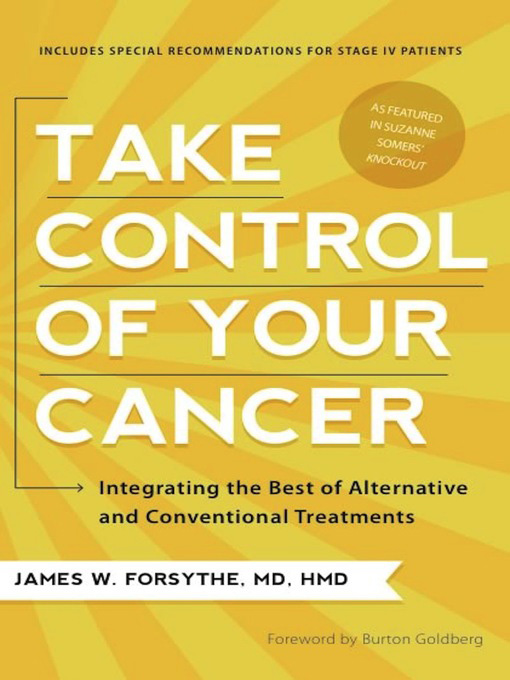
Dr. James Forsythe: Why I Abandoned Conventional Oncology

Take-control-of-your-cancer

Who is Dr. James Forsythe?

Dr James Forsythe earned his MD from the University of California at San Francisco. He is a board-certified oncologist and also a board-certified homeopath which makes for an interesting mix of Western and alternative medicines. The combination of the two allows Dr. Forsythe to be extremely creative in his approach to cancer. He is an integrative oncologist providing the best of what both worlds have to offer. Today, Dr. Forsythe enjoys a successful career as a medical oncologist who utilizes alternative treatments

In the Introduction chapter of his book Dr. Forsythe explained why I abandoned conventional oncology. Here is what Dr. Forsythe wrote:

  • Oncologists usually dismiss any anecdotes about miraculous remissions and cancer cures, even though most of them have encountered cases of remission they can’t explain.
  • Not only do conventionally trained cancer specialists not want to hear about (such) case … they are hostile toward any physician (like me) who takes an interest in these anecdotes.
  • We knew that chemo was killing good cells, but we just hope it was killing enough bad cells too.
  • All of the patients became horribly sick from the treatment and most of them relapsed within a few years.
  • It was during my training at UC San Francisco that I discovered how arbitrary the cancer treatment protocols we were learning had become. Someone higher up in the field would get an idea that we should prescribe a particular drug twice a week for this or that cancer and it should be the standard dose.
  • Many times there was no scientific evidence behind what they were saying. Because we were trainees, we had to follow their exact protocol, whether it was evidence based or not.
  • And despite the lack of evidence, these physicians and administrators were declaring the protocol to be an exact science, a sort of gold standard for medical practice. The obvious shortcomings bothered me a lot.
  • When I attended oncology conventions there would be an exercise in which a cancer case would be presented and everyone would vote how they would treat that particular case. There was never a consensus about treatment.
  • Of the specialists present, 60 percent might say one type of drug should be used, while 40 percent voted otherwise.
  • I would think to myself: How can this be? These physicians were all oncologists. They should have been on the same page. But they never were; unfortunately for cancer patients, they still aren’t.
  • More than 100 cancer drugs are out there today (some in use without FDA approval), and there is no consensus on which drugs to use, what dose to  use, how long to give them, or which types of cancer respond best to those drugs.
  • All these decisions are made arbitrarily, turning the patients into virtual guinea pigs.
  • An article written in the Journal of Oncology in 2004 noted … the overall survival rate for patients with Stage 4 cancer receiving chemotherapy was only 2.1% in the United States.
  • This finding showed me that the over-treatment approach and the treatment protocols using so many toxins constituted a failing strategy.
  • Even if you were lucky enough to be one of the two out of a hundred who survived, you would probably have chemo brain symptoms, you might have heart and liver problems, and you would probably experience constant pain and the loss of feelings in your feet and toes. These were just accepted side effects.
  • Oncologists didn’t want to think about this dismal 2 percent survival rate after five years. Understandably, they didn’t want to acknowledge that they were doing any harm to their patients.
  • What further disturbed me was the astounding escalation in patient treatment costs, especially when they were being directed to use toxic or ineffective cancer drugs following surgery.
  • These high-dose drugs are expensive and often problematic. One lung cancer drug was on the market for almost five years and cost patients $25,000 (approximately RM 75,000) a year, based on them taking one pill a day, yet studies found the drug to be no more effective than if the patients had taken a placebo sugar pill every day.
  • This amounted to a royal fleecing of the people who had been rendered vulnerable and fearful by the prospect of a painful death.
  • Those individuals who were lucky enough to survive Stage 4 cancers often suffered from many of the symptoms of toxic chemotherapy …. The quality of their lives, even though they may have survived cancer, was oftentimes dismal.
  • I found myself wondering if survival was worth the price. There was a morbid saying at some of our oncology meetings: We cure the cancer, but the patient died.
  • They labeled my method a pseudo-science, something that isn’t evidence based. Because they didn’t learn about it in medical school, they considered it mere quackery.
  • The bottom line is that they simply didn’t – and many still don’t – have the courage to deviate from Big Pharma’s indoctrination and drug-obsessed dogma.

2 Chemo-is-odd-UK-doctor

1 Chemo-worthless

Malaysia’s Well Known Oncologist Died of Cancer

Yesterday I got a shock when I received an e-mail informing me that Dr Albert Lim Kok Hooi died of cancer. The first thing that struck my mind was: How could this be? Is it a hoax? I wrote back to the one who sent me the email that I could not believe the information. He then sent me this link: http://thestar.com.my/news/story.asp?file=/2013/3/9/nation/12815175&sec=nation

In the article is the photo of Dr. Lim, the oncologist – this is my first time knowing how he looks like. From the article too I learned that his funeral was held at Trinity Methodist Church, Petaling Jaya. If this was in Penang, this is also the church Im and I worship in every Sunday – Trinity Penang.

I must say I do not know the late Dr. Lim at all, but I suspect we have “heard “of each other through our mutual cancer patients – he, an oncologist and I an alternative medicine practitioner (often referred to as quack or snake oil peddler)  who is on the other side of the great divide. Our patients went to see him for consultation and his patients came to see us after all those “scientific” treatments have failed them.

I also “know” him through his writing in the Star column. Dr. Lim was a prolific writer. And from his writings I learnt that his was an ardent and staunch supporter of “scientific medicine.”  I first learned of Dr. Lim as being the leading oncologist in Malaysia some 16 years ago when patients came to see me after consulting him.

As I surfed the Internet, I also stumbled onto what Dr. V. M. Palaniappan,Ph.D.  (I also do not know him as a person) wrote in  http://ecohealingsystem.blogspot.com/

I read a sad news today in The Star (Malaysian, p.16, Saturday, 9 March 2013). This reports the death of Dr. Albert Lim Kok Hooi, a great Consultant Oncologist who was just 60, due to CANCER. It seems he was passionate about many issues, including animal and human rights, the rights of underprivileged, unhealthy lifestyles and habits of people, and the like. Reading all about Dr. Lim, it appears he had been a wonderful human being, and has contributed to the society to the fullest. If he lived for another one or two decades, with this caliber and good soul, he could serve a lot more to humanity. I sincerely regret his loss. May God bless his soul, and to rest in peace!

Likewise, I too felt sad to know that Malaysia has lost one of its outstanding sons “too soon”. At age 60 because of cancer.  Allow me to extend our sincere belated condolence to his beloved family. As children of God, we believe his soul now finds rest and peace with the Lord.

I spent days surfing the Internet trying to find out more details or hints of what had really happened. Unfortunately, I was NOT fortunate. I could not find any information about his illness, although I had access to the articles that he wrote. The link to the 10-page listing of his articles are in:  http://archives.thestar.com.my/search/?q=Dr%20Albert%20Lim%20Kok%20Hooi

Dr. Lim also has his own blog: http://dralbertlim.wordpress.com/page/6/ And his most recent posting was on 13 January 2013. And he died on 9 March 2013 – that is, just about two months after that posting?   Sounds like a heart attack rather than cancer.

The questions that strike the mind are: When did he get his cancer? What cancer? What treatment did he undergo?  These, I believe, are fair questions to ask. I went through his articles trying to find out if he ever disclose or give any hint that he had cancer in his writing. I do not seem to find any.

Let me say that even though I have never met Dr. Lim, I found some of what he had written interesting, especially coming from an oncologist! I wish many doctors and oncologists have similar views like him.  Let me highlight what Dr. Lim wrote over the years in his articles in the Star. In fact, he was spot on regarding the issues below – and I hope cancer patients do take note of his advice seriously.  These are good advice!

Cry me a river, 9 December 2012

  • The cancer has been growing in your body for decades. It takes 10 to 20 years for the first cancer cell to transform to a mass of detectable and diagnosable cancer.
  • Take at least two weeks to a month to work things out. Do not embark on any treatment – surgery, radiotherapy, chemotherapy and targeted therapy – until most of your questions are answered. And until your emotions are no longer on a roller-coaster.
  • Never be pushed to see any doctor against your wishes.
  • Choose your surgeon wisely. You should also choose your radiologist and your pathologist.
  • Needless to say, you choose your oncologist. Change your attending oncologist by all means if you are not satisfied with him/her.

http://thestar.com.my/health/story.asp?file=/2012/12/9/health/12417247&sec=health

A sickly sweet life, 7 October 2012

  • Sugar is as harmful to our health as tobacco and alcohol, and yet, by comparison, so little bad press is given to it. There is much science behind the harm of sugar.
  • All the food we take (even if it does not taste sweet) has sugar in it. Fruit and vegetables contain sugar to a varying degree. Eating fruit (whole, not canned or bottled) and consuming a healthy diet (fruits, vegetables, whole grain, blah blah blah) is more than sufficient for our caloric requirement.
  • The sugar and the sweetened condensed milk we spoon into our coffee and tea are harmful. And so is the sugar in sodas, rose syrup and other sweet drinks. Not to mention the sugar in candy, sweets, chocolates, doughnuts, cakes, nyonya kuih and biscuits encrusted with sugar.
  • All this sugar is refined sugar as opposed to unrefined sugar, which is found naturally in fruit, vegetable and meat. Refined sugar is usually made from cane sugar, but stripped of all its natural goodness.
  • The copious amounts of sugar we consume through all the sweet drinks and food make up another approximately 90 pounds (40.8kg) or more of sugar a year. This 90 to 100 pounds of refined sugar (whether sucrose or fructose) is, to use an accurate term, a poison, i.e. a harmful substance that has no benefit.
  • For starters, we should avoid all processed meats, including bacon (bak kua in our local context) and most sausages.

http://thestar.com.my/health/story.asp?sec=health&file=/2012/10/7/health/12127186

Fat chance of cancer, 13 July 2008

  • It also advises against eating more than 6 gm of salt per day. I can’t imagine what 6 gm of salt is but I do not add any salt at the table and I would reject all foods that taste perceptibly salty.
  • How do you tell the common folk that their 10 favourite foods are a no-no from the scientific health-wise point of view? Nasi lemak, roti canai, curry mee, wanton mee, burger, doughnuts, fries, char kuay teow, chicken rice and mee goreng are out.

http://thestar.com.my/health/story.asp?file=/2008/7/13/health/1567884&sec=health

Something about Dr C, 6 January 2013

  • Dr C also taught me a lesson in healthy eating. Whenever we dine together, I notice he attacks fruit and vegetables before all else. I begin with the canapés, he starts with the fruit. I end with the Coeur a la Crème, he ends with fruit.
  • You don’t know how very guilty I feel whenever I dine with Dr C. He tells me that the fruit will fill him up. That would make it difficult for him to consume much else. He drinks water mostly.

http://thestar.com.my/health/story.asp?sec=lifeliving&file=/2013/1/6/health/12522144

Only human, 10 June 21012 

  • My failing as a doctor is my impatience with the pronouncements of alternative and traditional medicine. I feel bad each time I try to explain science to my patients and know that at times I have hurt their feelings.
  • The rights of a patient matter a lot to me. This includes the right of privacy, and the right not to undergo treatment.
  • To me, it was her fundamental human right: to be treated, not to be treated, to map the rest of her life, to die at a time and manner of her choosing.

http://thestar.com.my/health/story.asp?file=/2012/6/10/health/11421917&sec=health

Of course, I must say you cannot expect me to agree with everything that Dr. Lim wrote. That is understandable. We stood at the opposite, extreme ends of the pole.  Nevertheless, let not our differences of knowledge, training or upbringing divide us. As human beings we are merely travelers on a journey of learning experience as we walk through life on this earth. Once our job is done, we are called HOME. No one lives forever. Doctors also get sick like any other mortals. And CANCER doctors do get cancer too. And they also can die of cancer. This is the reality or irony of life.

I am not a medical doctor. After teaching and researching in the university for 26 years I got involved with the alternative management of cancer. I used my scientific knowledge trying to find truth through a non-conventional view.

Dr. Lim’s death had brought forth one question I often ask myself. If one day I were to be inflicted with cancer – like those thousands who have come and to seek my help – would I keep this illness a secret? My blunt answer is: NO.  This is because I am here on earth for a reason – and I am on a journey to gain experience. I would want to share my trials   and tribulations with my fellow travelers. I believe it is important and fair on my part that I share with you not only my successes but also my bitter experiences. I take the view that my experiences would be useful lessons or examples for others to learn from. If I fail I have to tell you and warn you of the pitfalls of my journey. Some of you may not agree with my personal beliefs. That is perfectly okay with me too.

Recently, I interviewed a cancer patient and at the end of our conversation I asked if he would want me to cover his face for our video presentation. He said NO, there is nothing to be ashamed about if you have cancer. I did not commit any crime!  I have full respect for this patient and am very impressed and proud of such an attitude. To me, failure to win over cancer is not a failure.  I come to this conclusion because I have learned early in my cancer career that there is NO such thing as a (permanent) cure for cancer. You get cancer, you die. You may have a remission but that is not a cure. That seems to be the scenario all over the world today.

President Hugo Chavez died of cancer after four surgeries and lots of chemotherapy.  Jacqueline Kennedy Onassis had non-Hodgkin’s lymphoma and she died after much chemotherapy.  Ted Kennedy died of brain cancer. In this blog, I have written about Tony Snow  who died of colon cancer that had spread to his liver. Then there was a story about Steve Jobs who died of pancreatic cancer. In fact the list goes on.

The world’s most iconic scientist of our time, Nobel laureate James Watson also has (prostate) cancer.  And I was told he refused to undergo the standard medical treatment. In his recent talk, Dr. Watson said: There’s now pretty good research that suggests that if you take a baby aspirin a day, you get less cancer … So every morning, I take an anti-inflammatory, to the laughter from the audience. He joined in with his own distinctive, raspy chuckle and shrugged, asking: Why not?  Watson also takes Metformin. The drug is normally taken by people who have type-2 diabetes, but research shows that fewer of those taking the drug get cancer.  He said: If this is right, this is a bombshell, and all chemotherapy should be done with Metformin.

 Source: http://today.ucla.edu/portal/ut/PRN-watson-and-cancer-193383.aspx

In his blog, Dr. Palaniappan raised some interesting questions about Dr. Lim’s “secret adventure” with his cancer. This is what he wrote (http://ecohealingsystem.blogspot.com/):

  • With all the credentials, Dr. Lim must have been a real … capable radiologist and oncologist…. how can Dr. Lim, a CANCER SPECIALIST, die of CANCER?
  • If a heart specialist, a child specialist, a skin specialist … dies of cancer, he/she can be excused … How can a CANCER specialist die of CANCER? How can a cardiologist die of heart attack?
  • If such best brains do not have the capacity to guard themselves, how are they going to protect the common people? How can we accept them as guardians of our health? Great and disturbing doubts appear to have risen.     

You may wish to ponder what Dr. Palani’s said. You may agree or disagree with him.

To me, Malaysia has lost a good doctor. If Dr. Lim were to leave behind his legacy by writing about his “battle” against cancer it would be a greater help to all of us.  If scientific medicine, which he believed in so ardently, has been so effective against cancer, what is it that went wrong that he had to die of cancer? I am sure this is the question that most, if not all, cancer patients want to know.

I am reminded of what happened in France in the 19th century at the time of Louis Pasteur and Claude Bernard – two great scientists of that period. Pasteur was a chemist and microbiologist, who put forward the germ theory. According to him diseases are caused by infectious microbes, that impair the functioning and structures of different organ systems. This paradigm is the basis for the use of antibiotics today.

Pasteur’s contemporary and friend, an equally great scientist, Claude Bernard was a physiologist. He argued the germs are not as important as the body’s internal environment – what he called le milieu intérieur. According to Bernard, The constancy of the interior environment is the condition for a free and independent life. Bernard thought that the body becomes susceptible to infectious agents only if the internal balance – or homeostasis as we now call it – is disturbed. After all, there are billions of microbes and bacteria inhabiting our guts, our blood, our whole body. Why do we sometimes get sick from them and sometimes not? When a bacterial or viral agent is “going around,” as we say, why do some people fall sick while others remain healthy?

History has it that when Pasteur was on his death-bed, he said:  Bernard is right. The microbe is nothing. The environment is everything.  With that confession, the world is left a bit wiser!

Source:  http://greenearthfound.blogspot.com/2009/09/louis-pasteur-versus-claude-bernard-on.html

Chemotherapy SPREADS and MAKES cancer more AGGRESSIVE

Can this statement be true? Is it a hoax? I would NOT dare say or write such a thing about chemotherapy lest I would be accused of trying to scare you away from chemotherapy – the gold standard treatment of cancer today.  That is the way it is with human nature – if you say something not nice about something then you are the enemy of that something – there is no middle ground.

Unfortunately, my daily reading of medical literature makes it difficult for me to keep quiet or play deaf and dumb about what I have read.

When patients go and see their oncologists for their cancer, they generally have high hope but at the same time are just as anxious. Some patients dare ask their oncologists: Can chemo cure me?  Others do not have a clue what to say or ask . They take it for granted that doctors know best – why ask questions? For those who asked, what answers do they get? Probably these:  There is a 95 percent chance; or Let’s see after three cycles of chemo; or Cannot cure, but can control the cancer from spreading; or You must do chemo to make the cancer less aggressive, or With chemo you have better quality of life!

The answers provide much comfort and assurance to patients. Indeed that is what patients want to hear! And then they play along with their oncologists.  But do you ever realize that such an answer is just a PR exercise rather than a statement of fact based on scientific evidence? With each passing day as more and more scientific evidence are being reported, such answers seem to be very leaky.

Let me ask you.

  • If you know that chemo CANNOT cure your cancer, would you still undergo chemotherapy?
  • If chemotherapy can make your cancer worse and makes it spread more aggressively, would you go for chemotherapy? 

Some will say NO. But some will say YES, because what choice have I got? For example, read this e-mail below:

14 June 2012: Dear Chris,

The doctor (looked experienced and kind) suggested Gemzar and Cisplatin for six cycles. He did not recommend radio because it is not solving the root cause of the growth (previous radio sites also growing). Honestly, I’m at loss because I also frightened of chemo after so many awful stories. Finally, we decided to try out 1 or 2 cycles and monitor my husband’s condition, scheduled to start next week. I know this sounds stupid. However, there does not seem to be other avenue to slow down this growth. We still plan to continue with herbs long term- but can we have herbs during chemo? Thanks and regards.

30 January 2013: Dear Chris,

My husband had passed away last November 2012.  After two cycles of chemo, he experienced leg weakness. He stopped chemo after that. Then he was paralysed starting from the legs, and moving upwards to both hands, and finally his breathing muscle was affected. He died due to breathing difficulties. In any case, I would like to thank you for the help rendered. Thanks and regards,

After two cycles of chemo and the patient was dead?  This is what I always tell patients:  It is your life and you have to make your own decision without me having to influence you. My responsibility is to provide honest information. You can ask your oncologists about the pros of chemo. But it is unlikely that they tell you in detail the cons of chemotherapy. Here, we tell you about the dark story of chemo because they are equally important although less talked about. Nevertheless you need to know them if you want to make a wise and empowered decision. But be reminded that by doing this we appear to be anti-chemo. We are not – at times we do urge you to go for chemotherapy.

Dr. Morton Walker (in Cancer’s Cause, Cancer’s Cure) wrote: I was astounded at how distorted the physicians’ presentations were when they discussed the side effects of their treatments. The doctors appeared to become almost like used-car salesmen in a pitch for their surgery, radiation therapy and/or chemotherapy.  I know something about medical practices and oncology from my work as a medical researcher and as a former practicing podiatrist. In my opinion, the information the oncologists gave my fiancee was hardly an honest assessment of the relative benefits and risks associated with the recommended treatments. 

Let me ask you to reflect on the following tragic story and see if you can learn anything from it.

Kathy (not real name) is a 44-year old lady. A CT scan done on 8 November 2010 showed a mass in her right lung. The doctor suspected malignancy, Stage 3B. A biopsy confirmed lung cancer, positive for EGFR (epidermal growth factor receptor), a case where taking oral drug, Iressa is said to be effective. Kathy started to take Iressa for seven months.  With Iressa the mass in her lung started to shrink until the size could not be measured.

In August 2011, Kathy’s condition deteriorated. The lung mass which had apparently disappeared after taking Iressa, had grown back to twice its original size. Kathy was told that her lung cancer was at Stage 4B.

The lung mass was again tested for its sensitivity to Iressa. Unfortunately this time it was negative for EGFR. Iressa would be useless for Kathy this time around. Kathy was asked to undergo chemotherapy.

In November 2011, Kathy went to China for further medical treatment.  Kathy underwent the following treatments:

1. Chemotherapy, a procedure called Transarterial Chemical Infusion (TACI).

2.  Cryosurgery (also called cryoablation).

3. Radioactive iodine seed implantation.

Kathy was told that she had a 60:40 chance of success – 60 percent that she would be cured by the treatments and 40 percent chance that the treatments would fail.

Kathy made a last visit to China in March 2012. She was told she was unable to receive anymore chemotherapy because the tumour had grown in between her ribs.

Kathy was asked to take Iressa (again? But she had taken Iressa before from December 2010 to June 2011). Kathy declined Iressa.

Kathy was asked to return to China for a checkup in June 2012 but she did not return. She did a PET scan in Jakarta. Unfortunately the results showed progressive disease and the cancer had spread to her bones, lymph nodes, liver, etc.

This effectively means the treatments in China had failed.

Back home in Jakarta, Kathy continued to receive radiotherapy to her backbone. She also received chemotherapy. A CT scan in October 2012 showed that the tumour had grown in size. She stopped chemotherapy.

Unfortunately after the radiation to her backbone, her right breast became hard, painful and developed rashes.

Kathy had probably reached the end of the road and did not know what else to do. She said: Now I only take supplements and PRAY.  Through a friend she got to know CA Care and came to Penang on 12 November 2012.

Ask the following questions:

  1. Iressa made the tumour disappear for a while – seven months. Does any cancer patient ever been told or know a complete story? Is there no evidence to show that shrinkage after treatment is just temporary and meaningless? If you have been reading our stories here, you know that there are many similar cases!
  2. Why did the cancer come back after its disappearance? Probably you will get the answer in the later part of this article.
  3. The lung tissue that was once positive for EGFR had then turned negative for EGFR – why? Is this not about the complexity, uncertainty and messiness of life that experts generally fail to see. Probably you will also get a scientific answer to this problem in the later part of this article.
  4. Kathy went for more treatments in China with the prospect that she would have a 60 percent chance of cure, in spite of the earlier failure. But it did not turn they way she or her doctor expected. She had MORE treatments and she ended up with MORE cancer.
  5. Can it be true that chemo and radiation encourage more cancer? Make the cancer more aggressive and spread more? Read further to know. It is up to you to make your own conclusion after that.

Research at the Fred Hutchinson Cancer Research Centre, Seattle, Washington, USA.

A  research report, published in Nature Medicine 18: 1359-1368 (2012) has this title: Treatment-induced damage to the tumour microenvironment promotes prostate cancer therapy resistance through WNT 16B. It was written by Yu Sun et al. – a team of eight researchers led by Peter Nelson of the Division of Clinical Research, Fred Hutchinson Cancer Research. http://www.nature.com/nm/journal/v18/n9/full/nm.2890.html )  From this paper we learn that:

  1. Acquired resistance to anti-cancer treatment is a problem in cancer treatment.
  2. Cancer tissue microenvironments can influence the success or failure of treatments.
  3. WNT 16B in the prostate tumour microenvironment promoted tumour cell survival and disease progression.

Many articles are written in lay language following the release this study. This is to allow you and me understand the implications of the above scientific finding.

Read this article written by Jonathan Benson:  Study accidentally exposes chemotherapy as fraud –  tumors grow faster after chemo! (24 January 2012: http://www.naturalnews.com/038811_chemotherapy_tumor_growth_fraud.html#ixzz2JVhgUwC5)

 The Daily News of 6 August 2012 had this heading, Shock study: Chemotherapy can backfire, make cancer worse by triggering tumor growth (http://www.nydailynews.com/life-style/health/shock-study-chemotherapy-backfire-cancer-worse-triggering-tumor-growth-article-1.1129897#ixzz2JiaJnOox)

Anthony Gucciardi wrote this article, Woops! Study Accidentally Finds Chemotherapy Makes Cancer Far Worse (7 August 2012, http://naturalsociety.com/chemotherapy-makes-cancer-far-worse/#ixzz2JibCe87N).

Let me summarise what these authors wrote.

  • A team of researchers from Washington state had a giant Oops! moment recently when it accidentally uncovered the deadly truth about chemotherapy while investigating why prostate cancer cells are so difficult to eradicate using conventional treatment methods. 
  • Chemotherapy does not actually treat or cure cancer at all, but rather fuels the growth and spread of cancer cells, making them much harder to stamp out once chemotherapy has already been initiated.

Jonathan Benson said:

  • You might call it the smoking gun that proves, once and for all, the complete fraud of the conventional cancer industry. Not only is chemotherapy, the standard method of cancer treatment today, a complete flop, based on the findings, but it is actually detrimental for patients with cancer. 
  • According to the study, chemotherapy induces healthy cells to release WNT 16B, a protein that helps promote cancer cell survival and growth. 
  • Chemotherapy also definitively damages the DNA of healthy cells. 
  • This combined action of healthy cell destruction and cancer cell promotion technically makes chemotherapy more of a cancer-causing protocol than a cancer-treatment protocol. 
  • Avoiding chemotherapy improves health outcomes. For all intents and purposes … the entire process of   chemotherapy is completely worthless, and is actually highly detrimental for cancer patients. Anyone searching for a real cure will want to avoid chemotherapy, in other words, and pursue an alternate route.

Co-author Peter Nelson from the Fred Hutchinson Cancer Research Center explained:

  • WNT 16B, when secreted, would interact with nearby tumor cells and cause them to grow, invade, and importantly, resist subsequent therapy.
  • Completely unexpected – our results indicate that damage responses in benign cells … may directly contribute to enhanced tumor growth kinetics.
  • In cancer treatment, tumors often respond well initially, followed by rapid re-growth and then resistance to further chemotherapy.

Deadly Cancer Drugs Make Cancer Worse and Kill Patients More Quickly

This finding should not come as a big shock really. Just before this discovery, medical researchers have also reported that certain cancer drugs not only fail to treat tumors, but actually make them far worse. The cancer drugs were found to make tumors spread and grow massively in size after consumption. As a result, the drugs killed the patients more quickly.

Vesseline Cooke et al. (and a team of 15 researchers headed by Raghu Kalluri of the Matrix Biology, Department of Medicine, Beth Israel Deaconess Medical Centre and Harvard Medical School, Boston, MA, USA, wrote an article: Pericyte Depletion Results in Hypoxia-Associated Epithelial-to-Mesenchymal Transition and Metastasis Mediated by Met Signaling Pathway. This was published in Cancer Cell . (http://ac.els-cdn.com/S1535610811004478/1-s2.0-S1535610811004478-main.pdf?_tid=dc206a6a-6d05-11e2-b7ac-00000aacb361&acdnat=1359788451_ea0e924ab8a26cdaa5bab696f3a0baf6)

  • Researchers examined drugs such as imatanib (Gleevec, a leukemia drug) and sunitinib (Sutent, a drug for gastrointestinal tumors and kidney cancer) found that these drugs may initially reduce tumor size but afterwards cause tumors to spread aggressivelymeaning  the tumors can come back much stronger and grow much larger than their original size.
  • In the study the researchers induced anti-angiogenesis in mice genetically engineered to have breast cancer. When they induced anti-angiogenesis, they saw a 30 percent decrease in the volume of each tumor over 25 days. But the number of tumors that had metastasized to the lungs tumors tripled compared to untreated control mice.
  • Kalluri and his team performed a previous study in humans that found breast cancer patients with fewer cells called pericytes, which support the walls of veins, were less likely to survive their cancer. It turns out those are the cells damaged by some anti-angiogenesis drugs. 
  • By studying the mice they found that those pericytes are important because without them tumors become weak and leaky. 
  • And that causes cancer cells to launch survival mechanisms: the researchers found a fivefold increase in factors inside the pericyte-lacking cells that promote cell migration and growth.

In an article on 19 January 2012: Exposed: Deadly Cancer Drugs Make Cancer Worse and Kill Patients More Quickly  http://naturalsociety.com/deadly-cancer-drugs-make-cancer-worse-and-kill-patients-more-quickly/#ixzz2JbbnsoG4 Anthony Gucciardi wrote:

  • Cancer drugs, pushed by many drug companies as the only scientific method of combating cancer alongside chemotherapy, have been found to actually make cancer worse and kill patients more quickly.
  • Sold at a premium price to cancer sufferers, it turns out these drugs are not only ineffective but highly dangerous.

Kristen Philipkoski, on 17 January 2012 (http://gizmodo.com/5876919/how-cancer-drugs-make-cancer-worse-and-kill-patients) wrote this article How Cancer Drugs Make Cancer Worse and Kill Patients.

  • You’d think that a tumor shrinking would be considered good news for anyone suffering from cancer. But maybe not. Scientists have found that a type of cancer treatment aimed at shrinking tumors can actually make them spread more efficiently and aggressively and kill patients quicker. 

I spoke to Dr. Raghu Kalluri, one of the study’s authors and chief of the matrix biology division at Beth Israel Deaconess Medical Center in Boston. He said:

  • Focusing on tumor growth, the treatment results looked good. Tumors shrunk. But if you looked at the big picture, making tumors smaller didn’t mean the cancer was being controlled. It was actually spreading. 
  • Whatever manipulations we’re doing to tumors can inadvertently do something to increase the tumor numbers to become more metastatic, which is what kills patients at the end of the day.

I’ve had several family members who died at the hands of cancer shortly after the good news that doctors had shrunk the tumor! Was that tumor shrinkage actually what killed them?

Dr.  Kalluri said:

  • It’s possible. If cancer drugs are used randomly against all kinds of cancer without thinking about all the biology of the tumor, it could lead to a poor prognosis. It’s important for doctors to remember that tumors contain lots of types of cells, and they’re not all bad.
  • Seventy to 80 percent of cells in a breast tumor are non-cancer cells.  Are they all bad? Some of them are there to protect us.
    • Cancer drugs that shrink tumours by cutting off their blood supply may end up helping them to spread.
    • Drugs such as Glivec and Sutent reduce the size of tumours but could also make them more aggressive and mobile.
    • A little-studied group of cells called pericytes that provide structural support to blood vessels act as gatekeepers to pen in cancer.
    • Pericytes are wiped out by some advanced cancer drugs that prevent the growth of tumour-nourishing blood vessels. As a result tumours find it easier to spread around the body.
    • Tests on mice showed that both Glivec and Sutent depleted pericytes by 70 per cent while metastasis rates tripled. They saw a 30 per cent decrease in tumour volumes over 25 days, but also a three-fold increase in the number of secondary tumours growing in the animals’ lungs.

Leon  Watson, on 18 January 2012, wrote this article: Cancer drugs that aim to shrink tumours by cutting blood supply can actually help them SPREAD (http://www.dailymail.co.uk/health/article-2088032/Cancer-drugs-aim-shrink-tumours-cutting-blood-supply-actually-help-SPREAD.html#axzz2Jiz17J7D) explained further:

To see how relevant the findings were to patients, the scientists went on to examine 130 human breast cancer samples.

  • Samples with low numbers of pericytes in tumour blood vessel networks correlated with the most deeply invasive cancers, distant cancer spread, and five and 10-year survival rates lower than 20 per cent.

Lead researcher Professor Raghu Kalluri, from Harvard Medical School in Boston said:

  • But when you looked at the whole picture, inhibiting tumour vessels was not controlling cancer progression. The cancer was, in fact, spreading.
  • Some assumptions about cancer must now be revisited. We must go back and audit the tumour and find out which cells play a protective role versus which cells promote growth and aggression. Not everything is black and white. There are some cells inside a tumour that are actually good in certain contexts. 

S. L. Baker, 19 January 2012, wrote Breaking news: cancer drugs make tumors more aggressive and deadly (http://www.infowars.com/breaking-news-cancer-drugs-make-tumors-more-aggressive-and-deadly/)

  • When natural health advocates warn against mainstream medicine’s arsenal of weapons used to fight cancer, including chemotherapy and radiation, their concerns often revolve around how these therapies can weaken and damage a person’s body in numerous ways. 
  • But scientists are finding other reasons to question some of these therapies. It turns out that while chemotherapies may kill or shrink tumors in the short term, they may actually be causing malignancies to grow more deadly in the long term. 
  • Scientists at the University of Alabama at Birmingham (UAB) Comprehensive Cancer Center and UAB Department of Chemistry are currently investigating the very real possibility that dead cancer cells left over after chemotherapy spark cancer to spread to other parts of the body (http://www.naturalnews.com/029042_cancer_cells_chemotherapy.html). 
  • And now comes the news that a little-explored specific cell type, the pericyte, found in what is called the microenvironment of a cancerous tumor actually may halt cancer progression and metastasis. And by destroying these cells, some anti-cancer therapies may inadvertently be making cancer more aggressive as well as likely to spread and kill.

 These results are quite provocative and will influence clinical programs designed to target tumor angiogenesis, Ronald A. DePinho, president of the University of Texas MD Anderson Cancer Center, said in a press statement. These impressive studies will inform and refine potential therapeutic approaches for many cancers.

An article in http://www.bewellbuzz.com/body-buzz/chemotherapy/ has an article entitled Truth About Chemotherapy. It makes a good conclusion to our discussion.

  • Chemotherapy drugs cannot differentiate between healthy cells and cancer cells, and attack both with the same vigor.
  • Scientists have found that non-cancerous cells that were damaged by chemo drugs release a certain protein, WNT 16B, in high quantities. WNT 16B secreted by healthy cells damaged by chemo drugs interact with nearby cancer cells, increasing their survival rate and, more disturbingly, making them more resilient to other treatments.
  • Studies show that chemotherapy drugs can cause DNA mutations. Scientists suspect that these DNA mutations may be passed to a patient’s future generations as well. In other words, chemotherapy drugs may negatively affect a patient’s entire hereditary line.   
  • Researchers at the Beth Israel Deaconess Medical Centre, Boston, studied the effect of cancer drugs and found that they caused cancer cells to metastasize aggressively.
  • In their findings, scientists noted that cancer drugs, Sutent and Gleevec , caused cancer cells to metastasize. The size of the tumor may initially reduce when these drugs are administered. However, these drugs make cancer cells metastasize aggressively over time.

Is it time we look beyond chemotherapy? Maybe yes. More studies should be performed to better understand the role of natural substances in cancer treatment.

Recent studies show that cancer drugs are not only ineffective in treating cancer, but that they cause the tumor to metastasize aggressively, and, thus, decrease the lifespan of cancer patients. Also chemotherapy is astronomically expensive, leaving many patients or their families financially ruined while the drug companies continue to profit.

Do your research before you commit to being poisoned with chemotherapy.

Part 5: Lessons We Can Learn From This Case

This article comes in five parts:
Part 1: PSA Came Tumbling Down: From 6,963 to 200 and Severe Pains Vanished
Part 2: Grim Prognosis
Part 3: Miraculous Healing
Part 4: Bonus Effects and Challenges
Part 5: Lessons We Can Learn From This Case

I believe one of the reasons why CA Care has been successful all these years is because we adopted the attitude that patients are our teachers. We can learn a lot from our patients. But if we treat patients as only numbers or record cards, then we remain deaf, dumb and blind to their problems and healing. So how can we really help them?

Our Advice to All Patients


Advice No 1: Be Patient and Be Grateful

So please be patient.  I am aware that you and your family are suffering but what can we do? Remember healing takes time.  There is no instant or magic bullet for cancer. I often say this to patients: If you can eat, can sleep and have no pains – Be Happy! At least in this case, the patient can still move about without any pain using the wheelchair.

I asked the patient: Reflect back on where you were one year ago. Are you better off now? Yes, absolutely.  Remember, this patient and his family was under extreme stress and uncertainty not too long ago. His wife lost 9 kg and his daughter also lost 9 kg within just a few weeks. Now, all is well except that the patient cannot walk by himself yet or eat anything he likes.

Learn to be contented and to be grateful for what we are each day. Don’t let unrealistic greed overcome us.

Advice No 2: Share your problem and also your success with others

How did Budi know of your problem? The daughter replied: I was lost and did not know what to do when cancer struck my father. I shared my problem with all my friends. And one of her friends is Pak Budi. And Pak Budi benefited from our therapy!

Indeed, it is good to share your problems with others. Who knows others may offer you some solutions – giving you a different perspective of how to solve your problem. Unfortunately, some people don’t want to share. They get struck in the rut – lost in the maze and do not know what to do.

Unfortunately, there is a down side of sharing. Some friends would probably offer you solutions that could lead to a disaster. With many suggestions – good or bad – you will get confused. As the daughter said:  Some told me that without chemotherapy, the cancer would spread faster!

 In fact, this is the selling point of most doctors and oncologists. They would say: With chemotherapy or radiotherapy, at least you can control the cancer. Or at least we can stop it from spreading even if we cannot cure it.

What a misinformation! Latest researches had shown that chemotherapy makes the cancer more aggressive and makes the cancer spread faster! Look out for our article (coming soon):  Chemotherapy SPREAD and MAKES cancer more aggressive!

Sharing your success: Pak, do you want me to cover your face in this video presentation? No, no. Let me share my experiences with others. I committed NO crime. There is nothing shameful about this.

My response: Yes, you have not committed any sin either. All of us do get sick – it is just a matter of how serious the illness it. I believe this story will be able to help and inspire others. This success has impacted me very much. In fact, this gives me all the reason why I should continue with our work at CA Care – success like this!

Advice No 3: Take care of your diet

Pak, take care of your diet! Do not take sugar or oil (fats). Visiting Surabaya and Malang, I observed that Indonesians here take too much sugar! They put sugar in everything they eat! The even put sugar is mee bakso! Sugar is not good for you!

Why this patient succeeded in finding his healing?

Almost all people who come to seek our help expect us to cure them. No, we cannot cure you. And only 30 percent who come find healing. You may want to ask how.  I shall give you the answer based on this case.

  • 1. Commitment and belief: The patient’s daughter wrote me an e-mail on 8 February 2012 from a far away land – 3 hours flight from Penang. On 10 February 2012, she was sitting with us at CA Care Penang trying to figure out what to do for her father. Don’t you see her commitment and belief? She was serious. On the contrary I have many e-mails asking for help – but they only want to do it by sitting in front of the computer! Some even told me that they would like an appointment 2 to 3 months later! But such people never turn up anyway. 

Granted, I learned from our conversation that the family was doubtful initially. Good – be skeptical.  Learn from this quotation: The business of science is to seek new knowledge, To test old assumptions And approach what we think we know with a skeptical eye ~ B. Barnes.

It is foolish to believe everything that you are told – even by your doctors! And it is equally foolish to believe all information found in the Internet.

This patient’s confidence grew when, after a month on our therapy and hormonal injection, his PSA came down by 50 percent. Go by the evidence and your experience and NOT what others tell you.

2. Willingness to share:  The value of sharing can work both ways – good or bad. In this case, the patient’s family was at a lost – bengong. They did not know what t do and what path to take. Patient’s daughter shared her problem with all her friends. This sharing resulted in Pak Budi telling her about CA Care. Pak Budi has firsthand experience with CA Care. His PSA also dropped after taking our herbs and changing his diet. If you want to believe someone, find someone who really has firsthand experience, not one who only blows hot air!

  • 3. Willingness to change: To take a new path which you have not gone through before is stressful enough and  to be told to change your diet and lifestyle which you have been used to for ages, would be real hard – impossible for some people.  Then you have to contend with the herbs which taste bitter and smell awful. So this is your choice – take it or go find something easier to follow.

4. Strong family support: Cancer does not only involve a patient, it involves everyone in the family.  The lives of everyone in the family are turned upside down when cancer strikes a member of the family. No doubt about that. And everyone in the family suffers. And for the patient to survive, he/she needs strong support from his/her spouse and children besides those close to him/her. I do not see how any patient can make it without the love and support of those around him/her.

Let me share what I learned from this amazing case.

1. Most people do not know anything about cancer. So when cancer strikes someone in the family everyone panic and did not know what to do. Within the next few days, the patient and his/her family will have to submit to treatments. But what treatment?  That is a big and sometime life-and-death question to answer.

How many of us take this Chinese proverb seriously – Dig the well before you are thirsty. In this case, the patient was lucky. Someone else has already dug a well! He found a short-cut to knowledge through Pak Budi, his daughter’s friend.

Over the years I have realized that knowledge is important and as such we, at CA Care, make it our mission to educate those who want to know about cancer so that we are not caught unaware.

Perhaps, some people don’t want to know about this dreaded disease. Some Chinese believe it is soi  (bad luck) getting involved in something evil when you are still healthy. My breast cancer book was displayed in one exclusive club in Penang. I was told NO one would even give it a glance! After all, if you are rich what is there to worry? If you happen to get cancer, there is always the best hospital to go to. Then there is the best oncologist to take care of you. And they will give you the best and most expensive poison to fight your cancer. That’s what you naïve mind would tell you – your money can buy you a cure.

Don’t you think that if you don’t know a road map, you will get lost? Of course, you would say: I have the money to hire a guide! But what if your expensive guide would only show you one – and only one – track to take?

My patient and friend, the late SK Chew told me: I saw the oncologist. He told me to do the chemo. When I saw everybody do chemo, everybody do radiotherapy, I told myself this must be the only way.  I went back to the doctor and asked him to do the chemo on me. So Chew  underwent both chemotherapy and radiotherapy. He did not get well but instead ended up with more tumours in his liver.  And they were growing in size. Chew said: I knew then that I had taken the wrong path. I started to find other ways. In this case, Chew was lucky. He survived the treatment. Some died during or after the aggressive, toxic treatment.

2. Before we parted, this patient made a request. Please do more research and come up with a new cure for him. I understood his request and his hope. For a sick person – he only has one request or aim in life –  to get well again. And some patients would go to any extent to achieve this. Unfortunately in cancer, the game is difficult and to score a goal is extremely remote.

There is nothing wrong to hope but patients beware! There are enough vultures around ever ready to exploit this weakness of yours. These days treatment of cancer is a big money making business – for both the doctors and the alternative healers. So beware. Don’t just buy into anything that promises you an instant cure for your cancer. I know of nothing that can really cure cancer.

These days when you get cancer and is being treated in a private hospital, be ready to spend RM 100,000 to RM 200,000 for the treatment. And the upper limit? It can run into millions, that is, if you have the money to spend or are still alive to receive the treatment. You can be told to take drugs that can cost RM 10,000 to RM 20,000 per month but they do not cure anything! At best they prolong your life (or misery) by a few days, weeks or months. What good is that? Click here to read more:

https://cancercaremalaysia.com/2011/05/27/dissecting-chemotherapy-part-4-how-much-is-life-worth-erbitux-for-lung-cancer/

https://cancercaremalaysia.com/2011/05/27/dissecting-chemotherapy-part-6-avastin-does-not-cure-cancer/

https://cancercaremalaysia.com/2012/11/13/part-1-the-high-cost-of-staying-alive-in-a-private-hospital/

  • 3. This patient was told that for those with PSA 1,000 and above they better get ready to die! And what about this patient who had a PSA of 6,962? How soon would he die? But, as I often tell patients: Believe the diagnosis but do not believe the prognosis!

Reflect of the quotation below:

Wrong

Patient-knows-best

 CA Care: Making a Difference and Putting a Smile Back on Your Face

When patients come to us they need encouragement. On the other hand, we – the healers – also need encouragement.

Let me just quote what Dr. Seymour Brenner, a radiologist from New York said:  The frustration of cancer is that we really don’t know what we are doing … it is frustrating thing to go to school for 30 years, to work for 20 … and at the age of 60 not know what you’re doing.

Dr. Bernie Siegel, a surgeon wrote: Too many doctors are depressed because they only see their failures – all you know is that everyone has cancer, everyone dies. And it just wears you out.


Study this video carefully.  When the patient’s daughter and daughter-in-law came to seek our help on 11 February 2012, none of us dared to smile! The situation was too grim then. The prognosis was not good. I must frankly say that I did not see any glimmer of hope in this case!

But look at the video clip taken a year later, 13 February 2013.

Indeed, what we do at CA Care does make a difference! A great difference! We are able to put smiles back onto everyone’s faces! This is indeed most satisfying which no amount of money can ever buy. Praise the Lord!

Part 4: CA Care Therapy: Bonus Effects & Challenges

This article comes in five parts:
Part 1: PSA Came Tumbling Down: From 6,963 to 200 and Severe Pains Vanished
Part 2: Grim Prognosis
Part 3: Miraculous Healing
Part 4: Bonus Effects and Challenges
Part 5: Lessons We Can Learn From This Case


Very often, patients are warned not to take herbs because of the possible adverse reactions or side effects. Really?  You are often told: Herbs will harm or damage the liver or kidney and they will make things worse for you! Never mind if the chemo-drugs that are pumped into you are actually poisonous cocktail! Or the radiation they give you is damaging to your body. And are told that these – some chemo-drugs and radiation are by themselves carcinogenic – i.e. they cause cancer?

Over my 16 years dealing with herbs for cancer, I see this very often  — Herbs help cancer patients. Very often too if you take herbs, you get unexpected bonus not side effects. Hence, I coin this word – bonus effects (and not side effects).  Listen to this video.


Gist of our conversation.

Bonus Effect 1: New Hair Growth

  • He has more hairs now on his head? Yes, according to the patient and also his daughter! Previously patient was bald on top of his head. Now there are new hairs growing. 

Comment: This bonus effect of hair growth has been reported by other patients as well before this. I too experience growth of black hairs on my head with the e-Therapy.

Bonus Effect 2: Hypertension Gone

  • When patient was in his 60s he developed hypertension. He had to take high blood pressure medication for the past 10 years. Now he is no more taking hypertension medication since he was started on the CA Care Therapy.
  • Before our therapy, his blood pressure was around 150 to 170/100. After the CA Care Therapy it is now 120/80.
  • Who asked you to stop the hypertension medication? Daughter: I did it on my own without anyone asking me to do that!
  • Patient said after he completely changed his diet to fruits and vegetables and avoided sugar, meat and salt in his diet per our advice, his blood pressed normalized. Up to this day, patient has not taken any hypertension medication.

Comment:  I was told that once a patient is on hypertension medication, he /she would be hooked on to this medication for life! Is that not a myth? This case is nothing unusual at all. Many patients before this have told us that after being on our therapy for a few months, their blood pressure improved and they come out of their hypertension medication.

Good news for patients but bad news for the doctors and drug companies!

Almost all patients who come to us want a cure for their problems.  We understand their request but healing does not come on a silver platter. Patients have to work for their healing and healing does not come easy or at the whims and fancies of patients.  Only 30 percent of those who come to us benefit, the remaining 70 percent just cannot. Let me repeat, just cannot. This is because they want to find healing on their own terms.

During our conversation with this patient that night in Surabaya, I asked him about the challenges he had to face while on our therapy.

Challenge No 1: Herbs are difficult to take!

  • Do you find our herbal teas difficult to drink?  Yes. They are bitter! But I persisted and never stop taking them. Of course, I prefer if they are in capsule forms!

Comment:  We understand but we do not wish to compromise on their effectiveness. Over the years we know that our herbal teas do a lot of good to patients. And we want to keep it that way! Processing them – extracting, concentrating, etc., will make them less effective (by 70 percent?) and we do not want to compromise on that! Of course, for marketing purposes —  make the teas like medical drugs and patients would be happier and more patients will come to us!

Challenge No 2: Change of diet. You can’t eat what you like!

  • You have to change your diet – wah, difficult for you to do that? Previously I ate a lot of meat and drank a lot of soft drink – lots of Coca Cola everyday! After your advice, I changed my diet completely – none of these anymore.
  • Are you angry at me? Because you cannot eat what you like?. I am compelled to follow your advice! After the PSA dropped from 6,962 to 3,103 within a month, I totally believed in your advice! Daughter: Initially we were skeptical!
  • In November 2012, the PSA shot up from 163.7 to 197.9. What did you do wrong?  I ate a lot of peanuts like never before!
  • Do you now believe that food is important for you? Absolutely yes!

Challenge No 3: Stressful Experience

  • Ibu (mama) what have you got to share? Wife: Initially it was very stressful for us. I lost 9 kg having to cope with his problem. Previously he was not able to sleep at night. According to the son, every half an hour patient called for attention. The family members took turns to massage or apply ointment for the patient throughout the night. And he was in severe pain. Now, he is okay. Can sleep well and does not need any more massage.

Challenge No 4: Looking forward to being able to walk again

  • Pak, you have no more problem – no pain, can sleep, can eat – now the only problem is to be able to walk again. Please be patient – healing takes time! Daughter: It is already too long.
  • Patient made a request before we parted:  I hope you can find new herbs to cure this problem. I replied:  Day and night for the past many years, I did nothing else but research and research for something better for my patients. Im: If we find some new we will surely let you know.

Comment:  One patient from Medan was in similar situation. He remained immobilized in bed for two years. Then one day he and his family appeared at our centre – he was able to walk again! In fact the story of Sujo inspired me a lot. I want to believe that this patient would be another Sujo.  I am optimistic. For full story click this link: https://cancercaremalaysia.com/2012/12/01/lung-cancer-an-outstanding-survivor/

Prostate-Bone Cancer Part 3: Miraculous Healing

This article comes in five parts:
Part 1: PSA Came Tumbling Down: From 6,963 to 200 and Severe Pains Vanished
Part 2: Grim Prognosis
Part 3: Miraculous Healing
Part 4: Bonus Effects and Challenges
Part 5: Lessons We Can Learn From This Case


1: Before CA Care Therapy


2: Miraculous Healing

Gist of our conversation:

  • Before undergoing the CA Care Therapy, patient was unable to move, sit or walk. He had to lie down on the bed and always in one (right) position. Any movement invited severe pains.  The severe pain caused him to sweat profusely.
  • He was unable to sleep throughout the night and someone (wife or children) had to attend to him every half an hour – massaging or applying ointment. So every member of the family took turn to take care of the patient. It was stressful for everybody. His daughter lost 9 kg in weight. Similarly his wife became thin.
  • Patient started to take the herbs and changed his diet. There was no immediate relief.  The pains persisted and his movements were impaired.
  • Why did you persist on taking the herbs if this did not help you?  About a month later, his PSA dropped from 6,962 to 3,013. This gave much encouragement to the patient and his family. He continued doing what he was doing. The next PSA test showed the value decreased further.
  • Three months on CA Care Therapy, patient’s health improved. His pains were less and he could turn around a bit.
  • Four months on CA Care Therapy he could be carried into his daughter jeep and took a ride to his son’s home everyday. The pains were bearable. His sleep was good. He was also able to control his urination. Previously he suffered from incontinence.
  • Did you take any doctor’s medication? No, not on any medical drugs like Casodex or painkillers whatsoever. However, based on our recommendation, patient received a monthly injection of Zoladex. He started to receive Zoladex injection on 1 March 2012.
  • By August 2012 – six months on CA Care Therapy, there was no more pain. His legs which previously were unable to move and had no feelings started to regain feelings. He was able to move his legs. His back pains were totally gone. And he could turn to the left or right without any discomforts.
  • What is your main problem now? Patient is still not able to walk but he can down stand up by himself while holding onto some support.
  • Patient was told by his doctor that generally those with PSA 1,000 and above would die soon. Surgery would not help. When patient told his doctor that he was on herbs, the doctor said: Continue taking them. The doctor requested to see the herbs. For this case, the doctor had lifted up his hands in surrender!

Prostate-Bone Cancer — Part 2: Grim Prognosis

This article comes in five parts:
Part 1: PSA Came Tumbling Down: From 6,963 to 200 and Severe Pains Vanished
Part 2: Grim Prognosis
Part 3: Miraculous Healing
Part 4: Bonus Effects and Challenges
Part 5: Lessons We Can Learn From This Case


Generally, during the Chinese New Year season, our CA Care family – Yeong & Khadijah from Kuala Lumpur, Pak Teddy from Jakarta and Im and I from Penang – would spend our time together in a city in Indonesia. This time we decided to go to Surabaya and climb Mount Bromo. What an exciting time we had!

This time too, I broke tradition by requesting to meet with our prostate cancer patient in Surabaya. So, on the evening of 13 February 2013, all of us got to meet this patient. Let me share with you his miraculous healing story.

With PSA Above 1,000 You Die!

Gist of our conversation:

  • One year ago, January 2012, patient suffered pain in his backbone which later resulted in not being able to move, sit and walk. Before this episode, patient was an active person and used to walk 7 km every morning.
  • He consulted a neurologist who said his problem was due to rheumatism. The drugs prescribed by the doctor did not cure him.
  • An X-ray and MRI showed bone destruction and the doctor said it was due to bone cancer. Further examination showed the cancer had not spread to the brain or lung.
  • PSA was elevated. The lab report indicated it was more than 100 (which could mean 10,000!).
  • Patient and his family consulted with four doctors and all of them gave different views and advices.
  • In the family, when cancer struck so suddenly like this, everyone was at a loss – not knowing what to do. Different people offered different opinions.  Some said: Go for chemotherapy, while others said: With chemotherapy you die!  Patient considered going to China for treatment and was in the process of applying his passport. But he ended up in Penang instead!
  • How did he get to know CA Care? Patient’s daughter shared her problem with her friends. One of her friends is Pak Budi who happened to be our patient. This patient said: Without Budi, we would have gone for chemo, etc. We didn’t know anything about cancer. Budi told us about you.
  • Did you have friends or know of anyone you have undergone chemotherapy for their cancer? Yes, and they die!
  • According to the doctors, if the PSA has gone above 1,000 the patient would die! And here it is this patient! His initially PSA was 6,962 (as of 22 February 2012). Indeed his prognosis was grim.

Believe the diagnosis but don’t believe the prognosis!

Prostate-Bone Cancer– Part 1: PSA Came Tumbling Down: From 6,963 to 200 and Severe Pains Vanished

This article comes in five parts:

Part 1: PSA Came Tumbling Down: From 6,963 to 200 and Severe Pains Vanished

Part 2: Grim Prognosis

Part 3: Miraculous Healing

Part 4: Bonus Effects and Challenges

Part 5: Lessons We Can Learn From This Case


On 8 February 2012, I received the e-mail (below) from a lady in Indonesia.

Dear Prof Dr. Chris K. H. Teo,

I am H from Surabaya, Indonesia. My father, 72 years old, was diagnosed have cancer by two doctors in Indonesia. One doctor said it is prostate cancer that had metastatized to his back bone, based on the PSA test result. It was (more than) >100. The other doctor said it is multiple myeloma. My father feels uncomfortable on his back (not his prostate/urine) so it’s difficult for him to take a long journey. Would you mind if I come to meet you without the patient? Hopefully Prof.  Dr. Chris Teo can help us soon. We are now still in Indonesia. If possible to meet, I shall look for flights today to meet you in Penang. 

Reply: Yes. Bring all the medical reports / scans, etc. No need to bring the patient. Chris.

Two days later, 10 February 2012, H flew to Penang and presented her father’s case. Sometime in January 2012, her father had pains in his backbone. He consulted a neurologist and was told that it could be due to pinched nerve. He was prescribed medication but this did not help him. Subsequently he did an MRI on 30 January 2012.

Composite-BackboneFinal

MRI report dated 30 January 2012:

  • Multiple malignant bone marrow replacement oleh heterogenous enhanced soft tissue mass pada hampir seluruh cervico-thoraco-lumbrosacral vertebrae, yang melibatkan posterior element and relative disc sparing.
  • Malignant intensity di ala sacrum and iliaca kanan kiri, ischium kiri. DD: proses metastase, multiple myeloma.
  • Level Th9, masa extensi ke posterior (kanan>kiri), dengan destruksi pediket and lamina kanan kiri serta adjacent costae kanan, juga ke neural foramina kanan and paraspinal muscle sisi kanan, sedikit masukj ke intra spinal canal sisi kanan and menyebabkan moderate central canal stenosis di level Th9.

Patient was asked to do a biopsy. He refused. He was asked to undergo chemotherapy. He also refused the treatment.  Patient’s daughter came to a private hospital in Penang for consultation. The doctor suggested orchidectomy, i.e. an operation to remove both testicles. This is actually a medical term for castration and the procedure was going to cost RM 8,000.

Not satisfied, his daughters came to seek our help. Patient was prescribed: Capsule A, Prostate A, deTox, Bone and Pain Teas and Gastric Paste and A-Kid-6 tea.

On 1 March 2012, he was started on Zoladex injection – this cost him IDR 1.5 million (approx. RM 500) each month.

A few months later, patient was started on the e-Therapy.

For a year, we communicated with patient’s daughter via e-mails as below:

22 February 2012: Dear Dr. Chris,

We have taken all the medicine you gave to me: Capsule A, Bone tea, Prostate tea, deTox Tea, Pain Tea and we only give him the food that are allowed (vegetables and fruit).

We never do any radiation, chemotherapy or operation.  Since Sunday, my father felt very intense pain. His leg became weak with no strength to walk. And today my father took PSA test again and the result was very high, it was 6962. The result was higher thousand times. What should I do Dr. Chris? Help me please. 

Reply:  You came to see me on 10 February now it is 23 February. Your father has taken herbs for less than two weeks. I don’t expect anything to come out of it.

Since Sunday, my father felt very intense pain. He leg became weak with no strength to walk.

YES. Some patients will suffer healing crisis after taking the herbs for a week or two … Did you take the pain tea? How many times a day? 

My father took PSA test and the result was very high, it was 6,962. PSA test result was higher thousand times.

You don’t understand the test results.  When it is written PSA >100, it does not mean that the PSA was 100. It can mean a million. That symbol > means more than.  Now you went for a second time it was 6,962. Okay, keep that result. In three months we shall see what happens.

What should I do, Dr. Chris?

Taking one or two week of herbs means nothing. The herbs don’t even work yet. You think it is magic bullet? No.  Only after two or three months can I know if the herbs help or not. But if you like you can go and see the doctors and see what they have to say.

23 February 2012: Dear Dr. Chris,

Thank you for your kind attention. Yesterday we’re so depressed. Panic! And felt no hope anymore but your explanation really makes me and my family feel so glad. This is because we really don’t want to undergo radiotherapy and chemotherapy. We have high hope that your herbs can heal my father, Dr. Chris. We will be more patient and of course only eat healthy food that is allowed. One more time, thank you very much.

15 March 2012: Dear Prof. Chris,

He has backache and his hip feel uncomfortable. Both his legs can’t move.  But if we touch his legs, he can feel that. In this case, is it correct to say that my father’s legs are paralyzed (lumpuh)? Is it because of the cancer or because he sleeps too much? It has been almost 2.5 months he rarely walks – just only sleeps or sits down, because of his backache. Because his can’t move his legs, he has difficulty sleeping. He can only sleep in one position (sleeping position) for about an hour, after that we need to change him to another position otherwise his leg will be become numb (mati rasa, kemeng). Help me Dr. Chris, because my father feels depressed, he can’t move his legs, he never need anyone to help in life until this three weeks. What should we do?  Thanks you for your attention.

1 April 2012: Dear Prof. Chris,

On 29 March 2012 my father did PSA test and the result was 3,103. On 22 February it was 6,962. He started taking your herb on 13 Febuary 2012, so it is about 1.5 month and the PSA is down. Thank you Dr. Chris.

But I have problems:

My father can’t walk now. The Indonesian doctors said that his spine marrow / backbone marrow (sumsum tulang belakang) has been damaged by cancer cell, so he can’t move his legs. Help me Dr. Chris. Do you have any herb to repair his backbone marrow / sumsum tulang belakang? Or to help restore the control of his legs?

3 May 2012: Dear Prof. Chris,

Again we did the PSA test on 1 May 2012. And the result was 1,084.

On 2 February 2012, my father ‘s PSA = 6,962

On 29 March 2012, PSA = 3,103

He started taking your herb on 13 February 2012, and after 2.5 month the PSA is down a lot. Thank you Dr. Chris. We all feel really happy, calm, and grateful. My father will continue taking your herbs.

In July or August I plan to meet you. I hope you can tell me what to do to help him walk again. Please one more time. Thank you Dr. Chris.

10 July 2012: Dear Dr. Chris,

I just want to give you my father’s latest information. Both his both legs can move now! But if he is tired, he can’t move his legs but still can’t stand up. His kidney test result is good and the hemoglobin increased. Praise the LORD. OK. I will be patient. Thanks for your attention.

23 October 2012: Dear Prof. Chris,

On 18 October 2012, his PSA = 163.7

Last month, 13 September 2012, PSA = 238.6
So it’s down 31% from last month.

Dr. Chris, I want to ask you. My father thinks that there is no need to take Zoladex injection anymore because he feels really painful on his stomach when the doctor gives him the injection. Can he only take your herb? What do you think Dr ? It is ok to do that? As I know after two years, Zoladex can become useless. What if we stop it now, although it’s only been 10 months?

Reply 23 October 2012: Hello H.,

Please tell me first about his health condition now. The last time you told me he can move his legs a bit. What happen now? What about other conditions, like sleep, pain, appetite? Has he improved on that? Okay, the problem about Zoladex. If he takes the injection he has pains in the stomach? For how long? Apart from pains any more problem? After all the answer above, let us decide what to do. Chris.

24 October 2012: Dear Dr. Chris,

My father’s condition is better and better every day. He feels no pain on his back anymore. He can sit and watch TV on wheel chair for about two hours every morning and night. He sleeps and eats well. He’s still learning to stand up by himself (but still use braces on his back & both legs). Now we still help him to stand up.

About the Zoladex — in fact my father is afraid of injection — afraid of needle (for Zoladex injection, doctor uses big and long needle. Every time we take him for injection he will be in bad mood. The pain is only at the time that needle is injected.So if you think Zoladex can be stopped, .it will be better. Thank you for your attention.

Reply:  Okay. Thank you for your answers. He has improved — not only his PSA goes down but also his health has improved. I understand about his fear of the injection BUT tell him that the Zoladex may also help him. My experience is that this injection and the herbs make the PSA go down faster. So I think it is good to continue taking the injection. Chris.

26 October 2012: Dear Dr. Chris,

About the Zoladex, as your advice, we have decided to continue taking it. Thank you.

About your coming to Surabaya in February 2013, and being willing to meet us, we really appreciate it. Thank you very much Dr. Chris. When will you come to Surabaya, when will you meet us, and what time — can you write me?

My father condition now is better and better:

BEFORE:

  1. Every movement he felt pain in his back when going to sleep and wake up. Can’t sit down for more than 20 minutes. 
  2. After a month, the doctor found he has prostate cancer that had metastatized to his back bone. It was difficult to move both his legs. Finally he totally couldn’t move his both legs. That time he had taken the herb for only a month
  3. He found it difficult to sleep because he couldn’t change to other position. Couldn’t move by himself, and felt pain with every movement. 

NOW:

  1. He feels better. No pain in his back anymore.
  2. He sleeps better because can move by himself on the bed (but still can’t stand up by himself).
  3. About his appetite, urination — no problem. 

I will tell you more about his condition (every development we will write to inform you). Hope he can stand up soon. Thank you very much. 

7 November 2012: Dear Dr. Chris,

My father condition now is better and better. Every day he goes to my brother’s house. Then he comes back to our house at night. Every week he goes to supermarket or mall with us. Sometimes he goes with us to the restaurant to have dinner (although he doesn’t eat but drinks real coconut!). He is happy to meet every one and happy to go any where  than stays at home. My father still can’t walk. He goes out very day and everywhere, but with wheel chair.

29 November 2012: Dear Dr. Chris,

This morning my father took his PSA test and the result was really bad. PSA = 197.9 (last month PSA = 163.7). It increases by 20.89%. Oh my God. All of us were shocked. It was really disappointing. We think my father ate too much peanut – almost every day in last month (steamed/ kacang rebus yang masih ada kulitnya) and also ate fried potato + tempe ( fried with pure coconut oil that we made by ourselves). Some food were made from coconut milk (santan) that we made ourselves too. Do you think all the food above are forbidden? Do you have any suggestion? All the herb are still taken, Zoladex is also given. What should we do?

His condition is the same as before. He goes everywhere (feel no pain in his back) but with wheel chair (we gave him much peanut because peanut contains vitamin B that is good for his legs, it is what we thought). Help me Dr. Chris. My father is down today because of the PSA result. Thank you for your attention. 

Reply: Hello H.,

NO, NO peanuts.  I tell all my patients not to eat peanuts! Yes, take care of the diet. Nothing to worry! If you take care of the diet the PSA will come down! Anyway he is okay — so now you learn well — take care of the diet.

One question: Before this problem, did he eat any peanut like he did now ? Did he eat fried potato + tempe ( fried with pure coconut oil that we made by ourselves) some food were made from coconut milk (santan) that we made ourselves too. Did he eat such things before? Chris.

29 November 2012: Yes he took but not too much. Only last month, almost every day he took steamed peanut.But fried tempe + potato (fried by pure coconut oil that we made ourselves) almost every day he took them (I think since June). So Dr. Chris, how about coconut milk? fried tempe? fried potato? 

Reply:  Okay, but don’t add sugar — green bean, red bean, okay. 

29 November 2012: Dear Dr. Chris,

Okay, I will give a big attention to my father’s food. No peanut, just a little santan, try to avoid fried food. About the itchy skin, you are right. My father has keloid on his body. Later (after too much peanut, santan and fried food) he feel itchy more and more on his keloid. Almost every night he felt itchy on his keloid. But that time we don’t know why (we thought it was because it’s hot summer season). So thank you for your attention. 

11 January 2013: Dear Dr. Chris,

Yesterday my father took PSAa test and the result was PSA = 176.8. This is about 10.66% down from November but still higher than October.

18 October 2012: PSA = 163.7

29 November 2012: PSA = 197.9

Yesterday, 10 January 2013: PSA=176.8

He doesn’t eat peanut anymore. His condition is better than before. No more pain in his back. Both legs can feel itchy when a mosquito bites them. Last year, his both legs felt nothing. But until now still can’t stand up. In this rainy season, sometimes his right leg feels cramp. Then I use your e-machine to reduce that. Sometime only massage the leg will make it alright. Besides being unable to stand up, all things are okay. He can sleep well (mostly after having fun, going to many places.) But if he only stays at home for two days….he can’t sleep well at night. He takes a pee (bab) every 2-3 days depend on his activity and the fruit he eats.

8 February 2012: Dear Dr. Chris,

First of all, I want to apologize to you. This morning my father took PSA test and the result is really bad. PSA = 200.6 (last month =176.8). So it’s going up. Sorry. He doesn’t eat peanut anymore. My family thought that he always eats fried potato (it’s fried by pure coconut oil). He used to eat potato fried with olive oil.

Chris and PSA table

Comments 

Almost always cancer patients are told by their doctors to eat thing they like! Dr. Russell Blaylock wrote: Oncologists harm their patients by giving them cancer-promoting nutritional advice.”  Dr. Harvey Kellogg was even more direct when he said: An ordinary pig knows more about diet than the most learned college professor. 

Over the years, we, at CA Care have been telling patients to take care of their diet if they wish to win over their cancer.  Those who do benefited but those who don’t pay for the consequences of their follies.

In this case, the patient was doing fine. His PSA was falling down with each passing month – from 6,962 down to 163.7 over a period of about seven months. Then after taking a lot of peanuts, his PSA rose again from 163.7 to 197.9.

At CA Care we advised patients to avoid cashew nuts and peanuts. They are not good for you! Peanut allergy is the most common cause of deaths from food allergy. http://www.medicinenet.com/script/main/art.asp?articlekey=15618

Read this story: Threat from peanut allergy very real.

http://www.today.com/id/21471171/site/todayshow/ns/today-today_health/t/threat-peanut-allergy-very-real/#.USGubh2VP6U

This is our clarion call to all cancer patients: Watch out for your diet even if you seem to be recovering well from your cancer!  Being told to eat anything you like is bad /wrong advice!

Cancer patients are often told not to take herbs while on medical treatment. Again Dr. Russell Blaylock has this to say: Oncologists forbid patients to take supplements or herbs while on treatment… This is base on ignorance – not valid scientific facts or studies.

Over the years I have seen that patients who are on our therapy (herbs + diet) fared far better than those who are on medical treatment alone! In this case even the doctor who gave monthly Zoladex injection to the patient was amazed   (or shocked) at the spectacular drop of his PSA.  The doctor asked to see our herbs!

I have learned of this synergistic effect between our herbs and hormonal therapy many years ago. In our book, Prostate Cancer Healed Naturally, I have documented other similar cases.

Prostate CA  Cover

Available in e-book and hard copy formats http://bookoncancer.com/productDetail.php?P_Id=57

  •  A prostate cancer patient in England had his PSA reduced from 107 to 0.5 (yes, zero point five) after three months on our herbs plus hormonal injection. The patient wrote: According to our GP and the consultant urologist that we met with yesterday afternoon this is exceptional and very much against the odds. Our consultant who is 55-years plus stated that during his lifetime in practice he had never before witnessed such an aggressive PSA de-escalation that I experienced. He used words such as fantastic, excellent.
  • Tom is a 58-year old man from New Zealand. He was diagnosed with prostate cancer that has spread to his back bones. His PSA was 140 plus. With the CA Care Therapy and hormonal injection his PSA tumbled down from 140 + to 0.75 within three months.
  • Back in Malaysia, we have a 52-year-old patient who came to us with his PSA at 674.5. He was started on our herbs and Goserelin injection in April 2002. Two months later, 14 June 2002, his PSA tumbled down to 2.6.

1 what-works-in-more-importan

2 What-works-in-enough-Tizian

8 Believer-dont-ask

Part 2: Understanding Medical Treatment Protocol for Childhood Leukemia

This article comes in two parts: Part 1: The Tragic Story of An Eleven-Year-Old Boy With Leukemia

Understanding the Symptoms

In leukemia patients, the normal development of the blood cells is disrupted and they are being crowded out by abnormal, immature blood cells. The full blood picture (FBC) of such patient shows abnormal blood counts. The patient is anemic with low red blood cells, haemoglobin, and platelet counts. The white blood cell may be high or low but there is usually neutropenia (low number of neutrophils).  Lactic dehydrogenase (LDH) level is usually raised.

Since leukemia is a disseminated disease it also produces a wide variety of other symptoms such as:

  • Rheumatoid arthritis fever.
  • Hyperparathyroidism (overactivity of the parathyroid glands resulting in excess production of parathyroid hormone).
  • Bone pain which may result in a limp, refusal to walk or localized discomfort of the jaw, long bones, vertebral column, hip, scapula and ribs.
  • Swelling of the liver, spleen and lymph nodes. Hepato-splenomegaly occurs in approximately two thirds of patients with ALL. About fifty percent of patients showed asymptomatic lymphadenopathy.
  • Paratracheal or mediastinal adenopathy and thymus enlargement may result in mild to severe respiratory symptoms.
  • Nephritis (kidney inflammation). Renal involvement by ALL can result in hematuria (blood in urine), hypertension and renal failure associated with nephromegaly.
  • Meningitis (inflammation of the protective membranes covering the brain and spinal cord). Meningeal involvement can result in severe headache, emesis (vomiting) and papilledema (optic disc swelling caused by increased intracranial pressure).

Central Nervous System (CNS) Leukemia

  • Less than 5 percent of children have evidence of CNS 2 at diagnosis (CNS 2 means less than 5 WBCs/ul but blasts are present). Unless adequate CNS preventive therapy is administered the majority of patients will eventually develop CNS disease.
  • CNS leukemia is presumed to develop either from the spreading or seeding of the meninges (membranes enveloping the central nervous system) by circulating leukemic cells or by direct extension from involved cranial bone marrow.

Testicular Leukemia

  • Clinically evident testicular involvement is rare at initial diagnosis but overt disease occurs in approximately 10 to 15 percent of boys with ALL.
  • Clinically overt, testicular leukemia presents as painless testicular enlargement that is usually unilateral.
  • Although it is believed that the testes are a leukemic sanctuary site, protected from systemic chemotherapy by a blood-testes barrier, animal studies suggest this is not the case.

Lymph Nodes

Nodal involvement is a characteristic feature of ALL and is often responsible for bringing the patient to medical attention. Typically the lymphadenopathy is generalized and enlarged nodes are painless and freely moveable. Nodal enlargement is an indirect measure of tumour burden and has been associated with prognosis.

Evaluation of the Patient

The diagnostic evaluation of a patient with acute leukemia is a comprehensive process involving:

  • Detailed history.
  • Complete physical examination.
  • Morphologic and laboratory assessment of peripheral blood and bone marrow, blood chemisty, comprehensive clotting studies, a lumbar puncture and CSF (cerebrospinal fluid) examinations.

Diagnosis

  • The diagnosis of acute leukemia entails a stepwise approach. First in sequence and importance is the distinction of acute leukemia from other neoplastic diseases and reactive disorders. Second is differentiating acute myeloid (AML) and acute lymphoblastic (ALL) leukemia. The third facet is the classification of AML and ALL into categories that define treatment and prognostic groups.
  • Approximately 80% of cases of ALL have a B-cell precursor immunophenotype.
  • Approximately 15% of ALLs have an antigen profile of T-cell precursors (thymic T cells).
  • A small group of cases (<5%) of ALL have the immunophenotypic profile of more mature B cells, i.e., surface immunoglobulin.

Prognosis

The prognosis for ALL differs between individuals depending on a variety of factors:

  • Gender: females tend to fare better than males.
  • Ethnicity: Caucasians are more likely to develop acute leukemia than African-AmericansAsians or Hispanics. However, they also tend to have a better prognosis than non-Caucasians.
  • Age at diagnosis: children between 1–10 years of age are most likely to develop ALL and to be cured of it. Cases in older patients are more likely to result from chromosomal abnormalities (e.g., the Philadelphia chromosome) that make treatment more difficult and prognoses poorer.
  • White blood cell count at diagnosis of less than 50,000/µl
  • Cancer spread into the Central nervous system (brain or spinal cord) has worse outcomes.
  • Morphological, immunological, and genetic subtypes.
  • Patient’s response to initial treatment.
  • Genetic disorders such as Down’s Syndrome 

Cytogenetic, Molecular Studies and Immunonophenotyping

Robert McKenna (Multifaceted Approach to the Diagnosis and Classification of Acute Leukemias in Clinical Chemistry August 2000 vol. 46 no. 8 1252-1259) http://www.clinchem.org/content/46/8/1252.long, wrote:

  • Until recently, the diagnosis and classification of acute myeloid (AML) and acute lymphoblastic (ALL) leukemias was based almost exclusively on well-defined morphologic criteria and cytochemical stains. Although most cases can be diagnosed by these methods, there is only modest correlation between morphologic categories and treatment responsiveness and prognosis.
  • The expansion of therapeutic options and improvement in remission induction and disease-free survival for both AML and ALL have stimulated emphasis on defining good and poor treatment response groups. This is most effectively accomplished by a multifaceted approach to diagnosis and classification using immunophenotyping, cytogenetics, and molecular analysis in addition to the traditional methods.
  • Immunophenotyping is important in characterizing morphologically poorly differentiated acute leukemias and in defining prognostic categories of ALL.
  • Cytogenetic and molecular studies provide important prognostic information and are becoming vitally important in determining the appropriate treatment protocol. With optimal application of these techniques in the diagnosis of acute leukemias, treatment strategies can be more specifically directed and new therapeutic approaches can be evaluated more effectively.

Cytogentics is an important predictor of outcome. Some cytogenetic subtypes have a worse prognosis than others. These include:

  • A translocation between chromosomes 9 and 22, known as the Philadelphia chromosome, occurs in about 20% of adult and 5% in pediatric cases of ALL.
  • Not all translocations of chromosomes carry a poorer prognosis. Some translocations are relatively favorable. For example, Hyperdiploidy (>50 chromosomes) is a good prognostic factor.

Cytogenetic change

Risk category

Philadelphia chromosome Poor prognosis
t(4;11)(q21;q23) Poor prognosis
t(8;14)(q24.1;q32) Poor prognosis
Complex karyotype (more than four abnormalities) Poor prognosis
Low hypodiploidy or near triploidy Poor prognosis
High hyperdiploidy (specifically, trisomy 4, 10, 17) Good prognosis
del(9p) Good prognosis

Source: http://en.wikipedia.org/wiki/Acute_lymphoblastic_leukemia

Immunonophenotyping

The importance of defining the immunophenotype in ALL lies in its correlation with response to treatment and prognosis  In childhood ALL, immunophenotype is a major factor in determining the chemotherapy protocol. The immunophenotypic prognostic groups of ALL are shown in below:

Favorable B-cell precursor (CD10+) (Cytogenetic findings influence prognosis)
Less favorable B-cell precursor (CD10−)
B cell (Slg+; Burkitt cell leukemia)
T cell

B-cell precursor ALLs have a more favorable prognosis than the other groups; however, within the B-cell precursor category, there are subsets with a poor prognosis. Most of the favorable and unfavorable prognostic groups of B-cell precursor ALL can be identified by their cytogenetic karyotype or molecular features.

Treatment for Chilhood ALL

Nearly 30 years ago, Dr. Donald Pinkel developed the concept of total therapy and demonstrated that childhood leukemia could not only be cured but CURED in approximately half of the patients. But note that acute leukemia in children is very different from the adult version of the disease.

The cornerstones of this successful treatment were:

  • Multiple drug combination chemotherapy.
  • Administration of different sets of drugs for induction and continuation of remission.
  • Specific meningeal therapy.
  • Intensive antimetabolites and alkylating agent treatment immediately after remission induction.
  • Cessation of all therapy after 2 to 3 years of continuous complete remission.

One of the most remarkable occurrences in the history of ALL therapy is the fact that there have been NO new agents introduced in the front-line therapy of ALL for the past 25 years. The same eight types of agents have been used in newly diagnosed patients since the early 1970s.

  1. A vinca alkaloid (vincristine).
  2. A corticosteroid (prednisone, prednisolone or dexamethasone).
  3. Asparaginase (four types are currently available).
  4. An anthracycline (daunorubicin or doxorubicin)
  5. An antifoliate (methotrexate).
  6. An antipurine (6-mercaptopurin or 6-thioguanine).
  7. Antipyrimidine (cytarabine), and
  8. An alkylating agent (cyclophosphamide).

Four main treatment phase or blocks are adopted by various treatment centres or international co-operative groups in their treatment protocols for ALL.

  1. Remission Induction phase
  2. CNS Preventive / Sanctuary Therapy
  3. Consolidation or  intensification phase
  4. Maintenance phase

REMISSION INDUCTION PHASE: The goal of this phase is to kill the leukemia cells in the blood and bone marrow. The treatment comprises a backbone of three systemic agents: a glucocorticoid, vincristine and L-asparaginase for standard-risk cases. Many treatment protocols add a fourth agent such as an anthracycline for high-risk cases.

The treatment is delivered over 4 to 5 weeks with the goal of achieving complete remission – meaning that leukemia cells are no longer found in bone marrow samples and the blood counts become normal. A bone marrow test is taken at the end of induction treatment to confirm whether or not there is still has leukemia. The bone marrow sample is looked at under a microscope. But take note that a remission is not the same as a cure.

More than 95% of children with ALL will go into remission after one month of treatment. A rapid early response to treatment, measured by the clearance of blasts from either the bone marrow or peripheral blood, has been shown to predict better treatment outcome.

CENTRAL NERVOUS SYSTEM (CNS) SANCTUARY THERAPY: Intrathecal Chemotherapy / Radiotherapy

Anticancer drugs given by mouth or injected into a vein to kill leukemia cells may not reach leukemia cells in the CNS (brain and spinal cord). The leukemia cells are believed to have the ability to find sanctuary (hide) in the CNS. CNS sanctuary therapy is also called CNS prophylaxis because it is given to stop leukemia cells from growing in the CNS.

All children with ALL receive CNS sanctuary therapy as part of their treatment and may start simultaneously with the remission induction therapy phase.

CNS treatment involves injecting a drug, usually methotrexate, directly into the spinal fluid. This procedure is referred to as intrathecal chemotherapy and is done during a lumbar puncture.

Some patients who have a relapse in which leukemia cells are found in one part of the body (such as the cerebrospinal fluid or the testicles) but are not found in the bone marrow. These children may have intense chemotherapy, sometimes along with radiation treatment to the affected area.  Radiotherapy to their brain (cranial radiotherapy) is not done if the patient is younger than two years old.

Those with T-cell leukemia or cancer cells in the CSF, may need radiation to the head, too.  But recent studies have found that many children even with high-risk ALL may not need radiation therapy if they are given more intense chemo. Doctors try to avoid radiation because, no matter how low the dose, it may cause some problems in thinking and growth.

CONSOLIDATION or INTENSIFICATION PHASE:  Studies from the German BFM (Berline-Frankfurt-Munster) group have shown that the use of drugs such as cyclosphamide, cytarabine, and thioguanine in combination may further reduce the levels of sub-microscopic residual ALL cells. However, this treatment may lead to substantial toxicities and complications, but the cure rate increase far outweighs these risks.

These treatments may be given immediately after remission has been achieved or they may be given later such as between 4 to 6 months after remission – this phase is known delayed intensification.

In high-risk patients, repeated delivery of intensive blocks of chemotherapy courses interspersed by relatively non-myeloablative interim maintenance chemotherapy has improved cure rate substantially.

The epipodophyllotoxins, such as VP-16, are potent anti-leukemia agents, but its use is often restricted in childhood ALL because of is potential for contributing to the secondary development of AML.  But in high-risk patients, its use is currently justified.

The goal of this intensification phase is to get rid of any remaining leukemia cells that may not be active but could begin to regrow and cause a relapse.  This phase lasts about one to two months. Several drugs are used, depending on the child’s risk category. Some children may benefit from a stem cell transplant at this time.

MAINTENANCE PHASE:  If the leukemia stays in remission after the first two phases of treatment, this last phase, maintenance chemotherapy begins. The total length of therapy for all third phases is two to three years for most children with ALL.  The purpose of this third phase of treatment is to kill any remaining leukemia cells that may regrow and cause a relapse. Often the cancer treatments in this phase are given in lower doses than those used for induction and consolidation phases.

In this phase of treatment, a majority of the medications are taken orally with few side effects. This consist of:

  • Daily oral doses of 6-mercaptopurine, best given at night on an empty stomach, combined with
  • Weekly oral doses of methotrexate.
  • Every four weeks,  pulses of intravenous vincristine  combined with 5 days of oral glucocorticoid.

Patients will be able to take part in their normal daily activities for as long as they feel able to. Most children return to school before beginning maintenance treatment.

This phase of treatment lasts for up to two years from diagnosis for girls and up to three years for boys. This is because boys are at higher risk for relapse than girls. The few attempts to reduce the duration of treatment protocols to less than 2 years from remission have been associated with increased risk of relapse. Likewise, there appears to be little benefit to extending the duration of maintenance therapy beyond 3 years.

Testicular radiotherapy

In some situations it may be necessary for boys to have radiotherapy to their testicles. This is because leukemia cells can survive in the testicles despite chemotherapy.

Bone Marrow  (BMT) / Peripheral Blood Stem Cell Transplantation (PBSCT)

Bone marrow contains immature cells known as hematopoietic  stem cells which divide to form more blood-forming stem cells, or they mature into one of three types of blood cells: white blood cellsred blood cells and platelets.  Most hematopoietic stem cells are found in the bone marrow, but some cells, called peripheral blood stem cells (PBSCs), are found in the bloodstream. Blood in the umbilical cord also contains hematopoietic stem cells. Cells from any of these sources can be used in transplants.

Chemotherapy and radiation therapy severely damage or destroy the patient’s bone marrow. Without healthy bone marrow, the patient is no longer able to make the needed blood cells. BMT and PBSCT replace stem cells destroyed by treatment. There are three types of transplants:

  1. In autologous transplantation, patients receive their own stem cells.
  2. In syngeneic transplantation , patients receive stem cells from their identical twin.
  3. In allogeneic transplantation, patients receive stem cells from their brother, sister, or parent. A person who is not related to the patient (an unrelated donor) also may be used.

Stem Cells Matching

To minimize potential side effects, the stem cells must match the patient’s own stem cells as closely as possible. A special blood test is done comparing the human leukocyte-associated (HLAantigens on the surface of the cells. In general, patients are less likely to develop a complication known as graft-versus-host disease (GVHD) if the stem cells of the donor and patient are closely matched.

Transplantation Procedure

High-dose chemotherapy is given before stem cell transplantation, i.e.  giving high doses of anti-cancer drugs to kill cancer cells. This treatment often causes the bone marrow to stop making blood cells and can cause other serious side effects.

After being treated with high-dose anticancer drugs and/or radiation, the patient receives the stem cells through an intravenous (IV) line just like a blood transfusion. This procedure takes one to five hours.

After entering the bloodstream, the stem cells travel to the bone marrow, where they begin to produce new white blood cells, red blood cells, and platelets in a process known as “engraftment.” Engraftment usually occurs within about 2 to 4 weeks after transplantation.

Doctors monitor it by checking blood counts on a frequent basis. Complete recovery of immune function takes much longer, however—up to several months for autologous transplant recipients and one to two years for patients receiving allogeneic transplants.

Doctors evaluate the results of various blood tests to confirm that new blood cells are being produced and that the cancer has not returned. Bone marrow aspiration (the removal of a small sample of bone marrow through a needle for examination under a microscope) can also help doctors determine how well the new marrow is working.

In the initial 2 to 4 weeks after transplantation, the patient’s immune system is not effective and is easily susceptible to infections. Hence, utmost care is required to maintain a sterile environment. The patient is put on antibiotics and other medications to protect against viral and fungal infections.

After this period, the graft begins to settle in the new bone marrow, produces blood cells and gradually improves the host’s condition. Drugs to suppress immunity may be withdrawn once the graft has taken hold in the recipient. Most patients may need re-immunization with vaccines at this stage.

Note:  Besides leukemia,  stem cell transplantation is used to treat lymphoma, multiple myeloma and myelodysplasia.

Possible Side Effects of BMT and PBSCT

  • The major risk is an increased susceptibility to infection and bleeding as a result of the high-dose cancer treatment. Doctors may give the patient antibiotics to prevent or treat infection. They may also give the patient transfusions of platelets to prevent bleeding and red blood cells to treat anemia.
  • Patients who undergo BMT and PBSCT may experience short-term side effects such as nausea, vomiting, fatigue, loss of appetite, mouth sores, hair loss, and skin reactions.
  • Potential long-term risks include infertility (the inability to produce children), cataracts , secondary (new) cancers,  and damage to the liverkidneys, lungs, and/or heart. These arise due to the effects of  the heavy doses of chemotherapy and radiation therapy received before transplantation.
  • With allogeneic transplants, graft-versus-host disease (GVHD) sometimes develops when white blood cells from the donor (the graft) identify cells in the patient’s body (the host) as foreign and attack them. The most commonly damaged organs are the skin, liver, and intestines. This complication can develop within a few weeks of the transplant (acute GVHD) or much later (chronic GVHD). To prevent this complication, the patient may receive medications that suppress the immune system.

Some Notes on T-cell ALL

  • The presence of massive lymphadenopathy or a large mediastinal mass, a particular feature of patients with T-cell disease, has been associated with a poor prognosis.
  • T-cell ALL may release a cytokine osteoclast-activating factor that results in symptomatic hypercalcemia (elevated levels of calcium in the blood) and diffuse osteopenia (mild decrease in bone mineralization, not as severe as osteoporosis.).
  • Facial palsy due to nerve root infiltration may also be an early sign of T-cell ALL.
  • B-cell ALL has a more rapid growth rate and relapses within 6 months, while B-precursor ALL relapses after considerably longer intervals.
  • The growth rate of T-cell ALL tends to be intermediate between B-precursor and B-cell ALL and the duration of risk of relapse is greater than for B-cell but less than for B-precursor ALL.

Overall Outcome of Medical Treatment of Childhood ALL

Conter V et al. of Italy wrote in Acute Lymphoblastic Leukemia:

  • Although the treatment of childhood ALL has been gradually intensified during the last 30 to 40 years, leading to a significant improvement of outcome, still roughly 25 percent of patients suffer from a relapse of the disease.
  • The management of relapse remains controversial but increasingly involves the use of high-dose chemo/radiotherapy and stem cell infusion. Despite recent improvements the overall results remain unsatisfactory worldwide. Relapsed ALL  continues to make a major contribution to the morbidity and mortality of childhood cancer.

(https://www.orpha.net/data/patho/Pro/en/AcuteLymphoblasticLeukemia-FRenPro3732.pdf )

Nita Seibel (Treatment of acute lymphoblastic leukemia in children and adolescents: peaks and pitfalls, Amer. Soc. Hematology Education Prog. Book, 2008) wrote:

  • Survival of children with acute lymphoblastic leukemia (ALL) is often described as the success story for oncology.  In the 1996-2204 SEER data the 5-year survival for patients will ALL was 84 percent for children and young adults less than 19 years of age and 88 percent for children and teens less than 15 years of age. This is in comparison to 3 percent reported in the 1960s. The outlook for children and adolescents diagnosed with ALL today is much better than even before.
  • However, as we all know, cure in not assured and is not obtained without sequelae (Note: sequelae means any abnormal condition that follows and is the result of a disease, treatment, or injury. E.g. deafness after treatment with an ototoxic drug, or scar formation after a laceration).

Martin Schrappe and Matin Stanulla of Germany (in International Society of Paediatric Oncology) wrote:

  • Nowadays … childhood ALL can be successfully treated in about 80 percent of patients by the applications of intensive combination chemotherapy regimens, which in specific patient subgroups may need to be supplemented with radiation therapy and /or hematopoietic stem cell transplantation.
  • However, although the goal of developing effective therapy for the majority of children with ALL has been achieved, significant numbers of patients still die due to recurrent disease or the toxicity of treatment applied.

Muller J et al. (Treatment results with ALL-BFM-95 protocol in children with acute lymphoblastic leukemia in Hungary. Article in Hungarian: Orv Hetil. 2005 Jan 9;146(2):75-80) reported that  the treatment outcome of Hungarian children with acute lymphoblastic leukemia improved remarkably over the last decades. Seventy-eight percent of children suffering from ALL could be cured with the ALL-BFM-95 protocol.

Kocak et al. (ALL-BFM 95 treatment in Turkish children with acute lymphoblastic leukemia-experience of a single center, Pediatr Hematol Oncol. 2012 Mar;29(2):130-40) reported that their 13 years’ experience treating 140 Turkish  children with ALL with original ALL-BFM (Berlin-Franfurt-Münster) 95 protocol.

  • Complete remission rate was 97.7% with a relapse rate of 12.9% and death rate 17.9% during a median follow-up of 69 months.
  • The event-free survival (EFS), disease-free survival (DFS), and overall survival (OS) in these patients at 12 years were 75.0%, 87.1%, and 80.6%, respectively.

In the article, Hope for children with leukemia (http://sg.theasianparent.com/hope-for-children-with-leukemia/#), Eeleen Lee reported on the experiences of childhood leukemia treatment in Singapore.

  • It is a highly curable disease with intensive chemotherapy. The current cure rates in the developed world surpass 80%.
  • Associate Professor Allen Yeoh, Principal Investigator of the study and Senior Consultant, Division of Paediatrics Haematology-Oncology, National University of Singapore Hospital said: Leukemia treatment creates a conundrum. On one hand, leukaemia is a rapidly fatal cancer if not treated correctly. On the other hand, chemotherapy drugs cause significant side effects that worry both doctors and parents
  • One of the significant side effects of the treatment is damage to organs like the heart, skin and brain, which may lead to long-term complications, including secondary cancers. In fact, the costs related to treating the side effects of chemotherapy often exceed those of treating leukemia.
  • The increased complications put the young patients at a high risk of long-term side effects, which can be life threatening and significantly reduce quality of life.

G. Gustafsson and S. O. Lie (Acute leukaemias in Cancer in children – clinical management) wrote:

  • One hope for the future is that the therapy of the acute leukaemias in children should be more globally available to children. Probably not more than 20 percent of the children on this planet with leukaemias are offered a therapy that gives any chance of cure.
  • Modern, high-intensity protocols are expensive and carry a high risk of morbidity and even mortality.  Therapy-related death or complications are of great concern, between 3 and 5 percent die from therapy-related complications.
  • Long-term late effects are also of increasing concern, especially when it comes to the commonly used anthracyclines and the development of heart failure. Clearly, the risk of heart failure is very significant in children. (Note; Examples of anthracyclines are Andriamycin, Doxorubicin, Epirubicin, Indarubicin, Mitoxoanthrone).

Points to Ponder

  • Treatment of childhood leukemia represents the most outstanding achievement of oncology. In spite of such success story, still 30 percent of patients die – either of the disease or from the treatment itself.
  • Other cancers such as sarcomas, ovarian cancer, breast cancer, small cell lung cancer, myeloma, follicular lymphoma are described low cure rate cancers. What do you think of the chance of success then?
  • Do you ever wonder why, Allen Rose, worldwide vice-president of Glaxo-SmithKline said (Daily Express, 8 Dec. 2003): Drugs for cancer are only effective in 25 percent of the patients?  Perhaps that is the most and the best that chemo-drugs can do for most of our common cancers!
  • Treatment of Leukemia is not cheap and comes with drastic side effects. And according to Professor Yeoh (above), the costs related to treating the side effects of chemotherapy often exceed those of treating leukemia.
  • Do you wonder if that is all scientific medical science can offer this world?
  • Has anyone ever attempted to find a better and effective alternative? No, that cannot happen because that will threaten the status quo.

Materials for this article are taken from:

http://emedicine.medscape.com/article/990113-treatment

http://www.cancer.org/cancer/leukemiainchildren/overviewguide/childhood-leukemia-overview-treating-children-with-all

http://www.cancer.umn.edu/cancerinfo/NCI/CDR258001.html

http://www.cancer.gov/cancertopics/factsheet/Therapy/bone-marrow-transplant

Acute Lymphoblatic Leukemia: https://www.orpha.net/data/patho/Pro/en/AcuteLymphoblasticLeukemia-FRenPro3732.pdf

Multifaceted Approach to the Diagnosis and Classification of Acute Leukemias http://www.clinchem.org/content/46/8/1252.full.pdf+html

An excellent article on Childhood Leukemia was written by Theodore Zipt et al (in Chapter 81: Clinical Oncology, 2nd Ed. Harcout Publishers, 2000).

Part 1: The Tragic Story of An Eleven-Year-Old Boy With Leukemia

This article comes in two parts: Part 2: Understanding Medical Treatment Protocol for Childhood Leukemia

At CA Care we do not get to see many leukemia cases. If we have the option, we would rather ask you to go for medical treatment. This is because, according to medical literature, modern-day chemotherapy achieve good cure rate with leukemia. However, of late, we get to see more leukemia patients – especially children and young adults. One case that triggered me to write this article is that of Matt (not real name),  an eleven-year-old boy who came to our centre on 21 January 2013. Matt had undergone all the necessary medical treatments but his leukemia did not go away. Eventually the doctors told Matt’s parents to just bring him home. There was nothing else that the doctors could do for him. Under such circumstance, Matt’s parents brought him to see us. We could not refuse this case, since this is probably the last hope for Matt and his parents.  However, we cautioned Matt’s parents that they still need the doctor’s help – for blood transfusion or other life-threatening problems that may crop up.

I brought Matt’s file home to study his case in more detail – what he had gone through. Then I decided to do more reading. Let me share with you what we know about leukemia as of today.

What is leukemia?

It is cancer of the blood that develops in the bone marrow. When a patient has leukemia, the bone marrow, for an unknown reason, begins to make white blood cells that do not mature correctly. They continue to reproduce themselves very quickly and do not function as healthy white blood cells. Then the immature white blood cells, called blasts, begin to crowd out other healthy cells in the bone marrow. The patient experiences many symptoms such as infections, anemia, bleeding, etc.

Childhood leukemia

Leukemia is the most common form of cancer in children. It accounts for about 30 percent of children cancers in American children.  According to Conter V.  et al. (Acute lymphoblastic leukemia. Orphanet Encyclopedia, Dec. 2004) about 3,000 children in the United States and 5,000 children in Europe are diagnosed with ALL (acute lymphoblastic leukemia )each year. The peak incidence of ALL occurs between age two and five years.

The 2003 – 2005 report  of Cancer Incidence in Peninsular Malaysia indicated that leukemia was the most frequent type of cancer among male and female Malaysian children from birth up to 14 years old.

Almost all cases of childhood leukemia are acute, meaning they develop rapidly and get worse quickly if not treated properly. ALL  is the most common type of leukemia in children. It   accounts for three out of every four cases of childhood leukemia in the US, making it the most common type of cancer in children.

Acute myelogenous leukemia (AML) is the next most common type of childhood leukemia.

In Malaysia, about 85 per cent of childhood leukemia cases are due to ALL. The remaining cases are mostly acute myeloid leukemia (AML).  In Singapore three out of every 10 youngsters are diagnosed with ALL annually. Note: Chronic lymphoblastic leukemia (CLL) does not occur in children and chronic myeloid leukemia (CML) is very rarely seen in children. AML is the most common type of acute leukemia in adults.

Symptoms of Childhood Leukemia

Common symptoms are: fatigue or weakness, infection and fever, easy bleeding or bruising, shortness of breath and coughing. Other symptoms may include: bone or joint pains, swelling of the abdomen, face, arms, sides of neck or groin, swelling above the collarbone, loss of appetite, headaches, seizures, balance problems, or abnormal vision, vomiting, rashes and gum problems.

According to Conter V. et al. of Italy, the first symptoms of children with ALL are usually non-specific and include anorexia, irritability and lethargy.  Fever is the most common symptom – found in 60 percent of patients. Progressive bone marrow failure leading to pallor (or anemia), bleeding (thrombocytopenia – low platelets) and susceptibility to infections (due to neutropenia  – low white blood cells). Over one third of patients may present with a limp, and pains in the bone and joints.  Less common signs and symptoms include headaches, vomiting, respiratory distress, oliguria (small amount of urine) and anuria (absence of urine).  At initial diagnosis, 60 to 70 percent of children have enlarged liver or spleen. Lymphadenopathy  (enlargement of lymph nodes, usually painless) is also frequent (Acute Lymphoblastic Leukemia:  https://www.orpha.net/data/patho/Pro/en/AcuteLymphoblasticLeukemia-FRenPro3732.pdf )

The Story of Matt

Mat was 10 years old when he had fevers, gum bleeding and both his lower limbs had bruises and petechiae (tiny red spots) rashes for four days. According to his mother, before this he was breathless and lethargic for about a month. They consulted a doctor in a government hospital in their hometown. On further examination, there were bruises at his lower lip and both lower limbs. There were petechiea rashes over the abdomen. The cervical and inguinal nodes were palpable and measured 0.5 to 1 cm in size. His liver and spleen were swollen.

Blood test showed hyperleucocytosis (abnormally excessive numbers of leukocytes in the blood) and thrombocytopenia (lower than normal platelets). Further test showed 89 percent blast cells, suggestive of acute leukemia.

Due to persistent oozing from a wound at the lower lips, Matt received platelet transfusion for three times. He was also given antibiotics, IV Cefuroxime.

Matt was referred to the General Hospital in Penang.  His blast cells were positive for CD2, CD3, CD7, CD8, cyTdT and weak for CD13 which was consistent with T-ALL.

Matt was started on ALL BFM 95 protocol on 27 December 2011.

  • IV Dexamethasone
  • Oral Prednisolone
  • IT methotrexate
  • IM Asparaginase

In addition Matt was given: Bactrim, Morphine, Ranitidine, Ceftazidime, Amikacin, Cloxacillin, Neupogen, Pyridoxine and Dexamethasone eyedrops.

After eight days, his blood showed 58 percent blast, 6786 cells – down from 89 percent.

On 21 January 2012 blood test showed 2 percent blast.

On 25 January 2012 PBF (peripheral blood film) showed no blasts.

On 27 February 2012 Matt received:

  • Dexamethasone
  • IV Vincristine
  • IV Methotrexate
  • IV Folinic acid
  • IV Ifoshpamide
  • IV Daunorubicin
  • IV Asparaginase
  • IV Kytril

However, the chemotherapy protocol was upgraded from moderate risk to HR (high risk) on 30 January 2012 due the day 8 PBF which showed blast more than 1,000.  Matt completed the following chemotherapy:

  • 1st HR1 protocol on 30 Janruary 2012
  • 1st HR 2 protocol on 27 February 2012
  • 1st HR 3 protocol on 19 March 2012
  • 2nd HR 1 protocol on 14 April 2012
  • 2nd HR 2 protocol on 25 May 2012

Among the drugs Matt received were:

  • Ara-C, Etoposide
  • Triple IT (Methotrexate + Cytarabine + Hydrocortisone)
  •  IV Asparaginase

Matt was started on chemotherapy Protocol IIa on 27 June 2012. He received:

  • Dexamehtasone
  • IV vincristine
  • IV Doxorubicin
  • Erwinsa Asparginase

In and Out of Hospital

Matt had been in and out of the hospital for quite a while. For examples:

He was admitted on 26 February 2012 and was discharged on 16 March 2012 due to the following problems:

  • Neutropenic fever: Despite being treated with IV Vancomycin, Matt developed multiple temperature spike. Despite starting on Cefepime, Matt still had persistent temperature spike.
  • Infection over chemoport.
  • Raised ALT. Chemotherapy completed on 16 March 2012 but his ALT = 144 on 16 March 2012.
  • Persistent abdominal pain.
  • Hypokalemia (lower-than-normal amount of potassium in the blood).

Matt was again admitted on 19 March 2012 and was discharged on 5 April 2012. His problems were:

  • Anaphylactic shock (sudden, severe allergic reaction characterized by a sharp drop in blood pressure, urticaria, and breathing difficulties).  Matt present with generalized skin itchness, epigastric pain, vomiting, chills and rigors. BP was lowish and pulse weak. This problem according to the medical report was a problem due to Asparginase.
  • Neutropenic fever.
  • Asymptomatic thrombocytopenia. Platelet count = 7.
  • Anemia.
  • Hypokalemia.
  • Raised ALT.  On 19 March 2012, ALT = 181; 23 March 2012 = 252; 24 March 2012 = 279; 25 March 2012 = 230.

Matt was admitted on 20 July 2012 due to:

  • Rhinorrhoea (persistent watery mucus discharge from the nose)
  • Neutropenic sepsis

For these he was covered with IV ceftazidime and amikacin. He had persistent temperature spike and had toothache on Day 3 admission and was reviewed by dental with impression of pericoronitis (infection causing swelling or inflammation of gums and surrounding soft tissues ).

Bone Marrow Transplantation (BMT) 

According to Mattt’s mother, they were in Kuala Lumpur for about a month. Matt underwent an allogenic  BMT on 14 August 2012. The donor was his brother.

Post-BMT Matt was on:

  • monthly IT Methotrexate (last done on 19 December 2012)
  • Cyclosporin
  • Bactrim

Relapse

Matt was admitted on 2 January 2013. This is what the doctor wrote (reproduced per report dated 3 January 2013):

  • Admission for poor oral intake for two days associated with lethargy and bilateral knee pain. On examination, he was noted to splenomegaly with hepatomegaly. An urgent Full Blood Picture was taken and verbally reported by our hematologist as 75 percent blast cell seen.
  • Both mother and father were explained regarding the patient’s condition and progress. Explained that patient’s FBC is such that TW is increasing trend and other parameters are reducing trend. PBF showed blast cells suggestive of relapse.  Also explained that chemotherapy is not an ideal option in view of his condition.
  • Parents were advised regarding palliative care.
  • The life expectancy is probable for another 6 months. Explained that prognosis is grave. Parents were also counseled regarding HOSPICE (only available in Penang).
  • Parents understood.

Following are excerpts of our conversation:

Chris: (After a year of chemotherapy and BMT, he suffered a relapse). After this, what did the doctor say?

Mother: Doctor said: Go home. The doctor could not do anything more for him. He could undergo more intensive chemotherapy   –  following the adult protocol – but he might not be able to take it.

C: So, after that you were left doing nothing?

Father: We went around the village and started taking herbs and some roots of plants.

M: The doctor told us that if there is any bleeding, then we should bring him back. If there is a need for blood transfusion, we need to do that. That is all that they can do for us.

C: Okay, that is good. We need the doctor – if there is not enough blood, go quickly and have a blood transfusion while we are not doing anything, you can try the herbs. But I cannot guarantee that I can help in this case. Anyway, we can try if you like.   Over the years, I did help some patients. But don’t expect that by taking the herbs for one or two months the problem will go away.

C: (To patient) Did you suffer while undergoing chemotherapy?

Patient: Shaking his head.

F:  They put a chemo-port for him.

M: It was very difficult.

F: But he is a person who can endure pain.

M: Oh, when undergoing BMT it was worse. He had pains in the bones – throughout the whole body. He received six times of intensive radiation – twice a day for three days. Then they gave him chemo. I forget how many cycles. But it lasted only about half an hour each time.

C: Let me have a look at his medical records. He had chemo for about a year? Do you see much success while in the hospital?

Father: Many failures.

M: It was just an experiment hoping to help the children.

Comments

In short, after a year of all possible medical treatments, Matt was back to the same condition he was as in early December 2012.  And he was given six months to live. It was at this point that Matt and his parents came to seek our help on 21 January 2013.

We have learned early that chemotherapy is said to be most effective – high complete response and high cure rate – for five types of cancer: Hodgkin’s disease, testicular cancer, choriocarcinoma, lymphoblastic leukemia and childhood cancers.  So, treating ALL is supposed to be one of chemotherapy’s success stories. Unfortunately for Matt, chemotherapy had failed to help him.

Sverre Lie, President of the International Society of Paediatric Oncology (in Cancer in children – clinical management) wrote:

  • The progress which has been achieved in the treatment of childhood cancer is in many ways a remarkable success story. From being an almost lethal disease 20 – 30 years ago, more than 70 percent of children with cancer can now be offered treatment with cure as most likely outcome.
  • However, this progress has its dark side …. The diagnostic process is complicated, the therapy very demanding or even life-threatening, and the possibility of relapse a constant threat.
  • The problems of long-term sequelae are a matter of concern. (Note:  Sequelae is any abnormal condition that follows and is the result of a disease, treatment, or injury. E.g. deafness after treatment with an ototoxic drug, or scar formation after a laceration).
  • Furthermore, it remains a sad fact that in spite of all the progress made, childhood cancer is still the leading cause of death from disease in children. The remaining third that we are still unable to cure with present strategies remains a tremendous challenge.
  • We have three important challenges: first we need to find effective therapy for the third whom we cannot cure with current strategies; secondly we want to get rid of long-term sequelae in the patients were are able to cure today; and thirdly we would like to spread the knowledge of effective treatment of childhood cancer to areas and countries where no such service is available.

Let me close by quoting Conter V. et al. of Italy (cited earlier):

  • Treatment has thus become increasingly complex and high levels of organization, expertise and knowledge are nowadays required to achieve optimal results.
  • For these reasons children with ALL should be treated in centers which can offer specialized personnel and provide up-to-date diagnostic tools and treatment strategies.

Cancer Research Has Failed!

Let us assume that you are a person with a magic touch – what you say is granted – What would you do if you see more and more cancer people getting cancer every day? (Note: in USA alone, more than 1,500 people will die of cancer per day).

The experts surrounding you would probably advise you (assuming you don’t know how to think for yourself): Build more cancer hospitals! Trains more oncologists! Make chemo-drugs cheaper and easily available to all those who need them! Bravo problem solved. QED (Quiet Easily Done was what my mathematics teacher said we should write at the end of our assignment after solving a problem).

A brilliant suggestion indeed! So you think, but you can be dead wrong!

Let me share with you these e-mails. And I get to receive such e-mails or hear such horror stories all too often.

Dear Dr Chris Teo,

I came to know about you after reading Betty Khoo-Kingsley’s book on Cancer Cured and Prevented Naturally. I am amazed on your method of treatment and I believed you may be able to help my husband who is a cancer patient.

My husband was diagnosed with nose cancer in August 2010. He did radiation and it went into remission. The cancer recurred the following year after a year’s break. He did three cycles of chemotherapy but it did not work and he underwent surgery in November, 2011.

In May 2012, PET scan showed a recurrence. He did another three cycles of chemotherapy and the chemotherapy failed again.

He had no choice but to do a surgery on his nose again in July 2012. A PET scan done three months after the surgery showed recurrence of cancer again. He was put on oral chemo but the latest PET scan in November 2012 showed the cancer cell had gone into his cervical spine. He is not on any medication now.

I am truly desperate. Thanking you in advance. Warmest regards. God bless.

This is another e-mail, received on 30 December 2012.

Hello Chris,

My father was diagnosed with 4th stage cancer two years ago, when the doctor found a 13 cm tumor around his kidney. The tumor and the kidney were removed by surgery. He has been taking Sutent for the past two years under the treatment and supervision of an oncologist at Hospital KL.

About a month ago, he had fluid in his lungs and was hospitalized.  A CT scan showed that the cancer had spread to his lung, bones, lymph nodes, liver and pelvis. The oncologist said Sutent is not working anymore and that they do not recommend taking another stronger medicine as his body is very weak now. So the doctor told him to go home and treat the fluid in lungs first and will not give any medication for the cancer.

I came across your centre with testimonials and would like to seek your consultation on my father’s condition. As my father is a stroke patient together with his lung condition, it may be quite difficult to put him in the car and drive to Penang for consultation. We live in Melaka.

Actually providing facilities – research money, hospitals, more oncologists, more drugs, etc. has proven to be a big flop when the whole concept of treatment is a basically flawed!

That was what President Nixon of the United States of American was trying to do when he declared war on cancer on 23 December 1971. He promised victory within five years. Money was poured into cancer research  by the billions – after all American was said to be the first and only nation to have landed a man on the moon.  So what is the big deal with conquering cancer? But for many decades the Americans and the world have been misled – even up to this day.

Read what Dr. Margaret Cuomo, has got to say in her book (below):

World wiithout cancer2

About The Author:  Dr. Margaret Cuomo is a board-certified radiologist and an attending physician in diagnostic radiology at North Shore University Hospital in Manhasset, N.Y. for many years. She specializes in body imaging, involving CT, Ultrasound, MRI and interventional procedures. Much of her practice was dedicated to the diagnosis of cancer and AIDS. She is the daughter of former New York Governor Mario Cuomo and Mrs. Matilda Cuomo and sister to current New York Governor Andrew Cuomo and ABC’s Chris Cuomo.

Dr. Cuomo has observed first-hand the issues related to current treatment methods. Recognizing the lack of significant progress in the prevention of cancer, she wrote this book, which reveals how profit, politics, and personal ambition have hindered progress in cancer research and prevention. Dr. Cuomo interviewed 60 experts across the country and pored over hundreds of studies to analyze why we have lost so many lives despite $90 billion in federal funds spent over the last 40 years on cancer research.

What Did She Say?

  • ·Cancer research has failed us. Cancer research has been a $90 billion waste. Our tax dollars aren’t being spent wisely. 
  • Despite decades of promises and a vast amount of funding, the current model has failed.
  • We no longer expect to cure cancer and now talk mostly of living longer with the disease.
  • We’re still using the cut, poison and burn approach. Chemotherapy and radiation have side effects, and they can cause secondary cancers.
  • Our target should be cancer prevention. But the author was deeply disappointed” to learn that out of the $4.5 billion the National Cancer Institute asked Congress for this year, only about $200 million will go to prevent cancer.
  • Cancer is big business, and companies that manufacture chemo drugs don’t profit from telling people to drink more green tea and cook with turmeric — elements in Cuomo’s cancer-prevention diet.
  • This year, about 1.6 million new cases of cancer will be diagnosed and more than 1,500 people will die per day. We’ve been asked to accept the disappointing strategy to “manage cancer as a chronic disease.”
  • We’ve allowed pharmaceutical companies to position cancer drugs that extend life by just weeks and may cost $100,000 for a single course of treatment as breakthroughs.
  • Where is the bold leadership that will transform our system from treatment to prevention?

Source: http://www.nydailynews.com/new-york/governor-andrew-cuomo-sister-cancer-research-failed-article-1.1175468#ixzz2JVkL3Alr

  • The system designed to study, diagnose, and treat cancer in the United States is fatally flawed. We would like to think that we have the tools to detect cancer early enough to cure it and that our treatments are safe and effective. We trust that compassion, not the quest for professional advancement and profits, is the primary driver of the cancer establishment. Sometimes, all of that is true. Too often, it is not.
  • For years, I have been observing our “cancer culture” and I have become convinced that it is not structured to do what we most need: to determine how to prevent cancer, and then implement our discoveries. Despite decades of promises and a vast amount of funding, the current model of research has failed us. We no longer expect to cure cancer and now talk mostly about living longer with the disease. We are not doing enough to pursue promising new approaches to prevention, and we are not dedicating sufficient energy to applying the strategies that already work.
  • Everyone who is diagnosed and treated with cancer has a unique story. Yet their journeys are also alike in many ways, with a painful and arduous course of treatment almost guaranteed. Together, we can change that, but only if we can first agree not to be shackled by the status quo.
  • In 1971, when President Richard Nixon signed the National Cancer Act, America declared a war on cancer, and for more than four decades we have continued to wage that war. Think of it: 40 years battling a disease, with billions of dollars spent to conduct research, build new cancer centers, and develop new drugs and new medical technologies. Still, victory eludes us. In 2012, according to our best estimates, some 1.6 million new cases of cancer will be diagnosed and about 577,000 people will die of the disease.
  • Why have we settled for a medical system that allows cancer to be recast as a chronic and tolerable disease rather than one we should try to prevent? Why do so many scientists at the nation’s drug companies and universities turn their backs on the possibility of prevention? How can we transform the agenda?
  • Dozens of conversations with some of the nation’s most accomplished and respected physicians and cancer researchers have confirmed my belief that while we may never be able to cure most cancers once they take hold, we can find ways to prevent cancer altogether, to eradicate it just as we have virtually wiped out devastating diseases like smallpox and polio.

Source: http://tv.msnbc.com/2012/10/19/an-excerpt-from-margaret-cuomos-a-world-without-cancer/

  • More than 40 years after Nixon launched the war on cancer, we are not much closer to curing the disease. Why? Because finding a cure is the wrong goal.
  • In his 1971 State of the Union address, President Richard M. Nixon promised Americans that he would begin “an extensive campaign to find a cure for cancer.” He added: “The time has come in America when the same kind of concentrated effort that split the atom and took man to the moon should be turned toward conquering this dread disease.” The idea made perfect sense. We had made so many strides in so many areas of medicine earlier that century, discovering antibiotics to cure infections and vaccines to curb viruses. Surely, ending cancer would be no more difficult.
  • More than 40 years after the war on cancer was declared, we have spent billions fighting the good fight. The National Cancer Institute has spent some $90 billion on research and treatment during that time. Some 260 nonprofit organizations in the United States have dedicated themselves to cancer. Together, these 260 organizations have budgets that top $2.2 billion.
  • As a result, we know much more about the disease than we once did, but we are not much closer to curing it. Almost 1.6 million people were diagnosed with cancer in 2011. Meanwhile, the rates of certain cancers are rising. When have Americans ever waged such a long, drawn-out, and costly war, with no end in sight?
  • When it comes to treating cancer, we seem to be in a holding pattern. We are still relying on surgery, chemotherapy and other anticancer drugs, and radiation, just as we did 40 years ago. “We are stuck in a paradigm of treatment,” says Ronald Herberman, MD, the former director of the University of Pittsburgh Cancer Institute. And our treatments are not working.
  • With the “war on cancer,” we may have created a framework that allows us to declare a stalemate, with no expectation of ultimate victory. We may have put generals in charge who think we should start talking about living with cancer as the “new normal.” At least that is what the director of the National Cancer Institute seems to be suggesting when he talks about “making cancer a disease you can live with and go to work with.”
  • Harold Varmus, MD, who has also served as president of Memorial Sloan-Kettering Cancer Center in New York City, one of the world’s great cancer hospitals, goes on to say, “We have many, many patients with lethal cancers who are actually feeling pretty good and are working full time and enjoying their families. As long as their symptoms can be kept under control by radiotherapy and drugs that control symptoms and other modalities, we’re doing right by our patients.”
  • What happened to ending cancer?
  • It’s true that … the prevention of cancer will be a formidable goal. But there are many promising avenues to pursue. It is time to commit our resources to more aggressively studying the ways in which diet, exercise, supplements, environmental exposure, and other factors can influence the development of cancer.
  • We also must get the word out about the prevention strategies we know are effective. As recently as March 2012, public health experts told us that we could prevent more than half the cancers that occur in the United States today if we applied the knowledge we already have.

Source: http://www.thedailybeast.com/articles/2012/10/02/are-we-wasting-billions-seeking-a-cure-for-cancer.html

Here Are What She Said About Cancer Prevention

1. Attention to diet – Your “daily plate” should contain two-thirds whole grains, vegetables and fruits, and one-third lean protein, including poultry and fish. Cruciferous vegetables, including broccoli, cabbage and cauliflower contain cancer-fighting compounds. Green leafy vegetables such as spinach, kale, and collard greens also have anti-carcinogenic activity. Cooked or processed tomatoes, including tomato juice and tomato sauce, contribute lycopene to your diet, which is a powerful antioxidant.

Berries such as strawberries and raspberries contain the cancer-fighting ellagic acid and blueberries are powerful antioxidants. Add the spice tumeric to your meals – which is being studied for its cancer-fighting properties.

Red meat should be eaten sparingly and processed meats should be eliminated from your diet. Avoid added sugar in beverages and avoid processed foods as much as possible. Buy organic products whenever possible. It’s a good investment in your good health.

2. Limit alcohol consumption – Alcohol has been linked to cancer risk. No more than one drink a day for women, or two drinks a day for men.

3. Stop smoking – which causes cancer for the smoker, and the person exposed to second-hand smoke.

4. Vitamin D – Have your doctor check your blood level of vitamin D. 40-60 ng/ml is the level recommended by over 40 vitamin D experts for cancer prevention. If your blood level is below this range, a vitamin D supplement is recommended. Vitamin D can also be found in salmon, sardines, vitamin D-fortified milk and orange juice.

5. Exercise daily – Exercise is good for your mind and body. Overweight and obesity are known risk factors for cancer, as well as heart disease and diabetes. Keep physcially fit, and maintain a healthy weight.

Include physical activity in your daily life  – climb stairs instead of taking the elevator, or walk a few blocks rather than taking a subway or driving. Be a good role model for children – take frequent breaks from your computer – pace while on the phone – do jumping jacks – all of this can be done in your home or office.

6. Read labels on your consumer products and food packaging. If plastic bottles containing water or other beverages, or food containers, contain the number 3, 6, or 7 within a small triangle imprinted on the bottle or package, it contains BPA – a weak estrogen classified as an “endocrine disruptor,” that has been linked to breast, prostate, and ovarian cancers.

7.  Read the labels on your cosmetics, body washes, shampoos, toothpaste, and other personal care products , and do not purchase any that contain harmful chemicals such as parabens, pthalates, and triclosans. Good news: In August, 2012, Johnson and Johnson becamse the first consumer product company to commit to removing a variety of chemicals, including the known carcinogen, formaldehyde, from its consumer products (including its subsidiaries Neutrogena, Clean and Clear and Aveeno) by 2015. Hopefully, other major consumer product and cosmetic companies will step forward to follow this important initiative to protect the public’s health.

Source: http://blog.tjmartell.org/cancer-prevention-tips-from-dr-margaret-cuomo/

(Note:  This general advice on diet is for those who are still healthy and are not cancer victims yet.  For cancer patients your diet will be much more restricted. No, cancer patients just cannot eat what you like. No, what you eat has everything to do whether your cancer is going to recur, spread or healed).

Related Article: Chemotherapy SPREADS and MAKES Cancer More AGGRESSIVE

The Cancer Odyssey: Discovering Truth and Inspiration on the Way to Wellness

Cancer Odyssey

If you are brave enough to leave behind everything familiar and comforting… and set out on a truth-seeking journey, and if you are truly willing to regard everything that happens to you on that journey as a clue,
and if you accept everyone you meet along the way as a teacher,
and if you are prepared … to face … some very difficult realities about yourself …
then truth will not be withheld from you. (From the movie Eat, Pray, Love).


The Author: Margeret B. Bermel, MBA

She lives on Long Island with her husband and cats. She graduated from Marywood University with a B.A. in Psychology and a minor in Music. She is an MBA from Hofstra University, a First Degree Black Belt, and an avid golfer.

In 2009, Margeret was diagnosed with ovarian cancer and her world suddenly changed.  She started to chronicle her discoveries.  She stumbled upon the dirty secret of the cancer industry:  chemotherapy does not work.  As her research progressed to the discovery of the truths about conventional treatment, she also opened up to the inspiration that life offers to us all on a daily basis, if only we pay attention.  She started blogging about her discoveries.  The book unfolded as her journey unfolded.

Her Book

In October 2009, the surgeon leaned over me in the recovery room and shouted, “It was malignant.”  My husband then leaned over me and whispered gently, but with conviction, “We WILL grow old together.”  That day was the start of my journey through the labyrinth of the cancer industry.  The Cancer Odyssey: Discovering Truth and Inspiration on the Way to Wellness chronicles my journey, searching both for truth about the cancer industry, and for inspiration about the purpose of life.  

  • This is a book of survival, a book of encouragement to show others in this situation how to live and how not to die.
  • This book is about how to be brave enough to resist the pressure of the medical “standard of care”, how to explain to well-meaning family and friends that you are going against conventional medicine, how to be open enough to find inspiration in life and to achieve happiness.  This is the only way to survive cancer.
  • This book is a blueprint to help others to overcome the fear of cancer and to return to wellness, by finding their own truth and their own inspiration.
  • This book offers an approach to dealing with cancer from a new viewpoint – to empower people to challenge the medical advice of chemotherapy that most people have unquestioningly accepted as the only option.  It encourages people to question and research, and to take their health care decisions into their own hands, because survival depends upon making the right decision.
  • The author is a survivor by choice, sheer luck, profound faith, and determination.  She is an ordinary person who was called upon to do the extraordinary:  overcome cancer and live to tell the story.

Why She Wrote this Book

  • To raise enough reasonable doubt about the motives and ineffectiveness of the cancer industry in approaching this disease so that people will start to question the “standard of care” treatment—chemotherapy.
  • To challenge the readers to suspend their belief system in the traditional approach to cancer.  At one time or another, everyone will hear a doctor tell them that they or a loved one have cancer and that they need chemotherapy.
  • To help others who suddenly find themselves caught in the same situation that I suddenly found myself in over a year ago:  the cancer trap.
  • My mission is to encourage people to ask questions and receive answers that are satisfactory to them.  I think it is important to both listen to your gut and to learn about various options.  I am not a medical practitioner and I cannot offer any medical advice or recommendations.  I can only encourage people to find the treatment that is right for them.  Although I am a strong proponent of natural treatments, in some circumstances the conventional treatments may be appropriate.  My intention is to help people set their fear aside to enable them to approach this challenge with the strength to ask the questions that need to be asked, in your situation, “How will this treatment help ME?

 The Message She Wants You to Know

  • We must stop going along with the conventional “inside the box” thinking, that chemo is the correct knee-jerk reaction to cancer.  It is not, and we must challenge it.  Chemotherapy is NOT the solution that people believe it is.
  • The cancer industry is complacent. There is no motivation to improve the product line because business is booming.  With ‘early detection’ marketing, more and more people are diagnosed with cancer every day.  People are buying what they think they need.  There is no reason to make “a better mousetrap.”
  • Big Pharma is the driving force behind the millions of futile treatments and resultant deaths … people should finally start asking questions and demand answers, and stop dying.
  • Chemotherapy is the greatest fraud ever perpetrated upon the American public.   The Big Pharma-FDA complex must be exposed as a cartel colluding, not on curing cancer, but on generating profits.
  • Cancer treatment is the Rolls-Royce of the medical profession.  This is where the real money is.  Oncologists are the Rolls-Royce sales team of the cancer industry.  What will it take to get you into this car today?  What will it take to get you to sign up for chemotherapy today?  Very strong sales tactics. A sense of urgency.  Scare tactics.
  • It is not about altruism.  It’s about “show me the money.”  People need to hear this message before making the very real life and death decision about chemotherapy.  The war against the cancer industry is the real “battle for truth, justice and the American way.”  Think of chemotherapy as kryptonite.  It is toxic.  It can harm healthy cells and organs.  It can kill the cancer.  It can also kill the patient.
  • Does chemotherapy work?  Maybe, sometimes, with some specific cancers.  But very often, it does not work. Some cancer cells may die, but the collateral damage is the patient’s life.
  • Approximately 600,000 Americans die each year ostensibly from “cancer”—but are they actually dying from the treatment?  A very provocative question.
  • Everything we thought we knew about chemo didn’t come from data sources, it comes from media sources fed by the pharmaceutical companies selling their wares.
  • Chemotherapy may be the correct choice in a particular situation, but it should be a “choice” and not a “given.”  The choice should be made only after a thorough review of all facts and all options.  The oncologist, much like a salesman, will try to create a sense of urgency in order to make the sale.  Recognize this as a sales tactic and don’t succumb to it.  Insist upon taking the time to do your research.
  • Who is the FDA protecting us from?  If no one was dying in this country from cancer and cancer treatment, then it might be appropriate for the FDA to block other treatments from the marketplace.  We would say that cancer treatment is efficacious.  There would be no need to search for an alternate treatment.  There would be no need for this book.  But 600,000 deaths annually?  These people all took the treatment, and we know that they took the treatment because the statistics don’t track the people who decline treatment.  Something is very wrong here.  It doesn’t add up.  It must be challenged.  The actions of the FDA must be scrutinized.

 Words of Advice

  • Over a year ago, I had major surgery and was diagnosed with ovarian cancer. I wrote the first story on January 1, 2010 … On that date, I was only 2 months out from receiving a diagnosis, and on that date, I stopped reeling from the fear, panic, dread, despair, and anxiety, and took control of my life.  What you are feeling today, I also felt.  It is a scary place to be, but feel that I am holding your hand to guide you through this storm.  You will be able to follow the progress I made by making discoveries about treatment options (what works and what doesn’t work) and discoveries about life options (what we can do to save our own lives).
  • This has been a tremendous effort, a change in lifestyle, a change in eating habits, and a change in mental and emotional patterns–eliminating stress from my life, even in stress-producing situations.
  • The key to recovery from cancer is the awareness of truth; this will lead to making informed choices.  I learned the truth about chemotherapy and so I avoided it.
  • Hopefully, you may find that some of my discoveries will help you through your own process.  My focus is on healthy living, and on natural alternatives to toxic treatments.  In some situations, some type of treatment may be the correct choice; however, it is very important that you ask questions and know exactly what your options are.
  • Find a medical professional who fits your comfort level.  If your gut is telling you something is wrong with what you are hearing, then it probably IS wrong for you.  Don’t be afraid to get a 2nd, 3rd, 4th opinion.  Do not just go along with recommendations without question.
  • Chemotherapy is the big killer, not cancer per se, but chemotherapy.  Chemo is not all that it’s cracked up to be.  Learn everything you can before you or your loved one agrees to it. Choose the right path for you to return to wellness.
  • Listen to your gut, listen to your heart, think this through.  You are your own best resource.  You are your own best healer.  Do your research, read a lot.  Do not panic.  You have time.  Take a deep breath and you will get through this.  Trust.  BE WELL! You can do this.
  • Through my own health circumstances, I was forced to research this issue.  I am grateful every day that I was able to sift through the deception and misleading statistics, and decline the highly toxic “standard of care” which I believe would have led to certain death.  Many people do not do this; they succumb to the scare tactics; they are too afraid not to go along with the conventional recommendation.
  • Read this (book) first before taking chemo.  Once it is understood that the cancer industry is driven by the profit motive, and not by altruism, then you have empowered yourself to ask the questions that need answers.  Find out specifically HOW chemo will help YOU in your specific situation.  Find out if taking chemo will make you BETTER.  This is key.  Most people taking chemo think that if they go through with it, if they take their medicine, that they will emerge healthy.  Many people do not emerge from chemo.  It turns out to be a slow, painful death.
  • The point is: find out exactly what you are getting into, BEFORE you get into it.  Keep an open mind as you read through this.
  • Start to notice what people say at funeral services for family and friends who died from ‘cancer’.  People will whisper in hushed tones that they think that it was the ‘chemo’ and not the ‘cancer’ that killed the deceased.  Pay attention.
  • People are starting to realize that chemo doesn’t work, and that the cancer industry has to come up with something better than this. Demand answers. Demand better options.

More about The Cancer Odyssey click these links:

http://www.thecancerodyssey.com/

http://www.just-say-no-to-chemo.blogspot.com/

https://www.facebook.com/pages/The-Cancer-Odyssey/110880959001636